Within Skim risks
Why Abstracts Are Not Enough
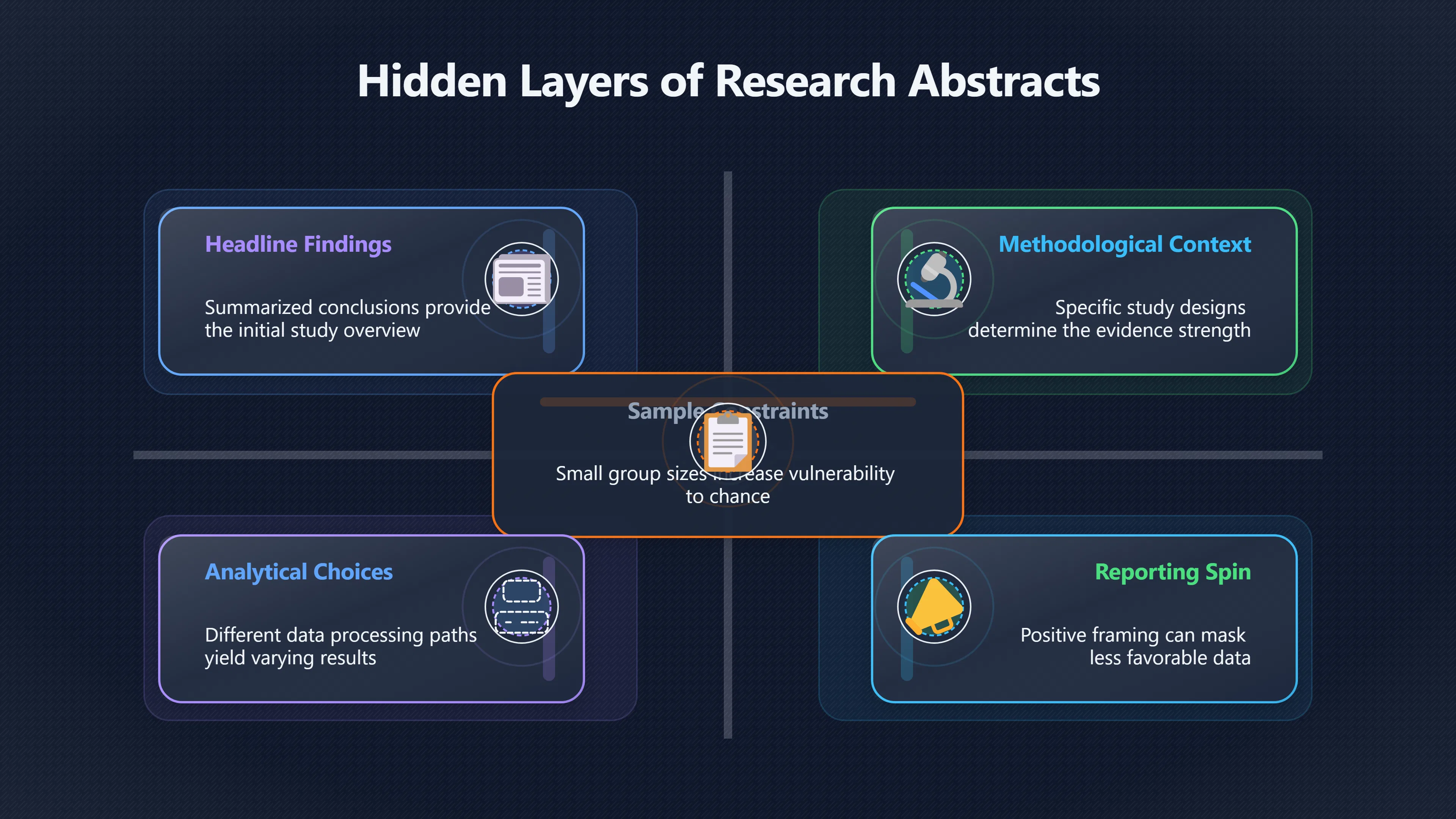
An abstract can summarize a study accurately while still leaving out the limits that decide how far the finding applies.
On this page
- What abstracts leave out
- Why methods and limitations change findings
- How to verify a paper before relying on it
Page outline Jump by section
Introduction
Speed-reading strategies often begin with the abstract, and for good reason. An abstract is designed to tell readers what a study examined, how it was conducted, and what it found in a few hundred words. When deciding whether a paper is worth reading, that summary is extremely useful.
 The problem is that an abstract is not designed to carry every detail needed to judge how reliable, generalisable, or important a finding really is. Word limits force authors to compress complex research into a brief overview, and many of the caveats that determine whether a result applies to a particular situation appear elsewhere in the paper. As a result, skimmers can come away with an accurate summary of a study’s headline finding while still misunderstanding what the evidence actually supports.[Wordvice]wordvice.comWord Count & LengthOctober 15, 2022 — 15 Oct 2022 — The abstract may also be the only part of your paper that has a word limit. Most word…
What Abstracts Leave Out
An abstract answers a narrow question: what did the researchers do and what did they conclude? It often cannot fully answer the harder questions that readers should ask before relying on a result.
Many abstracts provide only abbreviated descriptions of:
- How participants were selected.
- How large the sample was.
- How outcomes were measured.
- Which alternative explanations were considered.
- Important sources of bias.
- Limitations that restrict generalisation.
- Adverse effects or negative findings.
Reporting guidelines such as CONSORT were created partly because incomplete abstracts can make it difficult for readers to assess the validity and applicability of research findings. Researchers behind these guidelines argue that readers cannot properly judge reliability without transparent reporting of methods and results.[PLOS+2BMJ]journals.plos.orgCONSORT for Reporting Randomized Controlled Trials in…by S Hopewell · 2008 · Cited by 844 — CONSORT for Abstracts aims to improve…
The issue is not usually that abstracts are deliberately inaccurate. Rather, they are compressed summaries. A study involving a narrowly defined population, a short follow-up period, or a specific laboratory setting may still have an abstract that reads as if the conclusion applies broadly. The restrictions often become clear only in the methods, results, or discussion sections.
Why Methods and Limitations Change Findings
The fastest way to misread a paper is to treat the conclusion as independent from the method.
Two studies can reach similar-sounding conclusions while providing very different levels of evidence. The difference is often visible only after examining how the research was conducted.
Sample Size and Statistical Power
An abstract may report that a treatment improved an outcome or that a relationship was observed between two variables. What it may not emphasise is that the finding came from a small sample.
Small studies are more vulnerable to chance variation and often produce less precise estimates. A headline result can therefore sound stronger than the underlying evidence justifies.
Who Was Studied
A finding from healthy university students, professional athletes, hospital patients, or a single country may not apply to the wider population.
Abstracts usually mention the study population, but they rarely devote enough space to discussing how that population limits generalisation. Readers who skim may unconsciously broaden the claim beyond the group actually studied.
How Outcomes Were Measured
Methods determine what a result means.
For example, a paper might report improved performance, better health, or increased learning. The abstract may not fully explain whether these outcomes were measured through self-reports, objective tests, short-term observations, or long-term tracking. Different measurement approaches can substantially change how much confidence readers should place in the conclusion.
Alternative Analytical Choices
Research often involves numerous decisions about data collection, processing, modelling, and statistical analysis. Studies of scientific workflows have shown that different analytical choices can sometimes lead to different conclusions from the same underlying data. These decision paths are rarely visible in an abstract.[arXiv]arxiv.orgPaths Explored, Paths Omitted, Paths Obscured: Decision Points & Selective Reporting in End-to-End Data AnalysisOctober 30, 2019…
A skimming reader may therefore see only the final conclusion and miss the methodological context that determines how robust that conclusion is.

The Problem of “Spin” in Abstracts
Another reason abstracts can mislead is that they sometimes emphasise the most positive interpretation of the findings.
Reporting researchers have documented concerns about “spin” in scientific abstracts and summaries. This does not necessarily mean fabrication or fraud. More commonly, it refers to presenting results in a way that sounds stronger, more definitive, or more favourable than a careful reading of the full paper would support.[consort-spirit.org]consort-spirit.orgItem 1b: StructuredSummaryAuthors should avoid selectively reporting only statistically significant secondary outcomes or subgroup analyses. Conversely, omi…
Examples include:
- Highlighting statistically significant secondary outcomes while giving less attention to the primary outcome.
- Emphasising benefits while minimising harms.
- Framing uncertain findings as stronger than the data justify.
- Drawing broad practical implications from narrow evidence.
Because many readers never progress beyond the abstract, even subtle framing choices can shape how research is understood.
A Concrete Example of the Skimmer’s Mistake
Imagine a reader encounters an abstract stating that a new educational intervention improved student performance.
A skimming interpretation might be:
This method improves learning.
A deeper reading might reveal:
- The study involved a small number of students.
- Performance was measured immediately after instruction.
- The effect disappeared after several weeks.
- The intervention was tested only in a specialised setting.
- Several secondary outcomes showed no improvement.
The abstract may have accurately summarised the paper, yet the practical meaning of the finding changes considerably once the limitations are considered.
This is why experienced researchers often treat abstracts as navigation tools rather than final evidence. Guidance on reading scientific literature commonly recommends using the abstract to identify relevance and then examining methods, results, and discussion sections before accepting conclusions.[PMC+2Paperpile]pmc.ncbi.nlm.nih.govPMCTen simple rules for reading a scientific paperNIHby MA Carey · 2020 · Cited by 44 — We present 10 simple rules, relevant to novices and seasoned scientists alike, to teach our s…
How to Verify a Paper Before Relying on It
For readers trying to increase reading speed without sacrificing accuracy, the goal is not to stop using abstracts. The goal is to know when the abstract is insufficient.
A practical verification process can remain relatively fast:
- Read the abstract first. Use it to understand the research question and headline result.
- Check the methods section. Look at sample size, participant selection, measurements, and study design.
- Scan the results. Verify that the evidence presented matches the abstract’s claims.
- Read the limitations. Authors often identify weaknesses that materially affect interpretation.
- Review the discussion carefully. Distinguish between what the data show and what the authors speculate might be true.
- Ask where the finding applies. Consider whether the population, setting, and conditions resemble the situation in which you want to use the result.
This approach preserves much of the efficiency of skimming while reducing one of its most common failures: mistaking a paper’s summary for the full strength of its evidence.
Why Faster Readers Should Treat Abstracts as Entry Points
The most effective readers do not view abstracts as substitutes for the paper. They use them as filters.
An abstract is excellent for deciding whether a study deserves attention. It is far less reliable for deciding how much confidence to place in a finding. The details that determine reliability, validity, and applicability frequently live in the methods, results, and limitations sections rather than in the summary at the front. Reporting standards exist precisely because those details matter to interpretation.[PLOS+2EQUATOR Network]journals.plos.orgCONSORT for Reporting Randomized Controlled Trials in…by S Hopewell · 2008 · Cited by 844 — CONSORT for Abstracts aims to improve…
For anyone trying to read faster, this distinction is crucial. Speed comes from avoiding unnecessary reading, not from skipping the sections that determine whether a conclusion is actually supported by the evidence.
Amazon book picks
Further Reading
Books and field guides related to Why Abstracts Are Not Enough. Use these as the next step if you want deeper reading beyond the article.
Thinking, Fast and Slow
Explains cognitive shortcuts that encourage overreliance on simplified summaries.
Make It Stick
Supports careful engagement with evidence rather than surface-level reading.
Bad Science
Demonstrates how headline findings can mislead without examining underlying evidence.

How to read a paper
Directly teaches readers to go beyond abstracts and assess methods, results, and limitations.
Endnotes
1.
Source: wordvice.com
Link:https://wordvice.com/blog/how-to-decrease-the-length-of-a-research-abstract/
Source snippet
Word Count & LengthOctober 15, 2022 — 15 Oct 2022 — The abstract may also be the only part of your paper that has a word limit. Most word...
Published: October 15, 2022
2.
Source: journals.plos.org
Link:https://journals.plos.org/plosmedicine/article%3Fid%3D10.1371/journal.pmed.0050020
Source snippet
CONSORT for Reporting Randomized Controlled Trials in...by S Hopewell · 2008 · Cited by 844 — CONSORT for Abstracts aims to improve...
3.
Source: bmj.com
Title: bmj 2024 081124
Link:https://www.bmj.com/content/389/bmj-2024-081124
Source snippet
CONSORT 2025 explanation and elaborationby S Hopewell · 2025 · Cited by 235 — Without transparent reporting of the methods and results, r...
4.
Source: arxiv.org
Link:https://arxiv.org/abs/1910.13602
Source snippet
Paths Explored, Paths Omitted, Paths Obscured: Decision Points & Selective Reporting in End-to-End Data AnalysisOctober 30, 2019...
Published: October 30, 2019
5.
Source: consort-spirit.org
Title: Item 1b: Structured
Link:https://www.consort-spirit.org/item1b-structuredsummary
Source snippet
SummaryAuthors should avoid selectively reporting only statistically significant secondary outcomes or subgroup analyses. Conversely, omi...
6.
Source: pmc.ncbi.nlm.nih.gov
Title: PMCTen simple rules for reading a scientific paper
Link:https://pmc.ncbi.nlm.nih.gov/articles/PMC7392212/
Source snippet
NIHby MA Carey · 2020 · Cited by 44 — We present 10 simple rules, relevant to novices and seasoned scientists alike, to teach our s...
7.
Source: paperpile.com
Title: How to read a scientific paper [3 steps
Link:https://paperpile.com/g/read-scientific-paper/
Source snippet
2025]In this guide, we'll show you how to read a scientific paper in 3 steps. You will learn all about the scientific paper format, how t...
8.
Source: equator-network.org
Link:https://www.equator-network.org/reporting-guidelines/consort/
Source snippet
2025 Statement - Reporting guideline27 Jan 2026 — CONSORT 2025 Statement: updated guideline for reporting randomised trials. Reporting gu...
9.
Source: arxiv.org
Link:https://arxiv.org/html/2506.21634v1
Source snippet
Observe and quantify deficiencies. Suggest guidelines for writing...Read more...
10.
Source: pmc.ncbi.nlm.nih.gov
Title: A recent extension to the CONSORT
Link:https://pmc.ncbi.nlm.nih.gov/articles/PMC2844943/
Source snippet
CONSORT 2010 Explanation and Elaboration - PMCby D Moher · 2010 · Cited by 12818 — Conversely, omitting important harms from the abstr...
11.
Source: pmc.ncbi.nlm.nih.gov
Link:https://pmc.ncbi.nlm.nih.gov/articles/PMC4247631/
Source snippet
of adding a limitations section to abstracts of systematic...by A Yavchitz · 2014 · Cited by 18 — In conclusion, adding a limitations se...
12.
Source: pmc.ncbi.nlm.nih.gov
Link:https://pmc.ncbi.nlm.nih.gov/articles/PMC2211558/
Source snippet
for Reporting Randomized Controlled Trials in...by S Hopewell · 2008 · Cited by 844 — CONSORT for Abstracts aims to improve reporting of...
13.
Source: cwauthors.com
Link:https://www.cwauthors.com/article/what-to-include-and-exclude-in-an-abstract
Source snippet
abstract | CW Authors8 Apr 2022 — Because the abstract is essentially a summary of the main paper, it should not present any information...
14.
Source: linkedin.com
Title: How to read a research paper effectively: A step-by
Link:https://www.linkedin.com/posts/tathagata-ghosh-2219b711_how-to-read-a-research-paper-effectively-activity-7352691339655876609-ugV2
Source snippet
Abstract - A brief summary of the research paper, including the research question, methods, results, and conclusions.... limitations. 8...
Additional References
15.
Source: researchgate.net
Link:https://www.researchgate.net/publication/390792212_CONSORT_2025_explanation_and_elaboration_updated_guideline_for_reporting_randomised_trials
Source snippet
(PDF) CONSORT 2025 explanation and elaboration15 Apr 2025 — The CONSORT (Consolidated Standards of Reporting Trials) statement aims to im...
16.
Source: elearning.uniroma1.it
Link:https://elearning.uniroma1.it/pluginfile.php/1624702/mod_resource/content/1/Lezione%207_2026_How%20to%20read_write%20a%20paper%20%281%29.pdf
Source snippet
Scientific Papers go straight to the source. Try to distinguish first-hand from second-hand information. To get the real.Read more...
17.
Source: facebook.com
Link:https://www.facebook.com/groups/738098637595658/posts/1825386795533498/
Source snippet
4. Evaluate Relevance to your research? Are methods valid? Are results significant and reproducible? 5...Read more...
18.
Source: youtube.com
Link:https://www.youtube.com/watch?v=l1brryR5z_U
19.
Source: instatext.io
Link:https://instatext.io/abstract-writing-common-mistakes-and-tips/
Source snippet
Abstract writing: Common mistakes and tipsLearn the most common abstract writing mistakes and see how InstaText improves clarity, readabi...
20.
Source: reddit.com
Link:https://www.reddit.com/r/AskScienceDiscussion/comments/zvrkm8/apparently_most_researchers_just_read_abstracts/
Source snippet
abstract good? in a way that covered the bulk of the paper...
21.
Source: youtube.com
Link:https://www.youtube.com/watch?v=WVv2jWXW0K4
Source snippet
s often aim to grasp the main points swiftly. -Identify your [purpose]({{ 'purpose/' | relative_url }})...
22.
Source: writing.wisc.edu
Link:https://writing.wisc.edu/handbook/assignments/writing-an-abstract-for-your-research-paper/
Source snippet
Writing CenterWriting an Abstract for Your Research PaperAn abstract is a short summary of your (published or unpublished) research paper...
23.
Source: researchgate.net
Link:https://www.researchgate.net/post/What-are-the-information-we-have-to-include-in-the-abstract-and-conclusion-while-writing-research-articles
Source snippet
Specifically I expect what are the information we have to include in the abstract and conclusion...
24.
Source: researchgate.net
Title: 380129336 How to read a research paper more effectively
Link:https://www.researchgate.net/publication/380129336_How_to_read_a_research_paper_more_effectively
Source snippet
Scholars employ numerous methodologies, but I present the most...Read more...
Topic Tree