Within Skimming
The small words that stop bad skimming
Qualifier, contrast, evidence, and limitation words show whether a text is making a strong claim, a narrow claim, or a warning.
On this page
- Spot contrast and limitation markers
- Separate topics from actual claims
- Track evidence words without overvaluing visual emphasis
Page outline Jump by section
Introduction
One of the fastest ways to damage comprehension while increasing reading speed is to skip the small words that control an argument’s meaning. Readers often notice topics, keywords, bold phrases, and conclusions, but miss the qualifiers, contrasts, evidence signals, and limitation markers that determine what the author is actually claiming.
 A sentence can appear to support a strong conclusion until a single word such as “however”, “may”, “only”, or “although” changes its force. These words function as argument signals. They reveal whether a claim is broad or narrow, certain or tentative, supported or speculative. Research on discourse markers shows that readers use such signals to understand relationships between ideas and follow the structure of reasoning.[University of Warwick+2ResearchGate]warwick.ac.ukUniversity of WarwickDiscourse Markers15 Jul 2020 — Discourse markers (words like 'however', 'although' and 'Nevertheless') are referred…
For honest skimming, these signals are often more important than visually prominent text. They help fast readers preserve nuance rather than replacing careful understanding with an oversimplified summary.
The small words that stop bad skimming
When people skim quickly, they tend to remember subjects rather than claims.
Consider the difference:
- “Exercise improves mental health.”
- “Exercise may improve some mental health outcomes in certain populations.”
The topic is identical. The claim is not.
The second sentence contains narrowing language. Words such as “may”, “some”, and “certain” reduce the scope and certainty of the statement. Academic writers often use these forms deliberately because evidence rarely supports universal conclusions. Writing specialists describe these expressions as hedges: language that softens or limits claims to match the available evidence.[The Writing Center+2libguides.usask.ca]writingcenter.gmu.eduhedges softening claims in academic writingThe Writing CenterHedges: Softening Claims in Academic Writing17 Oct 2020 — With the help of the special language, called “hedges”, write…
Fast readers who ignore hedging frequently reconstruct the stronger version in memory. The result is not merely incomplete understanding but a different argument from the one the author actually made.
Spot contrast and limitation markers
Contrast markers are among the highest-value words in a rapid reading pass because they often indicate where the author’s real position begins.
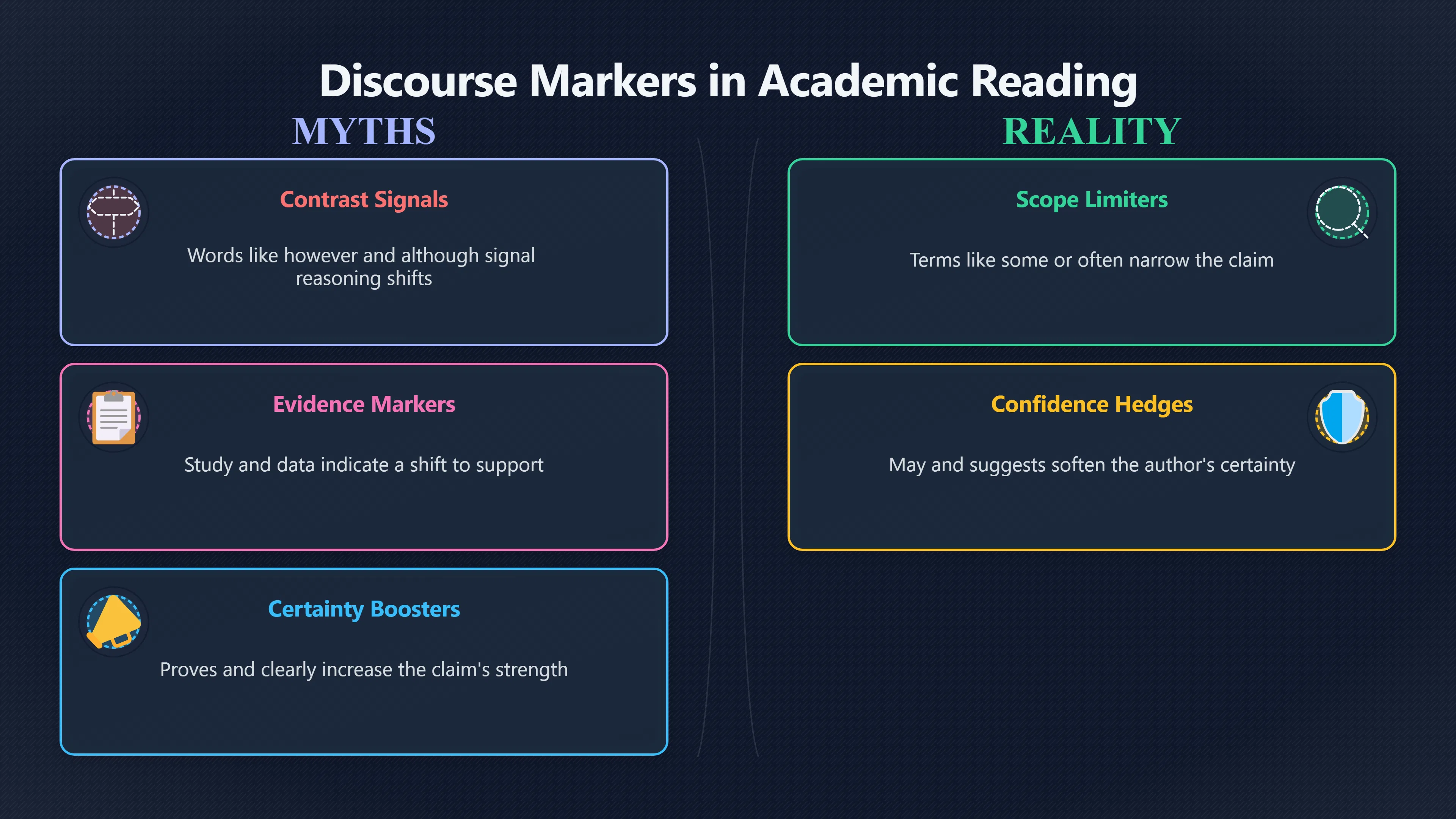
Words and phrases such as:
- however
- although
- despite
- nevertheless
- yet
- on the other hand[journal.unilak.ac.id]journal.unilak.ac.idJournal Universitas Lancang KuningA Discourse Marker (DM) Studyby KH Abidah · 2024 — Therefore, it needs discourse markers, such as "simi…
- in contrast
signal that the reader should slow down. Discourse research consistently identifies these markers as guides that help readers recognise relationships between ideas and detect shifts in reasoning. University of Warwick+2Journal Universitas Lancang Kuning[warwick.ac.uk]warwick.ac.ukUniversity of WarwickDiscourse Markers15 Jul 2020 — Discourse markers (words like 'however', 'although' and 'Nevertheless') are referred…
A common pattern looks like this:
Initial claim → contrast marker → qualification or correction
For example:
“Several studies found positive effects. However, most relied on small samples.”
A careless skim may retain only “studies found positive effects”. An attentive skim notices that the sentence after “however” changes how the evidence should be interpreted.
In many analytical articles, policy papers, reviews, and scientific reports, the most important sentence in a paragraph begins with a contrast marker because that is where the author introduces a limitation, exception, or competing explanation.
Why contrast words deserve extra attention
Many readers unconsciously treat the first statement they encounter as the author’s main point. Contrast markers often signal that the author is about to revise that first impression.
When skimming, a useful rule is:
Every time you see a major contrast word, ask what claim is being weakened, limited, or challenged.
This simple check prevents many of the comprehension failures associated with fast reading.
Separate topics from actual claims
A topic tells you what a text is about. A claim tells you what the author wants you to believe.
Argument researchers and academic writing guides consistently describe arguments as claims supported by reasons and evidence.[The Writing Center+2University College London]writingcenter.unc.eduThe Writing Center ArgumentThe Writing CenterArgument - The Writing CenterAn argument is usually a main idea, often called a “claim” or “thesis statement,” backed u…
The problem for skimmers is that topic words are easy to spot while claims are often hidden inside signal language.
Compare:
- “Artificial intelligence in education”
- “Artificial intelligence can improve feedback speed for some educational tasks”
- “Artificial intelligence appears to improve feedback speed in limited experimental settings”
All three statements concern the same topic. Each makes a different claim.
The signal words do most of the work:
- can indicates possibility.
- some narrows scope.
- appears signals uncertainty.
- limited experimental settings restricts where the finding applies.
A reader who only notices the topic may later report that the article “proved AI improves education”. The actual argument may be far narrower.
When skimming, look for the words attached to the topic, not merely the topic itself.
Track evidence words without overvaluing visual emphasis
Fast readers often rely heavily on formatting cues such as bold text, pull quotes, highlighted boxes, or large headings. These features can be useful, but they do not necessarily identify the strongest evidence.
Instead, look for evidence markers:
- study
- survey
- trial
- review
- experiment
- data
- analysis[researchgate.net]researchgate.netthe analysis of skimming and scanning technique to…by IR Aritonang · 2018 · Cited by 105 — The objective of this research is to find o…
- case study
- meta-analysis
These terms indicate that the author is moving from assertion to support. Academic argument guidance consistently treats evidence as the element that distinguishes a claim from a mere opinion.[The Writing Center]writingcenter.unc.eduThe Writing Center ArgumentThe Writing CenterArgument - The Writing CenterAn argument is usually a main idea, often called a “claim” or “thesis statement,” backed u…
However, evidence words should not automatically increase confidence.
A rapid but honest reader also checks for nearby limitation signals:
- preliminary
- correlational
- small sample
- self-reported
- uncertain
- not measured
- further research needed
The combination matters more than either element alone.
For example:
“A study found a positive association.”
is a different evidential signal from:
“A small correlational study found a positive association.”
The second sentence contains information that affects how strongly the evidence should be trusted.
Watch for hedges and boosters
Writers use two opposing families of signal words.
Hedges reduce certainty:
- may
- might
- appears
- suggests
- could
- likely
- tends to
Boosters increase certainty:
- clearly
- demonstrates
- proves
- undoubtedly
- definitely
- shows
Research on academic writing repeatedly finds that hedges help writers align claims with evidence and avoid overstating conclusions.[The Writing Center+2ResearchGate]writingcenter.gmu.eduhedges softening claims in academic writingThe Writing CenterHedges: Softening Claims in Academic Writing17 Oct 2020 — With the help of the special language, called “hedges”, write…
For a skimmer, the practical question is not whether a word is hedging or boosting. The question is:
How confident is the author asking me to be?
A sentence containing several hedges should not be remembered as a definitive conclusion. Likewise, a highly confident statement deserves scrutiny if strong evidence markers are absent.

A quick scanning method for preserving nuance
When moving rapidly through a text, focus on four categories of signal words:
Signal typeTypical wordsQuestion to askContrasthowever, although, despite, yetWhat is being qualified or challenged?Scopesome, often, among, in this study, under these conditionsHow narrow is the claim?Evidencestudy, data, review, survey, experimentWhat support is being offered?Limitationpreliminary, uncertain, correlational, small sampleWhat weakens confidence?
This approach adds only a few seconds per page but dramatically reduces the risk of leaving with a distorted version of the argument.
Research on reading and skimming consistently finds that faster reading tends to reduce comprehension compared with more careful reading. The most effective protection against that loss is not reading every word. It is paying attention to the words that control how all the other words should be interpreted.[PMC+2ResearchGate]pmc.ncbi.nlm.nih.govReading and skimming clinical information: insights from…by MA Soltan · 2025 · Cited by 1 — Reading times are shorter and comprehen…
Amazon book picks
Further Reading
Books and field guides related to The small words that stop bad skimming. Use these as the next step if you want deeper reading beyond the article.
How to Read a Book
Rating: 4.0/5 from 41 Google Books ratings
Helps readers identify the structure and meaning of arguments.

The art of thinking clearly
Shows how readers misinterpret information and overlook crucial qualifiers.
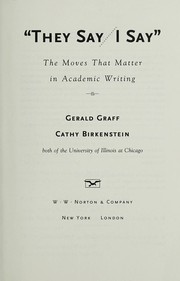
"They Say / I Say"
Teaches how arguments are signposted and how claims relate to evidence.

eBay marketplace picks
Marketplace Samples
Example marketplace items related to this page. Use the search link to explore similar finds on eBay.


Endnotes
1.
Source: researchgate.net
Link:https://www.researchgate.net/publication/273303212_The_Impact_of_Discourse_Markers_and_Relative_Clauses_on_the_Reading_Comprehension_of_EFL_Learners
Source snippet
The Impact of Discourse Markers and Relative Clauses on...30 Jun 2020 — These words and phrases support readers who are familiar with th...
2.
Source: libguides.usask.ca
Link:https://libguides.usask.ca/c.php?g=418130&p=4121136
Source snippet
Writing Help: Style, Argument, and OrganizationLearners can strengthen their reasoning, argument analysis, information interpretation, an...
3.
Source: researchgate.net
Link:https://www.researchgate.net/publication/329703189_Strengthening_or_Weakening_Claims_in_Academic_Knowledge_Construction_A_Comparative_Study_of_Hedges_and_Boosters_in_Postgraduate_Academic_Writing
Source snippet
(PDF) Strengthening or Weakening Claims in Academic...21 Dec 2018 — This paper reports on the findings of an exploratory study examining...
4.
Source: pmc.ncbi.nlm.nih.gov
Link:https://pmc.ncbi.nlm.nih.gov/articles/PMC12801452/
Source snippet
Reading and skimming clinical information: insights from...by MA Soltan · 2025 · Cited by 1 — Reading times are shorter and comprehen...
5.
Source: researchgate.net
Link:https://www.researchgate.net/publication/337256453THE_ANALYSIS_OF_SKIMMING_AND[SCANNING
Source snippet
the analysis of skimming and scanning technique to...by IR Aritonang · 2018 · Cited by 105 — The objective of this research is to find o...
6.
Source: researchgate.net
Link:https://www.researchgate.net/publication/391201722_USING_SCANNING_AND_SKIMMING_STRATEGY_TO_IMPROVE_THE_STUDENTS%27_READING_COMPREHENSION
Source snippet
menting scanning and skimming strategy.Read more...
7.
Source: warwick.ac.uk
Link:https://warwick.ac.uk/fac/soc/al/globalpad-rip/openhouse/academicenglishskills/grammar/discourse/
Source snippet
University of WarwickDiscourse Markers15 Jul 2020 — Discourse markers (words like 'however', 'although' and 'Nevertheless') are referred...
8.
Source: writingcenter.gmu.edu
Title: hedges softening claims in academic writing
Link:https://writingcenter.gmu.edu/writing-resources/research-based-writing/hedges-softening-claims-in-academic-writing
Source snippet
The Writing CenterHedges: Softening Claims in Academic Writing17 Oct 2020 — With the help of the special language, called “hedges”, write...
9.
Source: journal.unilak.ac.id
Link:https://journal.unilak.ac.id/index.php/REILA/article/download/15636/7161
Source snippet
Journal Universitas Lancang KuningA Discourse Marker (DM) Studyby KH Abidah · 2024 — Therefore, it needs discourse markers, such as "simi...
10.
Source: writingcenter.unc.edu
Title: The Writing Center Argument
Link:https://writingcenter.unc.edu/tips-and-tools/argument/
Source snippet
The Writing CenterArgument - The Writing CenterAn argument is usually a main idea, often called a “claim” or “thesis statement,” backed u...
11.
Source: ucl.ac.uk
Link:https://www.ucl.ac.uk/ioe/departments-and-centres/academic-writing-centre/resources-academic-reading-and-writing/argument-voice-structure
Source snippet
University College LondonArgument, voice, structureAn argument, in simple terms, is a claim plus support for that claim. Make sure you us...
12.
Source: pmc.ncbi.nlm.nih.gov
Link:https://pmc.ncbi.nlm.nih.gov/articles/PMC12689893/
Source snippet
supporting evidence in L2 argumentative writingby R Yang · 2025 — Evidence integration is central to argumentative writing, yet the relat...
13.
Source: gcwritingcenter.commons.gc.cuny.edu
Link:https://gcwritingcenter.commons.gc.cuny.edu/glossary/
Source snippet
The Writing Center - CUNYGood academic writing defines the meaning of all the [technical]({{ 'technical-texts/' | relative_url }}) terms it uses, thereby ensuring that readers are...
Additional References
14.
Source: test-english.com
Link:https://test-english.com/explanation/b2/discourse-markers-linking-words/
Source snippet
Discourse markers – linking wordsDiscourse markers are very important to structure text or speech to connect sentences in a meaningful an...
15.
Source: facebook.com
Link:https://www.facebook.com/groups/526960257896314/posts/1395978227661175/
Source snippet
Skimming vs scanning when reading comprehensionWeren't you people taught the difference between skimming and scanning when reading in hig...
16.
Source: digilib.unikama.ac.id
Link:https://digilib.unikama.ac.id/index.php?bid=36897&fid=4028&p=fstream-pdf
Source snippet
unikama.ac.idSTUDENTS' PERCEPTION TOWARDS SKIMMINGThis research focuses on the perception of students on the use of skimming-scanning tec...
17.
Source: allinnovationjournal.com
Link:https://allinnovationjournal.com/assets/archives/2025/vol7issue2/7013.pdf
Source snippet
arize the main idea within a time limit, while scanning tasks could involve...Read more...
18.
Source: scribd.com
Link:https://www.scribd.com/document/934704834/Skimming-and-Scanning-Detailed
Source snippet
tifying texts worth deeper study and understanding the writer's...Read more...
19.
Source: scribd.com
Link:https://www.scribd.com/presentation/836373773/Discourse-Markers-for-Comparing-and-Contrasting-Extended
Source snippet
structure communication by guiding the listener or reader.Read more...
20.
Source: academia.edu
Link:https://www.academia.edu/8910837/Discourse_markers_in_English_a_discourse_pragmatic_view
Source snippet
Discourse markers in English: a discourse-pragmatic viewThe study of discourse markers reveals historical linguistic changes and polyfunc...
21.
Source: oiccpress.com
Link:https://oiccpress.com/jals/article/download/5590/2281/3301
Source snippet
The present study sought to appraise three...Read more...
22.
Source: videnomlaesning.dk
Title: reading for understanding
Link:https://www.videnomlaesning.dk/media/2526/reading-for-understanding.pdf
Source snippet
Toward an R&D Program in Reading Comprehensionby C Snow · 2002 · Cited by 5123 — Research that would identify reader capabilities and lim...
23.
Source: libguides.uvt.nl
Link:https://libguides.uvt.nl/academic-reading/critical-reading-6
Source snippet
Uvt LibguidesAcademic reading: Analyzing arguments - LibGuidesAn argument consists of three elements: Claim: the opinion or conclusion th...
Topic Tree