Within Skimming
Can headings reveal the argument fast enough?
Headings, openings, and paragraph starts help readers build a quick outline before deciding where close reading is needed.
On this page
- Read structural signals before sentence by sentence prose
- Use paragraph openings without trusting them blindly
- Check the outline against conclusions and evidence
Page outline Jump by section
Introduction
Yes, headings can reveal an argument surprisingly quickly—but only if you treat them as a map rather than as proof. One of the fastest honest skimming techniques is to read a text’s visible structure before reading its prose in detail. Headings, subheadings, and paragraph-opening sentences often contain the author’s planned route through a topic. They show what questions will be addressed, what order ideas appear in, and which points are treated as major versus minor. Reading these structural signals first helps you build a rough outline of the text and decide where close reading is actually needed. University reading guides consistently recommend focusing on headings, introductions, summaries, and key paragraph sentences when skimming because these elements often carry the text’s main organisational framework. The Learning Center+2University of Tennessee at Chattanooga[learningcenter.unc.edu]learningcenter.unc.eduThe Learning Center SkimmingThe Learning CenterSkimming - The Learning CenterInstead of closely reading every word, focus on the introduction, chapter summaries, fir…
 For increasing reading speed honestly, the goal is not to replace reading with guessing. The goal is to identify the structure first, then spend detailed attention where the structure suggests it matters most.
Read Structural Signals Before Sentence-by-Sentence Prose
Many nonfiction texts announce their structure before they deliver their evidence. Academic articles, reports, textbooks, business documents, and long-form explainers commonly use headings to divide the argument into major stages. This means a reader can often understand the shape of a text before understanding its details.
Imagine encountering these headings:
- The Problem
- Current Evidence
- Limitations of Existing Research
- Recommended Approach
Even without reading the body, you already know the author is moving from a problem to evidence, then addressing weaknesses before proposing a solution.
This matters because comprehension begins with organisation. When readers possess a rough mental outline, new information has somewhere to fit. Reading guides that teach skimming often recommend surveying headings and major text features before detailed reading for exactly this reason. The Learning Center+2Open NCC Community Colleges[learningcenter.unc.edu]learningcenter.unc.eduThe Learning Center SkimmingThe Learning CenterSkimming - The Learning CenterInstead of closely reading every word, focus on the introduction, chapter summaries, fir…
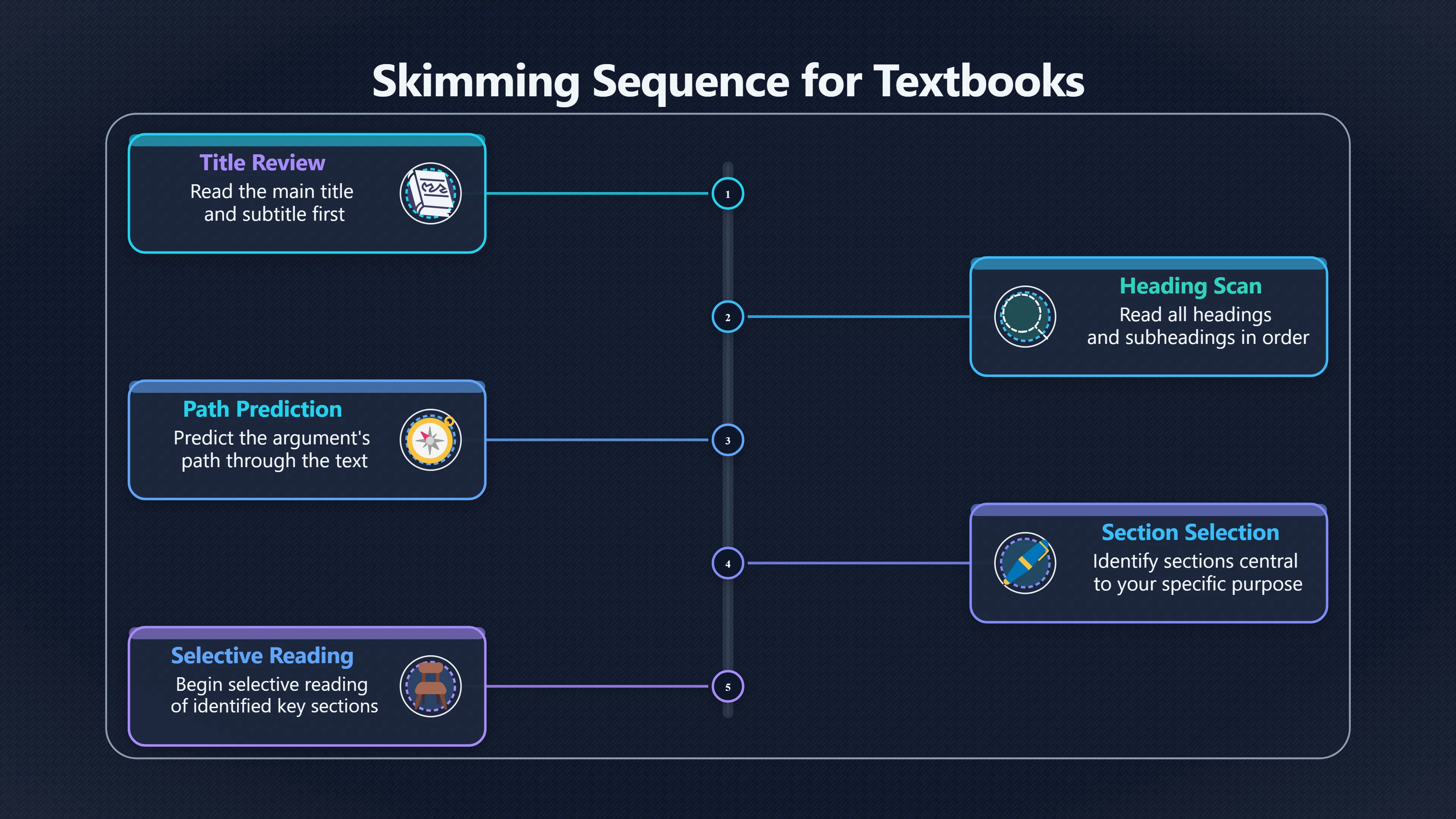
A useful skimming sequence is:
- Read the title and subtitle.
- Read all headings and subheadings in order.
- Predict the argument’s path.
- Identify sections that appear central to your purpose.
- Only then begin selective reading.
This approach turns a document from a wall of text into a visible structure.
What Headings Reveal Quickly
Good headings often expose:
- The scope of the discussion.
- The order of ideas.
- Major claims and supporting sections.
- Whether the text is explanatory, argumentative, descriptive, or instructional.
- Which sections are likely to contain evidence.
They also reveal what is absent. If an article makes a strong claim about a health intervention but has no obvious section discussing evidence, methods, limitations, or sources, that absence is itself informative.
Use Paragraph Openings Without Trusting Them Blindly
After headings, topic sentences are usually the next highest-value signals.
A topic sentence is the sentence that introduces a paragraph’s main point. Writing guides commonly describe it as the organising sentence that tells readers what the paragraph is about before supporting details appear.[Purdue OWL+2Purdue Global Success Center]owl.purdue.eduOWLOn ParagraphsPurdue OWLOn Paragraphs - Purdue OWLTo be as effective as possible, a paragraph should contain each of the following: Unity, Coherence, A…
Because many nonfiction writers place the main point near the beginning of a paragraph, reading opening sentences can provide a rapid overview of the argument. Some skimming guides explicitly recommend reading first sentences and other key structural elements to gather the main ideas quickly. The Learning Center+2my literacy tool kit[learningcenter.unc.edu]learningcenter.unc.eduThe Learning Center SkimmingThe Learning CenterSkimming - The Learning CenterInstead of closely reading every word, focus on the introduction, chapter summaries, fir…
For example:
Topic sentence: “Recent studies suggest that remote work improves employee retention.”
The rest of the paragraph may contain:
- Statistics.
- Examples.
- Caveats.
- Explanations.
- Exceptions.
If your purpose is to map the argument, the opening sentence often delivers most of the paragraph’s function immediately.
A fast skim might therefore read:[youtube.com]youtube.comSource details in endnotes.
- Heading.
- First sentence of each paragraph.[owl.purdue.edu]owl.purdue.eduOWLOn ParagraphsPurdue OWLOn Paragraphs - Purdue OWLTo be as effective as possible, a paragraph should contain each of the following: Unity, Coherence, A…
- Conclusion.
Within a few minutes, you can often reconstruct the author’s overall line of reasoning.
Why Topic Sentences Sometimes Mislead
The danger is assuming that a topic sentence proves what it claims.
A topic sentence tells you what a paragraph intends to argue. It does not tell you whether the argument succeeds.
Consider this sequence:
- Heading: “Evidence for the Theory”
- Topic sentence: “Strong evidence supports the conclusion.”
The paragraph might then provide:
- Weak studies.
- Anecdotes.
- Selective examples.
- Poor-quality sources.
If you stop at the topic sentence, you know the author’s claim but not the quality of support behind it.
This is where honest skimming differs from superficial skimming. The purpose of paragraph openings is orientation, not verification.
Build a Working Outline as You Move
The fastest readers often behave less like people consuming text and more like people constructing an outline.
As you skim, mentally reduce the document to a series of linked points:
- Main question.
- Major claim.
- Supporting reasons.
- Evidence sections.
- Limitations.
- Conclusion.
A heading provides a branch of the outline.
A topic sentence provides a node beneath that branch.
By the time you reach the conclusion, you should already possess a rough map of how the argument is assembled.
This method aligns with long-established previewing and survey techniques used in academic reading, where readers examine structure before investing attention in detailed comprehension. Center for Teaching and Learning+2Open NCC Community Colleges[ctl.wustl.edu]ctl.wustl.eduCenter for Teaching and LearningStrategies for College ReadingThis well-known active reading strategy is named for its five steps: Survey…
The advantage for reading speed is significant. Instead of deciding paragraph by paragraph whether something matters, you already know where you are in the document’s structure.
Check the Outline Against Conclusions and Evidence
A structural map is useful only if it matches reality.
Once you have skimmed the headings and topic sentences, perform a quick verification step.
Ask:
- Does the conclusion match the path suggested by the headings?
- Do evidence sections actually contain evidence?
- Are major claims supported or merely repeated?
- Are important limitations acknowledged?
This check prevents a common skimming error: mistaking organisation for substance.
Well-organised writing can create a strong impression of credibility even when evidence is weak. Conversely, valuable material may sometimes be hidden behind plain headings or awkward paragraph construction.
A practical method is:
- Read headings and subheadings.[neit.edu]neit.eduPay Attention to Headings and Subheadings · 2. Read the End of the Chapter First · 3. Break Your Assignments Up Into Chunks.Read more…[2. Read topic sentences.]owl.purdue.eduOWLOn ParagraphsPurdue OWLOn Paragraphs - Purdue OWLTo be as effective as possible, a paragraph should contain each of the following: Unity, Coherence, A…
- Read the conclusion.
- Inspect the most evidence-heavy section.
- Decide whether deeper reading is justified.
This preserves speed while maintaining intellectual honesty.
When the Map Is Most Reliable
Structural signals work best in:
- Textbooks.
- Academic articles.
- Reports.
- Professional documents.
- Long-form nonfiction.
- Explanatory journalism.
These formats are usually designed around explicit organisation, making headings and topic sentences useful navigation tools.[The Learning Center+2Purdue OWL]learningcenter.unc.eduThe Learning Center Reading Textbooks EffectivelyEffective reading strategies can ensure that you truly comprehend…Read more…
The map becomes less reliable in:
- Narrative writing.
- Literary essays.
- Opinion pieces built around storytelling.
- Texts that intentionally delay their main point.
- Poorly edited documents.
In these cases, paragraph openings may be less representative of the paragraph’s true value, and headings may conceal rather than reveal the central argument.
The key lesson is simple: headings and topic sentences are navigation aids, not substitutes for comprehension. Used well, they allow you to sketch the structure of a text in minutes, identify the sections that deserve attention, and avoid spending equal time on every paragraph. That makes them one of the most effective mechanisms for increasing reading speed without pretending that a skim is the same thing as understanding.
Amazon book picks
Further Reading
Books and field guides related to Can headings reveal the argument fast enough?. Use these as the next step if you want deeper reading beyond the article.
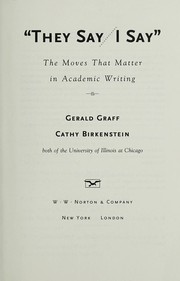
How to Read a Book
Rating: 4.0/5 from 41 Google Books ratings
Discusses inspectional reading, outlines, and understanding structure quickly.

The pyramid principle
Shows how information and arguments are structured hierarchically.
eBay marketplace picks
Marketplace Samples
Example marketplace items related to this page. Use the search link to explore similar finds on eBay.

Endnotes
1.
Source: owl.purdue.edu
Title: OWLOn Paragraphs
Link:https://owl.purdue.edu/owl/general_writing/academic_writing/paragraphs_and_paragraphing/index.html
Source snippet
Purdue OWLOn Paragraphs - Purdue OWLTo be as effective as possible, a paragraph should contain each of the following: Unity, Coherence, A...
2.
Source: owl.purdue.edu
Title: OWLOrganization and Structure
Link:https://owl.purdue.edu/owl/graduate_writing/graduate_writing_topics/graduate_writing_organization_structure_new.html
Source snippet
Purdue OWLOrganization and Structure - Purdue OWLThis handout provides strategies for making your writing comprehensible to someone who j...
3.
Source: owl.purdue.edu
Title: OWLIntroduction to Graduate Writing
Link:https://owl.purdue.edu/owl/graduate_writing/introduction_to_writing/documents/drafting-your-document/handouts/document-organization.pdf
Source snippet
Paragraph-level organization includes topic sentences that state the main point of the paragraph, a focus on one idea per paragraph...Re...
4.
Source: owl.purdue.edu
Link:https://owl.purdue.edu/owl/general_writing/academic_writing/paragraphs_and_paragraphing/paragraphing.html
Source snippet
Include on each page about two handwritten or three typed paragraphs. Make your paragraphs proportional...Read more...
5.
Source: owl.purdue.edu
Title: body paragraphs
Link:https://owl.purdue.edu/owl/general_writing/common_writing_assignments/argument_papers/body_paragraphs.html
Source snippet
Paragraphs - Purdue OWLA good paragraph should contain at least the following four elements: Transition, Topic sentence, specific Evidenc...
6.
Source: owl.purdue.edu
Title: argumentative essays
Link:https://owl.purdue.edu/owl/general_writing/academic_writing/essay_writing/argumentative_essays.html
Source snippet
Essays - Purdue OWLThe argumentative essay is a genre of writing that requires the student to investigate a topic; collect, generate, and...
7.
Source: owl.purdue.edu
Title: sentence clarity
Link:https://owl.purdue.edu/owl/general_writing/mechanics/sentence_clarity.html
Source snippet
Purdue OWLIf you're having sentence clarity problems in your papers, this handout might be just what you need...
8.
Source: owl.purdue.edu
Title: paragraph organization flow
Link:https://owl.purdue.edu/owl/graduate_writing/thesis_and_dissertation/paragraph_organization_flow.html
Source snippet
anization & Flow - Purdue OWLThis page hosts a vidcast and handouts that outline strategies for organizing paragraphs and creating flo...
9.
Source: owl.purdue.edu
Link:https://owl.purdue.edu/owl/general_writing/academic_writing/index.html
Source snippet
Writing Introduction - Purdue OWLThe OWL resources range from rhetorical approaches for writing, to document organization, to sentence le...
10.
Source: owl.purdue.edu
Link:https://owl.purdue.edu/owl/graduate_writing/documents/Flow-Handout.pdf
Source snippet
in Scholarly Writing Sentence-level flow Paragraph-level...Alignment across the text: the title, thesis, and main points match or develo...
11.
Source: reading.com
Link:https://www.reading.com/
Source snippet
Teach Your Child To Read Early, Step by StepReading.com helps your child learn to read with a proven, step-by-step program. Start today a...
12.
Source: learningcenter.unc.edu
Title: The Learning Center Skimming
Link:https://learningcenter.unc.edu/tips-and-tools/skimming/
Source snippet
The Learning CenterSkimming - The Learning CenterInstead of closely reading every word, focus on the introduction, chapter summaries, fir...
13.
Source: utc.edu
Link:https://www.utc.edu/enrollment-management-and-student-affairs/center-for-academic-support-and-advisement/tips-for-academic-success/skimming
Source snippet
University of Tennessee at ChattanoogaSkimming and [Scanning]({{ 'scanning-vs-reading/' | relative_url }}) | University of Tennessee at...By skimming, you can quickly locate the infor...
14.
Source: oercollective.caul.edu.au
Link:https://oercollective.caul.edu.au/communication/chapter/skimming-and-scanning/
Source snippet
OER CollectiveChapter 7: Skimming and ScanningSkimming is a time-saving beginning to reading, but it should not replace in-depth reading...
15.
Source: opennccc.nccommunitycolleges.edu
Link:https://opennccc.nccommunitycolleges.edu/courseware/lesson/188/overview
Source snippet
Open NCC Community CollegesChapter 12: Active Reading StrategiesPlan your reading by scanning the reading assignment first, then create q...
16.
Source: purdueglobalwriting.center
Link:https://purdueglobalwriting.center/topic-sentence-and-paragraph-organization/
Source snippet
Purdue Global Success CenterTopic Sentence and Paragraph OrganizationA topic sentence has two parts: 1) the topic that is being discussed...
17.
Source: lbarneslittoolkit.weebly.com
Link:https://lbarneslittoolkit.weebly.com/during-reading-strategies.html
Source snippet
my literacy tool kitDuring-reading strategiesSkimming is an instructional tool that helps readers quickly identify certain details as wel...
18.
Source: ctl.wustl.edu
Link:https://ctl.wustl.edu/learningcenter/wp-content/uploads/sites/2/2021/07/Reading-Strategies_TLC_2020.pdf
Source snippet
Center for Teaching and LearningStrategies for College ReadingThis well-known active reading strategy is named for its five steps: Survey...
19.
Source: learningcenter.unc.edu
Title: The Learning Center Reading Textbooks Effectively
Link:https://learningcenter.unc.edu/tips-and-tools/reading-textbooks-effectively/
Source snippet
Effective reading strategies can ensure that you truly comprehend...Read more...
20.
Source: Wikipedia
Link:https://en.wikipedia.org/wiki/Reading
Source snippet
ReadingReading is the process of taking in the sense or meaning of symbols, often specifically those of a written language, by means o...
21.
Source: purdueglobal.edu
Title: Purdue Global
Link:https://www.purdueglobal.edu/
Source snippet
An Accredited Online UniversityPurdue Global is 100% online so you can fit earning a degree into your busy life. Take undergraduate cours...
22.
Source: learningcenter.unc.edu
Title: reading comprehension tips
Link:https://learningcenter.unc.edu/tips-and-tools/reading-comprehension-tips/
Source snippet
Preview the text. Don't jump in all at once.Read more...
23.
Source: neit.edu
Link:https://www.neit.edu/blog/how-to-read-a-textbook
Source snippet
Pay Attention to Headings and Subheadings · 2. Read the End of the Chapter First · 3. Break Your Assignments Up Into Chunks.Read more...
Additional References
24.
Source: learn.rumie.org
Link:https://learn.rumie.org/jR/bytes/need-to-improve-your-reading-strategies-try-skimming-scanning-for-better-comprehension/
Source snippet
Improve Your Reading Strategies with Skimming & ScanningRead the topic sentences (first sentence in the paragraph) and last sentence...
25.
Source: facebook.com
Link:https://www.facebook.com/EnglishProTips/posts/skimming-and-scanning-for-ielts-reading-ieltsreading/994478272698983/
Source snippet
Skimming and Scanning for IELTS Reading #ieltsreadingSkim for main ideas, focus on headings and first sentences, then scan for specific i...
26.
Source: amle.org
Link:https://www.amle.org/skimming-and-scanning-for-understanding/
Source snippet
Skimming and Scanning for UnderstandingSkimming and scanning are great techniques to help students read long, complex pieces. As they pra...
27.
Source: smekenseducation.com
Link:https://www.smekenseducation.com/teach-readers-how-to-skim-long-texts/
Source snippet
Teach readers how to skim long textsSkimming involves reading key portions of a passage to glean the gist. Teach skimming in reading usin...
28.
Source: touro.edu
Link:https://www.touro.edu/departments/writing-center/tutorials/topic-sentence/
Source snippet
Touro UniversityTopic SentenceA topic sentence is the most important sentence in a paragraph. Sometimes referred to as a focus sentence...
29.
Source: purduesports.com
Link:https://purduesports.com/
Source snippet
Home Page - Purdue Boilermakers - Official Athletics WebsiteThe Official Athletic Site of Purdue University, partner of WMT Digital...
30.
Source: youtube.com
Link:https://www.youtube.com/watch?v=7MTAdhoqcOk
Source snippet
IWE: Paragraph Organization and FlowWe'll talk about three major components of paragraph level writing to consider including unity, coher...
31.
Source: youtube.com
Link:https://www.youtube.com/watch?v=iUX8Vu5nOeI
Source snippet
anization at the Paragraph LevelParagraphs should be focused on one main idea as the writer. You can divide your paragraphs so that ea...
32.
Source: youtube.com
Link:https://www.youtube.com/watch?v=3g2UYgOjbh0
33.
Source: oxfordlanguageclub.com
Link:https://oxfordlanguageclub.com/page/blog/reading-strategies-skimming-scanning-and-detailed-reading
Source snippet
Reading Strategies: Skimming, Scanning, and Detailed...Skimming: This technique involves quickly glancing through a text to get the main...
Topic Tree