Within Voice settings
Why new ideas slow the inner voice
New terms and unfamiliar ideas often need a more deliberate inner voice so meaning has time to settle in memory.
On this page
- Why unfamiliar terms increase memory load
- How inner speech supports encoding
- When to speed up again
Page outline Jump by section
Introduction
When a text introduces unfamiliar terms, new theories, or concepts you have never encountered before, reading speed naturally falls. This is not necessarily a weakness or a sign that your reading technique has failed. In many cases, slowing the inner voice is part of how the brain converts unfamiliar information into something it can remember and use later. Fast reading works best when knowledge is already stored in long-term memory and can be recognised in large meaning units. New material creates extra demands on working memory, forcing readers to spend more attention on decoding, connecting, and retaining ideas.[PMC]pmc.ncbi.nlm.nih.govIt facilitates planning, comprehension, reasoning,Working Memory Underpins Cognitive Development, Learning…by N Cowan · 2013 · Cited by 1420 — Working memory is the retention of a s…
 For readers trying to increase reading speed, the practical lesson is simple: unfamiliar concepts often require a stronger, slower inner voice at first. Once the concepts become familiar, reading speed can rise again without a major loss of comprehension.
Why unfamiliar terms increase memory load
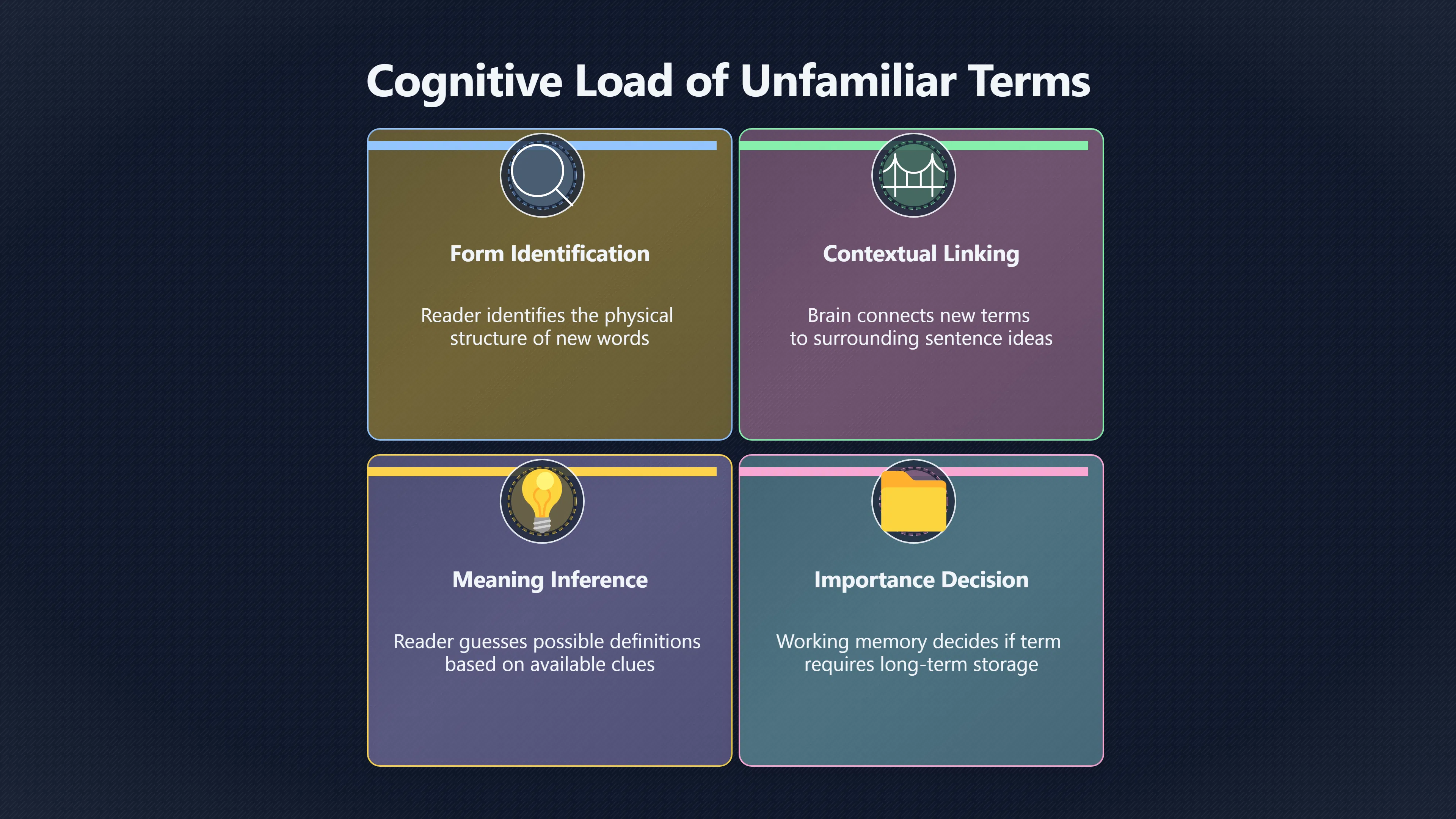
A familiar word is usually recognised as a single chunk of meaning. An unfamiliar word is different. The reader must identify its form, connect it to surrounding context, infer a possible meaning, and decide whether it is important enough to remember. Each of these steps consumes limited working-memory resources.[PMC+2The Decision Lab]pmc.ncbi.nlm.nih.govIt facilitates planning, comprehension, reasoning,Working Memory Underpins Cognitive Development, Learning…by N Cowan · 2013 · Cited by 1420 — Working memory is the retention of a s…
Consider the difference between reading:
- “The company increased revenue through subscription growth.”
- “The company improved revenue through recursive monetisation of platform-based network effects.”
The second sentence contains concepts that may not already exist in the reader’s knowledge base. Instead of processing the sentence as a single idea, the reader must pause mentally to unpack several unfamiliar elements. Cognitive load increases because working memory must temporarily hold these unresolved pieces while attempting to construct meaning.[My College]my.chartered.collegecognitive load theory and its application in the classroomMy CollegeCognitive Load Theory and its application in the classroomFeb 22, 2018 — Cognitive load theory asserts that learning is hampere…
This effect becomes stronger when a text introduces many new terms in rapid succession. Scientific papers, technical manuals, legal documents, and specialist textbooks often feel slow not because the sentences are long, but because every paragraph introduces new concepts that have not yet become automatic knowledge.
How inner speech supports encoding
The inner voice is often discussed as a speed limitation, but it also performs an important memory function. Research on inner speech and verbal working memory suggests that internally rehearsing words helps maintain information long enough for comprehension and learning to occur. The phonological loop—a component of working memory proposed by Alan Baddeley and Graham Hitch—stores speech-like information temporarily and refreshes it through internal rehearsal.[Wikipedia+2PMC]WikipediaOpen source on wikipedia.org.
When a reader encounters a new concept, a slightly slower inner voice can provide several benefits:
Maintaining unfamiliar terminology. New words disappear from awareness quickly unless they are actively rehearsed. Inner speech helps keep them available while the surrounding explanation is processed.[Wikipedia]WikipediaOpen source on wikipedia.org.
Linking terms to meaning. The reader can mentally repeat a new term while connecting it to examples, definitions, or prior knowledge. This strengthens encoding into long-term memory.[PMC]pmc.ncbi.nlm.nih.govPMCInner Speech: Development, Cognitive Functionsby B Alderson-Day · 2015 · Cited by 1151 — Inner speech—also known as covert speech or verbal thinking—has been implicated in theories…
Preserving sequence and relationships. Technical explanations often depend on the order of ideas. Internal verbal rehearsal helps readers keep track of how one concept leads to another.[PMC]pmc.ncbi.nlm.nih.govA case for the involvement of phonological loop in sentence…by LJR Lauro · 2010 · Cited by 78 — We suggest that the neural correlat…
Reducing premature skipping. A stronger inner voice can prevent the tendency to glide past unfamiliar vocabulary without truly processing it, a common cause of weak retention during speed-reading attempts.[Wikipedia]WikipediaOpen source on wikipedia.org.
In effect, inner speech acts as a temporary holding system. It gives new information enough time to stabilise before attention moves on.
Why familiar knowledge changes everything
The same text can feel dramatically different after a reader has learned its vocabulary and core concepts.
Background knowledge reduces cognitive load because familiar ideas no longer need to be reconstructed from scratch. Instead, they are retrieved from long-term memory as larger chunks. Researchers studying reading and cognitive load consistently find that existing knowledge helps readers allocate fewer resources to basic interpretation and more to higher-level understanding.[Taylor & Francis Online]tandfonline.comTaylor & Francis OnlineThe Role of Background Knowledge in Reading…by R Smith · 2021 · Cited by 725 — Cognitive Load Theory (CLT) inco…
This explains why experts often appear to read specialist material quickly. They are not necessarily processing every word faster than everyone else. Rather, they already possess mental structures that allow entire phrases and concepts to be recognised almost instantly.
A medical student encountering the term “myocardial infarction” for the first time may need careful inner rehearsal and contextual analysis. An experienced cardiologist recognises the term immediately and can focus on the broader argument surrounding it. The difference is not reading mechanics alone; it is stored knowledge.
A useful pattern: slow first exposure, faster later exposure
Many readers become frustrated when they cannot maintain their maximum speed through a difficult chapter. Yet learning often follows a predictable pattern.
During the first encounter with a new topic:
- The inner voice slows.
- Working memory carries a heavier burden.
- New terms require active rehearsal.
- Reading speed falls.[researchgate.net]researchgate.neta series of inner speech uses such as subvocalization, literal translation…Read more…
After several exposures:
- Vocabulary becomes familiar.
- Conceptual chunks form.
- Less rehearsal is needed.
- Reading speed increases naturally.
This progression reflects how information moves from effortful processing towards automatic recognition. Cognitive load theory describes learning as a process constrained by working-memory capacity, with increasing expertise reducing the burden on that system.[PMC+2My College]pmc.ncbi.nlm.nih.govPMCThe Application of Cognitive Load Theory to the Designby KA Baxter · 2025 · Cited by 39 — Cognitive load theory (CLT) is a theory of instructional design based on an understanding of human…
For this reason, the goal is not to force top speed through unfamiliar material. The goal is to reach familiarity as efficiently as possible.
When to speed up again
A slower inner voice is useful only while it serves comprehension and retention. Once a concept feels stable, continuing to rehearse every word may become unnecessary.
Signs that it is time to increase pace include:
- New terminology no longer requires conscious decoding.
- Definitions can be recalled without rereading.
- Paragraphs can be summarised immediately after reading.
- Concepts are recognised as part of larger patterns rather than isolated facts.
At this stage, the reader can begin processing larger meaning units and reducing the strength of inner speech. The text has effectively moved from the “learning” category towards the “familiar reading” category.
This adjustment is one of the most important skills in increasing reading speed. Efficient readers do not maintain a constant inner voice. They strengthen it when unfamiliar ideas need to be encoded and relax it when knowledge has become established. The result is a reading pace that matches the demands of the material rather than a fixed speed applied to every page.


eBay marketplace picks
Marketplace Samples
Example marketplace items related to this page. Use the search link to explore similar finds on eBay.




Endnotes
1.
Source: pmc.ncbi.nlm.nih.gov
Title: It facilitates planning, comprehension, reasoning,
Link:https://pmc.ncbi.nlm.nih.gov/articles/PMC4207727/
Source snippet
Working Memory Underpins Cognitive Development, Learning...by N Cowan · 2013 · Cited by 1420 — Working memory is the retention of a s...
2.
Source: Wikipedia
Link:https://en.wikipedia.org/wiki/Subvocalization
3.
Source: pmc.ncbi.nlm.nih.gov
Title: PMCThe role of consciousness in the phonological loop
Link:https://pmc.ncbi.nlm.nih.gov/articles/PMC3737516/
Source snippet
role of consciousness in the phonological loop - PMC - NIHby BR Buchsbaum · 2013 · Cited by 90 — Here we explore how the intuitive appeal...
4.
Source: pmc.ncbi.nlm.nih.gov
Title: PMCInner Speech: Development, Cognitive Functions
Link:https://pmc.ncbi.nlm.nih.gov/articles/PMC4538954/
Source snippet
by B Alderson-Day · 2015 · Cited by 1151 — Inner speech—also known as covert speech or verbal thinking—has been implicated in theories...
5.
Source: pmc.ncbi.nlm.nih.gov
Title: PMCThe Application of Cognitive Load Theory to the Design
Link:https://pmc.ncbi.nlm.nih.gov/articles/PMC12246501/
Source snippet
by KA Baxter · 2025 · Cited by 39 — Cognitive load theory (CLT) is a theory of instructional design based on an understanding of human...
6.
Source: Wikipedia
Link:https://en.wikipedia.org/wiki/Reading
Source snippet
ReadingReading is the process of taking in the sense or meaning of symbols, often specifically those of a written language, by means o...
7.
Source: Wikipedia
Link:https://en.wikipedia.org/wiki/[Phonology
Source snippet
PhonologyPhonology is the branch of linguistics that concerns how languages organize the foundational elements that make their words...
8.
Source: youtube.com
Title: How to READ so that you ACTUALLY RETAIN Information (Live Lecture)
Link:https://www.youtube.com/watch?v=EyOEB0EoIP8
Source snippet
Cognitive Load Theory...
9.
Source: youtube.com
Title: Cognitive Load Theory
Link:https://www.youtube.com/watch?v=QUHRo4b-XGA
Source snippet
Want to learn faster? Reduce cognitive load...
10.
Source: tandfonline.com
Link:https://www.tandfonline.com/doi/full/10.1080/02702711.2021.1888348
Source snippet
Taylor & Francis OnlineThe Role of Background Knowledge in Reading...by R Smith · 2021 · Cited by 725 — Cognitive Load Theory (CLT) inco...
11.
Source: thedecisionlab.com
Link:https://thedecisionlab.com/reference-guide/psychology/cognitive-load-theory
Source snippet
Cognitive Load TheoryWorking Memory: A limited-capacity system responsible for temporarily holding and processing information before it i...
12.
Source: my.chartered.college
Title: cognitive load theory and its application in the classroom
Link:https://my.chartered.college/impact_article/cognitive-load-theory-and-its-application-in-the-classroom/
Source snippet
My CollegeCognitive Load Theory and its application in the classroomFeb 22, 2018 — Cognitive load theory asserts that learning is hampere...
13.
Source: thedecisionlab.com
Link:https://thedecisionlab.com/reference-guide/psychology/phonological-loop
Source snippet
Phonological LoopThe phonological loop is the part of working memory that holds and processes verbal and auditory information, vital for...
14.
Source: pmc.ncbi.nlm.nih.gov
Link:https://pmc.ncbi.nlm.nih.gov/articles/PMC2995127/
Source snippet
A case for the involvement of phonological loop in sentence...by LJR Lauro · 2010 · Cited by 78 — We suggest that the neural correlat...
15.
Source: frontiersin.org
Link:https://www.frontiersin.org/journals/education/articles/10.3389/feduc.2020.00026/full
Source snippet
Working Memory Capacity but Not Prior Knowledge Impact...by T Schurer · 2020 · Cited by 53 — Working memory capacity (WMC) and prior kno...
16.
Source: pmc.ncbi.nlm.nih.gov
Link:https://pmc.ncbi.nlm.nih.gov/articles/PMC10764452/
Source snippet
awareness training and phonological therapy...by HM Farag · 2023 · Cited by 5 — PA training could facilitate the development of phonolog...
17.
Source: frontiersin.org
Link:https://www.frontiersin.org/journals/psychology/articles/10.3389/fpsyg.2013.00496/full
Source snippet
The role of consciousness in the phonological loopby BR Buchsbaum · 2013 · Cited by 91 — Here we explore how the intuitive appeal of the...
18.
Source: dictionary.cambridge.org
Link:https://dictionary.cambridge.org/dictionary/english/phonological
Source snippet
English meaning - Cambridge Dictionary5 days ago — relating to the sounds in a particular language or in languages, or to the study of...
Additional References
19.
Source: as-proceeding.com
Link:https://as-proceeding.com/index.php/ijanser/article/download/1802/1746/3392
Source snippet
Cognitive Processes in Reading ComprehensionSecond language learners may experience increased cognitive load when decoding unfamiliar voc...
20.
Source: therapyworks.com
Link:https://therapyworks.com/blog/language-development/phonological-processes/phonological-processes/
Source snippet
Phonological ProcessesPhonological processes are the ways that young children change or simplify the sounds in words as they learn to tal...
21.
Source: sheffield.ac.uk
Link:https://sheffield.ac.uk/linguistics/home/all-about-linguistics/about-website/branches-linguistics/phonology
Source snippet
Phonology | Linguistic Research | The University of SheffieldPhonology is the study of the categorical organisation of speech sounds in l...
22.
Source: merriam-webster.com
Link:https://www.merriam-webster.com/dictionary/subvocal
Source snippet
SUBVOCAL Definition & MeaningThe meaning of SUBVOCAL is characterized by the occurrence in the mind of words in speech order with or with...
23.
Source: researchgate.net
Link:https://www.researchgate.net/publication/247519101_The_phonological_loop_Some_answers_and_some_questions
Source snippet
The phonological loop: Some answers and some questionsThe use of inner speech as a rehearsal tool in working memory is perhaps its most w...
24.
Source: researchgate.net
Title: 319015822 A Meta Analysis on the Relation Between Reading and Working Memory
Link:https://www.researchgate.net/publication/319015822_A_Meta-Analysis_on_the_Relation_Between_Reading_and_Working_Memory
Source snippet
A Meta-Analysis on the Relation Between Reading and...30 Oct 2017 — The [purpose]({{ 'purpose/' | relative_url }}) of this study was to determine the relation between read...
25.
Source: wexler.free.fr
Title: smith (1995) the role of subvocalization in auditory imagery
Link:https://wexler.free.fr/library/files/smith%20%281995%29%20the%20role%20of%20subvocalization%20in%20auditory%20imagery.pdf
Source snippet
Smith (1995) The role of subvocalization in auditory imageryby JD SMITH · 1995 · Cited by 206 — Specifically, short-term memory for...
26.
Source: researchgate.net
Link:https://www.researchgate.net/publication/384201631_Inner_Speech_and_Speed_Reading_An_Analysis_of_Written_Texts_Internalization
Source snippet
a series of inner speech uses such as subvocalization, literal translation...Read more...
27.
Source: pedocs.de
Link:https://www.pedocs.de/volltexte/2022/23781/pdf/ZfPP_2019_2_Hahnel_et_al_The_role_of_cognitive_load_A.pdf
Source snippet
The role of cognitive load in university students'...by C Hahnel · 2019 · Cited by 30 — A joint consideration of the relationship betwee...
28.
Source: reddit.com
Link:https://www.reddit.com/r/AskPsychiatry/comments/zybmac/do_psychiatrists_understand_the_role_of/
Source snippet
calize owing to one of several symptoms (constant auditory hallucination??)...
Topic Tree