Within Rereading
A smarter way to reread hard pages
Separating orientation, repair and final integration helps readers reread less randomly and understand dense material faster.
On this page
- First pass for structure and direction
- Second pass for unresolved sentences
- Final pass for connections and consistency
Page outline Jump by section
Introduction
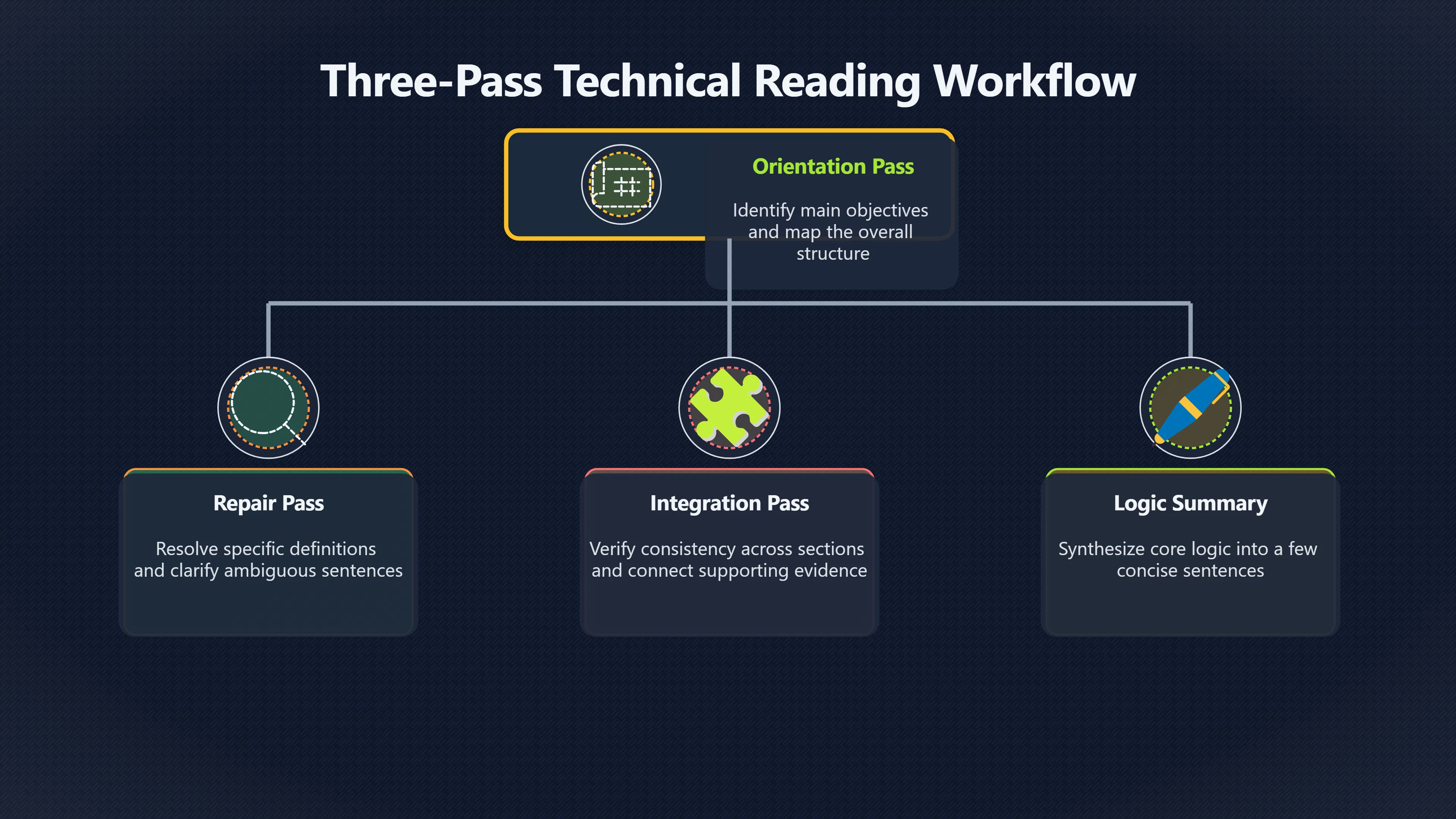
When readers tackle technical papers, standards documents, legal guidance, engineering specifications or advanced textbooks, a single careful reading is often not the fastest route to understanding. Dense material introduces definitions, assumptions and qualifications that only become meaningful after later sections have been read. A layered rereading approach solves this problem by assigning a different purpose to each pass. Instead of repeatedly revisiting pages whenever confusion arises, the reader moves through a structured sequence: first building a map of the material, then repairing unresolved points, and finally integrating the document into a coherent whole.
 This approach aligns with research showing that rereading and targeted regressions support comprehension when readers encounter ambiguity, inconsistency or information that must be integrated across a text. Backward eye movements are frequently used to reanalyse earlier content rather than merely refresh memory, suggesting that selective rereading is a functional part of understanding difficult material.[PubMed+2Springer]pubmed.ncbi.nlm.nih.govThe function of these "regressions" is still largely unknownThe function of regressions in reading: backward eye…by RW Booth · 2013 · Cited by 134 — Standard text reading involves frequent…
First pass for structure and direction
The first pass is not intended to achieve complete understanding. Its purpose is orientation.
Technical documents often contain concepts whose meaning depends on later sections. Attempting to master every sentence immediately can create unnecessary slowdowns because the reader lacks the context needed to interpret details accurately. During the first pass, the goal is to identify:
- The document’s main objective.
- Key definitions and terminology.
- Major claims or conclusions.
- The overall structure of sections and subsections.
- Areas that appear unclear or potentially important.
A useful mindset is to treat the first pass as creating a mental map. The reader should understand where information lives before worrying about every implication. This reduces random backtracking because uncertainties are marked for later attention rather than interrupting progress continuously.
For example, an engineering standard may introduce a technical term in the opening pages but only explain its practical significance several sections later. A reader who insists on full certainty during the first encounter may spend several minutes rereading a paragraph that becomes obvious after reading ahead. The orientation pass prevents this trap.
From a reading-speed perspective, this is important because it separates navigation from interpretation. The reader avoids repeatedly reprocessing text that cannot yet be fully understood.
Second pass for unresolved sentences
After the structure is clear, the second pass focuses on repair.
This is the stage where the reader returns to marked passages, difficult definitions, dense equations, exceptions and sentences whose meaning remained uncertain. Because the broader context is now available, many problems become easier to solve.
Research on comprehension monitoring shows that readers spend additional time rereading when they encounter inconsistencies or information that does not fit their developing understanding of the text. These look-backs appear to support the detection and repair of comprehension failures rather than representing wasted effort.[ResearchGate+2PMC]researchgate.netResearch Gate Does Online Comprehension Monitoring Make a UniqueDoes Online Comprehension Monitoring Make a Unique…April 5, 2018 — 13 Apr 2018 — PDF | The goal of this study was to inves…
During this pass, useful questions include:
- What exactly does this definition exclude as well as include?
- What assumption is this paragraph relying on?
- Does this sentence modify an earlier claim?
- Is a later section changing the meaning of an earlier statement?
- Which concepts depend on one another?
Technical reading frequently breaks down when readers fail to resolve these dependencies. Consider a scientific paper in which a method is described before the limitations are discussed. The first pass may leave uncertainty about the method’s significance. The second pass allows the reader to reinterpret the earlier description using information gained from the results and discussion sections.
Eye-tracking studies indicate that regressions often occur when readers need to reprocess earlier text and revise their representation of meaning. These rereading movements are particularly associated with comprehension work rather than simple visual correction.[MDPI+2PubMed]mdpi.comWe distinguish two types of these movements (regressions). One type consists of relatively large…Read more…
The practical advantage is efficiency. Instead of rereading entire chapters, the reader revisits only the passages that genuinely require clarification.
Final pass for connections and consistency
The final pass serves a different purpose again. At this point, the reader generally understands individual sections. The challenge is integration.
Technical documents rarely communicate meaning through isolated paragraphs. Important understanding emerges from relationships across the text. Definitions influence examples. Limitations qualify conclusions. Earlier assumptions constrain later recommendations.
The final pass asks whether the document works as a coherent system.
A reader might examine:
- Whether key terms are used consistently.
- How evidence supports major claims.
- Whether exceptions alter the interpretation of rules.
- How diagrams, tables and text reinforce one another.
- Whether conclusions actually follow from the stated premises.
Educational research has found that rereading can improve integration between textual explanations and accompanying graphics, an especially relevant benefit for technical documents that combine prose with figures, charts and schematics.[Reading Rockets]readingrockets.orgdont confuse reading comprehension and learning read rereadingBut even rereading benefits from instructional guidance.Read more…
This pass often reveals misunderstandings that would remain hidden if the reader stopped after repairing difficult sentences. Individual sections may appear clear while still being connected incorrectly. The integration pass is where fragmented understanding becomes a complete mental model.
Why layered passes are faster than random rereading
At first glance, reading the same material multiple times appears slower than reading it once. In practice, the opposite can occur with demanding texts.
Random rereading mixes three different tasks:
- Discovering the structure.
- Solving local confusion.
- Building global understanding.
When all three occur simultaneously, readers frequently revisit the same passages for different reasons without realising it.
A layered approach reduces this inefficiency by assigning each rereading cycle a distinct objective. The orientation pass identifies where information is located. The repair pass resolves uncertainties. The integration pass verifies relationships and consistency.
Research on rereading suggests that repeated encounters with text can improve comprehension, memory and reading efficiency, particularly when rereading is purposeful rather than automatic.[PMC+2SciEdu]pmc.ncbi.nlm.nih.govAssessing the rereading effect of digital reading through eye…by Y Xu · 2025 — Rereading can help students read more quickly, bette…
The result is not necessarily fewer rereading episodes. Instead, rereading becomes more deliberate. Readers spend less time wandering through the text and more time performing the specific comprehension task that remains unfinished.

A practical workflow for dense technical pages
For highly technical material, a simple three-pass workflow can be applied immediately:
Pass 1: Orientation
- Read continuously.
- Mark unclear sections.
- Note key definitions.
- Avoid stopping for lengthy investigation.
Pass 2: Repair
- Return to marked passages.
- Resolve terminology and references.
- Trace dependencies between claims.
- Clarify ambiguous sentences.
Pass 3: Integration
- Review major sections together.
- Check consistency of definitions and conclusions.
- Connect figures, examples and arguments.
- Summarise the document’s core logic in a few sentences.
This structure preserves the main advantage of rereading while avoiding its most common failure mode: repeatedly revisiting difficult passages without a clear purpose. For readers seeking greater reading speed on complex material, the goal is not to eliminate rereading but to organise it so that every pass performs a different job.
Amazon book picks
Further Reading
Books and field guides related to A smarter way to reread hard pages. Use these as the next step if you want deeper reading beyond the article.
How to Read a Book
Rating: 4.0/5 from 41 Google Books ratings
Its structural, interpretive, and critical reading stages closely match the article's layered rereading approach for difficult texts.
Make It Stick
Explains why strategic review, retrieval, and revisiting material improve comprehension and retention.
Ultralearning
Covers intensive learning strategies, self-directed study, and working through complex knowledge domains.
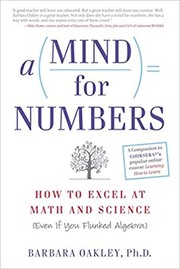
A Mind for Numbers
Provides practical techniques for understanding challenging technical and academic material.
eBay marketplace picks
Marketplace Samples
Example marketplace items related to this page. Use the search link to explore similar finds on eBay.


Endnotes
1.
Source: link.springer.com
Link:https://link.springer.com/article/10.3758/s13421-012-0244-y
Source snippet
function of regressions in reading: Backward eye...by RW Booth · 2013 · Cited by 134 — These results suggest that readers use regression...
2.
Source: mdpi.com
Link:https://www.mdpi.com/2411-5150/3/3/35
Source snippet
We distinguish two types of these movements (regressions). One type consists of relatively large...Read more...
3.
Source: researchgate.net
Title: Research Gate Does Online Comprehension Monitoring Make a Unique
Link:https://www.researchgate.net/publication/324256122_Does_Online_Comprehension_Monitoring_Make_a_Unique_Contribution_to_Reading_Comprehension_in_Beginning_Readers_Evidence_from_Eye_Movements
Source snippet
Does Online Comprehension Monitoring Make a Unique...April 5, 2018 — 13 Apr 2018 — PDF | The goal of this study was to inves...
Published: April 5, 2018
4.
Source: pmc.ncbi.nlm.nih.gov
Link:https://pmc.ncbi.nlm.nih.gov/articles/PMC7079677/
Source snippet
Relations Between Children's Comprehension Monitoring...by E Zargar · 2019 · Cited by 90 — We investigated how this skill may be associa...
5.
Source: core.ac.uk
Link:https://core.ac.uk/download/pdf/52172007.pdf
Source snippet
The func- tion of these “regressions”...Read more...
6.
Source: pmc.ncbi.nlm.nih.gov
Link:https://pmc.ncbi.nlm.nih.gov/articles/PMC12409514/
Source snippet
Assessing the rereading effect of digital reading through eye...by Y Xu · 2025 — Rereading can help students read more quickly, bette...
7.
Source: sciedu.ca
Title: view File
Link:https://www.sciedu.ca/journal/index.php/wjel/article/viewFile/26230/16731
Source snippet
The Impact of the Rereading Method on Reading Speed...13 Jan 2025 — The rereading method benefits automatic word recognition, which impa...
8.
Source: researchgate.net
Link:https://www.researchgate.net/publication/375566821_Summarizing_versus_Rereading_Multiple_Documents
Source snippet
Summarizing versus Rereading Multiple DocumentsAlthough this study did not find that document summarization was effective relative to doc...
9.
Source: researchgate.net
Link:https://www.researchgate.net/publication/399897944_Testing_the_Speed-Accuracy_Trade-Off_in_Reading_Effects_of_Reading_Speed_on_Comprehension_and_Eye_Movements
Source snippet
(PDF) Testing the Speed-Accuracy Trade-Off in Reading19 Jan 2026 — Conclusion The findings challenge the notion of a speed-accuracy trade...
10.
Source: researchgate.net
Link:https://www.researchgate.net/publication/230658181_The_function_of_regressions_in_reading_Backward_eye_movements_allow_rereading
Source snippet
(PDF) The function of regressions in reading: Backward...The most obvious explanation is that regressions allow for the rereading of pre...
11.
Source: mdpi.com
Title: 2226 471X
Link:https://www.mdpi.com/2226-471X/9/12/360
Source snippet
Tracking Adults' Eye Movements to Study Text...by G Andreou · 2024 · Cited by 7 — The aim of this review is to examine and analyze the c...
12.
Source: pubmed.ncbi.nlm.nih.gov
Title: The function of these “regressions” is still largely unknown
Link:https://pubmed.ncbi.nlm.nih.gov/22886737/
Source snippet
The function of regressions in reading: backward eye...by RW Booth · 2013 · Cited by 134 — Standard text reading involves frequent...
13.
Source: readingrockets.org
Title: dont confuse reading comprehension and learning read rereading
Link:https://www.readingrockets.org/blogs/shanahan-on-literacy/dont-confuse-reading-comprehension-and-learning-read-rereading
Source snippet
But even rereading benefits from instructional guidance.Read more...
14.
Source: pmc.ncbi.nlm.nih.gov
Link:https://pmc.ncbi.nlm.nih.gov/articles/PMC12641876/
Source snippet
by M Markevich · 2025 — Successful reading comprehension depends on many factors, including text genre. Eye-tracking studies indicate...
15.
Source: studysmartpbl.com
Link:https://www.studysmartpbl.com/self-regulated-learning-skills/rereading/
Source snippet
Study SmartRereading means that in order to learn a text, you read it, and then read it again. Often, this is done immediately after the...
16.
Source: frontiersin.org
Link:https://www.frontiersin.org/journals/psychology/articles/10.3389/fpsyg.2025.1576247/full
Source snippet
Assessing the rereading effect of digital reading through...by Y Xu · 2025 — The goal of this study is to investigate the differences in...
Additional References
17.
Source: shanahanonliteracy.com
Link:https://www.shanahanonliteracy.com/blog/everything-you-wanted-to-know-about-repeated-reading
Source snippet
Everything You Wanted to Know about Repeated ReadingRepeated reading usually leads to better [oral reading]({{ 'reading-aloud/' | relative_url }}) performance and reading compreh...
18.
Source: journals.sagepub.com
Link:https://journals.sagepub.com/doi/10.1177/00222194221081473
Source snippet
Sage JournalsDo Struggling Adult Readers Monitor Their Reading...This study used a comprehension monitoring task with struggling adult r...
19.
Source: studenttheses.universiteitleiden.nl
Link:https://studenttheses.universiteitleiden.nl/access/item%3A2629036/view
Source snippet
eye movements to predict reading skills in childrenSince eye tracking requires reading from a monitor, the first aim in this study was to...
20.
Source: theamericanscholar.org
Link:https://theamericanscholar.org/reading-fast-and-slow/
21.
Source: tmalsburg.github.io
Link:https://tmalsburg.github.io/MeziereEtAl2021MS.pdf
Source snippet
accades are regressions, which move the eyes back to a previous part of the...Read more...
22.
Source: search.proquest.com
Link:https://search.proquest.com/openview/4fb126a82ce13488a45cb3498db2377f/1?cbl=54207&pq-origsite=gscholar
Source snippet
and regressions during reading...by AY Wong · 2022 · Cited by 4 — Studies have found that metacomprehension accuracy tends to be poor, b...
23.
Source: tandfonline.com
Link:https://www.tandfonline.com/doi/full/10.1080/0163853X.2020.1727683
Source snippet
Full article: Differentiating Text-Based and [Knowledge]({{ 'knowledge/' | relative_url }})...by ML van Moort · 2021 · Cited by 33 — To examine the time course and cognitive...
24.
Source: youtube.com
Link:https://www.youtube.com/watch?v=fx1a6Dm64kA
Source snippet
; Regressions, Re-reading and Comprehension 02:22; The...
25.
Source: cognitivetrain.com
Link:https://cognitivetrain.com/regression-in-reading/
Source snippet
Regression in Reading: Why Your Eyes Keep Going...Eye-tracking research shows that regressions account for 10-15% of all eye movements d...
26.
Source: facebook.com
Link:https://www.facebook.com/groups/907060703274275/posts/1710166289630375/
Source snippet
But reading-retelling-rereadi...
Topic Tree