Within Phrases
Why silent reading still has rhythm
Even silent readers often use an inner rhythm that helps them follow syntax, emphasis, and meaning across a sentence.
On this page
- Prosody beyond reading aloud
- How rhythm supports syntax and memory
- When speed disrupts the inner voice
Page outline Jump by section
Introduction
Silent reading may look completely different from reading aloud, yet fluent readers rarely process text as a flat stream of words. Research suggests that many readers generate an internal rhythm—often called implicit prosody—that helps organise phrases, signal emphasis, and guide meaning. This rhythm is not necessarily a fully audible “voice in the head”, but it often carries features associated with speech, including stress patterns, phrasing, and timing. For readers seeking greater speed, this matters because efficient reading depends not only on rapid word recognition but also on moving through sentences in meaningful chunks rather than reconstructing syntax word by word.[ResearchGate]researchgate.net259542722 Evidence for Prosody in Silent ReadingResearchGate(PDF) Evidence for Prosody in Silent ReadingThis Implicit Prosody (IP) Hypothesis, as originally promulgated by Fodor (1998)…
 Within phrase reading, inner rhythm acts as a coordinating mechanism. It helps readers anticipate how a sentence is structured, hold information in working memory, and maintain comprehension while moving quickly through text. When rhythm breaks down, speed can increase temporarily, but understanding often suffers.[MDPI]mdpi.comMotivation for the present study.Read more…
Prosody beyond reading aloud
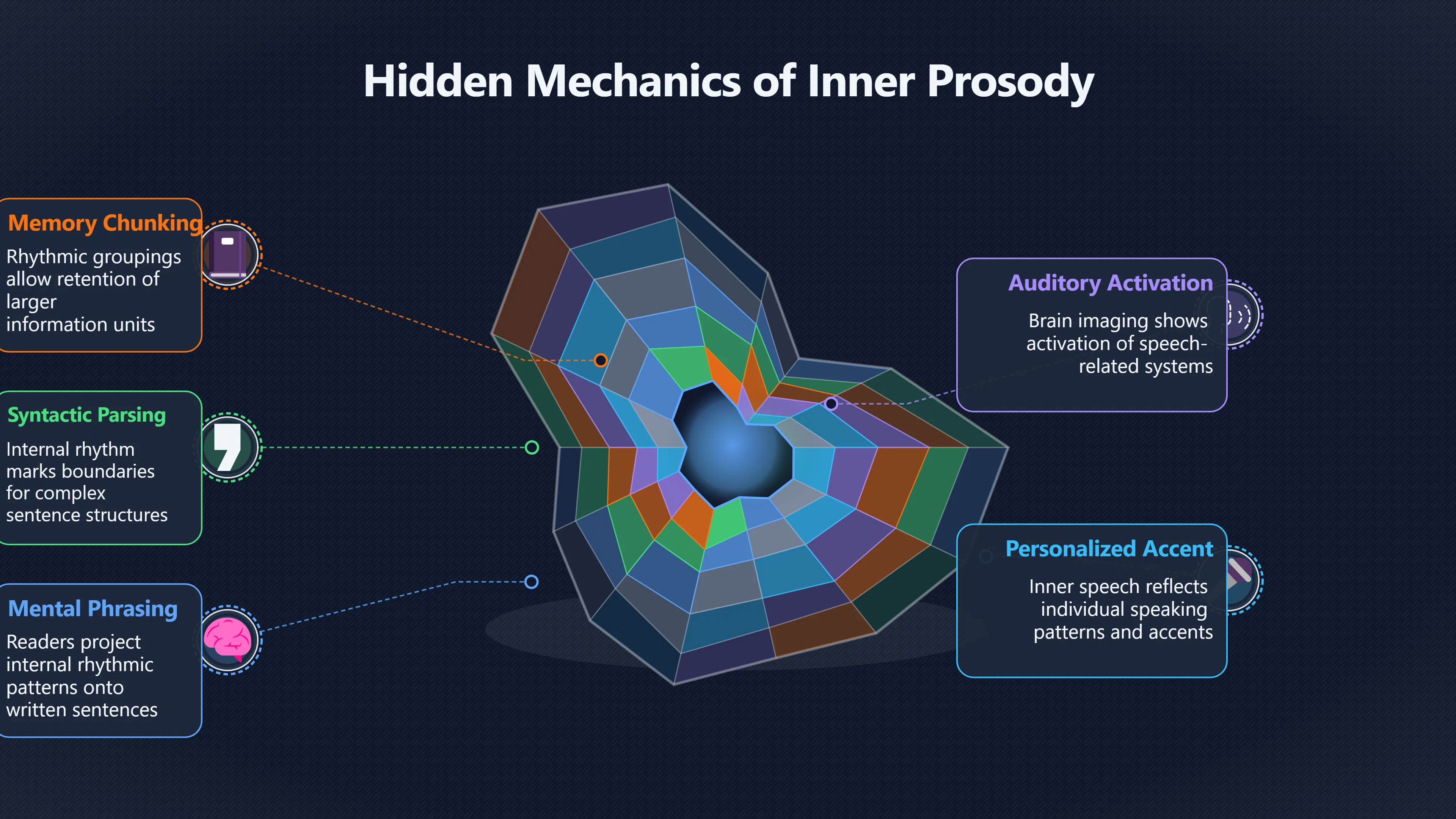
Prosody is usually associated with spoken language: pauses, stress, emphasis, and intonation. For many years, researchers assumed that prosody mattered mainly when people read aloud. Evidence from silent reading has challenged that view.
One influential framework, the Implicit Prosody Hypothesis, proposes that readers project a mental prosodic pattern onto written sentences. Even without producing sound, they assign phrasing and stress that help them interpret grammar and meaning. Studies using eye-tracking and sentence-processing tasks have repeatedly found signs that readers behave as though they are constructing an internal speech-like structure while reading.[ResearchGate]researchgate.net259542722 Evidence for Prosody in Silent ReadingResearchGate(PDF) Evidence for Prosody in Silent ReadingThis Implicit Prosody (IP) Hypothesis, as originally promulgated by Fodor (1998)…
The internal rhythm appears to be richer than a simple pronunciation guide. Research on skilled adult readers suggests that their inner voice can preserve expressive qualities such as emphasis and information focus. Readers often mentally stress new or important information in ways similar to natural speech.[ila.onlinelibrary.wiley.com]ila.onlinelibrary.wiley.comEvidence for Prosody in Silent ReadingGross - 201418 Dec 2013 — In two studies, we sought to understand whether the inner voice of skilled, adult readers preserves the prosodi…
Neuroscience studies provide additional support. Brain-imaging work has shown that silent reading can activate auditory and speech-related systems, particularly when text encourages vivid mental speech. Direct quotations, for example, tend to evoke stronger inner speech than indirect reporting.[Journal of Cognition]journalofcognition.orgJournal of CognitionMental Simulations of Phonological Representations Are…by B Yao · 2021 · Cited by 18 — The findings suggest that a…
Importantly, not every reader experiences inner speech in exactly the same way. Research suggests that aspects of a reader’s own speaking patterns, including accent-related features, can appear in silent reading. The rhythm is therefore not a fixed recording but a personal cognitive tool shaped by language experience.[PMC]pmc.ncbi.nlm.nih.govInner Speech during Silent Reading Reflects the Reader's…by R Filik · 2011 · Cited by 115 — The current study suggests that inner s…
How rhythm supports syntax and memory
The practical value of inner rhythm becomes most visible when sentences become longer or more complex.
Consider the sentence:
Although the committee approved the proposal, several members expressed concerns about implementation.
A fluent reader rarely treats this as a sequence of isolated words. Instead, the sentence naturally falls into larger units. The opening clause establishes a contrast, and the second clause delivers the main message. An internal rhythmic structure helps mark those boundaries.
Rhythm as a guide to sentence structure
Research on syntactic ambiguity shows that readers often rely on implicit prosody when deciding how a sentence should be parsed. Eye-tracking studies indicate that imagined phrasing influences where readers hesitate, reread, or become confused. In effect, the inner rhythm acts like punctuation that helps organise meaning before conscious analysis catches up.[MDPI]mdpi.comMotivation for the present study.Read more…
This is particularly important because written language often contains structures that are difficult to interpret without grouping. Readers who can quickly assign phrase boundaries expend less effort reconstructing syntax and can devote more attention to comprehension.
Rhythm as a memory aid
Inner rhythm also supports working memory. Meaningful phrase groupings allow readers to retain larger chunks of information instead of juggling many separate words. Cognitive theories of phonological coding suggest that written language is frequently recoded into sound-related representations, helping readers maintain information while integrating it with later parts of the sentence.[PMC]pmc.ncbi.nlm.nih.govPMCPhonological coding during readingNIHby M Leinenger · 2014 · Cited by 165 — This inner voice is a subjective manifestation of phonological coding, the recoding of or…
The benefit resembles how a phone number becomes easier to remember when grouped into sections. The reader is not memorising every word independently; the rhythmic structure creates larger, more manageable units.
Evidence from eye movements
Eye-tracking research provides a useful window into these processes. Studies have found that prosodic features such as lexical stress influence fixation patterns during silent reading. Readers do not simply recognise visual letter strings. Their eye movements suggest sensitivity to speech-related patterns that contribute to fluent processing.[PMC]pmc.ncbi.nlm.nih.govWe asked whether lexical stress registers in the eye…Read more…
Recent work has continued to find links between stress patterns and reading behaviour, reinforcing the view that silent reading contains more rhythmic structure than a purely visual account would predict.[MDPI]mdpi.comThis is…Read more…
Why skilled readers do not eliminate the inner voice
Popular speed-reading advice often presents the inner voice as an obstacle. The argument is simple: if speech is slower than vision, then eliminating internal speech should dramatically increase reading speed.
The evidence is more complicated.
Research on phonological coding indicates that sound-related representations remain deeply involved in skilled reading. While readers do not necessarily rehearse every syllable with full spoken detail, they often retain enough phonological and prosodic information to support comprehension.[PMC]pmc.ncbi.nlm.nih.govPMCPhonological coding during readingNIHby M Leinenger · 2014 · Cited by 165 — This inner voice is a subjective manifestation of phonological coding, the recoding of or…
Studies examining inner speech suggest that it becomes especially active when readers must understand, remember, or interpret text carefully. When attention and comprehension demands increase, inner-voice activity tends to increase rather than disappear.[PMC]pmc.ncbi.nlm.nih.govPMCHow Silent Is Silent Reading?Intracerebral Evidence for Top…by M Perrone-Bertolotti · 2012 · Cited by 182 — Sustained inner voice activation is not an automatic pr…
This helps explain why many readers can skim simple material rapidly but still rely on a stronger inner rhythm when reading literature, academic writing, legal documents, or complex arguments. The cognitive system appears to adjust the richness of internal speech according to task demands rather than switching it off entirely.[PMC]pmc.ncbi.nlm.nih.govPMCHow Silent Is Silent Reading?Intracerebral Evidence for Top…by M Perrone-Bertolotti · 2012 · Cited by 182 — Sustained inner voice activation is not an automatic pr…
When speed disrupts the inner voice
The relationship between speed and inner rhythm is not all-or-nothing. Faster reading does not require preserving every feature of spoken language. However, there is a point at which acceleration begins to undermine the rhythmic structure that supports comprehension.
Several warning signs suggest that reading speed has outpaced useful prosody:
- Frequent rereading of sentences.
- Losing track of clause boundaries.
- Missing contrasts, conditions, or qualifications.
- Remembering individual facts but not the argument connecting them.
- Reaching the end of a paragraph with little sense of its meaning.
In these situations, the problem is often not insufficient speed but insufficient phrasing. The reader’s eyes may be moving forward while the underlying syntactic and semantic structure is failing to form coherently.
Research on fluency consistently treats prosody as part of skilled reading rather than an optional extra. Accuracy, rate, and prosodic organisation work together. Improvements in speed are most durable when they occur alongside smoother phrase processing, not in opposition to it.[Five from Five+2PMC]fivefromfive.com.auFive from FiveComponents of fluencyText or passage reading fluency is generally defined as having three components: accuracy, rate, and p…

What inner rhythm means for increasing reading speed
For readers working on speed, the key lesson is that fluent silent reading is not silent in a cognitive sense. Skilled readers often maintain an abbreviated but meaningful internal rhythm that tracks phrase boundaries, highlights important information, and supports memory.
The goal is therefore not to eliminate rhythm but to make it more efficient. As word recognition becomes automatic, the reader can devote less attention to individual words and more attention to larger phrase units. The inner rhythm becomes lighter and faster while still preserving the structure needed for comprehension. Research on silent reading suggests that this balance—rapid visual processing combined with useful prosodic organisation—is a hallmark of fluent reading rather than a barrier to it.[ResearchGate+2PMC]researchgate.net259542722 Evidence for Prosody in Silent ReadingResearchGate(PDF) Evidence for Prosody in Silent ReadingThis Implicit Prosody (IP) Hypothesis, as originally promulgated by Fodor (1998)…
Amazon book picks
Further Reading
Books and field guides related to Why silent reading still has rhythm. Use these as the next step if you want deeper reading beyond the article.
How to Read a Book
Rating: 4.0/5 from 41 Google Books ratings
Focuses on reading for understanding and retention, aligning with themes of syntax, meaning, and thoughtful engagement with text.

Proust and the Squid
Directly explores how the reading brain processes written language, including fluency, meaning construction, and the cognitive foundation...

Reader, Come Home
Examines deep reading, concentration, and what is gained or lost when reading habits shift away from sustained, meaningful engagement wit...

Language at the Speed of Sight
Explains how skilled readers process written language, including the interaction of word recognition, sound patterns, and comprehension.
eBay marketplace picks
Marketplace Samples
Example marketplace items related to this page. Use the search link to explore similar finds on eBay.



Endnotes
1.
Source: researchgate.net
Title: 259542722 Evidence for Prosody in Silent Reading
Link:https://www.researchgate.net/publication/259542722_Evidence_for_Prosody_in_Silent_Reading
Source snippet
ResearchGate(PDF) Evidence for Prosody in Silent ReadingThis Implicit Prosody (IP) Hypothesis, as originally promulgated by Fodor (1998)...
2.
Source: pmc.ncbi.nlm.nih.gov
Title: PMCPhonological coding during reading
Link:https://pmc.ncbi.nlm.nih.gov/articles/PMC4211933/
Source snippet
NIHby M Leinenger · 2014 · Cited by 165 — This inner voice is a subjective manifestation of phonological coding, the recoding of or...
3.
Source: mdpi.com
Link:https://www.mdpi.com/1995-8692/6/2/9
Source snippet
Motivation for the present study.Read more...
4.
Source: pmc.ncbi.nlm.nih.gov
Title: PMCHow Silent Is Silent Reading?
Link:https://pmc.ncbi.nlm.nih.gov/articles/PMC6621680/
Source snippet
Intracerebral Evidence for Top...by M Perrone-Bertolotti · 2012 · Cited by 182 — Sustained inner voice activation is not an automatic pr...
5.
Source: ila.onlinelibrary.wiley.com
Title: Evidence for Prosody in Silent Reading
Link:https://ila.onlinelibrary.wiley.com/doi/10.1002/rrq.67
Source snippet
Gross - 201418 Dec 2013 — In two studies, we sought to understand whether the inner voice of skilled, adult readers preserves the prosodi...
6.
Source: ila.onlinelibrary.wiley.com
Title: Evidence for Prosody in Silent Reading
Link:https://ila.onlinelibrary.wiley.com/doi/abs/10.1002/rrq.67
Source snippet
Because the inner voice cannot be directly observed, we borrowed the cap-emphasis...Read more...
7.
Source: pmc.ncbi.nlm.nih.gov
Title: PMCMental Simulations of Phonological Representations
Link:https://pmc.ncbi.nlm.nih.gov/articles/PMC7792465/
Source snippet
by B Yao · 2021 · Cited by 18 — The findings suggest that a more vivid inner speech is mentally activated during silent reading of dir...
8.
Source: pmc.ncbi.nlm.nih.gov
Link:https://pmc.ncbi.nlm.nih.gov/articles/PMC3198452/
Source snippet
Inner Speech during Silent Reading Reflects the Reader's...by R Filik · 2011 · Cited by 115 — The current study suggests that inner s...
9.
Source: pmc.ncbi.nlm.nih.gov
Title: PMCInner Speech: Development, Cognitive Functions
Link:https://pmc.ncbi.nlm.nih.gov/articles/PMC4538954/
Source snippet
by B Alderson-Day · 2015 · Cited by 1167 — Inner speech—also known as covert speech or verbal thinking—has been implicated in theories...
10.
Source: pmc.ncbi.nlm.nih.gov
Link:https://pmc.ncbi.nlm.nih.gov/articles/PMC1479854/
Source snippet
We asked whether lexical stress registers in the eye...Read more...
11.
Source: researchgate.net
Link:https://www.researchgate.net/publication/228404042_Prosody_in_skilled_silent_reading_Evidence_from_eye_movements
Source snippet
Prosody in skilled silent reading: Evidence from eye...Recent eye movement experiments offer preliminary evidence that skilled readers a...
12.
Source: mdpi.com
Link:https://www.mdpi.com/1995-8692/18/3/24
Source snippet
This is...Read more...
13.
Source: pmc.ncbi.nlm.nih.gov
Title: PMCBecoming a Fluent Reader: Reading Skill and Prosodic
Link:https://pmc.ncbi.nlm.nih.gov/articles/PMC2748352/
Source snippet
by PJ Schwanenflugel · 2004 · Cited by 731 — The major [purpose]({{ 'purpose/' | relative_url }}) of the study was to learn how reading prosody is related to decoding an...
14.
Source: researchgate.net
Link:https://www.researchgate.net/publication/384201631_Inner_Speech_and_Speed_Reading_An_Analysis_of_Written_Texts_Internalization
Source snippet
a series of inner speech uses such as subvocalization, literal translation...Read more...
15.
Source: researchgate.net
Link:https://www.researchgate.net/publication/368145969_Effects_of_Reading_Aloud_and_Subvocalization_on_Text_Comprehension_and_Eye_Movementsyinshenghuatoneishenghuagawenzhangnolijieyayanqiuyundongnijibosuyingxiang
Source snippet
omprehension and eye movements, and also effects of type of subvocalization.Read more...
16.
Source: researchgate.net
Title: (PDF) Inner Prosody In Silent Poetry Reading
Link:https://www.researchgate.net/publication/400757425_Inner_Prosody_In_Silent_Poetry_Reading_The_Role_of_Subvocalisation_and_Imagined_Voice
Source snippet
The Role of...13 Feb 2026 — The article explores the phenomenon of inner prosody during silent poem reading, focusing on the role of sub...
17.
Source: researchgate.net
Link:https://www.researchgate.net/figure/Prosody-and-Silent-Reading-Comprehension-Scores_tbl2_264635890
Source snippet
Prosody and Silent Reading Comprehension ScoresThe relationship between fluency and comprehension is most likely reciprocal: students' co...
18.
Source: journalofcognition.org
Link:https://journalofcognition.org/articles/10.5334/joc.141
Source snippet
Journal of CognitionMental Simulations of Phonological Representations Are...by B Yao · 2021 · Cited by 18 — The findings suggest that a...
19.
Source: fivefromfive.com.au
Link:https://fivefromfive.com.au/fluency/components-of-fluency/
Source snippet
Five from FiveComponents of fluencyText or passage reading fluency is generally defined as having three components: accuracy, rate, and p...
20.
Source: pmc.ncbi.nlm.nih.gov
Link:https://pmc.ncbi.nlm.nih.gov/articles/PMC8557949/
Source snippet
subvocalization: An eye-tracking study on silent...by J Beck · 2021 · Cited by 22 — The present study investigates effects of convention...
21.
Source: pmc.ncbi.nlm.nih.gov
Link:https://pmc.ncbi.nlm.nih.gov/articles/PMC4782161/
Source snippet
by G Kentner · 2016 · Cited by 46 — We argue that reading comprehension requires the (implicit) assignment of accents according to the...
22.
Source: pmc.ncbi.nlm.nih.gov
Link:https://pmc.ncbi.nlm.nih.gov/articles/PMC12194486/
Source snippet
the Prosodic Structure of Texts Reflected in Silent Reading...by M Palmović · 2025 — This study provides indirect evidence in favour of...
23.
Source: howjournalcolombia.org
Link:https://www.howjournalcolombia.org/index.php/how/article/view/791
Source snippet
Inner Speech and Speed Reading: An Analysis of Written...by FLG Cobo · 2024 · Cited by 2 — Silent reading frequently entails engaging th...
Additional References
24.
Source: sarahsnippets.com
Link:https://sarahsnippets.com/fluency-phrased-reading-scooping/
Source snippet
Phrased Reading: Foundations of Fluency SkillsTeaching students to read in phrases strengthens prosody, decoding momentum, and comprehens...
25.
Source: asu.elsevierpure.com
Link:https://asu.elsevierpure.com/en/publications/what-the-readers-eye-tells-the-minds-ear-silent-reading-activates/
Source snippet
the reader's eye tells the mind's ear: Silent reading...by M Abramson · 1997 · Cited by 186 — The present study examined the similarity...
26.
Source: thereadingape.com
Title: that voice in your head inner speech and why it s important for reading
Link:https://www.thereadingape.com/single-post/that-voice-in-your-head-inner-speech-and-why-it-s-important-for-reading
Source snippet
THAT VOICE IN YOUR HEAD – INNER SPEECH AND WHY...Dec 15, 2024 — So, if as the research suggests, the sounds of words influences the spee...
27.
Source: keystoliteracy.com
Title: the importance of teaching prosody as part of reading fluency
Link:https://keystoliteracy.com/blog/the-importance-of-teaching-prosody-as-part-of-reading-fluency/
Source snippet
The Importance of Teaching Prosody as Part of Reading...11 Jul 2023 — Fluent readers chunk words together in appropriate, meaningful phr...
28.
Source: literacyworldwide.org
Title: staying literacy strong a focus on phrasing
Link:https://www.literacyworldwide.org/blog/literacy-now/2015/09/22/staying-literacy-strong-a-focus-on-phrasing
Source snippet
Staying Literacy Strong: A Focus on Phrasing22 Sept 2015 — Research and scholarly thought suggest helping students learn to read in phras...
29.
Source: reddit.com
Link:https://www.reddit.com/r/Aphantasia/comments/1e9u9tx/when_reading_do_you_have_inner_speech_or_youre/
Source snippet
they say each word in their head. They don’t and they are silent...
30.
Source: mtholyoke.edu
Title: professor studies silent inner voice
Link:https://www.mtholyoke.edu/news/news-stories/professor-studies-silent-inner-voice
Source snippet
13 Jan 2016 — Professor Mara Breen studies how we “hear” the words we read, and what happens when the brain expects one word but gets ano...
31.
Source: crackingtheabccode.com
Title: repeated reading fluency and prosody
Link:https://crackingtheabccode.com/repeated-reading-fluency-and-prosody/?srsltid=AfmBOoruB3H405q9XjCqrXwZlSKzLlvxgvX3Frz16aDkXF_td6JxN6Sc
Source snippet
Repeated Reading, Fluency and Prosody31 Oct 2024 — Reading fluency includes being able to read all the words in a passage without hesitat...
32.
Source: research.polyu.edu.hk
Link:https://research.polyu.edu.hk/en/publications/inner-and-outer-voices-l2-readers-experiences-of-silent-reading-r/
Source snippet
and Outer Voices: L2 Readers' Experiences of Silent...by HY Mok · 2025 · Cited by 1 — Walter (2008) argues that L2 readers' unreliable p...
33.
Source: ora.ox.ac.uk
Link:https://ora.ox.ac.uk/objects/uuid%3Adfe9f411-fa39-48db-9fc3-b61ed41deb1e/files/dsf2685900
Source snippet
ox.ac.ukL2 readers' experiences of silent reading, reading aloud and...by E Mok · 2023 · Cited by 1 — Results suggest that readers acces...
Topic Tree