Within Signal words
Why may is not a throwaway word
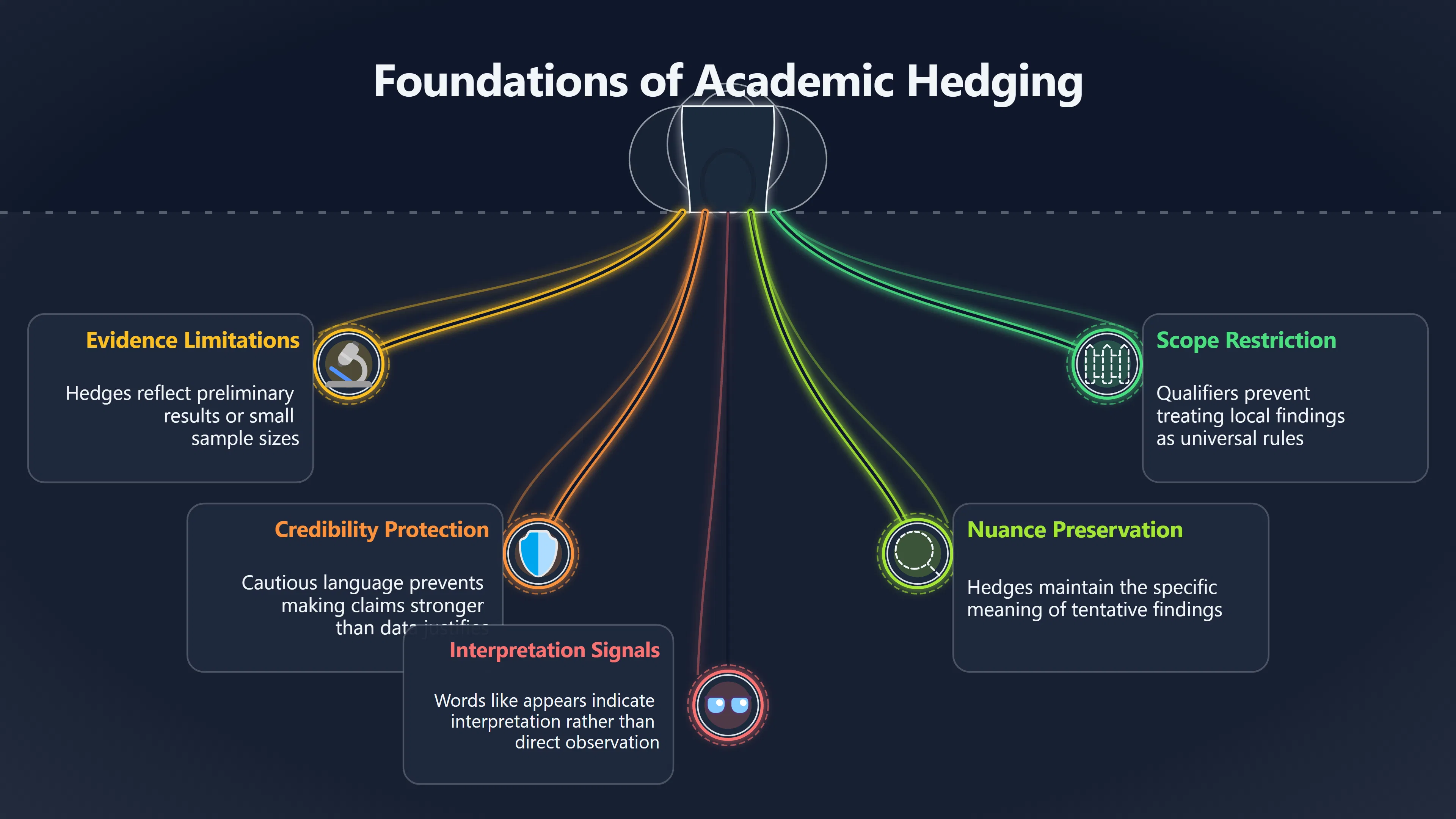
Hedges such as may, appears, and some tell readers how much certainty and scope the evidence can honestly support.
On this page
- How hedges narrow certainty and scope
- Common ways fast readers inflate weak claims
- A checklist for preserving tentative conclusions
Page outline Jump by section
Introduction
Fast reading only works when readers preserve the author’s level of certainty. One of the most common failures in skimming is turning a tentative finding into a strong conclusion by overlooking hedges such as may, might, appears, suggests, some, often, and in certain cases. These words are not filler. They tell readers exactly how much confidence the evidence can support and how widely a claim applies. Academic writing guides consistently describe hedging as a way of matching claims to evidence, avoiding overstatement, and signalling uncertainty where certainty is not justified.[The Writing Center+2Oxford Lifelong Learning]writingcenter.gmu.eduhedges softening claims in academic writingThe Writing CenterHedges: Softening Claims in Academic WritingOct 17, 2020 — With the help of the special language, called “hedges”, writ…
 For readers trying to increase reading speed, hedges are high-value signals. They allow a quick reader to identify whether a statement is a demonstrated finding, a probable interpretation, or a tentative possibility. Missing them can transform the meaning of an entire paragraph.
Why may is not a throwaway word
A hedge changes the strength of a claim without changing its topic.
Compare these statements:
- “The intervention improves reading speed.”
- “The intervention may improve reading speed.”
- “The intervention may improve reading speed for some readers.”
All three discuss the same subject. However, they make very different claims about certainty and scope.
The first sentence presents the effect as established. The second signals uncertainty. The third adds a limitation on who may benefit. Academic writing resources emphasise that hedging helps writers express appropriate levels of confidence and reflect the limits of available evidence rather than claiming more than the data can support.[Oxford Lifelong Learning+2Enago]lifelong-learning.ox.ac.ukOxford Lifelong Learning HedgingIt allows writers to show appropriate levels of certainty…Read more…
When skimmers ignore these qualifiers, they often remember only the strongest possible version. A finding that may exist becomes a finding that does exist. A result observed in some participants becomes a result that applies to everyone.
How hedges narrow certainty and scope
Different hedges perform different jobs.
Certainty hedges reduce confidence in a conclusion:
- may
- might
- could
- appears to
- seems to
- suggests
These indicate that the evidence supports a possibility or interpretation rather than a settled fact.[Monash University+2Grammarly]monash.eduMonash UniversityHow to use hedging to make nuanced claimsTo express a nuanced claim, you need to draw on a range of hedging devices. Gen…
Scope hedges limit how broadly a claim applies:
- some
- many
- often
- in certain cases
- among the participants studied
These prevent readers from treating a local finding as a universal rule.[IDP IELTS Poland+2UEfAP]ielts.idp.comIDP IELTS PolandHedging Language in IELTS Writing Task 2Dec 18, 2024 — Hedging language is a cautious way of expressing ideas without mak…
A useful reading shortcut is to ask two questions whenever you encounter a hedge:
- How certain is the author claiming this is?
- How broadly is the author claiming this applies?
Those two questions preserve most of the nuance that careless skimming loses.
Common ways fast readers inflate weak claims
The most frequent skimming errors involve silently removing qualifiers.
Turning possibility into proof
A sentence such as:
“The results suggest that faster previewing may improve reading efficiency.”
can easily become:
“Faster previewing improves reading efficiency.”
The topic remains unchanged, but the evidence claim becomes much stronger than the author intended.
This matters because researchers often hedge precisely when evidence is preliminary, samples are limited, measurements are imperfect, or alternative explanations remain plausible. Studies of scientific and academic writing note that hedges are frequently used to reflect these evidence limitations rather than to weaken arguments unnecessarily.[ERIC+2PMC]files.eric.ed.govERICHedging Scientific WritingREPORT NO ISS - ERICby K Hyland · 1995 · Cited by 316 — In science writers may hedge in this way because of preliminary results, small sa…
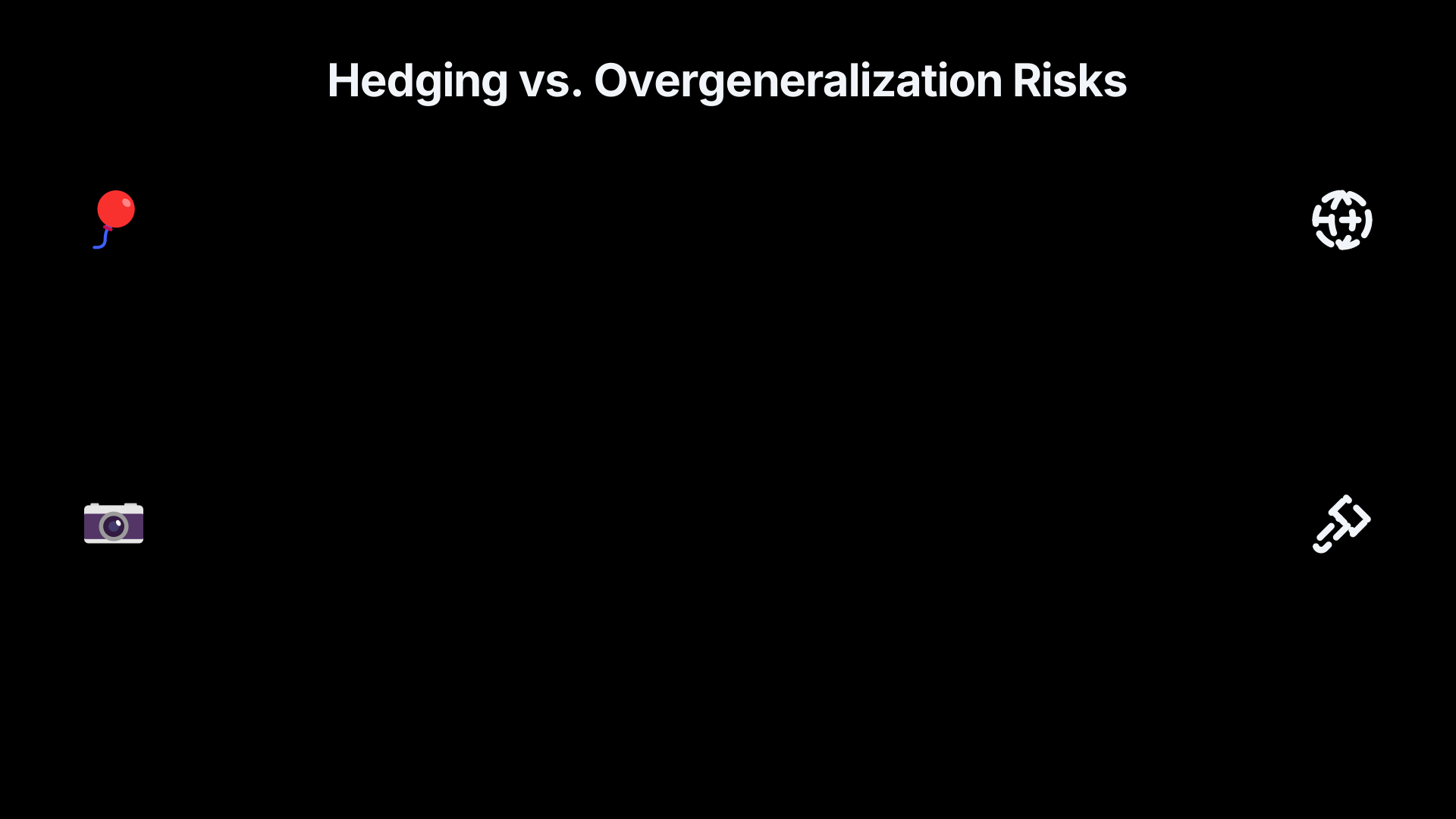
Turning trends into universals
Readers frequently overlook words such as many, most, or some.
Consider:
“Some fast readers benefit from previewing headings before reading.”
A rushed summary may become:
“Fast readers benefit from previewing headings.”
The second statement applies to everyone. The original does not.
Academic guidance on hedging repeatedly highlights that qualifiers help avoid overgeneralisation by restricting claims to the populations and situations actually supported by evidence. IDP IELTS Poland+2University of Pretoria Library[ielts.idp.com]ielts.idp.comIDP IELTS PolandHedging Language in IELTS Writing Task 2Dec 18, 2024 — Hedging language is a cautious way of expressing ideas without mak…
Treating interpretation as observation
Words such as appears, seems, and is believed to often indicate that authors are interpreting evidence rather than directly observing a fact.
For example:
“The pattern appears consistent with improved comprehension.”
is not equivalent to:
“The pattern proves improved comprehension.”
The hedge signals that competing interpretations may still exist.[Monash University+2PMC]monash.eduMonash UniversityHow to use hedging to make nuanced claimsTo express a nuanced claim, you need to draw on a range of hedging devices. Gen…

Why careful writers use hedges instead of stronger language
Some readers mistake hedging for weakness. In evidence-based writing, it is usually the opposite.
A claim becomes more credible when its certainty matches the evidence behind it. Writing specialists note that hedging protects credibility because it prevents authors from making claims stronger than their data justify. It also acknowledges that complex questions rarely produce absolute answers. University of Pretoria Library+2The Writing Center[library.up.ac.za]library.up.ac.zaFunctions of Hedging:.Read moreUniversity of Pretoria LibraryUsing Hedging Language - Academic Writing - UP LibraryMar 5, 2026 — It protects your credibility by ensurin…
This is particularly important in research summaries, reviews, and policy discussions. Evidence often points toward a conclusion without fully proving it. In such cases, a hedge is not a warning sign that the research is poor. It is often a sign that the writer is accurately representing what the evidence can and cannot establish.[PMC+2Enago]pmc.ncbi.nlm.nih.govPMCExploring Hedging Devices in Scientific Research Papersby H Hamidi · 2025 — Hedging generally serves several important rhetorical and epistemic purposes in academic writing, allowing author…
For fast readers, recognising this distinction prevents a common mistake: assuming that cautious language means unimportant findings. The real message is often that the finding is meaningful but not absolute.
A checklist for preserving tentative conclusions
When reading quickly, use a simple hedge-preservation check before moving on:
- Circle or mentally note words such as may, might, could, appears, suggests, and likely.
- Identify words that limit scope, such as some, many, often, or certain groups.
- Ask whether the claim is presented as a fact, a probability, or a possibility.
- Ask whether the claim applies to everyone or only to a specific group.
- When summarising, keep at least one hedge if the original author used one.
A useful test is to compare your summary with the original sentence. If removing a hedge makes the statement stronger, broader, or more certain, the hedge was carrying important meaning.
For readers seeking greater speed without sacrificing accuracy, hedges are among the highest-value words on the page. They tell you exactly where the evidence stops and where interpretation begins. Ignoring them may save a fraction of a second, but it often changes the claim itself.
Amazon book picks
Further Reading
Books and field guides related to Why may is not a throwaway word. Use these as the next step if you want deeper reading beyond the article.
How to Read a Book
Rating: 4.0/5 from 41 Google Books ratings
Encourages attentive reading of qualifications and limits.


eBay marketplace picks
Marketplace Samples
Example marketplace items related to this page. Use the search link to explore similar finds on eBay.


Endnotes
1.
Source: enago.com
Title: What Is Hedging in Academic Writing?
Link:https://www.enago.com/academy/hedging-in-academic-writing/
Source snippet
Enago AcademyHedging is the use of linguistic devices to express hesitation or uncertainty as well as to demonstrate politeness and indir...
2.
Source: monash.edu
Link:https://www.monash.edu/student-academic-success/improve-your-academic-english/strategies-for-writing-academic-english/express-uncertainty-in-writing/how-to-use-hedging-to-make-nuanced-claims
Source snippet
Monash UniversityHow to use hedging to make nuanced claimsTo express a nuanced claim, you need to draw on a range of hedging devices. Gen...
3.
Source: grammarly.com
Title: hedging language
Link:https://www.grammarly.com/blog/writing-techniques/hedging-language/
Source snippet
What Is Hedging Language? When to Use and Avoid ItMar 12, 2026 — Hedging language is most effective when writers need to express...
4.
Source: pmc.ncbi.nlm.nih.gov
Title: PMCThe use of tentative language in scientific publications
Link:https://pmc.ncbi.nlm.nih.gov/articles/PMC11586534/
Source snippet
use of tentative language in scientific publications - PMCby RA LeCouteur · 2024 · Cited by 3 — Words like “presumptive,” “probable,” “po...
5.
Source: ielts.idp.com
Link:https://ielts.idp.com/vietnam/about/news-and-articles/article-hedging-language/en-gb
Source snippet
IDP IELTS PolandHedging Language in IELTS Writing Task 2Dec 18, 2024 — Hedging language is a cautious way of expressing ideas without mak...
6.
Source: uefap.org
Link:https://www.uefap.org/writing-features-hedging/
Source snippet
Writing Features:HedgingHowever it is now recognised that an important feature of academic writing is the concept of cautious language, o...
7.
Source: files.eric.ed.gov
Title: ERICHedging Scientific Writing
Link:https://files.eric.ed.gov/fulltext/ED390258.pdf
Source snippet
REPORT NO ISS - ERICby K Hyland · 1995 · Cited by 316 — In science writers may hedge in this way because of preliminary results, small sa...
8.
Source: pmc.ncbi.nlm.nih.gov
Title: PMCExploring Hedging Devices in Scientific Research Papers
Link:https://pmc.ncbi.nlm.nih.gov/articles/PMC12584097/
Source snippet
by H Hamidi · 2025 — Hedging generally serves several important rhetorical and epistemic purposes in academic writing, allowing author...
9.
Source: youtube.com
Title: Hedging (cautious language) in Academic Writing
Link:https://www.youtube.com/watch?v=kajoEOfT8w4
10.
Source: youtube.com
Link:https://www.youtube.com/watch?v=_ZpzA1ieSHY
Source snippet
Certainty & Uncertainty in thesis & research writing: Hedges and Boosters...
11.
Source: writingcenter.gmu.edu
Title: hedges softening claims in academic writing
Link:https://writingcenter.gmu.edu/writing-resources/research-based-writing/hedges-softening-claims-in-academic-writing
Source snippet
The Writing CenterHedges: Softening Claims in Academic WritingOct 17, 2020 — With the help of the special language, called “hedges”, writ...
12.
Source: lifelong-learning.ox.ac.uk
Title: Oxford Lifelong Learning Hedging
Link:https://lifelong-learning.ox.ac.uk/about/hedging
Source snippet
It allows writers to show appropriate levels of certainty...Read more...
13.
Source: library.up.ac.za
Title: Functions of Hedging:.Read more
Link:https://library.up.ac.za/c.php?g=1505780&p=11264954
Source snippet
University of Pretoria LibraryUsing Hedging Language - Academic Writing - UP LibraryMar 5, 2026 — It protects your credibility by ensurin...
14.
Source: elc.polyu.edu.hk
Title: English Language Centre Hedging
Link:https://elc.polyu.edu.hk/cill/eap/hedging.aspx
Source snippet
English Language Centre - PolyUMar 23, 2012 — Aim: This page will help you to improve your academic essay writing style by using hedging...
15.
Source: uts.edu.au
Title: uts library academic writing guide 3
Link:https://www.uts.edu.au/globalassets/sites/default/files/2021-02/uts-library-academic-writing-guide_3.pdf
Source snippet
Academic Writing5 Feb 2013 — Reading narrowly helps to confirm your initial, maybe tentative, position. When you start your research, you...
Additional References
16.
Source: academia.edu
Link:https://www.academia.edu/47237471/Hedging_in_Academic_Writing_and_EAP_Textbooks
Source snippet
(DOC) Hedging in Academic Writing and EAP TextbooksThis paper discusses the importance, functions and expression of epistemic modality in...
17.
Source: researchgate.net
Link:https://www.researchgate.net/publication/337816920_Hedging_in_Academic_Discourse
Source snippet
(PDF) Hedging in Academic DiscourseThe paper will discuss ways in which the term “hedge” has been understood and defined in the literatur...
18.
Source: researchgate.net
Link:https://www.researchgate.net/publication/358342181_Hedging_Strategies_in_Research_Articles_A_Comparative_Analysis_of_Indonesian_Male_and_Female_English_Students
Source snippet
(PDF) Hedging Strategies in Research Articles21 May 2026 — The results will provide important insights about using tentative language str...
Published: May 2026
19.
Source: asociatia-alpha.ro
Link:https://www.asociatia-alpha.ro/Jrls/016-2019/Jrls-016-217.pdf
Source snippet
LEXICAL HEDGES IN WRITTEN ACADEMIC DISCOURSEby MM Marta · Cited by 2 — As already mentioned, hedging is a predominantly lexical phenomeno...
20.
Source: regent.edu
Link:https://www.regent.edu/wp-content/uploads/2024/07/Regent-University-Writing-Lab-Making-Claims-and-Using-Hedges.pdf
Source snippet
Making Claims and Using HedgesWhen writing, your claims must be clear, precise, and provable. Sometimes, however, you may need to provide...
21.
Source: yonsei.ac.kr
Link:https://www.yonsei.ac.kr/
Source snippet
YONSEI University, Seoul, KoreaExplore our diverse undergraduate programs designed to inspire curiosity, foster innovation, and prepare y...
22.
Source: ricl.aelinco.es
Link:https://ricl.aelinco.es/index.php/ricl/article/download/11/4/4
Source snippet
expressions used in academic written feedbackHedging is also considered as a softening feature which mitigates a proposition by making it...
23.
Source: youtube.com
Link:https://www.youtube.com/shorts/gv8ZLO_fh5E
Source snippet
Qualifiers (Hedges & Boosters) in Academic WritingHow to Write a Great Sentence | Writing Tips from an English Professor. Qualifiers (Hed...
24.
Source: academia.edu
Link:https://www.academia.edu/84675182/Hedging_an_exploratory_study_of_authors_and_readers_identification_of_toning_down_in_scientific_texts
Source snippet
Hedging: an exploratory study of authors' and readers'...This article represents a very tentative attempt to explore this conceptual space...
25.
Source: researchgate.net
Title: (PDF) Expressing claim: Hedges in English language
Link:https://www.researchgate.net/publication/275829055_Expressing_claim_Hedges_in_English_language_learners%27_writing
Source snippet
May 4, 2015 — This article presents a quantitative corpus-based comparative study of hedges used in academic essays written in English by...
Published: May 4, 2015
Topic Tree