Within Self Test
Is your reading speed actually improving?
Progress is genuine when speed rises while comprehension stays stable across comparable reading tests.
On this page
- Why one impressive score is not enough
- How to record wpm and comprehension side by side
- When rising speed means more skimming
Page outline Jump by section
Introduction
A higher words-per-minute (wpm) score does not automatically mean your reading speed is improving. The real test is whether you can read faster while maintaining roughly the same level of understanding. For that reason, the most useful benchmark combines reading rate and comprehension into a single tracking system rather than treating them as separate goals.
 Research on reading repeatedly finds a speed–accuracy trade-off: readers can often increase pace by skimming, but comprehension tends to fall as speed rises beyond the rate that supports normal understanding. Adult silent reading rates average around 238 wpm for non-fiction and 260 wpm for fiction, yet individual performance varies widely depending on text difficulty and reading purpose.[Audio-Reader+2Ghent University Bibliography]reader.ku.eduAudio-ReaderHow many words do we read per minuteby M Brysbaert · Cited by 847 — Based on the analysis of 190 studies (18,573 participants…
Why one impressive score is not enough
A single exceptional reading session can be misleading. Perhaps the passage was easier than usual, perhaps you were unusually focused, or perhaps comprehension quietly declined while speed increased.
The problem is that reading speed naturally fluctuates from test to test. Researchers reviewing 190 studies found substantial variation around average adult reading rates, meaning that one high score may simply reflect normal variation rather than a genuine improvement.[ResearchGate]researchgate.netResearch Gate(PDF) How many words do we read per minute?A review…by M Brysbaert · Cited by 864 — The average reading rate was 238 wpm (SD = 52.0; 95% confidence interval = 230 – 246). The me…
A more reliable approach is to look for a pattern across multiple tests. Genuine progress usually has three characteristics:
- Wpm trends upward over several sessions.
- Comprehension remains stable or improves.
- The tests use passages of comparable difficulty and length.
For example, moving from 220 wpm to 260 wpm over six weeks while maintaining comprehension around 85–90% is much stronger evidence of improvement than recording a single 320 wpm result with no comprehension check.
This approach mirrors a broader finding from reading research: speed should be interpreted alongside accuracy rather than in isolation. The question is not “How fast did I read today?” but “How much did I understand at that speed?”[PubMed]pubmed.ncbi.nlm.nih.govPub Med How Do We Read, and Can Speed Reading Help?by K Rayner · 2016 · Cited by 530 — The research shows that there is a trade-off between speed and accuracy. It is unlikely that re…
How to record wpm and comprehension side by side
The simplest tracking system uses two numbers for every reading test:
DatePassage typeWPMComprehensionWeek 1Non-fiction22588%Week 2Non-fiction23286%Week 3Non-fiction24189%Week 4Non-fiction24887%
The value of the dataset comes from consistency. Use similar material each time and measure comprehension with the same style of questions.
A practical method is:
- Read a passage of similar difficulty.
- Calculate wpm.
- Answer five to ten comprehension questions.
- Convert the result to a percentage.
- Record both figures together.
After several sessions, trends become visible. Instead of focusing on isolated scores, calculate rolling averages across three to five tests. Averaging smooths out unusually easy or difficult passages and gives a clearer picture of long-term change.
A useful combined metric
Some readers also create a simple “effective reading” score by multiplying speed and comprehension.
For example:
- 250 wpm × 90% comprehension = 225 effective points
- 300 wpm × 60% comprehension = 180 effective points
Although not a formal research metric, it helps reveal when a higher speed is actually producing less retained information.
In this example, the slower reader is absorbing more of the text despite having a lower raw wpm score.

When rising speed means more skimming
The most common mistake in self-testing is celebrating speed gains that are really comprehension losses.
Suppose a reader’s results evolve like this:
TestWPMComprehension123088%226085%329076%433063%
Viewed only through the lens of speed, the reader appears to be making dramatic progress. Viewed through the lens of comprehension, the picture changes. Understanding is steadily deteriorating as speed increases.
This pattern closely reflects the speed–accuracy trade-off documented in reading research. Reviews of the literature conclude that readers generally cannot double or triple their reading rate while preserving the same depth of comprehension. Extremely high claimed reading speeds are typically achieved through some form of skimming rather than full reading.[PubMed+2JSTOR Daily]pubmed.ncbi.nlm.nih.govPub Med How Do We Read, and Can Speed Reading Help?by K Rayner · 2016 · Cited by 530 — The research shows that there is a trade-off between speed and accuracy. It is unlikely that re…
A warning sign is when comprehension drops by more than a few percentage points while speed rises sharply. Small fluctuations are normal. Sustained declines indicate that the reader has moved beyond an efficient reading rate for that type of material.
What meaningful improvement looks like
The most convincing evidence of increased reading speed is not a dramatic jump in wpm. It is a gradual upward movement in speed while comprehension remains stable.
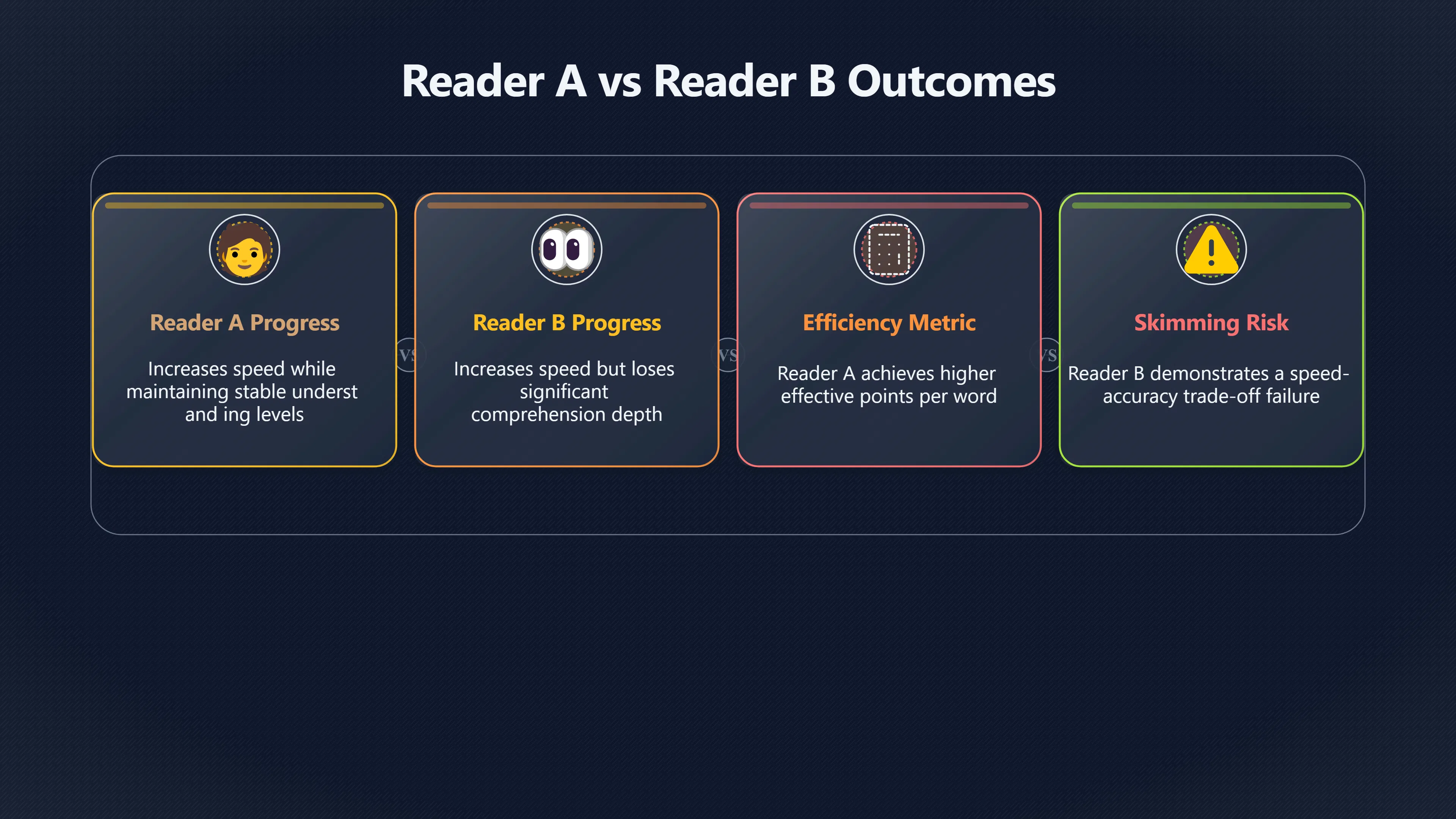
Consider two six-week outcomes:
Reader A
- Starts at 220 wpm and 87% comprehension.
- Finishes at 270 wpm and 86% comprehension.
Reader B
- Starts at 220 wpm and 87% comprehension.
- Finishes at 330 wpm and 58% comprehension.
Reader A has probably become a more efficient reader. Reader B has probably become a faster skimmer.
Research on skilled reading suggests that efficient reading develops through greater automaticity, vocabulary knowledge, familiarity with text structures, and reduced unnecessary regressions, not through bypassing comprehension. In other words, genuine gains occur when the reader can process text more efficiently while preserving understanding.[Compass]compass.onlinelibrary.wiley.comCompass Improving reading rates and comprehension?Benefits and…Mar 17, 2021 — In other words, increasing reading rates are a contributing cause of improved reading comprehension (Kuhn…
The benchmark to watch
When testing reading speed with comprehension, the most informative number is not your highest wpm score. It is the fastest rate at which you consistently maintain your target level of understanding.
For most readers, tracking both metrics over time transforms a reading-speed test from a one-off challenge into a meaningful performance dataset. A rising wpm trend accompanied by stable comprehension is strong evidence of improvement. A rising wpm trend accompanied by falling comprehension is usually evidence of increased skimming.
The distinction matters because the goal of reading is not merely to move your eyes across more words. It is to absorb information more efficiently, and only a combined record of speed and comprehension can show whether that is actually happening.
Amazon book picks
Further Reading
Books and field guides related to Is your reading speed actually improving?. Use these as the next step if you want deeper reading beyond the article.
How to Read a Book
Rating: 4.0/5 from 41 Google Books ratings
Strong focus on comprehension as the true measure of reading success.

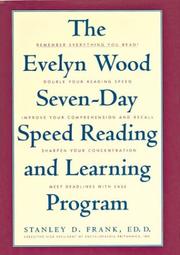
The Evelyn Wood Seven-Day Speed Reading and Learning Program
First published 1994. Subjects: Speed reading, Study skills, Reading.
Endnotes
1.
Source: researchgate.net
Title: Research Gate(PDF) How many words do we read per minute?
Link:https://www.researchgate.net/publication/332380784_How_many_words_do_we_read_per_minute_A_review_and_meta-analysis_of_reading_rate
Source snippet
A review...by M Brysbaert · Cited by 864 — The average reading rate was 238 wpm (SD = 52.0; 95% confidence interval = 230 – 246). The me...
2.
Source: daily.jstor.org
Title: [speed reading]({{ ‘myths/’ | relative_url }}) comprehension
Link:https://daily.jstor.org/speed-reading-comprehension/
Source snippet
JSTOR DailySpeed Reading and Comprehension18 Apr 2016 — It looks like we're still debunking the concept of “speed reading”—whether humans...
3.
Source: reading.com
Link:https://www.reading.com/
Source snippet
Teach Your Child To Read Early, Step by StepReading.com helps your child learn to read with a proven, step-by-step program. Start today a...
4.
Source: fast.com
Link:https://fast.com/
Source snippet
Internet Speed TestFAST.com gives you an estimate of your current Internet speed. will test Internet speed globally on any device (phone...
5.
Source: researchgate.net
Title: (PDF) How many words do we read per minute?
Link:https://www.researchgate.net/publication/335174808_How_many_words_do_we_read_per_minute_A_review_and_meta-analysis_of_reading_rate
Source snippet
A review...15 Aug 2019 — We estimate that the average silent reading rate for adults in English is 238 words per minute (wpm) for non-fi...
6.
Source: researchgate.net
Link:https://www.researchgate.net/publication/399897944_Testing_the_Speed-Accuracy_Trade-Off_in_Reading_Effects_of_Reading_Speed_on_Comprehension_and_Eye_Movements
Source snippet
(PDF) Testing the Speed-Accuracy Trade-Off in ReadingJan 19, 2026 — Results Comprehension remained consistent across a broad range of spe...
7.
Source: reader.ku.edu
Link:https://reader.ku.edu/sites/reader/files/2024-01/How%20many%20words%20do%20we%20read%20per%20minute%20%281%29.pdf
Source snippet
Audio-ReaderHow many words do we read per minuteby M Brysbaert · Cited by 847 — Based on the analysis of 190 studies (18,573 participants...
8.
Source: biblio.ugent.be
Title: Ghent University Bibliography How many words do we read per minute?
Link:https://biblio.ugent.be/publication/8647789
Source snippet
A review and meta...by M Brysbaert · 2019 · Cited by 842 — For silent reading of English non-fiction most adults fall in the range of 17...
9.
Source: pubmed.ncbi.nlm.nih.gov
Title: Pub Med How Do We Read, and Can Speed Reading Help?
Link:https://pubmed.ncbi.nlm.nih.gov/26769745/
Source snippet
by K Rayner · 2016 · Cited by 530 — The research shows that there is a trade-off between speed and accuracy. It is unlikely that re...
10.
Source: compass.onlinelibrary.wiley.com
Title: Compass Improving reading rates and comprehension?
Link:https://compass.onlinelibrary.wiley.com/doi/10.1111/lnc3.12408
Source snippet
Benefits and...Mar 17, 2021 — In other words, [increasing]({{ 'increasing/' | relative_url }}) reading rates are a contributing cause of improved reading comprehension (Kuhn...
11.
Source: Wikipedia
Link:https://en.wikipedia.org/wiki/Average
Source snippet
AverageIn mathematics, an average of a collection or group is a value that is most central, common, or typical in some sense, and repr...
12.
Source: dictionary.cambridge.org
Link:https://dictionary.cambridge.org/dictionary/english/average
Source snippet
a standard or level that is considered to be typical or usual: The quality of her work is well above average.Read more...
13.
Source: dictionary.cambridge.org
Link:https://dictionary.cambridge.org/us/dictionary/english/average
Source snippet
a standard or level that is considered to be typical or usual: The quality of her work is well above average...
14.
Source: speedtest.shaw.ca
Title: ca Internet Speed Test
Link:https://speedtest.shaw.ca/
Source snippet
Speed Test - Rogers with ShawTest your internet connection with Rogers Speedtest. Find out how fast your download and upload speeds are...
15.
Source: reddit.com
Title: 300 WPM
Link:https://www.reddit.com/r/books/comments/tkcul5/300_wpm_do_you_people_actually_read_this_fast/
Source snippet
"Do you people actually read this fast?: r/booksWas just looking at this site: [https://howlongtoread.com/books/6112/Crime-and-Punishment..."](https://howlongtoread.com/books/6112/Crime-and-Punishment...")...
16.
Source: pubmed.ncbi.nlm.nih.gov
Link:https://pubmed.ncbi.nlm.nih.gov/34516216/
17.
Source: e-flt.nus.edu.sg
Title: The second.Read m
Link:https://e-flt.nus.edu.sg/v11n12014/tran.pdf
Source snippet
Speed Improvement in a Speed Reading Course...by TNY Tran · 2014 · Cited by 48 — The first section gives a review of the recent research...
18.
Source: bso.bradford.gov.uk
Title: bradford.gov.uk Help Sheet
Link:https://bso.bradford.gov.uk/userfiles/file/%21Learning%20Support/Help%20Sheets/Help%20Sheet%20-%20Repeated%20Reading.pdf
Source snippet
Sheet - Repeated Reading.pdfThe average reading speed for an adult reading fiction is approximately 260 wpm and for non-fiction approxima...
Additional References
19.
Source: omnicalculator.com
Link:https://www.omnicalculator.com/math/average
Source snippet
Average CalculatorThe average of a set of numbers is simply the sum of the numbers divided by their total number. For example, suppose we...
20.
Source: byjus.com
Link:https://byjus.com/maths/average/
Source snippet
Average Formula in MathsWhat is the average formula? The formula to calculate the average of given numbers is equal to the sum of all the...
21.
Source: rcps-cr.org
Link:https://rcps-cr.org/?lang=en&p=2371
Source snippet
Reading Fast is not always the same as UnderstandingAn exploratory research question was formulated to evaluate whether speed is still pr...
22.
Source: reddit.com
Link:https://www.reddit.com/r/books/comments/oet3ym/the_false_promise_of_speed_reading_why_you_should/
Source snippet
why you should read slowly if you want to understandSpeed reading is not the same as reading quickly, I would say. You can eventually rea...
23.
Source: merriam-webster.com
Link:https://www.merriam-webster.com/dictionary/average
Source snippet
AVERAGE Definition & MeaningThe meaning of AVERAGE is a single value (such as a mean, mode, or median) that summarizes or represents the...
24.
Source: calculator.net
Link:https://www.calculator.net/average-calculator.html
25.
Source: bps.org.uk
Title: most comprehensive review date finds average persons reading speed slower
Link:https://www.bps.org.uk/research-digest/most-comprehensive-review-date-finds-average-persons-reading-speed-slower
Source snippet
Most comprehensive review to date finds the average...Jun 13, 2019 — Of the various estimates of average reading speed bandied around ov...
26.
Source: facebook.com
Link:https://www.facebook.com/groups/435820846445944/posts/7838532602841361/
Source snippet
1) Did you utilize a certain method or training to learn to speed read? 2) Does it affect your pleasure reading...
27.
Source: sasc.org.uk
Link:https://www.sasc.org.uk/media/4d4lsrfv/assessing-reading-and-writing-speeds-presentation-june-2020.pdf
Source snippet
• average silent reading speed for healthy adults was 238 wpm for non-fiction and 260 for fiction.Read more...
28.
Source: scholarwithin.com
Link:https://scholarwithin.com/average-reading-speed?srsltid=AfmBOooOiqJ0nDq_DEUAM8YS2ClascjWUxYYrnucTMy8BUkBaKXLZOTi
Source snippet
Adults who read aloud average 183 words per minute. With more and more new research on neuroplasticity, we...
Topic Tree