Within Faster Reading
When Looking Back Helps Reading
Looking back is sometimes a repair strategy, not a failure, but unnecessary rereading can slow attention and confidence.
On this page
- Useful versus anxious regressions
- Fixing lost focus
- When slowing down is the answer
Page outline Jump by section
Introduction
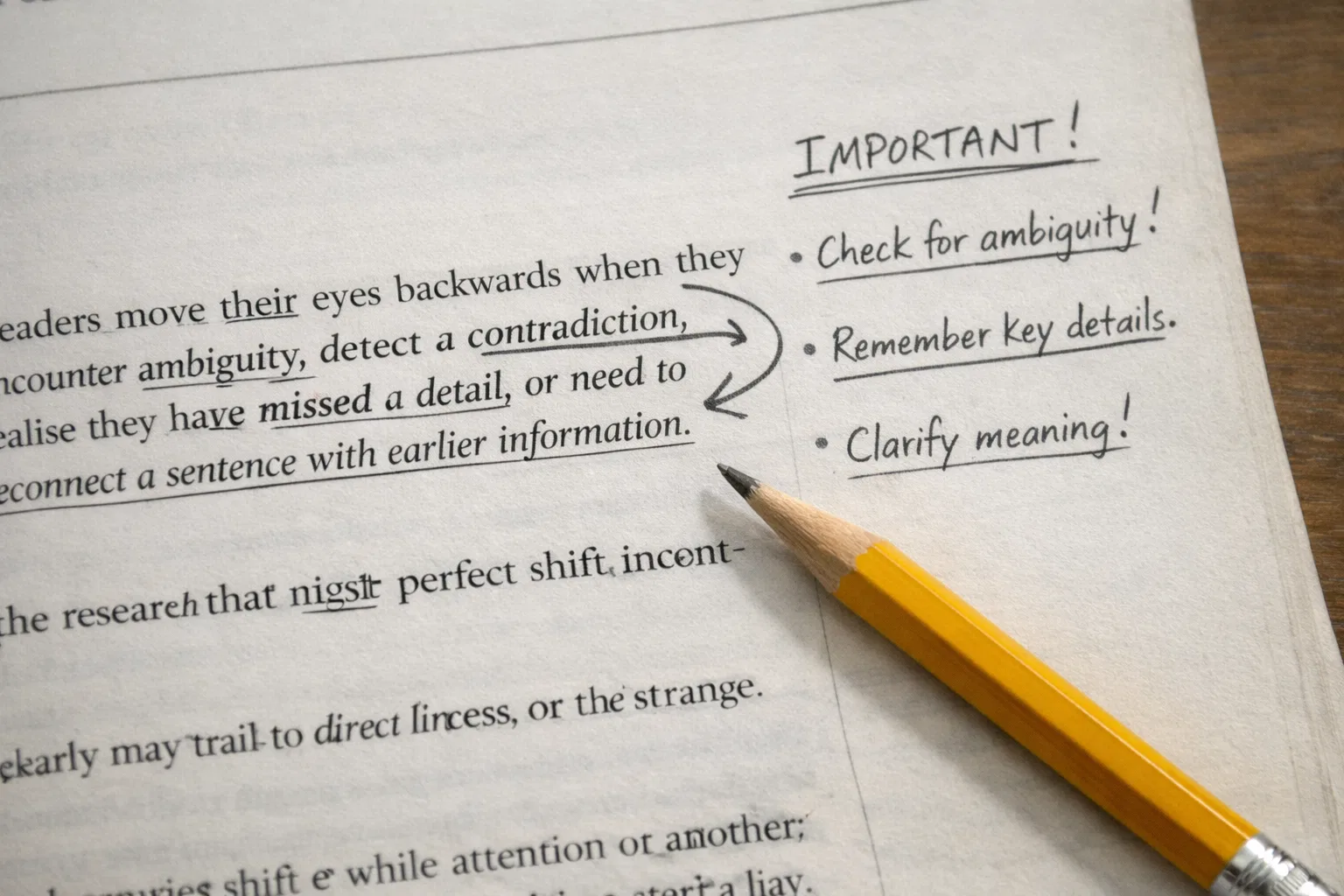
Looking back while reading is often treated as a bad habit. Many speed-reading systems encourage readers to eliminate backward eye movements, known as regressions, on the assumption that every glance back wastes time. The research tells a more complicated story. Regressions are a normal part of skilled reading. Readers move their eyes backwards when they encounter ambiguity, detect a contradiction, realise they have missed a detail, or need to reconnect a sentence with earlier information. The real goal is not to eliminate rereading but to distinguish useful rereading from unnecessary rereading.[PubMed+2Taylor & Francis Online]pubmed.ncbi.nlm.nih.govThe function of regressions in reading: backward eye…by RW Booth · 2013 · Cited by 134 — These results suggest that readers use…
For anyone trying to increase reading speed, this distinction matters. Strategic rereading can protect comprehension and prevent larger misunderstandings later. Habitual, anxiety-driven rereading can slow progress, fragment attention, and reduce confidence. Faster reading comes not from never looking back, but from learning when looking back serves a purpose and when it merely relieves uncertainty without adding understanding.
Useful Versus Anxious Regressions
Eye-tracking studies show that backward eye movements are built into normal reading behaviour. Readers do not move through text in a perfectly straight line. Roughly 10–15% of eye movements during ordinary reading are regressions, and these become more common when material is difficult or when comprehension problems arise.[Cambridge Assets]assets.cambridge.orgAssets Chapter 1Cambridge AssetsChapter 1 Introduction to Eye-TrackingIn reading, saccades do not always move the eye forward in a text. About 10–15 per…
The important question is why the regression happens.
A useful regression is a repair action. Examples include:
- Returning to a definition that clarifies a later sentence.
- Checking which person a pronoun refers to.
- Resolving a contradiction between two statements.
- Confirming a number, date, or instruction.
- Recovering meaning after a brief distraction.
In these situations, looking back supports comprehension. Research suggests that regressions allow readers to reread and reprocess information rather than merely triggering memory of previously seen text.[PubMed]pubmed.ncbi.nlm.nih.govThe function of regressions in reading: backward eye…by RW Booth · 2013 · Cited by 134 — These results suggest that readers use…
An anxious regression serves a different function. The reader understands the sentence reasonably well but rereads because of uncertainty or lack of confidence. Typical signs include:
- Re-reading the same phrase immediately after reading it.
- Returning to earlier lines without a clear question to answer.
- Feeling compelled to “make sure” every sentence was perfectly understood.
- Frequently restarting paragraphs despite following the overall meaning.
This behaviour often feels productive because it creates a sense of checking. In practice, it can consume time without significantly improving understanding.

A Practical Test
Before moving your eyes back, ask:[readlite.in]readlite.inThese regressions aren't mistakes — they're essential comprehension repairs that skilled…Read more…
What specific information am I trying to recover?
If the answer is clear—perhaps a name, condition, definition, or instruction—the regression is likely useful.
If the answer is simply “I want to feel certain”, rereading may be becoming a habit rather than a repair strategy.
Why Regressions Happen
Reading is not just seeing words. It is continuous interpretation. Eye-movement research shows that readers slow down, make additional fixations, and increase regressions when texts become more difficult or contain inconsistencies.[Taylor & Francis Online]tandfonline.comTaylor & Francis OnlineEye Movements as Reflections of Comprehension…by K Rayner · 2006 · Cited by 860 — In this article, we discuss t…
Several mechanisms commonly trigger regressions:
Ambiguity. A sentence initially seems clear but later information changes its meaning.
Integration problems. A new idea does not fit smoothly with what was read earlier.
Memory limitations. A reader loses track of a relationship, sequence, or reference.
Attention lapses. The eyes continue moving while attention briefly drifts elsewhere.
Task demands. Readers behave differently when they expect to answer questions, study material, or verify details. Reading goals influence how often rereading occurs.[D-NB]d-nb.infoComprehension demands modulate re-reading, but not first…by AF Weiss · Cited by 58 — Abstract: Several studies have examined effec…
These mechanisms explain why eliminating all regressions is unrealistic. A reader who never looks back may simply miss opportunities to repair understanding.
Fixing Lost Focus Without Endless Rereading
Many regressions occur not because the text is difficult but because attention has slipped.
Imagine reaching the bottom of a page and realising that you remember none of the previous paragraph. The instinctive response is often to restart the entire section. That is not always necessary.
A more efficient approach is targeted recovery:
- Stop and identify where attention disappeared.
- Return only to the point where comprehension broke down.
- Read forward once with full attention.
- Continue rather than repeatedly checking the same passage.
Research on reading interruptions shows that disruptions increase behaviours associated with rereading and recovery because readers must reconstruct context after their attention is broken.[lead.ube.fr]lead.ube.frJune 9, 2022 — by G Chevet · 2022 · Cited by 19 — The aim of the present study is to observe the consequences of an interruption on readi…
The key is precision. If you lost focus for one sentence, reread one sentence. If you restart entire pages whenever concentration wavers, reading speed collapses.

Reduce the Conditions That Trigger Recovery
Many unnecessary regressions originate before reading begins.[researchgate.net]researchgate.netPDF) Regressions during ReadingMay 20, 2026 — Three experiments examine the role of previously read text in sentence comprehension and the control of eye movements duri…
Common triggers include:
- Frequent phone notifications.
- Multitasking.
- Reading while tired.[readlite.in]readlite.inThese regressions aren't mistakes — they're essential comprehension repairs that skilled…Read more…
- Dense material tackled without a clear purpose.
- Trying to read faster than comprehension allows.
Improving attention often reduces rereading more effectively than consciously forcing the eyes to move forward.
When Slowing Down Is the Answer
A common mistake among readers trying to increase speed is treating every slowdown as a failure.
Sometimes the need to reread is evidence that the reading rate is too high for the material.
Technical manuals, legal agreements, academic papers, safety instructions, and complex arguments place heavier demands on working memory than familiar narrative prose. In these situations, deliberate slowing can reduce the total amount of rereading required.
Paradoxically, a reader who slows down at difficult passages often finishes sooner than a reader who repeatedly rushes, becomes confused, and backtracks.
Eye-tracking research consistently finds that reading behaviour changes with text difficulty and comprehension demands. Skilled readers do not maintain one constant pace. They adapt.[Taylor & Francis Online+2PMC]tandfonline.comTaylor & Francis OnlineEye Movements as Reflections of Comprehension…by K Rayner · 2006 · Cited by 860 — In this article, we discuss t…
A useful mindset is:
- Speed through material that is familiar and low-stakes.
- Slow down when relationships, conditions, or arguments become complex.
- Use rereading as a tool, not as a default response.
Building Confidence Without Constant Checking
Many unnecessary regressions arise from mistrust of one’s own understanding.
Readers sometimes assume that effective reading means remembering every sentence immediately. Real comprehension works differently. Understanding develops across paragraphs and sections. Meaning accumulates.
A confident reader accepts temporary uncertainty. They continue reading when the missing detail is likely to become clear from context. They return only when a genuine gap remains.
One practical technique is delayed verification. Instead of rereading instantly after encountering uncertainty, continue for another paragraph. If the confusion resolves itself, no regression was needed. If it remains important, return with a precise purpose.
This approach reduces the cycle of read–doubt–reread–doubt that can make reading feel slow and effortful.
The Goal Is Strategic Rereading
Regression is not the enemy of reading speed. Uncontrolled regression is.
Research on eye movements suggests that backward glances are part of normal comprehension and often serve a genuine repair function. Readers use them when understanding requires reanalysis, clarification, or recovery after distraction.[PubMed+2Oxford University Research Archive]pubmed.ncbi.nlm.nih.govThe function of regressions in reading: backward eye…by RW Booth · 2013 · Cited by 134 — These results suggest that readers use…
The fastest effective readers are not those who never look back. They are the readers who know why they are looking back.
When a regression answers a specific question, it supports comprehension. When it merely relieves uncertainty without adding meaning, it becomes a habit worth reducing. Learning that distinction allows reading speed to increase without sacrificing understanding.
Amazon book picks
Further Reading
Books and field guides related to When Looking Back Helps Reading. Use these as the next step if you want deeper reading beyond the article.
How to Read a Book
Rating: 4.0/5 from 41 Google Books ratings
Directly addresses reading methods, comprehension, and when to reread for understanding.
Proust and the Squid
First published 2007. Subjects: Brain, Evolution, Reading history, Neurophysiology, Reading comprehension.

eBay marketplace picks
Marketplace Samples
Example marketplace items related to this page. Use the search link to explore similar finds on eBay.


Endnotes
1.
Source: assets.cambridge.org
Title: Assets Chapter 1
Link:https://assets.cambridge.org/97811084/15354/excerpt/9781108415354_excerpt.pdf
Source snippet
Cambridge AssetsChapter 1 Introduction to Eye-TrackingIn reading, saccades do not always move the eye forward in a text. About 10–15 per...
2.
Source: d-nb.info
Link:https://d-nb.info/1227301006/34
Source snippet
Comprehension demands modulate re-reading, but not first...by AF Weiss · Cited by 58 — Abstract: Several studies have examined effec...
3.
Source: pmc.ncbi.nlm.nih.gov
Link:https://pmc.ncbi.nlm.nih.gov/articles/PMC6234076/
Source snippet
of reader- and text-level characteristics to eye...by V Kuperman · 2018 · Cited by 75 — Eye-movements during passage reading are suscept...
4.
Source: lead.ube.fr
Link:https://lead.ube.fr/wp-content/uploads/2023/09/Chevet_et_al._2022b.pdf
Source snippet
June 9, 2022 — by G Chevet · 2022 · Cited by 19 — The aim of the present study is to observe the consequences of an interruption on readi...
Published: June 9, 2022
5.
Source: pubmed.ncbi.nlm.nih.gov
Link:https://pubmed.ncbi.nlm.nih.gov/22886737/
Source snippet
The function of regressions in reading: backward eye...by RW Booth · 2013 · Cited by 134 — These results suggest that readers use...
6.
Source: tandfonline.com
Link:https://www.tandfonline.com/doi/abs/10.1207/s1532799xssr1003_3
Source snippet
Taylor & Francis OnlineEye Movements as Reflections of Comprehension...by K Rayner · 2006 · Cited by 860 — In this article, we discuss t...
7.
Source: ora.ox.ac.uk
Link:https://ora.ox.ac.uk/objects/uuid%3Aa16f42e2-529d-47ae-ba51-50b75dd43899/files/rkh04dp70d
Source snippet
ford University Research ArchiveComprehension monitoring during reading: an eye-tracking...by AK Hessel · 2020 · Cited by 50 — We chos...
8.
Source: pmc.ncbi.nlm.nih.gov
Link:https://pmc.ncbi.nlm.nih.gov/articles/PMC6235565/
Source snippet
by JR Folk · 2018 · Cited by 9 — The method described in this paper was designed to investigate the role of inhibition of return (IOR)...
9.
Source: pmc.ncbi.nlm.nih.gov
Link:https://pmc.ncbi.nlm.nih.gov/articles/PMC2906818/
Source snippet
Movements in Reading: [Models]({{ 'models/' | relative_url }}) and Data - PMCModels of eye movement control in reading and their impact on the field are discussed...
10.
Source: pmc.ncbi.nlm.nih.gov
Link:https://pmc.ncbi.nlm.nih.gov/articles/PMC12409514/
Source snippet
the rereading effect of digital reading through eye...by Y Xu · 2025 — The goal of this study is to investigate the differences in eye m...
11.
Source: researchgate.net
Title: (PDF) Regressions during Reading
Link:https://www.researchgate.net/publication/334364752_Regressions_during_Reading
Source snippet
May 20, 2026 — Three experiments examine the role of previously read text in sentence comprehension and the control of eye movements duri...
Published: May 20, 2026
12.
Source: frontiersin.org
Link:https://www.frontiersin.org/journals/psychology/articles/10.3389/fpsyg.2025.1576247/full
Source snippet
Assessing the rereading effect of digital reading through...by Y Xu · 2025 — Objective: This study aimed to investigate the differences...
13.
Source: tandfonline.com
Link:https://www.tandfonline.com/doi/full/10.1080/10888438.2025.2612649
Source snippet
This study investigates whether the natural reading rate aligns with the rate optimal for reading comprehension.Read more...
Additional References
14.
Source: papers.ssrn.com
Link:https://papers.ssrn.com/sol3/papers.cfm?abstract_id=5405257
Source snippet
Regressive Eye Movements in Reading Go from Easy to...by AT Lopes Rego — One prevailing hypothesis is that regressions reflect compr...
15.
Source: scirp.org
Link:https://www.scirp.org/journal/paperinformation?paperid=89391
16.
Source: scholarsarchive.byu.edu
Link:https://scholarsarchive.byu.edu/context/facpub/article/8947/viewcontent/5._Immediate_repeated_reading_has_positive_effects_on_reading_rate_for_English_language.pdf
Source snippet
Repeated Reading Has Positive Effects on...by JH Hansen · 2024 · Cited by 4 — The objective of this eye- tracking study was to accuratel...
17.
Source: readlite.in
Link:https://readlite.in/concepts/regressions-reading
Source snippet
These regressions aren't mistakes — they're essential comprehension repairs that skilled...Read more...
18.
Source: researchgate.net
Link:https://www.researchgate.net/publication/224967614_Reading_Speed_Comprehension_and_Eye_Movements_While_Reading_Japanese_Novels_Evidence_from_Untrained_Readers_and_Cases_of_Speed-Reading_Trainees
Source snippet
Results revealed higher reading speed and lower comprehension scores in the trainees...Read more...
19.
Source: tmalsburg.github.io
Link:https://tmalsburg.github.io/MeziereEtAl2021MS.pdf
Source snippet
ndex online cognitive processing during reading (Rayner, Chace, Slattery, &...Read more...
20.
Source: allgemeinepsychologie.uni-wuppertal.de
Title: Vorstius Radach Lonigan Silent Oral Readig VC 2014 01
Link:https://allgemeinepsychologie.uni-wuppertal.de/fileadmin/psychologie/allgemeinepsychologie/Artikel/Artikel_Radach/Vorstius_Radach_Lonigan_Silent_Oral_Readig_VC_2014_01.pdf
Source snippet
movements in developing readers: A comparison of silent...by C Vorstius · 2014 · Cited by 174 — We present sentence reading data from a...
21.
Source: eprints.soton.ac.uk
Title: Rayner 2C Pollatsek 2C Drieghe 2C et al. 282007 29
Link:https://eprints.soton.ac.uk/144841/1/Rayner_2C_Pollatsek_2C_Drieghe_2C_et_al._282007_29.pdf
Source snippet
on Kliegl, Nuthmann, and Engbert (2006)by K Rayner · 2007 · Cited by 133 — Recently, considerable attention has been devoted to the devel...
22.
Source: researchgate.net
Title: The function of these “regressions” is still largely unknown.Read more
Link:https://www.researchgate.net/publication/230658181_The_function_of_regressions_in_reading_Backward_eye_movements_allow_rereading
Source snippet
(PDF) The function of regressions in reading: Backward...Standard text reading involves frequent eye movements that go against normal re...
23.
Source: researchgate.net
Link:https://www.researchgate.net/publication/228625379_Eye_Movements_as_Reflections_of_Comprehension_Processes_in_Reading
Source snippet
ResearchGate(PDF) Eye Movements as Reflections of Comprehension...In this article, we discuss the use of eye movement data to assess mom...
Topic Tree
Follow this branch
Parent topic
Faster ReadingRelated pages 11
- Benchmarks How Fast Do Adults Really Read?
- Dense Texts Why Hard Texts Need Slower Reading
- Inner Voice Should You Silence Your Inner Voice?
- Knowledge Why Familiar Topics Feel Faster to Read
- Measure The Reading Speed Test That Actually Helps
- Myths Why Speed Reading Promises Fall Apart
- Phrases Read Phrases, Not Just Words
- Practice Can Rereading Make You Faster?
- +3 more in sidebar