Within Checking Loop
Are You Rereading for Understanding or Reassurance?
Anxious rereading often begins when vague doubt replaces a clear need to recover information.
On this page
- Specific confusion versus vague doubt
- Repeated rereading without new information
- Why confidence and comprehension can separate
Page outline Jump by section
Introduction
Many readers assume that slow reading means difficult material. Often, however, the real culprit is a subtler habit: rereading driven by uncertainty rather than by a genuine comprehension problem. The challenge is that anxious rereading can feel responsible and careful. In reality, it often begins when a vague sense of doubt replaces a clear reason to revisit the text.
 Spotting this pattern early matters because speed is usually lost long before a reader notices a problem. A few unnecessary regressions become a habit, attention fragments, and progress slows without a corresponding gain in understanding. Research on metacognitive monitoring—the ability to judge what you do and do not understand—shows that confidence and comprehension do not always move together. People can understand material while feeling uncertain, or feel certain while misunderstanding it.[IDEALS]ideals.illinois.eduIn addition,Comprehension monitoring - IDEALSMarch 28, 2008 — by L Baker · 1979 · Cited by 508 — Thus, readers who monitor their comprehension…
Are You Rereading for Understanding or Reassurance?
The most useful question is not whether you reread. Effective readers reread all the time. The question is why.
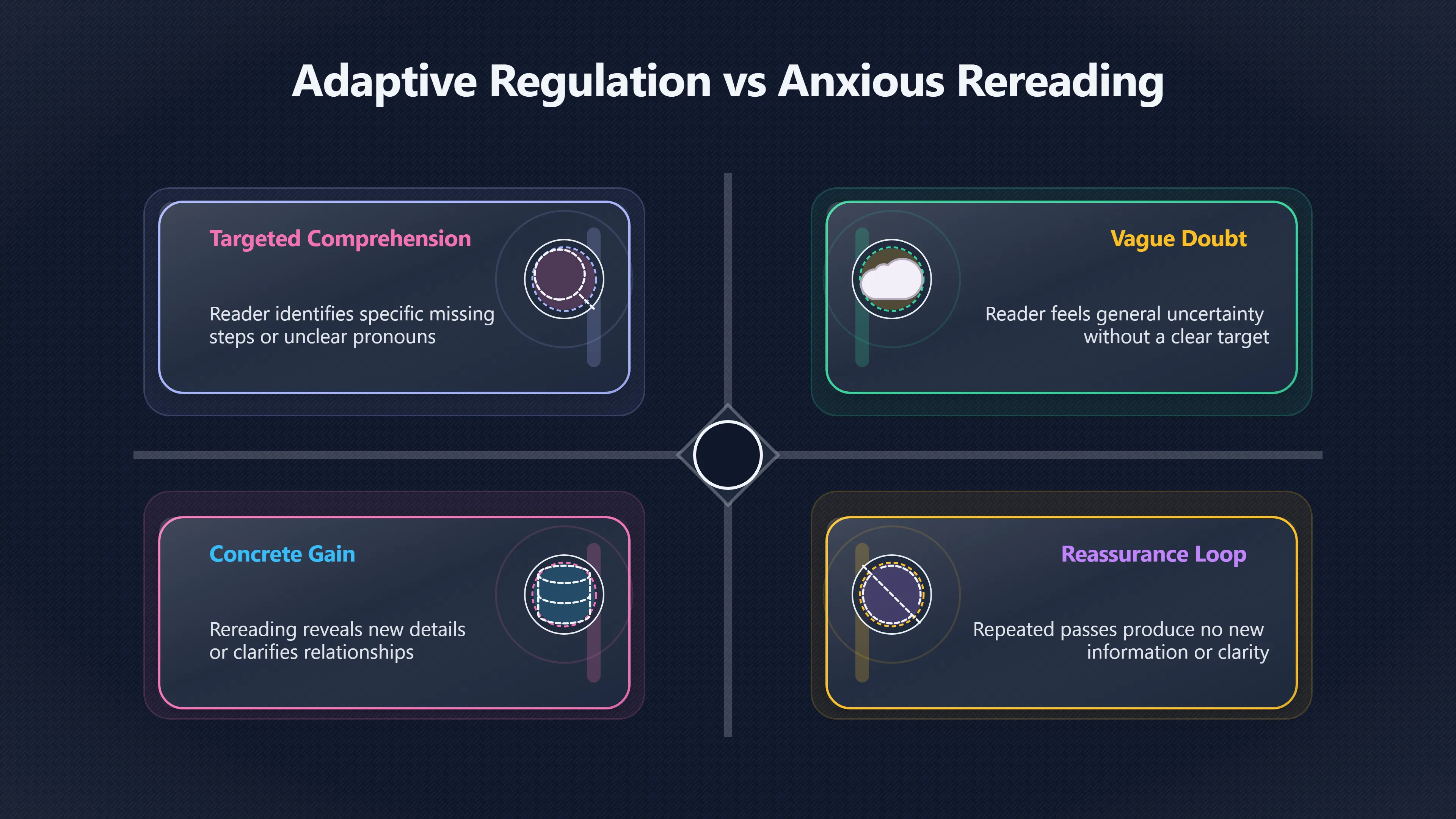
When rereading serves comprehension, there is usually a specific target. Perhaps a pronoun has an unclear reference, an argument contains a missing step, or a technical term was unfamiliar. The reader can identify the problem and explain what information is being recovered. Comprehension monitoring research describes this as adaptive regulation: recognising a concrete breakdown and taking corrective action.[My College]my.chartered.collegeMy CollegeMetacognition and readingFor example, through monitoring you realise you're not understanding aspects of what you're reading. Y…
Anxious rereading feels different. The trigger is often difficult to describe. Instead of thinking, “I missed the author’s point,” the reader thinks, “Something feels uncertain.” The urge is not tied to a particular gap in understanding. It is tied to discomfort.
A practical test is simple:
- If asked what was confusing, can you answer immediately?
- Can you identify the exact sentence, concept, or connection that caused trouble?
- Do you expect the next reread to reveal something specific?
If the answer is no, the rereading may be serving reassurance rather than understanding.
Specific Confusion Versus Vague Doubt
One of the clearest warning signs is the difference between a concrete question and a general feeling.
What genuine confusion looks like
A reader encounters a problem that can be named:
- “I lost track of who ‘she’ refers to.”
- “I do not understand how step three follows from step two.”
- “I cannot remember the definition introduced earlier.”
The rereading has a mission. Success can be measured because the reader knows what information is being sought.
What anxious doubt looks like
The reader experiences uncertainty without a clear target:
- “I should read that again just in case.”
- “What if I missed something important?”
- “I think I understood it, but I am not completely sure.”
Notice how these thoughts focus on certainty rather than comprehension. The goal shifts from understanding the text to eliminating doubt. That distinction matters because complete certainty is rarely available in real reading. Complex material often requires moving forward with partial confidence and allowing understanding to develop across several paragraphs or pages.[IDEALS]ideals.illinois.eduIn addition,Comprehension monitoring - IDEALSMarch 28, 2008 — by L Baker · 1979 · Cited by 508 — Thus, readers who monitor their comprehension…
Repeated Rereading Without New Information
A second warning sign is that each reread produces less and less information.
Strategic rereading usually changes something. The reader notices a missed detail, clarifies a relationship, or resolves confusion. Afterward, there is a concrete gain.
Anxious rereading often produces a different experience. The sentence is read again. Then again. Nothing new is discovered, yet the urge persists.
Ask yourself:
- Did this reread reveal information I genuinely missed?
- Can I state one new idea I learned from the extra pass?
- Am I returning because the text changed, or because my feeling about the text has not changed?
When repeated passes fail to generate new understanding, the activity may have shifted from learning to checking.
Research on checking behaviour shows that repeated verification can become self-reinforcing. The immediate reduction in uncertainty feels rewarding, which encourages another round of checking later, even when no new evidence is being collected.[PMC+2Springer]pmc.ncbi.nlm.nih.govThe Etiology, Assessment and Treatment of Compulsive…by S Guo · 2025 · Cited by 4 — Research shows that anxiety, uncertainty and in…

Why Confidence and Comprehension Can Separate
One reason anxious rereading is difficult to detect is that people naturally use feelings as evidence.
If a passage feels uncertain, it seems logical to assume it was not understood. Yet metacognitive research consistently shows that subjective confidence is an imperfect guide to actual comprehension. People are not always accurate judges of what they know.[PMC+2Frontiers]pmc.ncbi.nlm.nih.govPMCMetacognitive Monitoring in Reading Comprehensionby V Markovich · 2026 — This study examined associations between vocabulary knowledge, reading fluency, cognitive flexibility, and met…
This creates an important trap:
- Comprehension answers the question: “Did I understand?”
- Confidence answers the question: “Do I feel sure that I understood?”
Those questions sound similar but are not identical.
A reader may correctly grasp a paragraph while still feeling uneasy. Conversely, familiarity can create a feeling of certainty that exceeds genuine understanding. Studies of metacomprehension show that readers often rely on cues that are only loosely connected to actual learning and performance.[PubMed+2ERIC]pubmed.ncbi.nlm.nih.govIn Experiments 1 and 2, the participants read texts either once or twice, rated their…Read more…
For reading speed, the consequence is significant. If every feeling of uncertainty triggers a return to the text, progress becomes dependent on emotional reassurance rather than on evidence of misunderstanding.
Early Warning Signs Before Speed Drops
The most useful signals tend to appear before reading speed collapses.
Watch for these patterns:
Immediate regression. You reach the end of a sentence and instantly jump back before attempting to continue. There has been no opportunity to determine whether the information would become clearer in context.
Restarting paragraphs you can summarise. If you can accurately explain the main point but still feel compelled to reread, the problem may be confidence rather than comprehension.
Looking for certainty instead of clarity. The internal goal becomes “feel sure” rather than “understand better”.
Increasing frequency of self-checks. Questions such as “Did I really get that?” begin appearing every few lines, even when comprehension questions are answered correctly.
No stopping rule. There is no clear condition under which the rereading will end. The reader continues until uncertainty fades rather than until a specific question is resolved.
These behaviours are especially costly because they interrupt reading flow. Comprehension often emerges across larger units of meaning, but constant backward movement prevents that broader integration from taking place.[IDEALS]ideals.illinois.eduIn addition,Comprehension monitoring - IDEALSMarch 28, 2008 — by L Baker · 1979 · Cited by 508 — Thus, readers who monitor their comprehension…
A Quick Reality Check
When you catch yourself moving backwards, pause briefly and ask one question:
“What exactly am I trying to recover?”
If you can identify missing information, rereading is probably justified.
If the answer is only a feeling—“I just want to be certain”—you may be seeing the start of anxious rereading.
The distinction is small but powerful. Readers who increase speed successfully do not eliminate rereading altogether. Instead, they learn to distinguish corrective rereading from reassurance-seeking rereading. One repairs understanding; the other repeatedly checks understanding that may already be there. Recognising that difference early prevents the checking loop from quietly consuming both time and reading momentum.[My College+2PMC]my.chartered.collegeMy CollegeMetacognition and readingFor example, through monitoring you realise you're not understanding aspects of what you're reading. Y…
Amazon book picks
Further Reading
Books and field guides related to Are You Rereading for Understanding or Reassurance?. Use these as the next step if you want deeper reading beyond the article.
The Imp of the Mind
Focuses on uncertainty and repeated checking without new information.
eBay marketplace picks
Marketplace Samples
Example marketplace items related to this page. Use the search link to explore similar finds on eBay.


Endnotes
1.
Source: ideals.illinois.edu
Title: In addition,
Link:https://www.ideals.illinois.edu/items/17988/bitstreams/64436/data.pdf
Source snippet
Comprehension monitoring - IDEALSMarch 28, 2008 — by L Baker · 1979 · Cited by 508 — Thus, readers who monitor their comprehension...
Published: March 28, 2008
2.
Source: pmc.ncbi.nlm.nih.gov
Title: PMCMetacognitive Monitoring in Reading Comprehension
Link:https://pmc.ncbi.nlm.nih.gov/articles/PMC13027792/
Source snippet
by V Markovich · 2026 — This study examined associations between [vocabulary]({{ 'knowledge/' | relative_url }}) knowledge, reading fluency, cognitive flexibility, and met...
3.
Source: pmc.ncbi.nlm.nih.gov
Link:https://pmc.ncbi.nlm.nih.gov/articles/PMC12126976/
Source snippet
The Etiology, Assessment and Treatment of Compulsive...by S Guo · 2025 · Cited by 4 — Research shows that anxiety, uncertainty and in...
4.
Source: link.springer.com
Link:https://link.springer.com/article/10.1007/s41811-024-00220-5
Source snippet
Low Memory Confidence Drive Excessive Reassurance...by SM Champion · 2024 · Cited by 2 — We investigated whether low memory confidence...
5.
Source: link.springer.com
Title: How often are thoughts metacognitive?
Link:https://link.springer.com/article/10.3758/s13423
Source snippet
Findings from...by ML Jordano · 2018 · Cited by 71 — Metacognitive monitoring refers to how people evaluate their cognitive performance...
6.
Source: eric.ed.gov
Title: ERICMetacomprehension and Regressions during Reading
Link:https://eric.ed.gov/?id=EJ1331905
Source snippet
by AY Wong · 2022 · Cited by 4 — The findings suggest that the rereading effect is related to usage of metacomprehension cues related...
7.
Source: my.chartered.college
Link:https://my.chartered.college/research-hub/metacognition-and-reading/
Source snippet
My CollegeMetacognition and readingFor example, through monitoring you realise you're not understanding aspects of what you're reading. Y...
8.
Source: frontiersin.org
Link:https://www.frontiersin.org/journals/psychology/articles/10.3389/fpsyg.2018.02253/full
Source snippet
Metacognitive Monitoring of Text Comprehensionby C Mirandola · 2018 · Cited by 29 — The current study was aimed at investigating metacogn...
9.
Source: pubmed.ncbi.nlm.nih.gov
Link:https://pubmed.ncbi.nlm.nih.gov/11105526/
Source snippet
In Experiments 1 and 2, the participants read texts either once or twice, rated their...Read more...
10.
Source: cci.health.wa.gov.au
Title: We will also
Link:https://www.cci.health.wa.gov.au/~/media/CCI/Consumer-Modules/Helping-Health-Anxiety/Helping-Health-Anxiety—06—Reducing-Checking-and-Reassurance-Seeking.pdf
Source snippet
6: Reducing Checking and Reassurance SeekingThroughout this module we will explore the different types of checking and reassurance seekin...
Additional References
11.
Source: ncsall.net
Link:https://www.ncsall.net/fileadmin/resources/ann_rev/rall_v5_ch7_supp.pdf
Source snippet
ability to monitor one's own thinking during reading (metacognitive monitoring) and strategies that can be taught to...
12.
Source: youtube.com
Link:https://www.youtube.com/watch?v=f9GTuM9qxoA
Source snippet
Classroom Strategies for Re-readingMary Kathleen Norris, LPC, talks about strategies that teachers can use with anxious students who re-r...
13.
Source: journals.sagepub.com
Link:https://journals.sagepub.com/doi/10.5127/jep.011110
Source snippet
An investigation of factors involved in compulsive behaviour in OCD and depression. Journal of Anxiety...
14.
Source: asu.elsevierpure.com
Title: reading comprehension and metacognition the importance of inferen
Link:https://asu.elsevierpure.com/en/publications/reading-comprehension-and-metacognition-the-importance-of-inferen/
Source snippet
comprehension and metacognitionby C Soto · 2019 · Cited by 208 — We explored relations between reading comprehension performance and self...
15.
Source: shanahanonliteracy.com
Link:https://www.shanahanonliteracy.com/blog/dont-confuse-reading-comprehension-and-learning-to-read-and-to-reread
Source snippet
ense to reread a text in its entirety or to reread specific parts of a text.Read more...
16.
Source: scispace.com
Link:https://scispace.com/pdf/an-experimental-investigation-of-factors-involved-in-2np4c1tich.pdf
Source snippet
anxiety, urges to check and urges to seek reassurance), perceived responsibility did not influence participants' urges to seek reassuranc...
17.
Source: structural-learning.com
Title: metacognitive strategies in reading comprehension
Link:https://www.structural-learning.com/post/metacognitive-strategies-in-reading-comprehension
Source snippet
Structural LearningMetacognitive Strategies in Reading Comprehensionby P Main — Metacognitive regulation means learners plan, monitor and...
18.
Source: researchgate.net
Link:https://www.researchgate.net/publication/234707511_An_Experimental_Investigation_of_Responsibility_and_Reassurance_Relationships_with_Compulsive_Checking
Source snippet
g and checking have comparable short-term outcomes in reducing anxiety...
19.
Source: diligencecareplus.com
Title: ocd reassurance seeking how to stop the cycle
Link:https://diligencecareplus.com/ocd-reassurance-seeking-how-to-stop-the-cycle/
Source snippet
OCD Reassurance Seeking: How to Stop the Cycle29 Nov 2025 — OCD reassurance seeking occurs when people repeatedly ask the same questions...
20.
Source: youtube.com
Title: How to Think About Thinking — The Metacognition Explained
Link:https://www.youtube.com/watch?v=tn2jyKgwHMg
Source snippet
Relevant video: Your Brain Isn't Built for Rereading. This video provides concrete insight into why habitual, repetitive reading fails as...
Topic Tree