Within Inner Voice
When silencing the inner voice backfires
Trying to silence the inner voice can backfire on dense, unfamiliar, or logically complex prose.
On this page
- What comprehension losses look like in real reading
- Why negations, conditions, and clauses need extra support
- How to tell useful speed from shallow scanning
Page outline Jump by section
Introduction
Many speed-reading systems treat subvocalisation as an obstacle to be eliminated. That advice can be useful when a reader is trapped in slow, word-by-word mental narration. However, trying to suppress the inner voice too aggressively often damages comprehension, especially when material is unfamiliar, technical, or logically dense. Research on phonological coding and articulatory suppression repeatedly shows that preventing readers from using sound-based representations can make it harder to integrate ideas across sentences, detect syntactic relationships, and retain information long enough to understand complex arguments.[PMC+2CoLab]pmc.ncbi.nlm.nih.govPhonological coding during reading - PMC - NIHby M Leinenger · 2014 · Cited by 168 — When we read silently, we experience the sensatio…
 For increasing reading speed, the key question is not whether the inner voice exists. The more important question is when that voice is helping. The risk appears when readers gain speed by stripping away a support mechanism that certain texts still require.
What comprehension losses look like in real reading
The most common sign that subvocalisation suppression has gone too far is not that readers fail to recognise words. It is that they understand individual sentences but lose track of the relationships between them.
Classic experiments by Ronald Slowiaczek and Charles Clifton found that blocking subvocalisation impaired comprehension on tasks requiring readers to integrate concepts within and across sentences. Readers could often remember individual word meanings, but they struggled more when understanding depended on connecting ideas over larger stretches of text.[CoLab]colab.wsCo Lab Subvocalization and reading for meaningSubvocalization and reading for meaning - CoLab.wsTwo experiments demonstrated that subvocalization is of value in reading for certa…
In practical reading, this can appear as:
- Reaching the end of a paragraph and realising little of its argument has been retained.
- Following the topic but missing qualifications, exceptions, or causal links.
- Feeling that the text was easy while being unable to explain it afterwards.
- Misunderstanding legal, scientific, or technical passages that depend on precise wording.
- Missing subtle contradictions or logical reversals.
Research on articulatory suppression—tasks that occupy the speech system while reading, such as repeatedly saying irrelevant syllables—shows similar effects. Comprehension may decline even when reading speed remains unchanged, suggesting that faster eye movements do not necessarily indicate better understanding.[Sage Journals]journals.sagepub.comSage JournalsThe Role of Subvocalisation in ReadingA series of experiments explored the role of subvocalisation in fluent reading. Experi…
This distinction matters because speed-reading enthusiasts sometimes judge success by pages per hour rather than by how accurately they can reconstruct the author’s reasoning.
Why negations, conditions, and clauses need extra support
Not all sentences place equal demands on the reader. Some structures require information to remain active in working memory while later words change or qualify earlier ones.
Consider the difference between:
- “The treatment was effective.”
- “The treatment was not effective unless administered after symptoms appeared.”
The second sentence requires the reader to hold several relationships simultaneously: negation, exception, timing, and condition. Even modern language-processing systems find negation unusually difficult because it changes meaning through relationships rather than isolated words.[arXiv]arxiv.orgCONDAQA: A Contrastive Reading Comprehension Dataset for Reasoning about NegationNovember 1, 2022…
Human readers face a similar challenge. Sound-based representations appear to help maintain linguistic information long enough for these relationships to be assembled into a coherent interpretation. Research on sentence comprehension and working memory consistently links phonological storage mechanisms with successful processing of complex sentence structures.[PMC+2PMC]pmc.ncbi.nlm.nih.govComplex Sentence Comprehension and Working Memory in…by JW Montgomery · 2008 · Cited by 429 — This study investigated the associati…
This is particularly relevant for:
- Sentences with multiple subordinate clauses.
- Legal and contractual language.
- Mathematical or logical explanations.
- Academic prose with dense qualifications.
- Technical documentation where one word can reverse meaning.
A reader may be able to visually recognise every word rapidly while still failing to construct the correct logical structure. In these situations, some degree of internal speech can function as a temporary scaffold rather than a bottleneck.
The hidden role of phrasing
Readers often underestimate how much silent phrasing contributes to understanding.
Experiments investigating subvocalisation suppression found reduced ability to detect word-order anomalies and linguistic irregularities even when reading speed itself was largely unaffected. The disruption seemed specific to speech-related processing rather than to the mere burden of doing a second task.[Sage Journals]journals.sagepub.comSage JournalsThe Role of Subvocalisation in ReadingA series of experiments explored the role of subvocalisation in fluent reading. Experi…
This suggests that the inner voice does more than pronounce words. It helps preserve sequence, emphasis, grouping, and syntactic boundaries. When those cues disappear, complex sentences can become harder to parse correctly.
Why unfamiliar material is especially vulnerable
The strongest speed gains from reduced subvocalisation usually occur when readers already understand the subject matter. Familiar content allows prediction to carry much of the load.
Dense new material is different.
When readers encounter unfamiliar terminology, new concepts, or unusual sentence structures, they have fewer existing mental models available. The reading process becomes more dependent on working memory and active integration. Under those conditions, suppressing phonological coding can remove a useful support system at exactly the moment it is needed most.[PMC]pmc.ncbi.nlm.nih.govPhonological coding during reading - PMC - NIHby M Leinenger · 2014 · Cited by 168 — When we read silently, we experience the sensatio…
This helps explain a common experience:
- A reader can skim a familiar business report at high speed with little loss.
- The same reader struggles when applying identical techniques to philosophy, law, computer science, or advanced mathematics.
The difference is not intelligence or discipline. The information itself requires more intermediate processing before meaning becomes stable.
How to tell useful speed from shallow scanning
The danger of excessive subvocalisation suppression is that it can create the feeling of fluency without the substance of comprehension.
Several warning signs indicate that reading speed may be outrunning understanding:
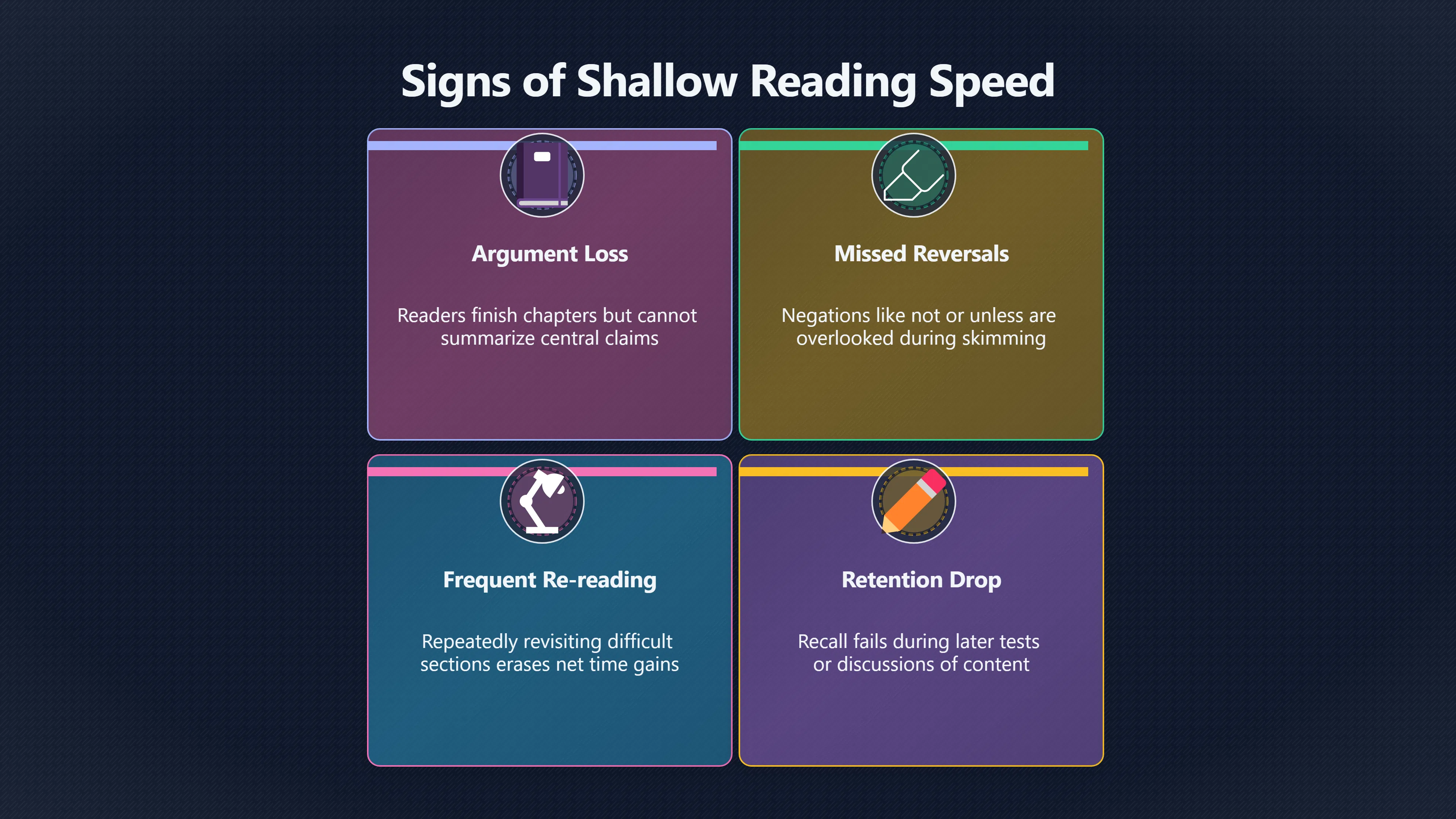
You cannot summarise the argument.
Finishing a chapter quickly matters little if you cannot explain its central claim in a few sentences.
You miss reversals and qualifications.
Words such as “not”, “unless”, “except”, “although”, and “however” often carry disproportionate importance. Losing track of them is a classic symptom of shallow processing.
Re-reading becomes frequent.
Some readers gain speed on the first pass but repeatedly revisit difficult sections, erasing any net time advantage.
Retention falls sharply.
If notes, tests, or later discussions reveal poor recall, the apparent speed improvement may simply reflect reduced processing.
Research examining interference with speech recoding found average comprehension decreases when subvocalisation was disrupted, although the magnitude varied across individuals. The practical lesson is that speed gains must always be evaluated alongside understanding rather than in isolation.[Springer]link.springer.comHowever, Experiment 2 also showed…Read more…

A better goal than elimination
The evidence does not support a simple rule that subvocalisation should always be removed. Instead, it points toward flexibility.
For straightforward material, readers may rely less on internal speech and move rapidly through text. For dense reasoning, unfamiliar concepts, or clause-heavy prose, allowing some sound-based processing can improve accuracy and retention. Studies of phonological coding suggest that silent reading normally recruits these mechanisms, and attempts to block them often create measurable comprehension costs.[PMC+3PMC+3CoLab]pmc.ncbi.nlm.nih.govPhonological coding during reading - PMC - NIHby M Leinenger · 2014 · Cited by 168 — When we read silently, we experience the sensatio…
The most useful benchmark is not whether the inner voice disappears. It is whether reading becomes faster while preserving the ability to understand, connect, and remember what the text actually says.
Amazon book picks
Further Reading
Books and field guides related to When silencing the inner voice backfires. Use these as the next step if you want deeper reading beyond the article.

Proust and the Squid
Explains the cognitive mechanisms involved in reading and comprehension.


Reader, Come Home
Addresses comprehension losses that accompany shallow reading habits.
Endnotes
1.
Source: pmc.ncbi.nlm.nih.gov
Link:https://pmc.ncbi.nlm.nih.gov/articles/PMC4211933/
Source snippet
Phonological coding during reading - PMC - NIHby M Leinenger · 2014 · Cited by 168 — When we read silently, we experience the sensatio...
2.
Source: colab.ws
Title: Co Lab Subvocalization and reading for meaning
Link:https://colab.ws/articles/10.1016%2FS0022-5371%2880%2990628-3
Source snippet
Subvocalization and reading for meaning - CoLab.wsTwo experiments demonstrated that subvocalization is of value in reading for certa...
3.
Source: link.springer.com
Link:https://link.springer.com/article/10.1007/BF01027072
Source snippet
However, Experiment 2 also showed...Read more...
4.
Source: arxiv.org
Link:https://arxiv.org/abs/2211.00295
Source snippet
CONDAQA: A Contrastive Reading Comprehension Dataset for Reasoning about NegationNovember 1, 2022...
Published: November 1, 2022
5.
Source: pmc.ncbi.nlm.nih.gov
Link:https://pmc.ncbi.nlm.nih.gov/articles/PMC4684953/
Source snippet
Complex Sentence Comprehension and Working Memory in...by JW Montgomery · 2008 · Cited by 429 — This study investigated the associati...
6.
Source: pmc.ncbi.nlm.nih.gov
Title: It facilitates planning, comprehension, reasoning,
Link:https://pmc.ncbi.nlm.nih.gov/articles/PMC4207727/
Source snippet
Working Memory Underpins Cognitive Development, Learning...by N Cowan · 2013 · Cited by 1472 — Working memory is the retention of a s...
7.
Source: pmc.ncbi.nlm.nih.gov
Title: PMCNo Correlation Between Articulation Speed and Silent
Link:https://pmc.ncbi.nlm.nih.gov/articles/PMC10360968/
Source snippet
by M Brysbaert · 2023 · Cited by 12 — Silent reading often involves phonological encoding of the text in addition to orthographic proc...
8.
Source: journals.sagepub.com
Link:https://journals.sagepub.com/doi/10.1080/14640748108400802
Source snippet
Sage JournalsThe Role of Subvocalisation in ReadingA series of experiments explored the role of subvocalisation in fluent reading. Experi...
9.
Source: journals.sagepub.com
Link:https://journals.sagepub.com/doi/10.1080/14640749008401227
Source snippet
Sage JournalsArticulatory Suppression and Phonological Codes in...The aim of this study was to investigate whether the phonological code...
10.
Source: pmc.ncbi.nlm.nih.gov
Link:https://pmc.ncbi.nlm.nih.gov/articles/PMC4511188/
Source snippet
nih.govExpertise, Working Memory and Articulatory Suppression Effectby I Injoque-Ricle · 2015 · Cited by 62 — Articulatory suppression im...
11.
Source: pmc.ncbi.nlm.nih.gov
Link:https://pmc.ncbi.nlm.nih.gov/articles/PMC8557949/
Source snippet
subvocalization: An [eye-tracking]({{ 'eye-tracking/' | relative_url }}) study on silent...by J Beck · 2021 · Cited by 22 — The present study investigates effects of convention...
12.
Source: pmc.ncbi.nlm.nih.gov
Link:https://pmc.ncbi.nlm.nih.gov/articles/PMC8655773/
Source snippet
Influence of Articulatory Suppression on Reading Among...by X Li · 2021 · Cited by 2 — The study aimed to examine how the phonological l...
13.
Source: journals.sagepub.com
Link:https://journals.sagepub.com/doi/10.2307/1510799
Source snippet
of Subvocal Suppression on Learning Disabled...For both reading groups subvocalization was found to be necessary for comprehension of in...
Additional References
14.
Source: researchgate.net
Link:https://www.researchgate.net/publication/280043352_Expertise_Working_Memory_and_Articulatory_Suppression_Effect_Their_Relation_with_Simultaneous_Interpreting_Performance
Source snippet
Their Relation with Simultaneous Interpreting Performance1 Jan 2026 — The aim of this work was to study the relationship between expertis...
15.
Source: research.manchester.ac.uk
Link:https://research.manchester.ac.uk/en/studentTheses/the-effect-of-reading-direction-on-sentence-processing-an-investi/
Source snippet
Effect of Reading Direction on Sentence ProcessingIn Chapters 5 and 6, we examined the effect of reading direction on complex sentence co...
16.
Source: pubs.asha.org
Link:https://pubs.asha.org/doi/10.1044/jslhr.4302.293
Source snippet
ASHA PublicationsVerbal Working Memory and Sentence Comprehension in...In this study we examined the influence of verbal working memory...
17.
Source: psychology.stackexchange.com
Title: what is the effect of not sub vocalizing on reading comprehension
Link:https://psychology.stackexchange.com/questions/2009/what-is-the-effect-of-not-sub-vocalizing-on-reading-comprehension
Source snippet
is the effect of not sub-vocalizing on reading...6 Dec 2012 — Sometimes when reading, text segments are not so important or relevant, wh...
18.
Source: advancedtherapyclinic.com
Title: how speech therapy assists with comprehending complex sentences
Link:https://www.advancedtherapyclinic.com/blog/how-speech-therapy-assists-with-comprehending-complex-sentences
Source snippet
How Speech Therapy Assists with Comprehending...22 Oct 2025 — Research has established that [knowledge]({{ 'knowledge/' | relative_url }}) of sentence structures influences...
19.
Source: scotthyoung.com
Title: Even expert speed readers do it, they just do it a bit faster than
Link:https://www.scotthyoung.com/blog/2015/01/19/speed-reading-redo/
Source snippet
I Was Wrong About Speed Reading: Here are the Facts19 Jan 2015 — Here the evidence is clear: subvocalization is necessary to read well...
20.
Source: researchgate.net
Link:https://www.researchgate.net/publication/368145969_Effects_of_Reading_Aloud_and_Subvocalization_on_Text_Comprehension_and_Eye_Movementsyinshenghuatoneishenghuagawenzhangnolijieyayanqiuyundongnijibosuyingxiang
Source snippet
omprehension and eye movements, and also effects of type of subvocalization.Read more...
21.
Source: researchgate.net
Link:https://www.researchgate.net/publication/328586159_Articulatory_Suppression_Impairs_Working_Memory_for_Ostensibly_Unvocalizable_Abstract_Sounds
Source snippet
etention interval showed worse memory performance than a control condition.Read more...
22.
Source: researchgate.net
Link:https://www.researchgate.net/publication/23190459_Complex_Sentence_Comprehension_and_Working_Memory_in_Children_With_Specific_Language_Impairment
Source snippet
cal short-term memory [PSTM], attentional resource capacity/allocation)Read more...
23.
Source: reddit.com
Title: Researchers are still trying to understand those who don’t need it.Read more
Link:https://www.reddit.com/r/books/comments/plkx2r/the_never_ending_use_of_subvocalization_when/
Source snippet
The never ending use of subvocalization, when reading.Studies have shown that for 90+% of readers, subvocalization is essential for compr...
Topic Tree