Within Easy Trap
When Familiar Words Fake Understanding
Familiar words can make a passage feel understood before the reader has checked the author's actual claim.
On this page
- Why recognition feels like comprehension
- How known vocabulary hides new relationships
- A quick explanation test for familiar passages
Page outline Jump by section
Introduction
Fast reading often feels easiest on subjects we already know. Familiar terminology, familiar examples and familiar arguments create a sense that comprehension is happening automatically. The danger is that recognition can be mistaken for understanding. A reader may recognise nearly every word on a page yet still miss the author’s actual claim, the relationship between ideas, or the specific way an argument differs from what they already believe.
 This distinction matters for increasing reading speed because the passages that feel safest to skim are often the ones most likely to produce overconfidence. Cognitive research on fluency, metacognition and the illusion of explanatory depth repeatedly shows that people tend to judge familiar material as better understood than it really is.[PMC+2IIPDM]pmc.ncbi.nlm.nih.govby L Rozenblit · 2002 · Cited by 1423 — We argue here that people's limited knowledge and their misleading intuitive epistemology comb…
Why Recognition Feels Like Comprehension
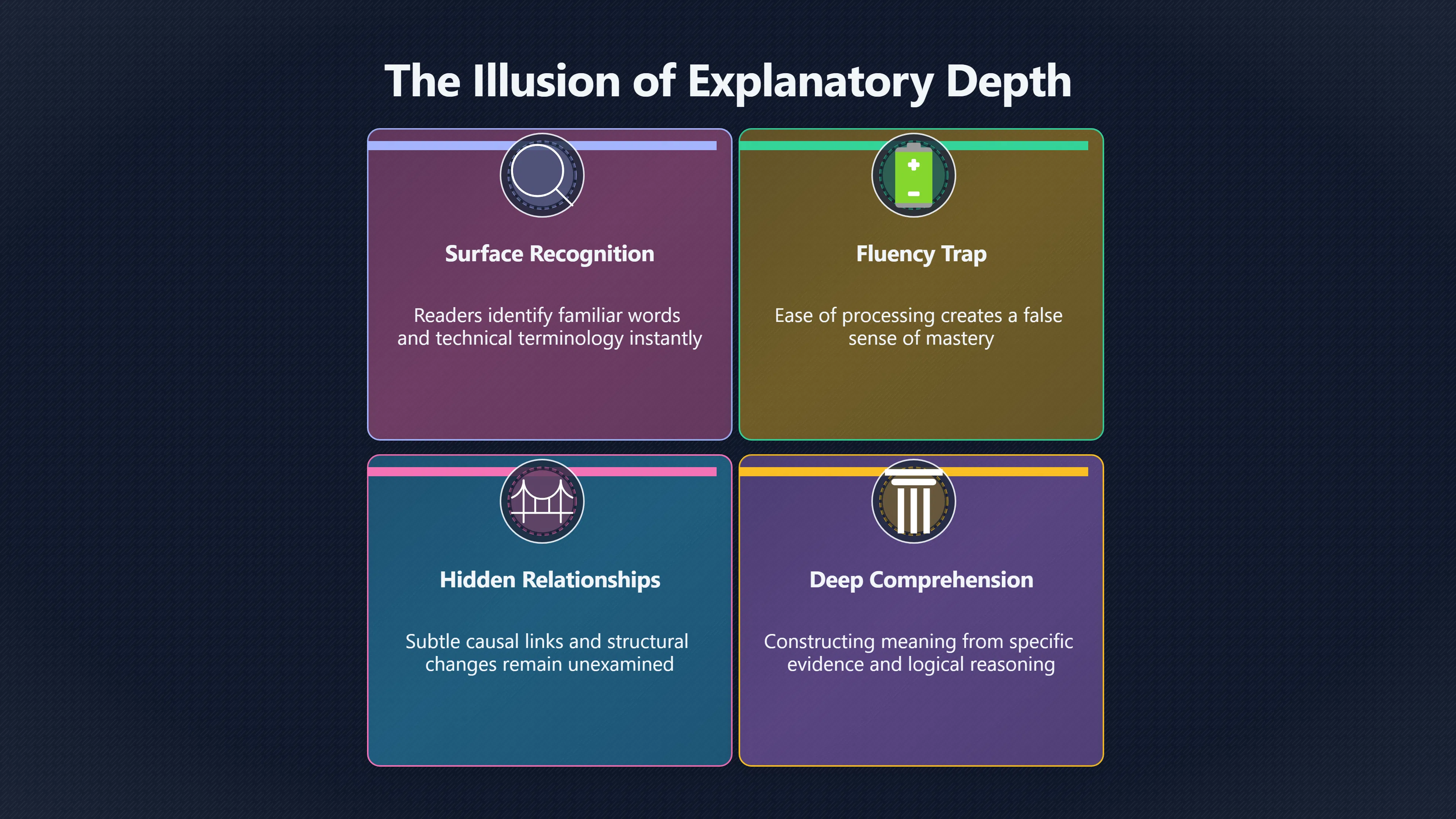
Recognition is the experience of encountering something that seems familiar. Comprehension is the construction of meaning from relationships, explanations and claims. The two often occur together, which is why they are easy to confuse.
When readers move through a familiar topic, processing becomes smoother. Technical terms are recognised instantly. Expected ideas appear where they are supposed to appear. Sentences require less effort to decode. This ease of processing, often called fluency, is useful because it allows faster reading. However, fluency can also become a misleading cue. People frequently use the feeling of ease as evidence that they understand, even when they have not tested that understanding.[Ovid+2ResearchGate]ovid.comIllusions of Familiarityby BWA Whittlesea · 1993 · Cited by 1441 — Numerous subsequent studies have provided further evidence of a co…
A common example occurs when reading within a professional field. A software engineer reading about databases may instantly recognise terms such as indexing, caching and replication. Because the vocabulary is familiar, the article feels transparent. Yet the author may be making a new causal argument about how those concepts interact. The reader recognises the pieces but never fully processes the new relationship between them.
The result is a false sense of mastery: “I know this already,” when what is actually known is only the surface language.
How Known Vocabulary Hides New Relationships
The most important information in a familiar passage is often not the individual words but the connections between them.
Readers rarely misunderstand familiar vocabulary. Instead, they overlook changes in structure, emphasis or causation. An author may accept a familiar idea but redefine its scope. They may agree with a common conclusion while rejecting the standard explanation. They may introduce an exception that reverses the practical implication of an otherwise familiar argument.
Because the building blocks are recognised so quickly, readers can slide past these changes.
Consider the difference between these two statements:
- “Practice improves performance.”
- “Practice improves performance only when feedback identifies errors.”
A reader who already believes the first statement may mentally collapse the second into the first. The vocabulary feels familiar, but the qualification changes the meaning substantially.
Research on the illusion of explanatory depth suggests that people often overestimate understanding when they possess a broad outline of a topic but lack access to the detailed mechanisms underneath it. Familiarity creates a feeling of coherence that can mask missing links in reasoning.[PMC+2PhilPapers]pmc.ncbi.nlm.nih.govby L Rozenblit · 2002 · Cited by 1423 — We argue here that people's limited knowledge and their misleading intuitive epistemology comb…
This is especially relevant in speed reading. The faster a reader moves, the more likely they are to rely on pattern recognition. Pattern recognition is efficient when the text truly follows expectations. It becomes risky when the author’s contribution lies in a subtle modification of those expectations.
The False Fluency Trap
False fluency occurs when reading feels easy for reasons unrelated to actual understanding.
Several cues can create this effect:
- Recognisable terminology. Known words produce confidence even when the argument is unclear.
- Repeated exposure. Material seen before feels easier to process, creating the impression of learning.[Lafayette Sites]sites.lafayette.eduthe fluency illusion and a better way to studyLafayette SitesThe Fluency Illusion and a Better Way to Study8 Apr 2015 — The Fluency Illusion suggests that rereading text can create a…
- Topic familiarity. Existing knowledge supplies missing details automatically, whether or not the text supports them.[ResearchGate]researchgate.netDomain familiarity as a cue for judgments of learningFor example, people's memory judgments often relate to the experience of…
- Predictable structure. Readers assume they know where the argument is going and stop checking carefully.
The key problem is that these cues are feelings, not evidence. They tell readers that processing is easy. They do not prove that the author’s meaning has been accurately captured.
In familiar reading, the brain often fills gaps with prior knowledge. That usually helps comprehension, but it can also cause readers to substitute their own understanding for the author’s. The passage then becomes a confirmation of existing beliefs rather than a source of new information.
A Quick Explanation Test for Familiar Passages
One of the most reliable ways to separate recognition from comprehension is to force an explanation.
Research on the illusion of explanatory depth consistently finds that confidence drops when people attempt to explain a topic in detail. The act of explaining exposes missing connections that recognition alone conceals.[PMC+2Cambridge University Press & Assessment]pmc.ncbi.nlm.nih.govby L Rozenblit · 2002 · Cited by 1423 — We argue here that people's limited knowledge and their misleading intuitive epistemology comb…
For a familiar passage, use a simple three-question test immediately after reading:
- What is the author’s main claim?
- What specific evidence or reasoning supports it?
- How does this differ from what I believed before reading?
The third question is particularly useful. If the answer is “it doesn’t differ at all,” check whether that conclusion comes from the text or from assumptions carried into the text.
Another effective version is the one-sentence explanation test. Close the document and explain the argument in a single sentence without looking back. If the sentence contains only topic labels and familiar buzzwords, comprehension may be shallower than it seemed.
For example:
- Weak explanation: “It’s about productivity and learning.”
- Strong explanation: “The author argues that immediate feedback matters more than repetition because repetition alone reinforces existing mistakes.”
The second explanation captures relationships and causation rather than mere recognition.
Reading Faster Without Falling for Familiarity
The goal is not to slow down every time a familiar topic appears. Familiarity remains one of the strongest advantages a reader can have. The goal is to reserve extra attention for places where familiarity is most likely to mislead.
A practical approach is to scan for signals that new relationships are being introduced:
- Contrasts such as “however”, “although” and “despite”.
- Causal language such as “because”, “therefore” and “results in”.
- Boundary conditions such as “only when”, “except” and “under certain circumstances”.
- Places where the author explicitly disagrees with a common view.
These are the locations where recognition is least reliable and comprehension matters most.
Fast readers often assume their greatest risk lies in difficult passages. In reality, familiar passages can be equally dangerous because they generate confidence before understanding has been verified. Recognition makes reading feel complete. Comprehension is what confirms that it actually is.


Endnotes
1.
Source: pmc.ncbi.nlm.nih.gov
Link:https://pmc.ncbi.nlm.nih.gov/articles/PMC3062901/
Source snippet
by L Rozenblit · 2002 · Cited by 1423 — We argue here that people's limited knowledge and their misleading intuitive epistemology comb...
2.
Source: iipdm.haifa.ac.il
Title: The present chapter focuses on the.Read more
Link:https://iipdm.haifa.ac.il/images/publications/Asher_Koriat/1998-Koriat-Yzerbit.pdf
Source snippet
Illusions of Knowing: The Link between Knowledge and...by A Koriat · Cited by 78 — One puzzling observation about metacognition is...
3.
Source: researchgate.net
Link:https://www.researchgate.net/publication/257135791_Domain_familiarity_as_a_cue_for_judgments_of_learning
Source snippet
Domain familiarity as a cue for judgments of learningFor example, people's memory judgments often relate to the experience of...
4.
Source: ovid.com
Link:https://www.ovid.com/journals/jeplm/pdf/10.1037/0278-7393.19.6.1235~illusions-of-familiarity
Source snippet
Illusions of Familiarityby BWA Whittlesea · 1993 · Cited by 1441 — Numerous subsequent studies have provided further evidence of a co...
5.
Source: philpapers.org
Title: Phil Papersan illusion of explanatory depth
Link:https://philpapers.org/rec/ROZTML
Source snippet
Then we show differences in overconfidence about knowledge across different...Read more...
6.
Source: sites.lafayette.edu
Title: the fluency illusion and a better way to study
Link:https://sites.lafayette.edu/rothm/2015/04/08/the-fluency-illusion-and-a-better-way-to-study/
Source snippet
Lafayette SitesThe Fluency Illusion and a Better Way to Study8 Apr 2015 — The Fluency Illusion suggests that rereading text can create a...
7.
Source: cambridge.org
Link:https://www.cambridge.org/core/journals/judgment-and-decision-making/article/broad-effects-of-shallow-understanding-explaining-an-unrelated-phenomenon-exposes-the-illusion-of-explanatory-depth/9B9B8927C3E530EBCF0453504730E3F3
Source snippet
Participants who copied a block of irrelevant text...Read more...
8.
Source: researchgate.net
Link:https://www.researchgate.net/publication/372669028_Broad_effects_of_shallow_understanding_Explaining_an_unrelated_phenomenon_exposes_the_illusion_of_explanatory_depth
Source snippet
Broad effects of shallow understanding: Explaining an...We discuss alternative accounts of the illusion of explanatory depth that might...
9.
Source: researchgate.net
Link:https://www.researchgate.net/publication/352704150_Illusion_of_explanatory_depth_and_social_desirability_of_historical_knowledge
Source snippet
Illusion of explanatory depth and social desirability...Jun 23, 2021 — The Illusion of Explanatory Depth (IOED) occurs when people overe...
10.
Source: researchgate.net
Link:https://www.researchgate.net/publication/365020948_Broad_effects_of_shallow_understanding_Explaining_an_unrelated_phenomenon_exposes_the_illusion_of_explanatory_depth
Source snippet
Explaining an unrelated phenomenon exposes the illusion...16 Dec 2025 — The Illusion of Explanatory Depth (IOED) occurs when people over...
11.
Source: researchgate.net
Link:https://www.researchgate.net/publication/325856022_The_illusion_of_knowing_in_metacognitive_monitoring_Effects_of_the_type_of_information_and_of_personal_cognitive_metacognitive_and_individual_psychological_characteristics
Source snippet
(PDF) The illusion of knowing in metacognitive monitoringThe aim of the paper is to analyse the illusion of knowing in metacognitive moni...
12.
Source: time.com
Link:https://time.com/wp-content/uploads/2015/02/ioed_proofs.pdf_1.pdf
13.
Source: pmc.ncbi.nlm.nih.gov
Link:https://pmc.ncbi.nlm.nih.gov/articles/PMC13027792/
Source snippet
Monitoring in Reading Comprehension - PMCby V Markovich · 2026 — This study examined associations between vocabulary knowledge, reading f...
14.
Source: pmc.ncbi.nlm.nih.gov
Link:https://pmc.ncbi.nlm.nih.gov/articles/PMC11020624/
Source snippet
We investigated whether power is also related to the illusion of explanatory depth (IOED).Read more...
15.
Source: pmc.ncbi.nlm.nih.gov
Link:https://pmc.ncbi.nlm.nih.gov/articles/PMC11276545/
Source snippet
Understanding is Reduced by Mechanistic Framingby JC Zemla · 2024 · Cited by 1 — In moving away from the illusion of explanatory depth pa...
16.
Source: Wikipedia
Title: Illusion of explanatory depth
Link:https://en.wikipedia.org/wiki/Illusion_of_explanatory_depth
Source snippet
Illusion of explanatory depthThe illusion of explanatory depth (IOED) is cognitive bias or an illusion where people tend to believe th...
Additional References
17.
Source: gwern.net
Link:https://gwern.net/doc/psychology/cognitive-bias/illusion-of-depth/index
Source snippet
'illusion-of-depth bias' directoryHumans believe they have a rich sensory world with precise memories, deep, detailed, and accurate causa...
18.
Source: firth.substack.com
Link:https://firth.substack.com/p/metacognitive-illusions
Source snippet
Metacognitive IllusionsOverall, the idea of metacognitive illusions demonstrates how hard it is for learners to say what 'w...
19.
Source: thedecisionlab.com
Link:https://thedecisionlab.com/biases/the-illusion-of-explanatory-depth
Source snippet
The Illusion of Explanatory DepthThe illusion of explanatory depth (IOED) describes our belief that we understand more about the world th...
20.
Source: my.chartered.college
Link:https://my.chartered.college/research-hub/metacognition-and-reading/
Source snippet
and readingThe [purpose]({{ 'purpose/' | relative_url }}) of reading is to understand text – to construct meaning from the written word. Metacognition is a well-evidenced...
21.
Source: tandfonline.com
Title: Taylor & Francis Online Full article: Gaining insight through explaining?
Link:https://www.tandfonline.com/doi/full/10.1080/21548455.2021.2018627
Source snippet
N Vaupotič · 2022 · Cited by 13 — This study transfers the Illusion of explanatory depth (IOED) paradigm to learning from a wri...
22.
Source: structural-learning.com
Link:https://www.structural-learning.com/post/fluency-illusions-students-think-they-know
Source snippet
Structural LearningFluency Illusions: Why Students Think They Know More4 Jun 2026 — Re-reading builds fluency through recognition, not re...
23.
Source: maestrolearning.com
Title: What is the Illusion of Explanatory Depth?
Link:https://maestrolearning.com/blogs/illusion-of-explanatory-depth/
Source snippet
MaestroThe illusion of explanatory depth occurs when people feel that they understand a complex topic or concept better than they actuall...
24.
Source: terryu.substack.com
Title: comprehension mirages and faulty
Link:https://terryu.substack.com/p/comprehension-mirages-and-faulty
Source snippet
Mirages and Faulty Learning from TextThe illusion of comprehension as a phenomenon amenable to empirical study has been discussed since t...
25.
Source: instagram.com
Title: Recognition won’t help you
Link:https://www.instagram.com/reel/DWrl7orEdFF/
Source snippet
I promise your next exam result will look completely different if...When you re-read, your brain just sees familiar words and assumes yo...
26.
Source: youtube.com
Title: THE INTELLIGENCE TRAP (The Mistake Smart People Make When Learning)
Link:https://www.youtube.com/watch?v=sXwpQlKdCck
Source snippet
What is the Fluency Illusion? | Teaching Tips & Tricks | Mango Languages...
Topic Tree