Within Rereading
When Rereading Becomes a Checking Habit
Repeatedly rereading lines to feel certain can become a habit that fragments attention without improving understanding.
On this page
- Signs of anxious rereading
- Why checking feels productive
- How delayed verification breaks the loop
Page outline Jump by section
Introduction
Not all rereading is a comprehension problem. Sometimes the reader already understands the material reasonably well but feels compelled to go back anyway. This pattern creates what can be called a checking loop: reading a sentence, doubting whether it was understood correctly, rereading it for reassurance, feeling briefly satisfied, and then experiencing the same doubt again a few lines later.
 For people trying to increase reading speed, this loop is costly because it consumes time without necessarily improving understanding. Unlike strategic regressions that repair a genuine misunderstanding, anxiety-driven rereading is often an attempt to reduce uncertainty. The result is fragmented attention, reduced reading flow, and a growing dependence on repeated verification. Research on eye movements, metacognitive monitoring, and checking behaviours suggests that the feeling of certainty gained from repeated checking can be misleading and may even weaken confidence in one’s own judgement over time.[PubMed+2PMC]pubmed.ncbi.nlm.nih.govThe function of these "regressions" is still largely unknownThe function of regressions in reading: backward eye…by RW Booth · 2013 · Cited by 132 — Standard text reading involves frequent…
Signs of Anxious Rereading
The easiest way to identify a checking loop is to look at the purpose of the rereading.
A reader engaged in productive rereading usually has a specific question: a forgotten name, an unclear reference, a missing step in an argument, or a detail that needs verification. The rereading targets a known problem.
In anxious rereading, the trigger is often vaguer. The reader returns to the text because something feels uncertain, even when no concrete misunderstanding can be identified. Common signs include:
- Rereading a sentence immediately after finishing it.
- Restarting paragraphs despite being able to summarise them.
- Frequently asking internally, “Did I really get that?”
- Returning to the same passage multiple times without discovering new information.
- Feeling unable to move forward until a sense of certainty appears.
The key distinction is that comprehension and confidence are not always the same thing. A reader can understand a passage while feeling uncertain about that understanding. When confidence becomes the criterion for moving forward, rereading can become habitual rather than corrective. Research on metacognitive monitoring shows that readers are not always accurate judges of their own comprehension, which means feelings of uncertainty are not reliable indicators that understanding is actually missing.[PMC+2Taylor & Francis Online]pmc.ncbi.nlm.nih.govPMCMetacognitive Monitoring of Text ComprehensionThe ability to assess and monitor one's own understanding of a written text is fundamental for learning and academic achievement…
Why Checking Feels Productive
The checking loop survives because it provides an immediate reward.
When a reader rereads a sentence, anxiety temporarily drops. The text looks more familiar, processing becomes easier, and the reader experiences a brief sense of relief. This relief creates the impression that rereading was necessary and beneficial.
Psychologists studying checking and reassurance-seeking behaviours have found a similar pattern in anxiety-related conditions. Checking reduces discomfort in the short term but often reinforces the urge to check again later. Rather than teaching confidence, repeated verification can teach the mind that certainty must always be obtained before moving on.[International OCD Foundation+3PMC+3ADAA]pmc.ncbi.nlm.nih.govThe Etiology, Assessment and Treatment of Compulsive…by S Guo · 2025 · Cited by 4 — Research shows that anxiety, uncertainty and in…
In reading, this produces a subtle trap. The reader mistakes the reduction of anxiety for an increase in comprehension.
Familiarity Is Not the Same as Understanding
A second reason the checking loop feels effective is that rereading increases familiarity.
Words that have just been seen are easier to process a second time. This fluency creates a subjective feeling that the material is becoming clearer. Yet the sensation comes partly from recognition rather than from new understanding. Research on metacognition has repeatedly shown that people can mistake familiarity and processing ease for genuine mastery, a phenomenon sometimes described as an illusion of knowing.[PMC+2ejop.psychopen.eu]pmc.ncbi.nlm.nih.govPMCThe Illusion of Knowing in Metacognitive Monitoringby MM Avhustiuk · 2018 · Cited by 73 — The research has shown that the illusion of knowing can occur in all types of metacognitive jud…
This helps explain why some readers can spend large amounts of time rereading while making little progress. Each pass produces a feeling of reassurance, but the reassurance is not evidence that additional comprehension was gained.
The Mechanics of the Checking Loop
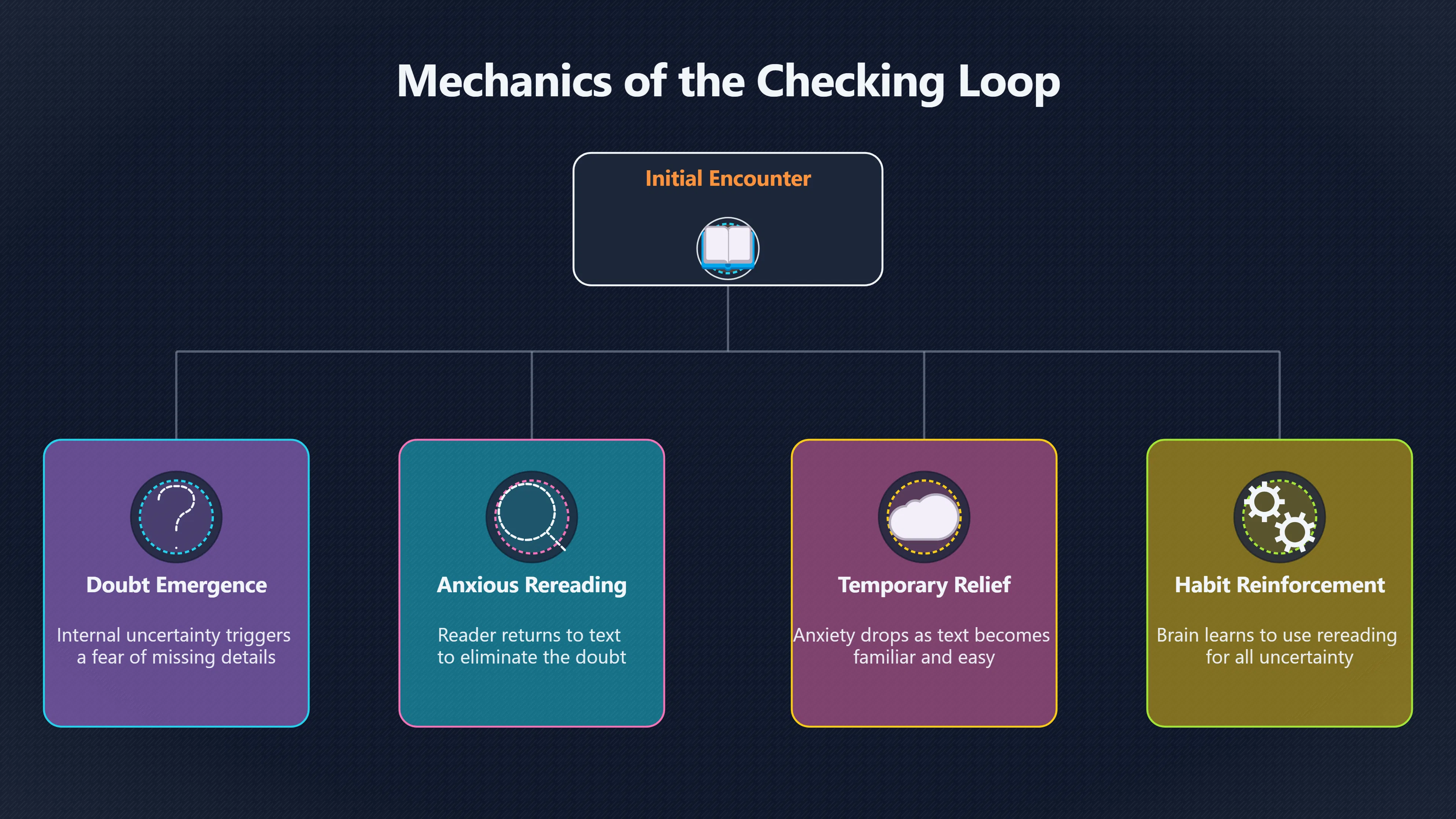
The loop often unfolds in a predictable sequence:
- The reader encounters a sentence.
- The sentence is understood well enough to continue.
- A doubt appears: “What if I missed something?”
- The reader rereads to eliminate the doubt.
- Anxiety falls temporarily.
- The brain learns that rereading is the way to handle uncertainty.
- The next moment of uncertainty triggers another rereading cycle.
The important point is that the loop is driven by uncertainty tolerance rather than information needs.
Eye-movement research shows that regressions are a normal and useful part of reading when they help repair comprehension problems. Readers regularly move their eyes backwards to reprocess information and resolve difficulties. However, the existence of useful regressions does not mean every regression is useful. The checking loop appropriates a normal repair mechanism and deploys it repeatedly even when no repair is required.[Cambridge Assets+3PubMed+3Springer]pubmed.ncbi.nlm.nih.govThe function of these "regressions" is still largely unknownThe function of regressions in reading: backward eye…by RW Booth · 2013 · Cited by 132 — Standard text reading involves frequent…
How Delayed Verification Breaks the Loop
One of the most effective ways to weaken anxious rereading is to postpone verification rather than eliminating it completely.
The goal is not to force blind reading or ignore genuine confusion. Instead, it is to create a delay between uncertainty and checking.
For example, instead of rereading immediately after a doubtful sentence, continue to the end of the paragraph. If the meaning remains unclear, return and verify. If comprehension remains intact, the urge to reread was probably driven by uncertainty rather than necessity.
This approach changes the reader’s evidence base. Instead of asking, “Do I feel certain right now?”, the reader asks, “Can I still follow the argument a few sentences later?”
Many apparent comprehension failures disappear when tested this way. Context often resolves uncertainty naturally. A pronoun becomes clear, a definition is expanded, or an argument becomes more explicit as the paragraph develops. Immediate rereading prevents the reader from benefiting from this additional context.

A Practical Question
Before moving backwards, ask:
What specific information am I trying to recover?
If the answer is precise—such as a date, condition, definition, or reference—the regression is probably serving a real purpose.
If the answer is merely “I want to be sure”, delaying verification often reveals that comprehension was already adequate.
Confidence Grows by Moving Forward
An overlooked consequence of excessive checking is that it can reduce trust in one’s own reading ability.
Every unnecessary reread sends a small message: “My first reading cannot be trusted.” Repeated hundreds of times, that message becomes a habit. Readers begin treating initial comprehension as provisional until confirmed by multiple passes.
The opposite habit is not recklessness but calibrated trust. Skilled readers monitor understanding, notice genuine problems, and return when needed. They do not require perfect certainty before advancing. Research on comprehension monitoring suggests that effective reading depends not only on detecting problems but also on accurately judging when understanding is sufficient.[PMC+2ResearchGate]pmc.ncbi.nlm.nih.govPMCMetacognitive Monitoring of Text ComprehensionThe ability to assess and monitor one's own understanding of a written text is fundamental for learning and academic achievement…
For increasing reading speed, this distinction is crucial. The objective is not to eliminate rereading altogether. It is to reserve rereading for moments when it repairs understanding and to resist using it as a tool for managing uncertainty. Once the checking loop weakens, reading becomes smoother, attention remains on the developing meaning of the text, and speed improves without sacrificing comprehension.
Amazon book picks
Further Reading
Books and field guides related to When Rereading Becomes a Checking Habit. Use these as the next step if you want deeper reading beyond the article.
How to Read a Book
Rating: 4.0/5 from 41 Google Books ratings
Provides structured approaches that reduce uncertainty-driven rereading.
The Imp of the Mind
Explains uncertainty-driven checking behaviors that mirror rereading loops.
The Reading Mind
Helps readers understand comprehension monitoring and reading confidence.
eBay marketplace picks
Marketplace Samples
Example marketplace items related to this page. Use the search link to explore similar finds on eBay.



Endnotes
1.
Source: pmc.ncbi.nlm.nih.gov
Link:https://pmc.ncbi.nlm.nih.gov/articles/PMC12126976/
Source snippet
The Etiology, Assessment and Treatment of Compulsive...by S Guo · 2025 · Cited by 4 — Research shows that anxiety, uncertainty and in...
2.
Source: adaa.org
Title: when reassurance seeking becomes compulsive
Link:https://adaa.org/learn-from-us/from-the-experts/blog-posts/consumer/when-reassurance-seeking-becomes-compulsive
Source snippet
3 Jun 2022 — Being stuck in reassurance-seeking can lead to paralysis in decision-making, haunting worries about making a mistake or caus...
3.
Source: pmc.ncbi.nlm.nih.gov
Title: PMCMetacognitive Monitoring of Text Comprehension
Link:https://pmc.ncbi.nlm.nih.gov/articles/PMC6255937/
Source snippet
The ability to assess and monitor one's own understanding of a written text is fundamental for learning and academic achievement...
4.
Source: pmc.ncbi.nlm.nih.gov
Title: PMCThe Illusion of Knowing in Metacognitive Monitoring
Link:https://pmc.ncbi.nlm.nih.gov/articles/PMC6016031/
Source snippet
by MM Avhustiuk · 2018 · Cited by 73 — The research has shown that the illusion of knowing can occur in all types of metacognitive jud...
5.
Source: ejop.psychopen.eu
Link:https://ejop.psychopen.eu/index.php/ejop/article/view/1418/1418.html
Source snippet
The Illusion of Knowing in Metacognitive Monitoringby MM Avhustiuk · 2018 · Cited by 73 — The illusion of knowing is usually viewed as su...
6.
Source: link.springer.com
Link:https://link.springer.com/article/10.3758/s13421-012-0244-y
Source snippet
function of regressions in reading: Backward eye...by RW Booth · 2013 · Cited by 132 — These results suggest that readers use regression...
7.
Source: assets.cambridge.org
Title: Assets Chapter 1
Link:https://assets.cambridge.org/97811084/15354/excerpt/9781108415354_excerpt.pdf
Source snippet
Cambridge AssetsChapter 1 Introduction to Eye-TrackingIn reading, saccades do not always move the eye forward in a text. About 10–15 per...
8.
Source: researchgate.net
Link:https://www.researchgate.net/publication/362198331_Metacognitive_Monitoring_Skills_of_Reading_Comprehension_and_Writing_between_Proficient_and_Poor_Readers
Source snippet
Metacognitive Monitoring Skills of Reading...Aug 31, 2022 — Findings revealed that proficient readers exhibited significantly better mon...
9.
Source: researchgate.net
Link:https://www.researchgate.net/publication/230658181_The_function_of_regressions_in_reading_Backward_eye_movements_allow_rereading
Source snippet
ue their memory for previously read words.Read more...
10.
Source: researchgate.net
Title: (PDF) Regressions during Reading
Link:https://www.researchgate.net/publication/334364752_Regressions_during_Reading
Source snippet
May 20, 2026 — Three experiments examine the role of previously read text in sentence comprehension and the control of eye movements duri...
Published: May 20, 2026
11.
Source: researchgate.net
Link:https://www.researchgate.net/publication/230797275_Patterns_of_Reassurance_Seeking_and_Reassurance-Related_Behaviours_in_OCD_and_Anxiety_Disorders
Source snippet
thy controls. Individuals diagnosed with OCD...
12.
Source: researchgate.net
Link:https://www.researchgate.net/publication/228625379_Eye_Movements_as_Reflections_of_Comprehension_Processes_in_Reading
Source snippet
t comprehension processes.Read more...
13.
Source: scholarworks.waldenu.edu
Link:https://scholarworks.waldenu.edu/cgi/viewcontent.cgi?article=12210&context=dissertations
Source snippet
Strategies Used for Reading Comprehension...by M Lukes · 2021 · Cited by 6 — Metacognition enables self-regulation of learning and behav...
14.
Source: pubmed.ncbi.nlm.nih.gov
Title: The function of these “regressions” is still largely unknown
Link:https://pubmed.ncbi.nlm.nih.gov/22886737/
Source snippet
The function of regressions in reading: backward eye...by RW Booth · 2013 · Cited by 132 — Standard text reading involves frequent...
15.
Source: tandfonline.com
Link:https://www.tandfonline.com/doi/full/10.1080/2331186X.2019.1565067
Source snippet
Taylor & Francis OnlineFull article: Reading comprehension and metacognitionby C Soto · 2019 · Cited by 209 — We explored relations betwe...
16.
Source: pubmed.ncbi.nlm.nih.gov
Link:https://pubmed.ncbi.nlm.nih.gov/34922212/
Source snippet
implicit motivators and mechanismsby SM Champion · 2022 · Cited by 10 — Like checking, reassurance facilitates short-term threat re-appra...
17.
Source: iocdf.org
Link:https://iocdf.org/expert-opinions/expert-opinion-self-directed-erp/
Source snippet
International OCD FoundationSelf-Directed Treatment for OCD: The Irony of Doing...Because so many compulsively seek reassurance to calm...
18.
Source: pmc.ncbi.nlm.nih.gov
Link:https://pmc.ncbi.nlm.nih.gov/articles/PMC6071415/
Source snippet
(2017) is an exception and showed relations between eye movements and off-line reading skills for 22 German adolescent readers.Read m...
19.
Source: pmc.ncbi.nlm.nih.gov
Link:https://pmc.ncbi.nlm.nih.gov/articles/PMC12641876/
Source snippet
by M Markevich · 2025 — Successful reading comprehension depends on many factors, including text genre. [Eye-tracking]({{ 'eye-tracking/' | relative_url }}) studies indicate...
20.
Source: pmc.ncbi.nlm.nih.gov
Link:https://pmc.ncbi.nlm.nih.gov/articles/PMC6234076/
Source snippet
of reader- and text-level characteristics to eye...by V Kuperman · 2018 · Cited by 76 — Eye-movements during passage reading are suscept...
21.
Source: pmc.ncbi.nlm.nih.gov
Link:https://pmc.ncbi.nlm.nih.gov/articles/PMC13027792/
Source snippet
Monitoring in Reading Comprehension - PMCby V Markovich · 2026 — This study examined associations between [vocabulary]({{ 'knowledge/' | relative_url }}) knowledge, reading f...
22.
Source: pmc.ncbi.nlm.nih.gov
Link:https://pmc.ncbi.nlm.nih.gov/articles/PMC12409514/
Source snippet
the rereading effect of digital reading through eye...by Y Xu · 2025 — This study aimed to investigate the differences in eye movement c...
23.
Source: Wikipedia
Link:https://en.wikipedia.org/wiki/Eye
Source snippet
EyeAn eye is a sensory organ that allows an organism to perceive visual information. It detects light and converts it into electro-che...
24.
Source: cci.health.wa.gov.au
Link:https://www.cci.health.wa.gov.au/~/media/CCI/Consumer-Modules/Helping-Health-Anxiety/Helping-Health-Anxiety—06—Reducing-Checking-and-Reassurance-Seeking.pdf
Source snippet
6: Reducing Checking and Reassurance SeekingThroughout this module we will explore the different types of checking and reassurance seekin...
Additional References
25.
Source: ies.ed.gov
Link:https://ies.ed.gov/use-work/awards/development-oral-and-silent-reading-fluency-and-their-relation-reading-comprehension-first-through
Source snippet
of Oral and Silent Reading Fluency and Their...This monitoring captured in children's eye movements was related to reading comprehension...
26.
Source: my.chartered.college
Link:https://my.chartered.college/research-hub/metacognition-and-reading/
Source snippet
and readingGood readers use metacognitive strategies before, during and after reading to think about their reading and control their unde...
27.
Source: ora.ox.ac.uk
Link:https://ora.ox.ac.uk/objects/uuid%3Aa16f42e2-529d-47ae-ba51-50b75dd43899/files/rkh04dp70d
Source snippet
monitoring during reading: an eye-tracking...by AK Hessel · 2020 · Cited by 50 — We chose to use regression-in probability as an indicat...
28.
Source: ncsall.net
Link:https://www.ncsall.net/fileadmin/resources/ann_rev/rall_v5_ch7_supp.pdf
Source snippet
he other hand, tend to show less evidence of monitoring: They more often fail to notice when they do not understand...
29.
Source: rivenpsychology.com
Link:https://rivenpsychology.com/whats-the-difference-between-unhelpful-reassurance-seeking-and-practical-research/
Source snippet
Constructive information-gathering is a relatively efficient process. It starts with clear...Read more...
30.
Source: structural-learning.com
Title: fluency illusions students think they know
Link:https://www.structural-learning.com/post/fluency-illusions-students-think-they-know
Source snippet
Fluency Illusions: Why Students Think They Know More4 Jun 2026 — Re-reading, highlighting, and passive review create strong fluency illus...
31.
Source: layerscs.com
Title: reassurance seeking mental compulsion ocd
Link:https://www.layerscs.com/blogs/reassurance-seeking-mental-compulsion-ocd
Source snippet
Why Reassurance-Seeking Is a Mental Compulsion (And...1 Feb 2026 — Reassurance-seeking is a common mental compulsion in OCD. Learn how i...
32.
Source: papers.ssrn.com
Title: Keywords: regression, reading, language
Link:https://papers.ssrn.com/sol3/papers.cfm?abstract_id=5405257
Source snippet
Eye Movements in Reading Go from Easy to...by AT Lopes Rego — Our results suggest that readers tend to regress from easy words to diffic...
33.
Source: structural-learning.com
Title: metacognitive monitoring fixing student
Link:https://www.structural-learning.com/post/metacognitive-monitoring-fixing-student
Source snippet
Metacognitive Monitoring: Fixing Student Overconfidence...Mar 4, 2026 — The Dunning-Kruger effect demonstrates that individuals with low...
34.
Source: structural-learning.com
Link:https://www.structural-learning.com/post/metacognitive-strategies-in-reading-comprehension
Source snippet
They know when they get it, and when they don't...Read more...
Topic Tree