Within Tech docs
How Fast Should You Read Concept Docs?
Concept pages are fastest when you read for structure first, then slow down only for definitions, diagrams, and relationships.
On this page
- What concept pages are trying to give you
- The parts worth reading first
- When a skim has become enough
Page outline Jump by section
Introduction
Concept documentation is the fastest type of technical documentation to read because its job is not to tell you what to do next. Its job is to give you a mental model: what the system is, why it exists, what its major parts are, and how those parts relate to each other. Documentation frameworks such as DITA and Diátaxis explicitly separate concept or explanation content from tasks and reference material because readers need understanding before they need procedures.[Diátaxis+2Heretto]diataxis.frDiátaxisExplanationExplanation is a discursive treatment of a subject, that permits reflection. Explanation is understanding-oriented. Ex…
 The key to increasing reading speed is recognising that concept pages should not be read line by line on the first pass. Instead, read for structure first and detail second. A good skim captures the model of the system while skipping examples, narrative digressions, and implementation details that can be revisited later.
How Fast Should You Read Concept Docs?
You can usually read concept documentation much faster than task documentation because mistakes are less costly. Missing a command-line flag in a setup guide can cause failure. Missing a secondary example in a concept page rarely prevents understanding.
The goal is not memorisation. The goal is orientation. Concept topics exist to provide background, context, definitions, rules, and relationships that help readers understand a product, process, or architecture before performing work.[PTC Support+2Heretto]support.ptc.comPTC SupportConceptThe DITA Concept topic is used to provide background information that users must understand before they can work with a…
A useful mindset is to treat the page as a map rather than a procedure. You are trying to answer questions such as:
- What are the main components?
- What problem does this system solve?
- How do the components interact?
- Which concepts depend on other concepts?
- Which terms will appear again in later documentation?
Once those questions are answered, the page has delivered most of its value.
What Concept Pages Are Trying to Give You
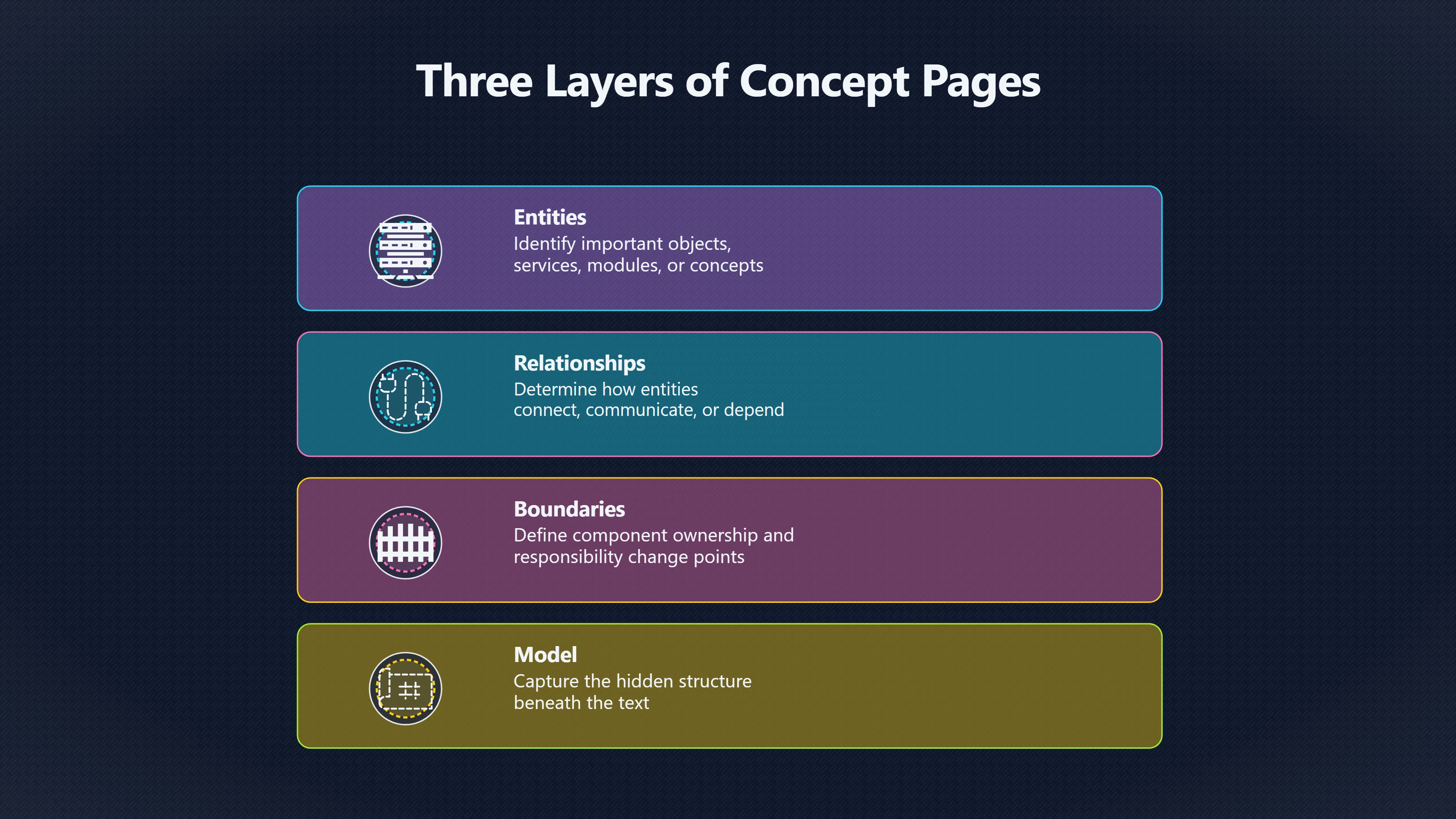
Many readers skim too aggressively and end up remembering isolated facts rather than the model itself. The model is the hidden structure beneath the text.
Documentation frameworks describe concept or explanation content as understanding-oriented rather than action-oriented. The purpose is to deepen comprehension and provide context, not to guide a specific procedure.[Diátaxis+2I'd Rather Be Writing]diataxis.frDiátaxisExplanationExplanation is a discursive treatment of a subject, that permits reflection. Explanation is understanding-oriented. Ex…
When reading a concept page, try to identify three layers:
The entities. What are the important objects, services, modules, or concepts?
The relationships. How do those entities connect, communicate, depend on, or influence each other?
The boundaries. What does each component own, and where does responsibility change?
If you can explain those three things to another person, you have usually captured the model.
For example, a cloud platform concept page might introduce authentication, storage, networking, and applications. The important takeaway is not every detail about each service. The important takeaway is that authentication controls access, applications consume storage, and networking connects everything together. The relationships matter more than the individual descriptions.
The Parts Worth Reading First
A fast skim works because concept pages tend to concentrate their highest-value information in predictable locations.
Start with headings and section structure
Read every heading before reading the body text.
Well-structured documentation is intentionally organised into concept, task, and reference units. The headings often reveal the complete architecture of the idea without requiring a full read.[Oxygen XML Editor+2Adobe Help Center]oxygenxml.comOxygen XML EditorInformation types and topicsThe three base DITA information types are concept, task and reference. What is a topic? A to…
As you scan, mentally build a hierarchy:
- Main topic
- Major components
- Supporting concepts
- Dependencies
This creates a framework into which later details can fit.
Read diagrams before paragraphs
Architecture diagrams, conceptual diagrams, and system maps frequently communicate relationships more efficiently than prose.
A conceptual architecture diagram is specifically designed to show key components and their interactions without implementation detail. Architecture documentation guidance similarly emphasises diagrams as tools for understanding systems and communicating structure.[Boardmix+2Bizzdesign]boardmix.comUnderstanding Conceptual Architecture Diagrams A conceptual architecture diagram is a graphical representation that illustrates the highBoardmixUnderstanding Conceptual Architecture DiagramsA conceptual architecture diagram is a graphical representation that illustrates th…
When you encounter a diagram, ask:
- What are the boxes?
- What are the connections?
- Which components appear central?
- Which components appear optional?
A thirty-second diagram review often replaces several minutes of reading.

Slow down for definitions
Most concept pages contain a small number of terms that everything else depends on.
These definitions deserve careful attention because they act as anchors for the entire model. If a page defines a workspace, tenant, cluster, repository, or namespace, understanding that definition often unlocks the rest of the document.
Read these sections slowly enough that you could restate the definition in your own words.
Watch for relationship lists
Lists often expose the model directly.
Examples include:
- Component A communicates with Component B.
- Service X depends on Service Y.
- Layer 1 contains Layer 2.
- Resource M belongs to Project N.
These statements are often more valuable than long explanatory paragraphs because they reveal structure.
How to Build the Model While Skimming
A useful technique is to maintain a running one-sentence summary.
After each major section, ask:
“What changed in my understanding of the system?”
Your answer should become progressively richer.
For example:
- “This is a deployment platform.”
- “It contains applications, environments, and users.”
- “Applications run inside environments.”
- “Users gain access through roles.”
Notice that the model grows through relationships, not through memorising details.
This approach prevents a common failure mode: reaching the end of a page having read every paragraph but still being unable to explain how the pieces fit together.
Common Skimming Mistakes
Reading examples before understanding the structure
Examples are useful, but they are usually subordinate to the model.
If you read examples first, you may learn isolated cases without understanding how they generalise.
Find the structure first. Use examples afterwards to confirm understanding.
Treating every paragraph as equally important
Concept documentation is not uniformly dense.
Definitions, diagrams, and relationship descriptions often contain most of the information value. Narrative explanations, historical notes, and repeated descriptions can often be read more quickly.
Confusing explanation with reference
Many readers continue reading after the conceptual model is already clear.
Reference content exists to provide exact facts, specifications, or detailed lookup information. Concept content exists to create understanding. Once the understanding is established, continuing to absorb every supporting detail often yields diminishing returns.[Heretto+2OASIS Open]heretto.comThe 3 Core DITA Topic Types ExplainedMaster the 3 core DITA topic types: concept, task, and reference. Learn when to use each for…
When a Skim Has Become Enough
A skim is complete when you can reconstruct the model without looking at the page.
You do not need perfect recall. You need enough understanding to answer questions such as:
- What is this system?
- Why does it exist?
- What are its major parts?
- How do those parts interact?
- Which concepts should I learn next?
If you can answer those questions confidently, further reading often shifts from high-value understanding to lower-value detail accumulation.
At that point, the fastest path is usually to move on to task documentation, practical examples, or implementation work. The concept page has already achieved its purpose: it has given you a mental framework that makes everything else easier and faster to learn.
Amazon book picks
Further Reading
Books and field guides related to How Fast Should You Read Concept Docs?. Use these as the next step if you want deeper reading beyond the article.
The Phoenix Project
Builds mental models of systems and processes, matching concept-oriented reading.
The DevOps Handbook
Explains how complex systems fit together, similar to concept documentation.

The DevOps Handbook - Audio-eBook Combo
First published 2020. Subjects: Business and economics.
eBay marketplace picks
Marketplace Samples
Example marketplace items related to this page. Use the search link to explore similar finds on eBay.


Endnotes
1.
Source: heretto.com
Link:https://www.heretto.com/blog/concept-task-reference
Source snippet
The 3 Core DITA Topic Types ExplainedMaster the 3 core DITA topic types: concept, task, and reference. Learn when to use each for...
2.
Source: support.ptc.com
Link:https://support.ptc.com/help/arbortext/r8.2.1.0/en/editor/tutorial/help17039.html
Source snippet
PTC SupportConceptThe DITA Concept topic is used to provide background information that users must understand before they can work with a...
3.
Source: help.adobe.com
Link:https://help.adobe.com/en_US/framemaker/using/using-framemaker/user-guide/frm_structauthdita_sd_dita-topics.html
Source snippet
Adobe Help CenterDITA topicsA topic in DITA is the most granular entity of information. According to the DITA specifications, a topic sho...
4.
Source: boardmix.com
Link:https://boardmix.com/[knowledge
Source snippet
Understanding Conceptual Architecture DiagramsA conceptual architecture diagram is a graphical representation that illustrates th...
5.
Source: bizzdesign.com
Link:https://bizzdesign.com/blog/technical-architecture-diagrams
Source snippet
Mastering Technical Architecture Diagrams for BeginnersOverall, technical architecture diagrams facilitate effective communication, under...
6.
Source: docs.oasis-open.org
Link:https://docs.oasis-open.org/dita/v1.0/archspec/topicover.html
Source snippet
topicsTasks Task topics answer "How do I?" questions, Reference Reference topics describe regular features of a subject or product, such...
7.
Source: docs.oasis-open.org
Title: dita technical Content Information Types
Link:https://docs.oasis-open.org/dita/v1.2/os/spec/archSpec/dita_technicalContent_InformationTypes.html
Source snippet
oasis-open.org2.2.2 Technical content: Document and information types1 Dec 2010 — The Technical Content package contains five topic speci...
8.
Source: docs.oasis-open.org
Title: dita concept topic
Link:https://docs.oasis-open.org/dita/v1.2/os/spec/archSpec/dita_concept_topic.html
Source snippet
oasis-open.org2.2.2.1 Concept topicDec 1, 2010 — The DITA concept document type uses the concept information type. Concept topics are spe...
9.
Source: heretto.com
Title: What’s the DITA Full Form? A Practical
Link:https://www.heretto.com/blog/dita-task
Source snippet
IntroductionLearn the DITA full form and how Task, Concept, and Reference topic types help you create clear, reusable technical documenta...
10.
Source: diataxis.fr
Link:https://diataxis.fr/explanation/
Source snippet
DiátaxisExplanationExplanation is a discursive treatment of a subject, that permits reflection. Explanation is understanding-oriented. Ex...
11.
Source: idratherbewriting.com
Title: what is diataxis documentation framework
Link:https://idratherbewriting.com/blog/what-is-diataxis-documentation-framework
Source snippet
I'd Rather Be WritingWhat is Diátaxis and should you be using it with your...18 Oct 2023 — The Diátaxis approach to documentation organi...
12.
Source: discuss.ocaml.org
Title: “Diátaxis” documentation structure
Link:https://discuss.ocaml.org/t/diataxis-documentation-structure/7750
Source snippet
ocaml.org"Diátaxis" documentation structure - Community27 Apr 2021 — Diátaxis divides documentation across two axes of knowledge: theory/...
13.
Source: oxygenxml.com
Link:https://www.oxygenxml.com/dita/styleguide/c_Topics_and_Information_Types.html
Source snippet
Oxygen XML EditorInformation types and topicsThe three base DITA information types are concept, task and reference. What is a topic? A to...
14.
Source: idratherbewriting.com
Link:https://idratherbewriting.com/specializations/
15.
Source: oxygenxml.com
Link:https://www.oxygenxml.com/dita/1.3/specs/archSpec/technicalContent/dita-concept-topic.html
Source snippet
Concept topicConcept topics are specialized from topic. They include the standard topic elements, including the short description, prolog...
16.
Source: dita-lang.org
Link:https://dita-lang.org/1.3/dita/langref/technicalcontent/task
Source snippet
DITAConcept topic · Reference topic · General task topic · Task topic (strict task) · Machinery Task topic · Troubleshooting topic · Glos...
Additional References
17.
Source: medium.com
Link:https://medium.com/the-ci-cd-guild-automate-evolve-deploy/a-practical-guide-to-architecture-documentation-34855a514923
Source snippet
A Practical Guide to Architecture DocumentationThis blog series is mainly focused on standardizing architecture documentation and sharing...
18.
Source: postdigitalarchitecture.com
Link:https://postdigitalarchitecture.com/blogs/articles/the-complete-guide-to-architectural-documents-for-students-amp-professionals?srsltid=AfmBOopKRXZsBqdZ2x4HlcIEVY8_VjssnMoP6o4GNNbUo286WkwMhNjM
Source snippet
Guide to Architectural DocumentsThis guide breaks down over varied types of architectural documents into simple, useful categories—from e...
19.
Source: medium.com
Link:https://medium.com/%40techdineshwrites/my-take-on-the-diataxis-approach-9400e65e2f5b
Source snippet
My Take on the Diataxis ApproachThis approach for technical documentation lays down four kinds of documentation: Tutorials and how-to gui...
20.
Source: medium.com
Link:https://medium.com/%40techdineshwrites/using-dita-for-technical-documentation-c5c846260a73
Source snippet
Using DITA for Technical Documentation | by Dinesh NairTopic Types. There are three main types of DITA topics: Concept, Task, and Referen...
21.
Source: youtube.com
Link:http://www.youtube.com/watch?v=buEKMi4tAew
Source snippet
Diataxis explanation concept documentation framework Better docs, happier users: What we learned applying Diataxis to HoloViz libraries P...
22.
Source: freecodecamp.org
Title: system architecture documentation best practices and tools
Link:https://www.freecodecamp.org/news/system-architecture-documentation-best-practices-and-tools/
Source snippet
12 Nov 2025 — Here's a practical guide for creating system architecture documentation that anyone on your team can read and use: Step 1...
23.
Source: lobehub.com
Title: sammcj agentic coding diataxis documentation
Link:https://lobehub.com/skills/sammcj-agentic-coding-diataxis-documentation
Source snippet
writing-documentation-with-diataxis15 May 2026 — Diataxis is a framework for creating documentation that feels good to use - documentatio...
Published: May 2026
24.
Source: edel-optics.com
Title: Buy DITA sunglasses online at low prices
Link:https://www.edel-optics.com/DITA-Sunglasses.html
Source snippet
Choose from 419 pairs of DITA Sunglasses to buy or order in our online shop at low prices. Quick and inexpensive shipping in U...
25.
Source: github.com
Link:https://github.com/evildmp/diataxis-documentation-framework/discussions/130
Source snippet
able to them for more information. In the later part of the...
26.
Source: Wikipedia
Title: Darwin Information Typing Architecture
Link:https://en.wikipedia.org/wiki/Darwin_Information_Typing_Architecture
Source snippet
Darwin Information Typing ArchitectureThe Darwin Information Typing Architecture (DITA) specification defines a set of document types...
Topic Tree