Within Skimming
A safer way to skim difficult nonfiction
A three-pass skim separates structure, argument, and evidence so a fast read still produces a checkable understanding.
On this page
- First pass for structure
- Second pass for argument movement
- Third pass for evidence and limits
Page outline Jump by section
Introduction
A three-pass skim is one of the safest ways to increase reading speed when dealing with difficult nonfiction. Instead of racing through a report, essay, policy paper, or academic article in a single sweep, the reader makes three deliberate passes. The first identifies structure, the second traces the argument, and the third checks the evidence and limitations. The result is a faster reading process that still produces a testable understanding rather than a vague impression. This approach draws on established academic reading practices and the widely cited three-pass method used for research papers, adapting them to nonfiction more broadly.[CCR]ccr.sigcomm.orgpapers. I also de- scribe how to use this method to do a literature…Read more…
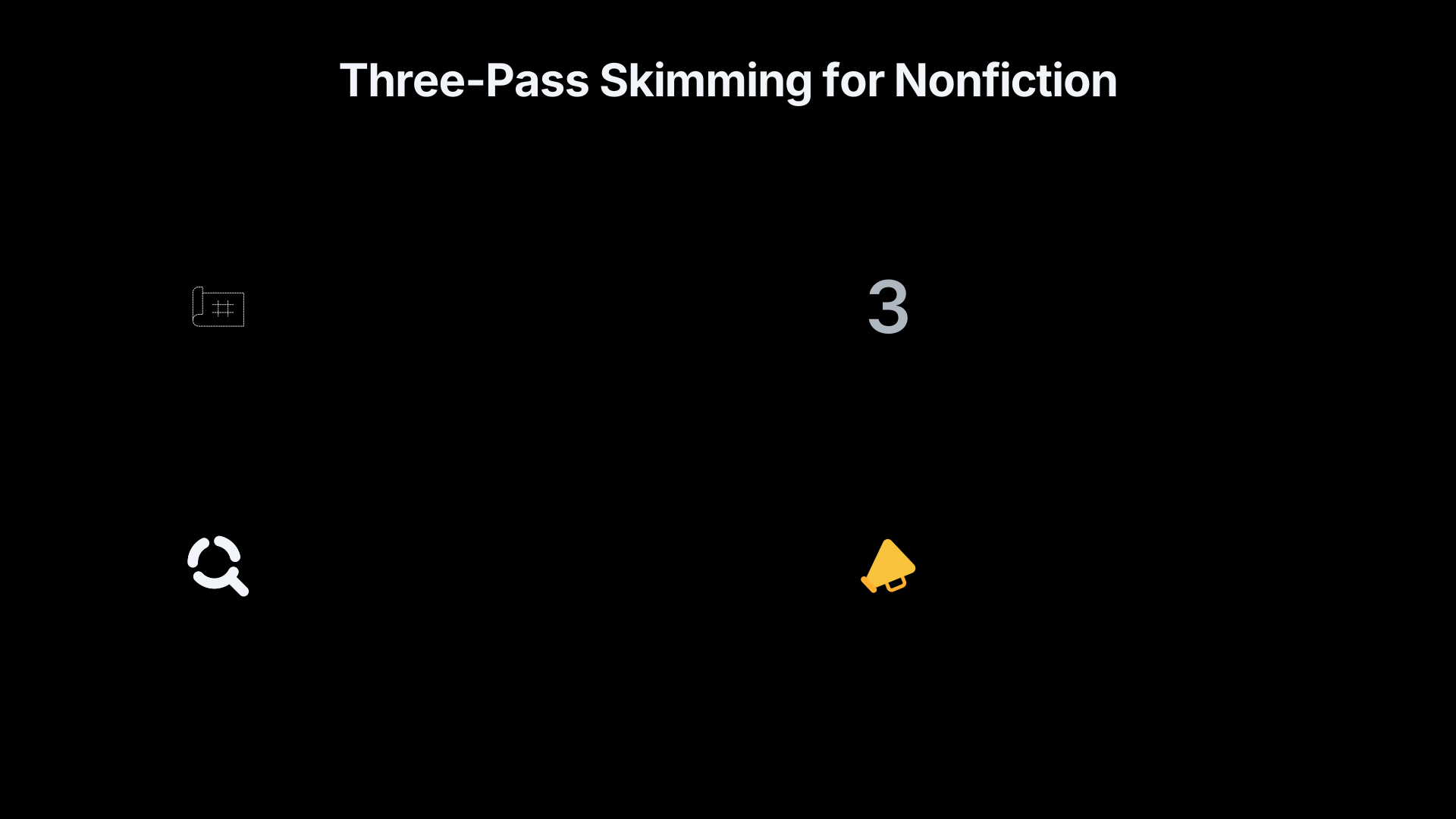 The key advantage is that each pass has a different job. Structure answers “What is this document trying to do?” Argument answers “How does the author move from problem to conclusion?” Evidence answers “Why should I believe it, and where are the limits?” By separating those tasks, readers avoid the common mistake of confusing familiarity with comprehension.[The Learning Center]learningcenter.unc.eduThe Learning Center SkimmingThe Learning CenterSkimming - The Learning CenterSkimming is a strategic, selective reading method in which you focus on the main ideas o…
First pass for structure
The first pass should be fast. The goal is not to understand every claim but to build a map of the document.
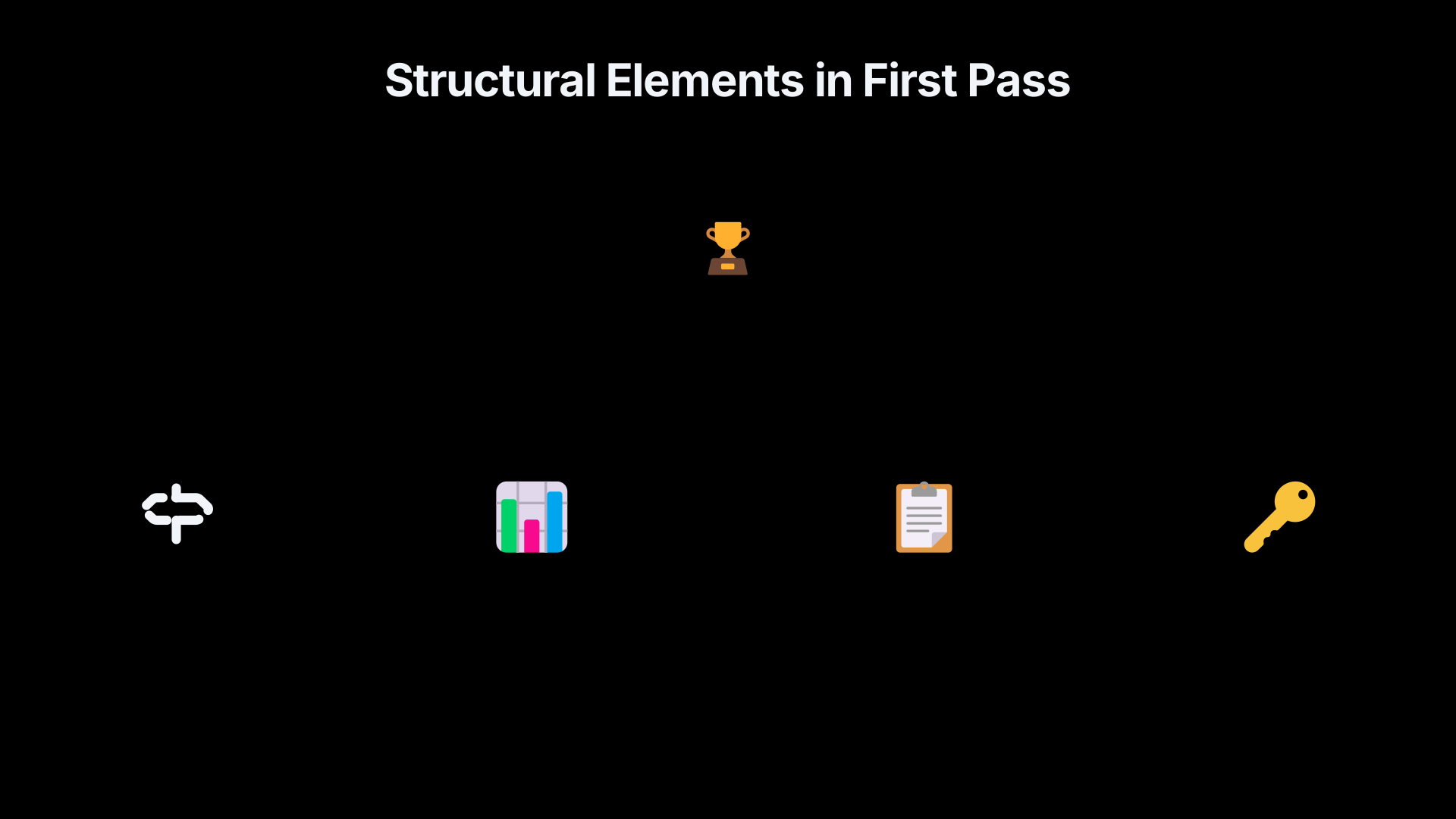
For most nonfiction texts, focus on:
- Title and subtitle
- Executive summary, abstract, or introduction
- Headings and subheadings
- Conclusions or final recommendations
- Tables, figures, and captions
- Any highlighted definitions or key terms
Many university reading guides recommend concentrating on these structural elements because they reveal the organisation of ideas without requiring line-by-line reading.[The Learning Center+2Concordia University]learningcenter.unc.eduThe Learning Center SkimmingThe Learning CenterSkimming - The Learning CenterSkimming is a strategic, selective reading method in which you focus on the main ideas o…
At the end of the first pass, you should be able to answer a few basic questions:
- What type of document is this?
- What problem is it addressing?
- How is it organised?
- Which sections appear most important?
- Is a deeper read justified?
For example, in a 40-page policy report, the first pass might reveal that only three sections contain findings relevant to your project. The rest can be deprioritised immediately. That is a genuine speed gain because it reduces unnecessary reading rather than simply accelerating eye movements.
What a successful first pass looks like
A useful test is whether you can sketch the document’s outline from memory. Not the details, just the shape:
- Problem or question.
- Main sections.
- Central conclusion.
- Supporting themes.
If you cannot describe the structure, the first pass was probably too fast.
Second pass for argument movement
Once the structure is clear, the second pass follows the logic of the text.
Instead of asking “What does this paragraph say?”, ask “What role does this paragraph play?”
Look particularly for:
- Main claims
- Contrasts and objections
- Cause-and-effect relationships
- Recommendations
- Transitions between sections
- Repeated concepts
Argument markers such as “however”, “therefore”, “despite”, “suggests”, and “in contrast” often reveal where the author is making important moves. Academic reading guides frequently recommend paying special attention to topic sentences and concluding sentences because they carry much of the argumentative burden.[Concordia University]concordia.careading strategies skimming vs close readingConcordia UniversityReading Strategies: Skimming vs Close Reading | News12 Oct 2022 — Look at the abstract – “Always read the abstracts f…
During this pass, ignore many details. Detailed examples, long anecdotes, and extensive quotations can usually wait. The objective is to understand how the conclusion emerges from the premises.
A useful technique is to summarise each major section in one sentence. If a document contains six major sections, you should finish the second pass with six concise statements that explain how the argument progresses from beginning to end.
Finding the “spine” of the text
Many nonfiction works contain a large amount of supporting material around a relatively small argumentative core.
Consider an academic article:
- Introduction explains the problem.
- Literature review provides context.
- Method section explains the approach.
- Results present findings.
- Discussion interprets those findings.
- Conclusion states implications.
The second pass identifies how these parts connect rather than trying to absorb every statistic or citation. The three-pass method originally developed for research papers emphasises understanding the content and overall reasoning before attempting detailed mastery.[CCR]ccr.sigcomm.orgpapers. I also de- scribe how to use this method to do a literature…Read more…
Third pass for evidence and limits
The third pass is where honest skimming separates itself from superficial reading.
After identifying structure and argument, examine the support behind the claims.
Look for:
- Data and statistics
- Case studies
- Expert testimony
- Experimental results
- Sources and references
- Qualifications and caveats
Just as important, look for limitations. Strong nonfiction often states where its conclusions do not apply. Words such as “may”, “under these conditions”, “correlational”, “limited sample”, or “further research” indicate boundaries on the claim.
At this stage, ask three questions:
- What evidence supports the central argument?
- Is the evidence proportionate to the claim?
- What uncertainties remain?
For example, a report may recommend a policy change based on a small pilot study. The second pass may have captured the recommendation, but the third pass reveals how much confidence the reader should place in it.
Why this pass matters
Research on reading and skimming consistently finds a trade-off between speed and comprehension. Readers who skim gain time but often lose detail and accuracy. A dedicated evidence pass helps recover some of that lost understanding by concentrating attention on the parts most likely to determine whether a claim is trustworthy.[PMC+2Butte-Glenn Community College]pmc.ncbi.nlm.nih.govReading and skimming clinical information: insights from…by MA Soltan · 2025 · Cited by 1 — Reading times are shorter and comprehen…
This pass also prevents a common failure mode: remembering conclusions while forgetting how those conclusions were justified.
When three passes work best
The method is especially useful for:
- Academic articles
- Government reports
- Policy papers
- Long-form journalism
- Business analyses
- Technical white papers
- Historical and analytical essays
These documents often have a clear structure and explicit argumentation, making staged reading highly efficient. University reading resources frequently recommend surveying a text before deeper engagement for exactly this reason.[Humanities LibreTexts+2University of Toronto Mississauga]human.libretexts.orgIt calls for readers to skim a text before readingities LibreTexts3.3: Reading Strategies - PreviewingNovember 12, 2019 — 19 Mar 2025 — Previewing is a strategy that readers use to r…
The method is less valuable for highly narrative nonfiction where the argument emerges gradually through storytelling. In those cases, excessive skimming can distort the author’s intent.

Common mistakes
The most frequent error is treating the first pass as the entire process. Readers look at headings, read the introduction and conclusion, and then assume they understand the work.
Other common problems include:
- Spending too long on details during the second pass.
- Ignoring evidence until after forming opinions.
- Skipping limitations and uncertainty statements.
- Confusing recognition with understanding.
A useful self-check is simple: explain the document aloud in two minutes. Describe its structure, argument, and evidence separately. If one of those categories is missing, another pass may be necessary.
A practical time allocation
For a challenging 30-page nonfiction document, a rough allocation might be:
PassFocusApproximate timeFirstStructure and relevance5–10 minutesSecondArgument movement15–25 minutesThirdEvidence and limits10–20 minutes
The exact numbers matter less than the separation of tasks. Each pass narrows attention onto a different layer of understanding.
By the end, the reader should know not only what the author concluded, but also how the conclusion was reached and how strong the supporting evidence appears. That combination makes three-pass skimming one of the most reliable ways to read nonfiction faster without pretending that speed alone creates understanding.
Amazon book picks
Further Reading
Books and field guides related to A safer way to skim difficult nonfiction. Use these as the next step if you want deeper reading beyond the article.
How to Read a Book
Rating: 4.0/5 from 41 Google Books ratings
Its inspectional and analytical reading framework closely matches a multi-pass skim.

eBay marketplace picks
Marketplace Samples
Example marketplace items related to this page. Use the search link to explore similar finds on eBay.


Endnotes
1.
Source: ccr.sigcomm.org
Link:https://ccr.sigcomm.org/online/files/p83-keshavA.pdf
Source snippet
papers. I also de- scribe how to use this method to do a literature...Read more...
2.
Source: concordia.ca
Title: reading strategies skimming vs close reading
Link:https://www.concordia.ca/cunews/offices/vprgs/gradproskills/blogs/2022/10/13/reading-strategies-skimming-vs-close-reading.html
Source snippet
Concordia UniversityReading Strategies: Skimming vs Close Reading | News12 Oct 2022 — Look at the abstract – “Always read the [abstracts]({{ 'abstracts/' | relative_url }}) f...
3.
Source: pmc.ncbi.nlm.nih.gov
Link:https://pmc.ncbi.nlm.nih.gov/articles/PMC12801452/
Source snippet
Reading and skimming clinical information: insights from...by MA Soltan · 2025 · Cited by 1 — Reading times are shorter and comprehen...
4.
Source: butte.edu
Title: Glenn Community College Skimming and Scanning
Link:https://www.butte.edu/departments/cas/tipsheets/readingstrategies/skimming_scanning.html
Source snippet
Glenn Community CollegeSkimming and Scanning - TIP SheetSkimming and scanning are reading techniques that use rapid eye movement an...
5.
Source: human.libretexts.org
Title: It calls for readers to skim a text before reading
Link:https://human.libretexts.org/Courses/City_College_of_San_Francisco/Writing_Reading_and_College_Success%3A_A_First-Year_Composition_Course_for_All_Learners_%28Kashyap_and_Dyquisto%29/03%3A_The_Reading-Writing_Connection/3.03%3A_Reading_Strategies_-_Previewing
Source snippet
ities LibreTexts3.3: Reading Strategies - PreviewingNovember 12, 2019 — 19 Mar 2025 — Previewing is a strategy that readers use to r...
Published: November 12, 2019
6.
Source: concordia.ca
Title: reading strategies skimming vs close reading
Link:https://www.concordia.ca/cunews/offices/vprgs/gradproskills/blogs/2017/09/21/reading-strategies-skimming-vs-close-reading.html
Source snippet
Reading Strategies: Skimming vs Close Reading | News21 Sept 2017 — This week's blog post will address two reading methods discussed in th...
7.
Source: learningcenter.unc.edu
Title: The Learning Center Skimming
Link:https://learningcenter.unc.edu/tips-and-tools/skimming/
Source snippet
The Learning CenterSkimming - The Learning CenterSkimming is a strategic, selective reading method in which you focus on the main ideas o...
8.
Source: utm.utoronto.ca
Link:https://www.utm.utoronto.ca/rgasc/student-resource-hub/study-skills-resources/read-effectively-sq3r
Source snippet
University of Toronto MississaugaRead Effectively with SQ3R | Robert Gillespie Academic...The SQ3R method (Survey, Question, Read, Recit...
9.
Source: pdf.ai
Title: improving reading comprehension
Link:https://pdf.ai/resources/improving-reading-comprehension
Source snippet
Improve Your Reading Skills: Top Tips for Better...15 May 2025 — This listicle presents eight proven techniques to enhance your understa...
Published: May 2025
Additional References
10.
Source: researchgate.net
Link:https://www.researchgate.net/publication/337256453_THE_ANALYSIS_OF_SKIMMING_AND_SCANNING_TECHNIQUE_TO_IMPROVE_STUDENTS_IN_TEACHING_READING_COMPREHENSION
Source snippet
the analysis of skimming and scanning technique to...by IR Aritonang · 2018 · Cited by 105 — The objective of this research is to find o...
11.
Source: researchgate.net
Link:https://www.researchgate.net/publication/394297308_Survey_Question_Read_Recite_Review_SQ3R_Method_Improves_Reading_Comprehension_of_Descriptive_Texts_for_Tenth_Grade_Students
Source snippet
(PDF) Survey, Question, Read, Recite, Review (SQ3R...28 Jun 2025 — This study aims to determine the effectiveness of the SQ3R method (Su...
12.
Source: researchgate.net
Link:https://www.researchgate.net/publication/400600826_The_Effectiveness_of_Survey_Question_Read_Recite_and_Review_SQ3R_Technique_to_Increase_Students%27_Reading_Comprehension
Source snippet
(PDF) The Effectiveness of Survey, Question, Read, Recite...30 Apr 2026 — The results revealed that the SQ3R technique significantly imp...
13.
Source: help.open.ac.uk
Link:https://help.open.ac.uk/critical-reading-techniques/use-an-efficient-approach
Source snippet
Open University HelpUse an efficient approach: Critical reading techniquesScanning and skimming · get an indication of the scope and cont...
14.
Source: medium.com
Link:https://medium.com/%40riazleghari/sqrrr-and-memory-techniques-effective-reading-and-remembering-strategies-5d038864ab44
Source snippet
SQRRR and Memory Techniques: Effective Reading and...... SQ3R approach is particularly useful for enhancing reading comprehension and in...
15.
Source: researchgate.net
Link:https://www.researchgate.net/publication/380172463_Evaluating_the_Effectiveness_of_the_SQ3R_Method_in_Enhancing_Students%27_Reading_Proficiency
Source snippet
(PDF) Evaluating the Effectiveness of the SQ3R Method in...20 Apr 2024 — This study underscores the effectiveness of the SQ3R method in...
16.
Source: adlit.org
Link:https://www.adlit.org/in-the-classroom/strategies/sq3r-survey-question-read-recite-review
Source snippet
SQ3R: Survey-Question-Read-Recite-ReviewSQ3R is a comprehension strategy that helps students think about the text they are reading while...
17.
Source: cdn.vanderbilt.edu
Title: CDNStrategies for Reading and Comprehending Scholarly Texts Reading resource
Link:https://cdn.vanderbilt.edu/vu-wpfsx/wp-content/uploads/sites/50/2024/11/VUELC-Scholarly-Reading-Guide-Strategies-for-Reading-and-Comprehending-Scholarly-Texts.pdf
Source snippet
Three-Pass Method3. Another strategy is called the three-pass method. The three-pass method suggests reading articles in three passes. A...
18.
Source: youtube.com
Link:https://www.youtube.com/watch?v=3g2UYgOjbh0
19.
Source: kaggle.com
Link:https://www.kaggle.com/general/527494
Source snippet
Read title, abstract, and introduction · Second Pass (up to 1 hour): Grasp the content, but not...Read more...
Topic Tree