Within Inner Rhythm
How rhythm makes long sentences easier
Inner rhythm helps readers group clauses, resolve ambiguity, and keep meaning intact when sentences become longer or more layered.
On this page
- Why silent readers hear phrase structure
- How imagined pauses guide grammar
- When complex syntax breaks the rhythm
Page outline Jump by section
Introduction
When readers encounter a long sentence, they rarely decode it one word at a time and then assemble the meaning afterwards. Instead, they tend to impose an internal rhythm that groups words into phrases, highlights relationships between clauses, and signals where ideas begin and end. Researchers often describe this process as implicit prosody: the mental pattern of phrasing, stress, and pauses that accompanies silent reading. Evidence from sentence-processing studies suggests that this inner rhythm helps readers resolve grammatical structure, especially when syntax is complex or temporarily ambiguous.[Janet Dean Fodor]janetdeanfodor.wordpress.comfodor 2002 prosodic disambiguation in silent readingThe Implicit Prosody Hypothesis (IPH): In silent reading, a default prosodic contour is projected onto the stimulus, and it may influence…
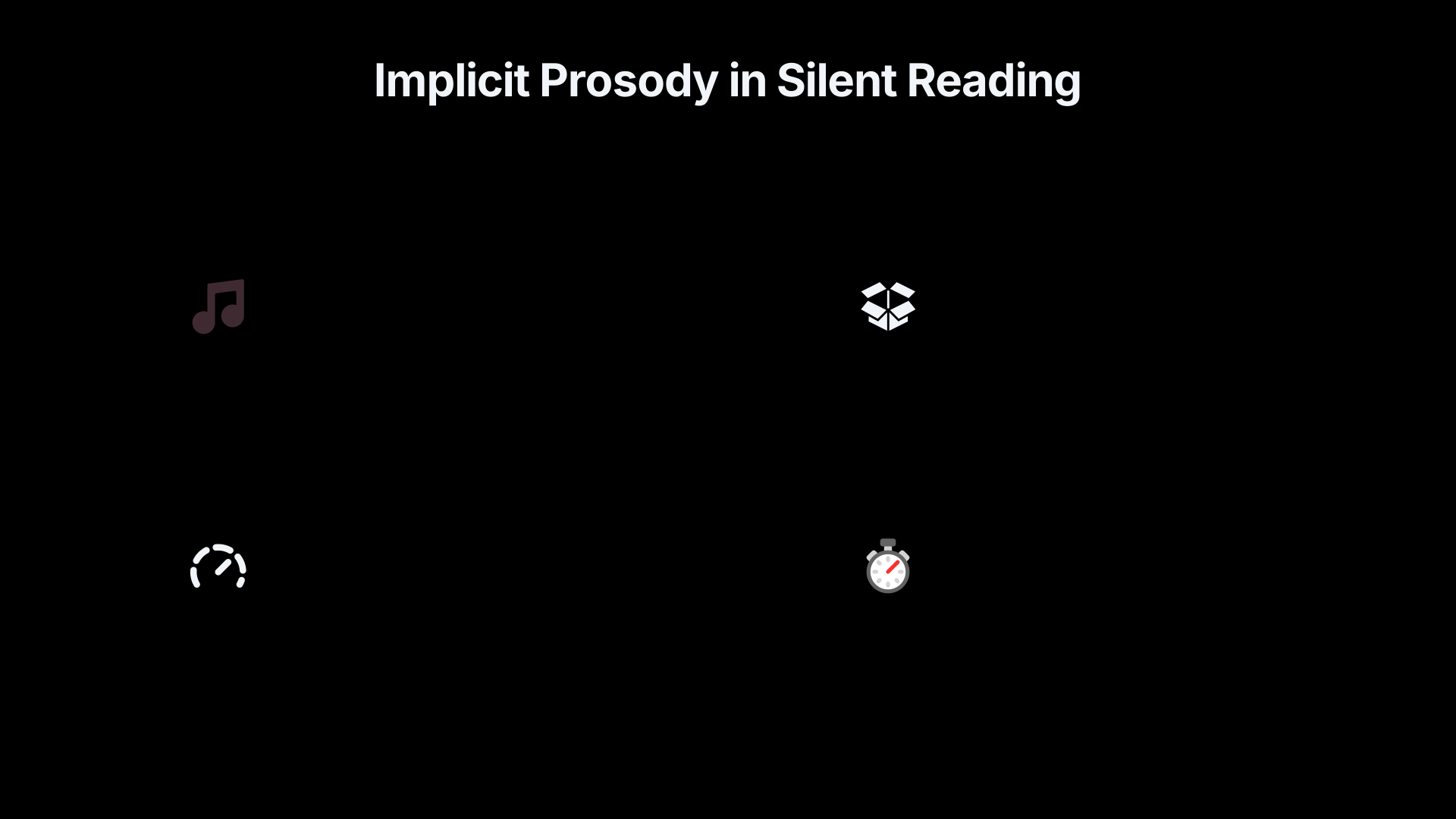 For reading speed, the benefit is not merely aesthetic. Efficient readers can move through longer sentences quickly because they process larger units of meaning rather than repeatedly reconstructing grammar from individual words. Inner rhythm acts as a guide that keeps comprehension intact while reducing the cognitive effort required to parse complex syntax.[ResearchGate]researchgate.net385970231 The role of prosodic phrasing in silent readingResearchGate(PDF) The role of prosodic phrasing in silent readingNov 28, 2024 — This study tested this hypothesis by manipulating the lex…
Why silent readers hear phrase structure
Complex sentences often contain nested clauses, modifiers, and relationships that are not immediately obvious from word order alone. A reader must determine which words belong together and which ideas are subordinate to others.
Consider a sentence such as:
While the manager who supervised the project was travelling, the team completed the final revisions.
Understanding this sentence depends on recognising that who supervised the project belongs to the manager, while the team completed the final revisions forms the main clause. Skilled readers typically do not calculate these relationships from scratch. Instead, they mentally group the sentence into meaningful chunks, creating an internal pattern similar to spoken phrasing.
The Implicit Prosody Hypothesis, developed by psycholinguist Janet Dean Fodor and supported by later studies, proposes that silent readers project a default prosodic contour onto text. This mental contour influences how grammatical structure is interpreted and can steer parsing decisions before conscious analysis is complete.[Janet Dean Fodor]janetdeanfodor.wordpress.comfodor 2002 prosodic disambiguation in silent readingThe Implicit Prosody Hypothesis (IPH): In silent reading, a default prosodic contour is projected onto the stimulus, and it may influence…
Research on syntactic ambiguity repeatedly finds that imagined phrasing affects interpretation. Readers tend to favour grammatical analyses that fit the prosodic structure they have mentally assigned to a sentence.[Wiley Online Library]onlinelibrary.wiley.com1467 9817.12124Wiley Online LibraryImplicit prosody and parsing in silent readingby R Webman‐Shafran · 2018 · Cited by 25 — The current study explored t…
Chunking reduces processing load
One reason rhythm aids parsing is that it reduces the burden on working memory.
Instead of holding a long string of individual words, readers organise information into larger phrase-sized units:
- Introductory clauses
- Relative clauses
- Coordinated phrases
- Main clauses
These units function as manageable packages of information. The reader can process each package and then connect it to the larger sentence structure. This reduces the likelihood of losing track of grammatical relationships as sentences grow longer.[ILA]ila.onlinelibrary.wiley.comILAEvidence for Prosody in Silent ReadingGross - 2014Dec 18, 2013 — According to the implicit prosody hypothesis (Fodor, 2002), silent readers project prosody onto written senten…
How imagined pauses guide grammar
In spoken language, pauses and intonation often reveal structure. Silent readers appear to recreate some of these signals internally.
A mentally inserted pause after an introductory clause, for example, helps mark where the main statement begins. Likewise, a subtle boundary before a relative clause can indicate that the upcoming information modifies a noun rather than introducing a new action.
Studies examining punctuation provide particularly clear evidence. Commas influence more than visual organisation; they can trigger implicit prosodic boundaries that shape grammatical interpretation. Experiments using event-related brain responses and sentence-processing tasks show that readers often treat comma-induced boundaries similarly to prosodic breaks in speech.[PMC]pmc.ncbi.nlm.nih.govPMCPunctuation and Implicit Prosody in Silent ReadingNIHby JE Drury · 2016 · Cited by 46 — This study presents the first two ERP reading studies of comma-induced effects of covert (imp…
This matters because many difficult sentences contain temporary ambiguities. Readers may initially favour one interpretation only to discover later that it is incorrect. Internal phrasing helps reduce these errors by signalling likely structural boundaries earlier in the reading process.[MDPI]mdpi.comImplicit Prosody and Contextual Bias in Silent Readingby K McCurdy · 2013 · Cited by 21 — This experiment seeks to probe the interact…
Resolving ambiguous structures
A classic challenge in sentence processing involves attachment ambiguity, where a phrase could logically connect to more than one part of a sentence.
Research across several languages has found that prosodic expectations influence which attachment readers choose. Silent readers often interpret ambiguous constructions in ways that align with their internally generated phrasing patterns.[Wiley Online Library]onlinelibrary.wiley.com1467 9817.12124Wiley Online LibraryImplicit prosody and parsing in silent readingby R Webman‐Shafran · 2018 · Cited by 25 — The current study explored t…
More recent experiments have strengthened this finding. A 2024 study on silent reading found faster reading times when sentence structure matched expected prosodic phrasing than when it conflicted with it, suggesting that readers actively use internal rhythm during syntactic processing.[ResearchGate]researchgate.net385970231 The role of prosodic phrasing in silent readingResearchGate(PDF) The role of prosodic phrasing in silent readingNov 28, 2024 — This study tested this hypothesis by manipulating the lex…
When complex syntax breaks the rhythm
Inner rhythm is most noticeable when it fails.
Readers often experience this during so-called garden-path sentences—sentences that encourage an initial interpretation which later proves incorrect. An example is:
The old man the boat.
Many readers initially treat old man as a noun phrase, only later discovering that man functions as a verb. The sentence becomes confusing because the expected rhythmic grouping does not match the actual grammatical structure.[ILA]ila.onlinelibrary.wiley.comILAEvidence for Prosody in Silent ReadingGross - 2014Dec 18, 2013 — According to the implicit prosody hypothesis (Fodor, 2002), silent readers project prosody onto written senten…
When the mental rhythm leads the reader down the wrong path, several things commonly happen:
- Eye movements slow down.
- Regressions increase as readers look back.
- Working memory demands rise.
- Comprehension becomes less efficient.
Studies investigating ambiguous and garden-path constructions show that interactions between syntax and implicit prosody strongly influence these moments of difficulty. Readers often need to rebuild both the grammatical structure and the accompanying mental phrasing before understanding can resume.[MDPI]mdpi.comImplicit Prosody and Contextual Bias in Silent Readingby K McCurdy · 2013 · Cited by 21 — This experiment seeks to probe the interact…
Why some sentences feel harder than others
Not all syntactic complexity produces the same level of disruption.
Long sentences remain manageable when their phrase structure aligns with natural rhythmic grouping. Difficulty tends to increase when:
- Clauses are heavily embedded.
- Important boundaries are unclear.
- Punctuation is sparse or misleading.
- Competing interpretations fit the same word sequence.
In these situations, readers must invest more effort in constructing and revising their internal phrasing. The resulting slowdown is often experienced as grammatical confusion rather than simple vocabulary difficulty.[PMC]pmc.ncbi.nlm.nih.govPMCPunctuation and Implicit Prosody in Silent ReadingNIHby JE Drury · 2016 · Cited by 46 — This study presents the first two ERP reading studies of comma-induced effects of covert (imp…
What this means for reading speed
Faster reading is not achieved by eliminating inner rhythm. In many cases, rhythm enables speed by preserving structure.
When readers can quickly establish phrase boundaries, they process larger units of meaning at once. Rather than pausing to analyse every grammatical relationship explicitly, they allow internal phrasing to guide interpretation. Research supporting the Implicit Prosody Hypothesis suggests that this process is not an optional extra layered on top of comprehension; it is one of the mechanisms that makes fluent comprehension possible in the first place.[ILA]ila.onlinelibrary.wiley.comILAEvidence for Prosody in Silent ReadingGross - 2014Dec 18, 2013 — According to the implicit prosody hypothesis (Fodor, 2002), silent readers project prosody onto written senten…
The practical implication is straightforward: long sentences become easier when readers perceive their underlying rhythm. Internal phrasing helps identify clause boundaries, maintain grammatical relationships, and prevent misunderstandings. By turning a potentially overwhelming string of words into organised chunks of meaning, inner rhythm allows readers to move through complex syntax more efficiently without sacrificing comprehension.[ResearchGate+2eScholarship]researchgate.net385970231 The role of prosodic phrasing in silent readingResearchGate(PDF) The role of prosodic phrasing in silent readingNov 28, 2024 — This study tested this hypothesis by manipulating the lex…
Amazon book picks
Further Reading
Books and field guides related to How rhythm makes long sentences easier. Use these as the next step if you want deeper reading beyond the article.
Proust and the Squid
Focuses on how the reading brain develops and processes written language, including fluent comprehension of complex text.
Reading in the Brain
Examines neural mechanisms underlying reading, helping explain how readers parse and understand lengthy sentences.

The Sense of Style
Discusses sentence design, readability, and how readers mentally process complex prose.
Reading Mind
Explains how readers process words, sentences, and larger structures, closely matching discussion of phrase grouping and complex syntax.
eBay marketplace picks
Marketplace Samples
Example marketplace items related to this page. Use the search link to explore similar finds on eBay.




Endnotes
1.
Source: ila.onlinelibrary.wiley.com
Title: ILAEvidence for Prosody in Silent Reading
Link:https://ila.onlinelibrary.wiley.com/doi/10.1002/rrq.67
Source snippet
Gross - 2014Dec 18, 2013 — According to the implicit prosody hypothesis (Fodor, 2002), silent readers project prosody onto written senten...
2.
Source: researchgate.net
Title: 385970231 The role of prosodic phrasing in silent reading
Link:https://www.researchgate.net/publication/385970231_The_role_of_prosodic_phrasing_in_silent_reading
Source snippet
ResearchGate(PDF) The role of prosodic phrasing in silent readingNov 28, 2024 — This study tested this hypothesis by manipulating the lex...
3.
Source: escholarship.org
Link:https://escholarship.org/uc/item/3nw5828p
Source snippet
The role of prosodic phrasing in silent readingby R Murakami · 2024 — According to the Implicit Prosody Hypothesis, readers are assumed t...
4.
Source: onlinelibrary.wiley.com
Title: 1467 9817.12124
Link:https://onlinelibrary.wiley.com/doi/abs/10.1111/1467-9817.12124
Source snippet
Wiley Online LibraryImplicit prosody and parsing in silent readingby R Webman‐Shafran · 2018 · Cited by 25 — The current study explored t...
5.
Source: researchgate.net
Link:https://www.researchgate.net/publication/318754434_Implicit_prosody_and_parsing_in_silent_reading
Source snippet
(PDF) Implicit prosody and parsing in silent readingThe findings suggest that children good at [oral reading]({{ 'reading-aloud/' | relative_url }}) prosody would use prosodic va...
6.
Source: pmc.ncbi.nlm.nih.gov
Title: PMCPunctuation and Implicit Prosody in Silent Reading
Link:https://pmc.ncbi.nlm.nih.gov/articles/PMC5023661/
Source snippet
NIHby JE Drury · 2016 · Cited by 46 — This study presents the first two ERP reading studies of comma-induced effects of covert (imp...
7.
Source: mdpi.com
Link:https://www.mdpi.com/1995-8692/6/2/9
Source snippet
Implicit Prosody and Contextual Bias in Silent Readingby K McCurdy · 2013 · Cited by 21 — This experiment seeks to probe the interact...
8.
Source: pmc.ncbi.nlm.nih.gov
Link:https://pmc.ncbi.nlm.nih.gov/articles/PMC12194486/
Source snippet
the Prosodic Structure of Texts Reflected in Silent Reading...by M Palmović · 2025 — This study provides indirect evidence in favour of...
9.
Source: researchgate.net
Link:https://www.researchgate.net/publication/331716353_Prosodic_Disambiguation_In_Silent_Reading
Source snippet
(PDF) Prosodic Disambiguation In Silent ReadingMost of the research reported below has adopted Fodor's method of demonstrating implicit p...
10.
Source: researchgate.net
Title: 242475204 Prosodic Disambiguation In Silent Reading
Link:https://www.researchgate.net/publication/242475204_Prosodic_Disambiguation_In_Silent_Reading
Source snippet
Prosodic Disambiguation In Silent Reading | Request PDFFodor's (2002) implicit prosody hypothesis (IPH) formalizes this idea, stating tha...
11.
Source: researchgate.net
Link:https://www.researchgate.net/publication/392831765Is_the_Prosodic_Structure_of_Texts_Reflected_in_Silent_Reading_An[Eye-Tracking
Source snippet
(PDF) Is the Prosodic Structure of Texts Reflected in Silent...11 Jun 2025 — The aim of this study was to test the Implicit Prosody Hypo...
12.
Source: mdpi.com
Link:https://www.mdpi.com/1995-8692/18/3/24
Source snippet
Is the Prosodic Structure of Texts Reflected in Silent...by M Palmović · 2025 — In research using the eye-tracking method, this evidence...
13.
Source: janetdeanfodor.wordpress.com
Title: fodor 2002 prosodic disambiguation in silent reading
Link:https://janetdeanfodor.wordpress.com/wp-content/uploads/2016/06/fodor-2002-prosodic-disambiguation-in-silent-reading.pdf
Source snippet
The Implicit Prosody Hypothesis (IPH): In silent reading, a default prosodic contour is projected onto the stimulus, and it may influence...
14.
Source: pmc.ncbi.nlm.nih.gov
Link:https://pmc.ncbi.nlm.nih.gov/articles/PMC1479854/
Source snippet
Eye movements were used to...Read more...
15.
Source: pmc.ncbi.nlm.nih.gov
Link:https://pmc.ncbi.nlm.nih.gov/articles/PMC6558037/
Source snippet
by M Yu · 2019 · Cited by 6 — According to the implicit prosody hypothesis (IPH), which was first proposed... ambiguity in silent rea...
Additional References
16.
Source: sr-research.com
Link:https://www.sr-research.com/reading-language-publications/
Source snippet
Reading and Language Eye-Tracking PublicationsSentence stress as part of linguistic prosody plays an important role for verbal communicat...
17.
Source: aclanthology.org
Link:https://aclanthology.org/2022.lrec-1.182.pdf
Source snippet
The Copenhagen Corpus of Eye Tracking Recordings from...by N Hollenstein · 2022 · Cited by 35 — We present CopCo, the Copenhagen Corpus...
18.
Source: academia.edu
Title: Explicit and Implicit Prosody in Sentence Processing
Link:https://www.academia.edu/120630609/Explicit_and_Implicit_Prosody_in_Sentence_Processing
Source snippet
(PDF) Explicit and Implicit Prosody in Sentence ProcessingOct 11, 2025 — The study shows that implicit prosody plays a critical role in i...
19.
Source: frontiersin.org
Link:https://www.frontiersin.org/journals/psychology/articles/10.3389/fpsyg.2019.01308/full
Source snippet
FrontiersEffects of Implicit Prosody and Semantic Bias on the...by M Yu · 2019 · Cited by 6 — According to the implicit prosody hypothes...
20.
Source: cambridge.org
Link:https://www.cambridge.org/engage/coe/article-details/673f31c25a82cea2fa37239b
Source snippet
Cambridge University Press & AssessmentExploring the Contribution(s) of Prosody to Ambiguity...by C Triantafyllidou · 2024 · Cited by 1...
21.
Source: isca-archive.org
Title: mills26 speechprosody
Link:https://www.isca-archive.org/speechprosody_2026/mills26_speechprosody.html
Source snippet
Individual differences in use of prosodic and lexical...by J Mills · 2026 — Implicit prosody (prosody experienced during silent reading)...
22.
Source: tandfonline.com
Link:https://www.tandfonline.com/doi/abs/10.1080/01690965.2010.503658
Source snippet
This study investigates the validity of the Implicit Prosody Hypothesis (IPH) by examining default phrasing in English, a low attachment...
23.
Source: digitalcommons.memphis.edu
Link:https://digitalcommons.memphis.edu/cgi/viewcontent.cgi?article=4141&context=etd
Source snippet
Relation of Oral and Silent Reading with...by EK Lewis · 2023 · Cited by 1 — Due to limitations associated with eye-voice coordination a...
24.
Source: pubs.asha.org
Link:https://pubs.asha.org/doi/10.1044/2017_JSLHR-L
Source snippet
of Lexical Variables on Silent Reading...18 Sept 2017 — In eye tracking during reading, participants read a sentence on a computer scree...
25.
Source: books.google.com
Title: Explicit and Implicit Prosody in Sentenc
Link:https://books.google.com/books/about/Explicit_and_Implicit_Prosody_in_Sentenc.html?id=K7H-CQAAQBAJ
Source snippet
and Implicit Prosody in Sentence ProcessingJun 23, 2015 — How are general constraints on prosody ('[timing]({{ 'timing/' | relative_url }})') and intonation ('melody') use...
Topic Tree