Within Lookbacks
When Rereading Is Actually Worth It
A brief targeted lookback can protect comprehension, while aimless rereading can drain speed without solving the problem.
On this page
- Signs a lookback is solving a real problem
- How habitual rereading wastes time
- A simple test for purposeful rereading
Page outline Jump by section
Introduction
Readers who want to increase reading speed are often told to stop rereading. That advice is only partly correct. Some rereading is a symptom of lost concentration, uncertainty, or habit, and it slows reading without improving understanding. Other rereading is a targeted repair action that prevents misunderstandings from spreading through the rest of the text.
 Research on eye movements shows that skilled readers regularly make brief backward movements, known as regressions, when they encounter ambiguity, contradictions, or information that does not fit their developing understanding of a passage. These lookbacks are part of normal comprehension monitoring rather than evidence of poor reading. The key distinction is not whether you reread, but whether the rereading solves a specific problem.[PubMed+2Springer]pubmed.ncbi.nlm.nih.govThe function of these "regressions" is still largely unknownThe function of regressions in reading: backward eye…by RW Booth · 2013 · Cited by 132 — Standard text reading involves frequent…
For readers focused on speed, the goal is not to eliminate all rereading. It is to reduce unnecessary rereading while preserving the small amount that protects comprehension.
Signs a Lookback Is Solving a Real Problem
Useful rereading tends to be brief, targeted, and triggered by a clear comprehension issue.
A lookback is usually productive when you have identified a specific gap in understanding. Examples include reaching the end of a sentence and realising you no longer know who a pronoun refers to, discovering that a later clause changes the meaning of an earlier one, or encountering a technical term whose definition appeared a few lines above. In these situations, continuing forward often compounds confusion. A quick return to the relevant phrase is usually faster than struggling through the rest of the passage with an incorrect interpretation.[Oxford University Research Archive]ora.ox.ac.ukford University Research ArchiveComprehension monitoring during reading: an eye-tracking…by AK Hessel · 2020 · Cited by 50 — We chos…
Eye-tracking studies suggest that regressions are closely linked to moments when readers detect inconsistencies or recognise that their current interpretation may be wrong. Researchers frequently use regression patterns as indicators of active comprehension monitoring and reanalysis.[Oxford University Research Archive]ora.ox.ac.ukford University Research ArchiveComprehension monitoring during reading: an eye-tracking…by AK Hessel · 2020 · Cited by 50 — We chos…
Useful rereading often has several characteristics:
- A clear destination. You know exactly which word, phrase, or sentence you need to revisit.
- A specific question. You are looking for missing information, not rereading because something feels vaguely uncomfortable.
- A short duration. The rereading ends once the uncertainty is resolved.
- An immediate payoff. Understanding improves when you return to the original reading path.
Research examining regressions during reading supports the idea that readers use backward eye movements to obtain information again from the text itself rather than merely to trigger memory. In other words, the rereading serves a practical corrective function.[PubMed+2Springer]pubmed.ncbi.nlm.nih.govThe function of these "regressions" is still largely unknownThe function of regressions in reading: backward eye…by RW Booth · 2013 · Cited by 132 — Standard text reading involves frequent…
How Habitual Rereading Wastes Time
Not all rereading is corrective. Many readers develop habits that consume time without improving comprehension.
One common pattern is automatic line-checking. A reader finishes a sentence and immediately glances back over part of it despite having understood it adequately. Another is rereading because of low confidence rather than actual confusion. The reader assumes understanding is incomplete and repeatedly verifies information that was already processed successfully.
These habits create a hidden speed penalty. Every unnecessary return interrupts the flow of ideas, adds extra eye movements, and increases total reading time. Speed-reading interventions that achieve modest improvements often do so partly by reducing needless rereading behaviours rather than by teaching readers to process words dramatically faster.[ResearchGate]researchgate.netResearch Gate(PDF) Does speed-reading training work, and if so, why?January 31, 2023 — 1 Feb 2023 — A study by Klimovich et al. (2023) reports that the positive effect of speed-reading training is limited…
The problem is not merely lost time. Habitual rereading can become a substitute for attention. Readers may drift mentally because they expect they can always go back. When concentration weakens, rereading becomes more frequent, which further slows progress.
A useful distinction is that purposeful rereading responds to a detected comprehension failure, whereas habitual rereading occurs before any real failure has been identified.
Consider these contrasting examples:
SituationLikely ValueReturning to check which scientist a result refers to after encountering conflicting findingsHelpfulRereading the previous sentence because it felt difficult, despite understanding the main pointOften unhelpfulLooking back to resolve a contradiction that appeared later in the paragraphHelpfulAutomatically rereading the last line of every pageUsually wastefulRevisiting a definition needed to understand the next sectionHelpfulRechecking information repeatedly for reassuranceUsually wasteful
The distinction matters because comprehension and speed are not opposing goals. Research consistently shows that reading too quickly can damage understanding, but excessive rereading can also impair overall efficiency. Effective readers operate between those extremes.[Research Schools Network]researchschool.org.ukbeyond the stopwatch why speed isnt the goal of readingResearch Schools NetworkBeyond the stopwatch26 Sept 2025 — When reading is too quick, the brain doesn't have time to process meaning. But…
A Simple Test for Purposeful Rereading
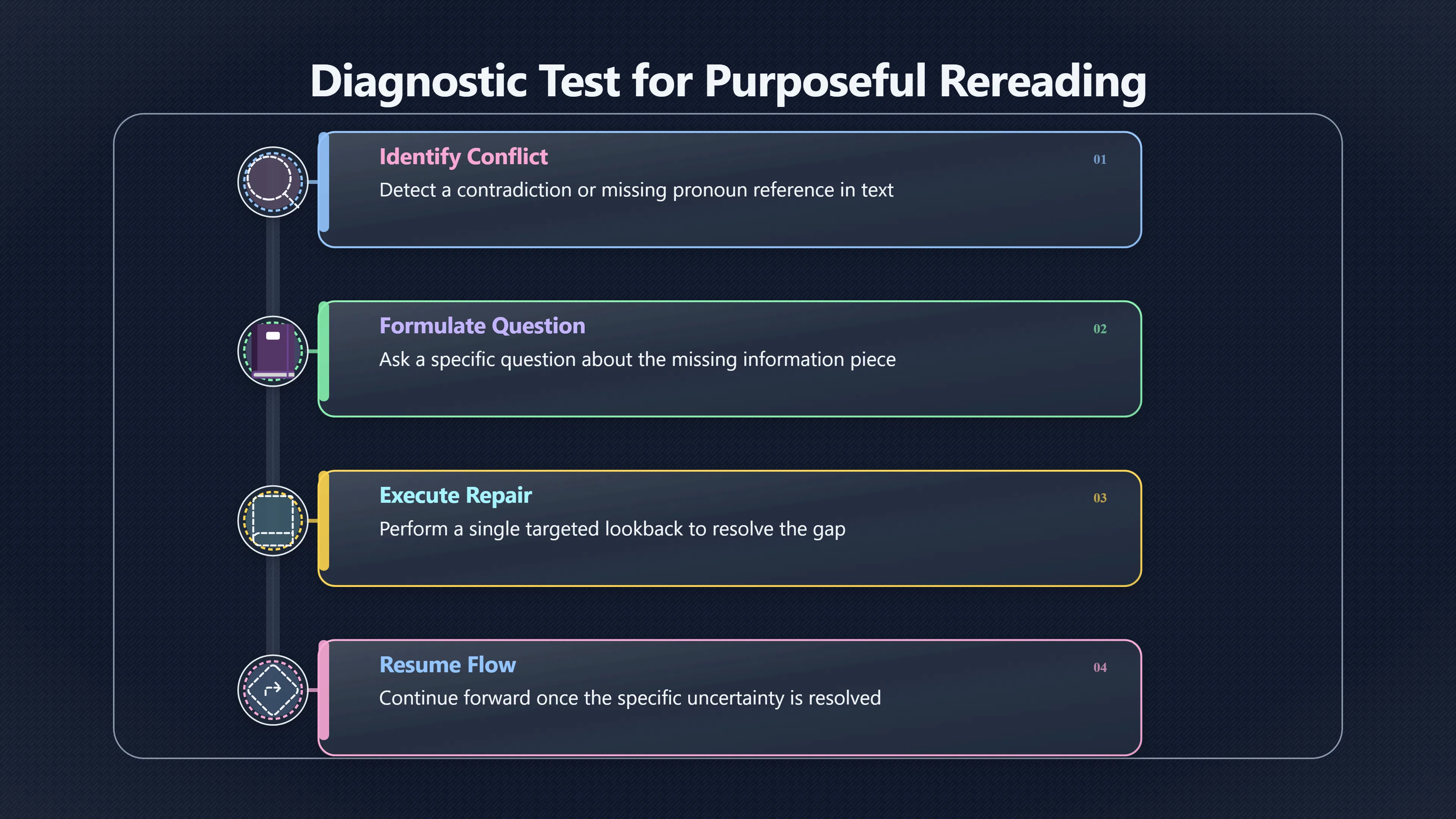
When you catch yourself about to reread, use a quick diagnostic question:
What specific problem am I trying to solve?
If you can answer that question immediately, the rereading is more likely to be worthwhile.
For example:
- “I lost track of which company acquired which.”
- “I do not know what ‘this result’ refers to.”
- “The conclusion seems to contradict the previous paragraph.”
- “I need the earlier definition to understand this section.”
In each case, the rereading has a defined objective.
If your answer is vague—“I just want to make sure”, “It felt difficult”, or “I always reread important sections”—the rereading may be habit rather than necessity.
Another useful rule is the one-pass repair principle. Go back once, locate the source of confusion, resolve it, and continue. If the same sentence requires multiple rereads and still does not make sense, the issue may lie in the text’s complexity, missing background knowledge, or fatigue rather than a simple oversight.
Building a Faster, Smarter Rereading Habit
The most efficient readers do not eliminate regressions. Instead, they become selective about them.
A practical approach is to allow brief lookbacks when comprehension genuinely breaks down while resisting automatic verification of material that is already understood. Over time, this shifts rereading from a reflex into a deliberate tool.
Eye-movement research increasingly supports the idea that reading behaviour is adaptive: readers adjust their attention, regressions, and rereading according to comprehension demands and the value of the information they are trying to recover. From a speed perspective, that is the model worth following. The fastest useful reading is not the reading with the fewest lookbacks. It is the reading where every lookback has a purpose.[ILA]ila.onlinelibrary.wiley.comUsing Eye Movements From a “Read‐Only” Task to Predict…by DC Mézière · 2025 · Cited by 1 — This suggests that eye movements related…
Amazon book picks
Further Reading
Books and field guides related to When Rereading Is Actually Worth It. Use these as the next step if you want deeper reading beyond the article.
How to Read a Book
Rating: 4.0/5 from 41 Google Books ratings
Helps distinguish productive rereading from inefficient habits.

eBay marketplace picks
Marketplace Samples
Example marketplace items related to this page. Use the search link to explore similar finds on eBay.




Endnotes
1.
Source: link.springer.com
Link:https://link.springer.com/article/10.3758/s13421-012-0244-y
Source snippet
eye movements allow rereading - Springer Natureby RW Booth · 2013 · Cited by 133 — These results suggest that readers use regressions to...
2.
Source: ila.onlinelibrary.wiley.com
Link:https://ila.onlinelibrary.wiley.com/doi/full/10.1002/rrq.70023
Source snippet
Using Eye Movements From a “Read‐Only” Task to Predict...by DC Mézière · 2025 · Cited by 1 — This suggests that eye movements related...
3.
Source: researchgate.net
Link:https://www.researchgate.net/publication/230658181_The_function_of_regressions_in_reading_Backward_eye_movements_allow_rereading
Source snippet
(PDF) The function of regressions in reading: Backward...These results suggest that readers use regressions to reread words and not to c...
4.
Source: researchgate.net
Title: Research Gate(PDF) Does speed-reading training work, and if so, why?
Link:https://www.researchgate.net/publication/367560632_Does_speed-reading_training_work_and_if_so_why_Effects_of_speed-reading_training_and_metacognitive_training_on_reading_speed_comprehension_and_eye_movements
Source snippet
January 31, 2023 — 1 Feb 2023 — A study by Klimovich et al. (2023) [reports]({{ 'reports/' | relative_url }}) that the positive effect of speed-reading training is limited...
Published: January 31, 2023
5.
Source: researchgate.net
Title: (PDF) Regressions during Reading
Link:https://www.researchgate.net/publication/334364752_Regressions_during_Reading
Source snippet
May 20, 2026 — Three experiments examine the role of previously read text in sentence comprehension and the control of eye movements duri...
Published: May 20, 2026
6.
Source: link.springer.com
Link:https://link.springer.com/article/10.1007/s11251-024-09686-4
Source snippet
the effectiveness of multiple text reading and...by P Seban · 2025 · Cited by 10 — The goal of the present study is to investigate the s...
7.
Source: pubmed.ncbi.nlm.nih.gov
Title: The function of these “regressions” is still largely unknown
Link:https://pubmed.ncbi.nlm.nih.gov/22886737/
Source snippet
The function of regressions in reading: backward eye...by RW Booth · 2013 · Cited by 132 — Standard text reading involves frequent...
8.
Source: ora.ox.ac.uk
Link:https://ora.ox.ac.uk/objects/uuid%3Aa16f42e2-529d-47ae-ba51-50b75dd43899/files/rkh04dp70d
Source snippet
ford University Research ArchiveComprehension monitoring during reading: an eye-tracking...by AK Hessel · 2020 · Cited by 50 — We chos...
9.
Source: researchschool.org.uk
Title: beyond the stopwatch why speed isnt the goal of reading
Link:https://researchschool.org.uk/town-end/news/beyond-the-stopwatch-why-speed-isnt-the-goal-of-reading
Source snippet
Research Schools NetworkBeyond the stopwatch26 Sept 2025 — When reading is too quick, the brain doesn't have time to process meaning. But...
10.
Source: pmc.ncbi.nlm.nih.gov
Link:https://pmc.ncbi.nlm.nih.gov/articles/PMC12409514/
Source snippet
the rereading effect of digital reading through eye...by Y Xu · 2025 — During rereading, students exhibited shorter total reading time...
Additional References
11.
Source: scirp.org
Link:https://www.scirp.org/journal/paperinformation?paperid=89391
12.
Source: revistas-fonseca.com
Link:https://revistas-fonseca.com/index.php/2172-9077/article/download/626/624/1337
13.
Source: journal.lppmunindra.ac.id
Link:https://journal.lppmunindra.ac.id/index.php/Deiksis/article/download/463/775
Source snippet
EFFECTS OF SPEED READING METHOD UPON...by E Martiarini — The aim of the research is to obtain empirical data about the effects of speed...
14.
Source: readlite.in
Link:https://readlite.in/concepts/regressions-reading
Source snippet
Eye-tracking studies show skilled readers regress regularly — about 10-15% of fixations. What differs is...Read more...
15.
Source: education-progress.org
Title: GEM Report SCOPEDoes reading speed matter?
Link:https://www.education-progress.org/focus/24-readingspeed
Source snippet
GEM Report SCOPEA positive correlation between reading speed and reading comprehension at the individual level has been empirically fou...
16.
Source: d-nb.info
Link:https://d-nb.info/1227301006/34
Source snippet
Comprehension demands modulate re-reading, but not first...by AF Weiss · Cited by 58 — Abstract: Several studies have examined effects o...
17.
Source: papers.ssrn.com
Link:https://papers.ssrn.com/sol3/papers.cfm?abstract_id=5405257
Source snippet
Eye Movements in Reading Go from Easy to...by AT Lopes Rego — Our results suggest that readers tend to regress from easy words to diffic...
18.
Source: assets.cambridge.org
Title: 9781108415354 excerpt
Link:https://assets.cambridge.org/97811084/15354/excerpt/9781108415354_excerpt.pdf
Source snippet
1 Introduction to Eye-TrackingIn reading, saccades do not always move the eye forward in a text. About 10–15 per cent of the time, reader...
19.
Source: shanahanonliteracy.com
Title: dont confuse reading comprehension and learning to read rereading
Link:https://www.shanahanonliteracy.com/blog/dont-confuse-reading-comprehension-and-learning-to-read-rereading
Source snippet
But even rereading benefits from instructional guidance.Read more...
20.
Source: cognitivetrain.com
Link:https://cognitivetrain.com/regression-in-reading/
Source snippet
Regression in Reading: Why Your Eyes Keep Going...Eye-tracking research shows that regressions account for 10-15% of all eye movements d...
Topic Tree