Within Skimming Risk
The Tiny Words Skimmers Miss Most
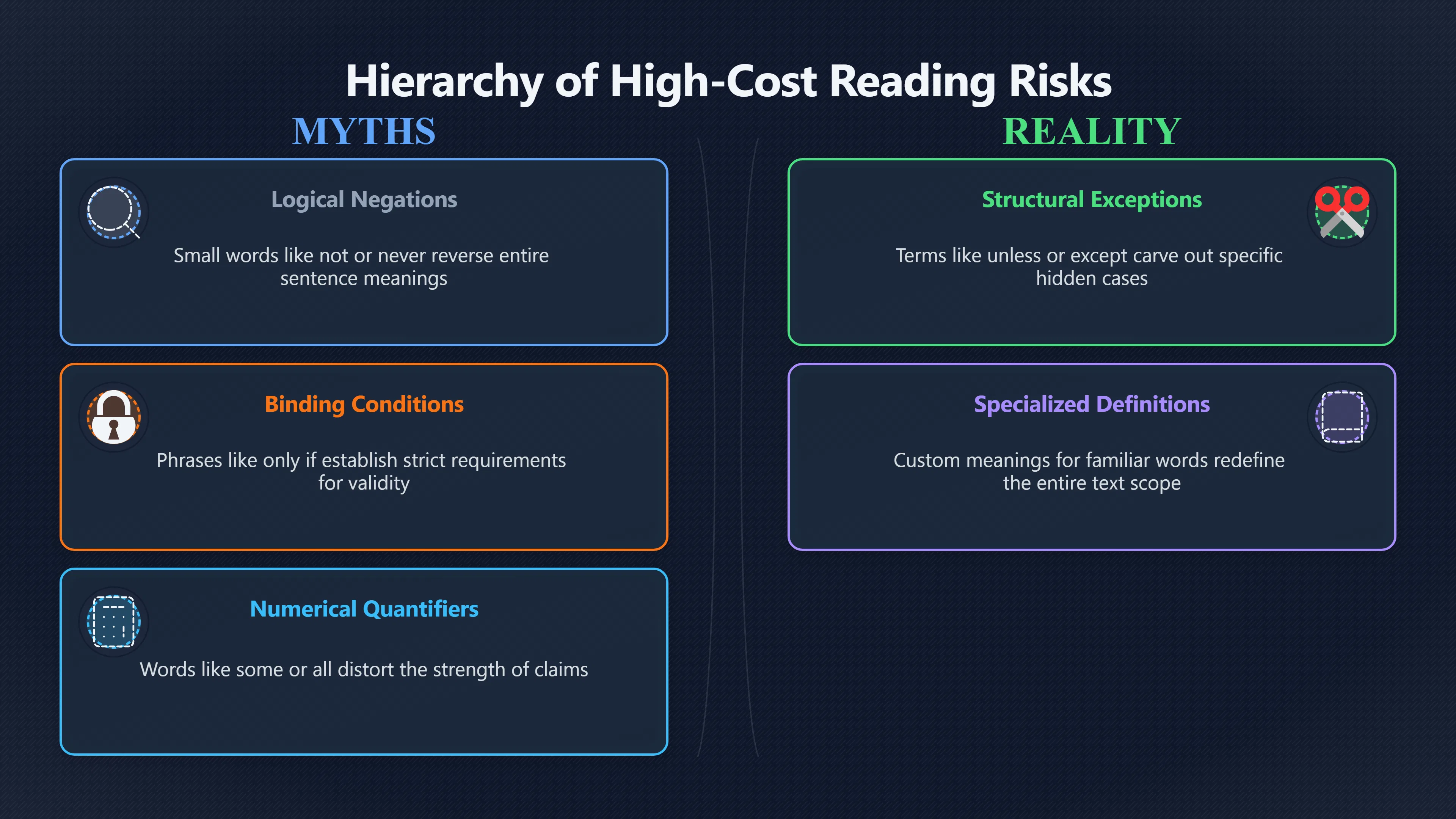
Small words such as unless, except, not, and only if can change a rule more than the surrounding sentence seems to suggest.
On this page
- Exceptions, conditions, and negations that flip meaning
- Definitions and quantifiers that reshape later passages
- A checklist for spotting high cost wording while reading fast
Page outline Jump by section
Introduction
One of the biggest risks in increasing reading speed is not missing long explanations. It is missing tiny words that quietly control the meaning of everything around them. In dense documents, a single word such as unless, except, not, only if, or at least can determine whether a rule applies, whether a conclusion is valid, or whether an instruction should be followed at all.
 Skimming works well when the goal is to capture the general idea of a text. The danger appears when a passage concentrates its practical meaning into short qualifiers. Readers often remember the headline claim while overlooking the word that limits, reverses, or narrows it. Research on skim reading consistently finds that faster reading tends to reduce comprehension because readers process fewer words deeply and spend less time verifying details.[PMC+2ResearchGate]pmc.ncbi.nlm.nih.govPMCThe impact of skim reading and navigation whenNIHby G Fitzsimmons · 2020 · Cited by 40 — It has been shown that readers spend a great deal of time skim reading on the Web and th…
This makes certain words disproportionately expensive to miss. They are small on the page but large in consequence.
Exceptions, Conditions, and Negations That Flip Meaning
The most dangerous words for skimmers are those that change the logical structure of a sentence rather than adding information.
Exceptions: the hidden carve-out
An exception removes cases from a general rule. Readers moving quickly often retain the rule and lose the exception.
Compare:
- All employees may access the system.
- All employees may access the system except contractors.
The second sentence is not a minor variation of the first. Missing except creates a fundamentally incorrect understanding.
Words that often signal exceptions include:
- except
- excluding
- unless[learnenglish.ecenglish.com]learnenglish.ecenglish.comunless and if15 Feb 2013 — Often when we are talking about present situations, we use unless instead of if…not. Unless means except if or simply it…
- notwithstanding
- however
- save for
The word unless is particularly costly because it compresses a negative condition into a single term. In practical usage it means something close to “if not” or “except if”. Missing it can reverse the operational meaning of a policy, contract clause, or technical instruction.[Learn English Weekly+2learnenglish.ecenglish.com]learnenglishweekly.comIt sets an exception to the rule. You can't go… Provided (that) means “only if”. It sets a strict requirement. This phrase…
Conditions: when a statement is not always true
Many dense texts describe actions that are permitted, prohibited, or valid only under certain circumstances.
Consider:
- The refund will be issued.
- The refund will be issued only if proof of purchase is provided.
The first statement is unconditional. The second is conditional.
Words and phrases that signal conditions include:
- if
- only if
- provided that
- on condition that[test-english.com]test-english.comif instead of if when we want to emphasise the condition that…
- subject to
- as long as
These terms often carry more practical importance than the surrounding sentence. A skimmer who remembers the action but misses the condition may walk away with the opposite understanding of what is required. Linguistically, expressions such as provided that and only if explicitly establish requirements that must be satisfied before the statement becomes true.[Learn English Weekly]learnenglishweekly.comIt sets an exception to the rule. You can't go… Provided (that) means “only if”. It sets a strict requirement. This phrase…
Negations: the smallest word with the largest effect
Negations are easy to miss because they are visually short and often embedded in longer sentences.
Examples include:
- not
- never
- cannot
- without
- no
- neither
A missed negation does not merely reduce precision. It often reverses meaning.
Compare:
- The device can be operated remotely.
- The device cannot be operated remotely.
Everything hinges on a single word.
The challenge is significant enough that researchers in natural-language processing treat negation as a specialised reasoning problem. Systems that perform well on many language tasks still struggle when meaning depends on the scope of a negation. If sophisticated language models find negation difficult, human readers rushing through dense prose should expect similar risks.[arXiv]arxiv.orgCONDAQA: A Contrastive Reading Comprehension Dataset for Reasoning about NegationNovember 1, 2022…
Why Tiny Words Escape Attention
The mechanism is simple: skimming prioritises content words and deprioritises function words.
When people read quickly, attention naturally gravitates towards nouns, verbs, numbers, headings, and visually distinctive terms. Words such as unless, not, if, and only are short, common, and visually unremarkable. They often receive less processing time than the words around them. Research on web reading shows that skim readers process text selectively, sacrificing some comprehension in exchange for speed.[PMC+2ResearchGate]pmc.ncbi.nlm.nih.govPMCThe impact of skim reading and navigation whenNIHby G Fitzsimmons · 2020 · Cited by 40 — It has been shown that readers spend a great deal of time skim reading on the Web and th…
This creates a mismatch between importance and visibility:
Visually noticeableLogically importantTechnical termsSometimesNumbersOftenProper namesOftenNegationsVery oftenConditionsVery oftenExceptionsVery often
The words that determine meaning are frequently the least visually prominent.
Definitions That Reshape Everything Afterwards
Some of the most expensive reading mistakes occur when a document defines a familiar word in a specialised way.
In everyday reading, readers assume words retain their ordinary meanings. Dense documents often reject that assumption.
A regulation might state:
“Vehicle” includes bicycles and electric scooters.
After that definition appears, every later use of vehicle inherits the specialised meaning.
A contract may define:
“Business day” excludes public holidays.
A scientific paper may define:
“Response” means a change exceeding a specific threshold.
Readers who skim past the definition frequently misunderstand every later reference.
This principle is reflected in legal interpretation. Courts and legal drafters routinely distinguish between ordinary meanings and explicitly defined meanings because a definition section can control the interpretation of the entire document.[Wikipedia]WikipediaPlain meaning rulePlain meaning rule
When reading quickly, definitions deserve disproportionate attention because they often have cascading effects across dozens of later pages.

Quantifiers: Small Words, Large Numerical Consequences
Quantifiers describe quantity, frequency, or scope. They appear modest but can dramatically alter what a statement claims.
Common examples include:
- all
- some
- most
- many
- few
- none
- at least
- at most
- more than
- less than
Consider these statements:
- Most participants improved.
- Some participants improved.
- All participants improved.
The underlying event is the same—participants improved—but the strength of the claim changes dramatically.
Quantifiers are central to how language expresses scope and quantity. Their importance is recognised in both grammar and formal logic because changing a quantifier can change the truth conditions of a statement. LearnEnglish - British Council+2National Digital Library of Ethiopia[learnenglish.britishcouncil.org]learnenglish.britishcouncil.orgLearn EnglishBritish CouncilQuantifiers | LearnEnglishMarch 15, 2010 — Learn about quantifiers like all, some, enough and less and do t…
For skimmers, quantifiers create a common illusion. The reader remembers the topic and outcome while forgetting the amount.
A scientific finding that applies to some cases may be remembered as applying to all cases. A policy that requires at least three approvals may be remembered as requiring approvals in general.
The result is not incomplete comprehension but distorted comprehension.

A Checklist for Spotting High-Cost Wording While Reading Fast
When speed matters but accuracy still matters, treat certain words as warning signals rather than background text.
Before moving on from a dense paragraph, scan specifically for:
Negations
- not
- never
- cannot
- without
- no
Exceptions
- except
- excluding
- unless[learnenglish.ecenglish.com]learnenglish.ecenglish.comunless and if15 Feb 2013 — Often when we are talking about present situations, we use unless instead of if…not. Unless means except if or simply it…
- however
- notwithstanding
Conditions
- if
- only if
- provided that
- subject to
- on condition that[test-english.com]test-english.comif instead of if when we want to emphasise the condition that…
Definitions
- means
- defined as
- for the purposes of
- refers to
[Quantifiers]learnenglish.britishcouncil.orgLearn EnglishBritish CouncilQuantifiers | LearnEnglishMarch 15, 2010 — Learn about quantifiers like all, some, enough and less and do t…
- all
- some
- most
- few
- none
- at least
- at most
A useful habit is to pause briefly whenever one of these markers appears and ask a single question:
“Does this word limit, reverse, or redefine what I just read?”
If the answer is yes, that sentence is no longer suitable for pure skimming.
The Practical Rule for Fast Readers
Most words in a dense document contribute information. High-cost words control information. That distinction matters when reading quickly.
A reader can often skim descriptions, examples, and elaborations without serious consequences. Skimming past unless, not, only if, except, or a key definition is different. Those words determine the logical structure of the text. Missing them can transform a correct summary into a fundamentally incorrect one.
For anyone trying to increase reading speed, the most reliable strategy is not to read every word equally. It is to recognise that some of the smallest words carry the greatest share of meaning and deserve attention out of proportion to their size.
Amazon book picks
Further Reading
Books and field guides related to The Tiny Words Skimmers Miss Most. Use these as the next step if you want deeper reading beyond the article.
How to Read a Book
Rating: 4.0/5 from 41 Google Books ratings
Directly addresses analytical reading, inspectional reading, skimming, and how to avoid missing meaning-critical details.
Thinking, Fast and Slow
Explains cognitive shortcuts and errors that occur when readers rely on fast processing instead of careful evaluation.

The art of thinking clearly
Helps readers recognize common reasoning mistakes that can arise when qualifiers, exceptions, and framing cues are overlooked.

Critical Thinking
Supports careful attention to definitions, conditions, evidence, and logical structure in dense texts.
Endnotes
1.
Source: pmc.ncbi.nlm.nih.gov
Title: PMCThe impact of skim reading and navigation when
Link:https://pmc.ncbi.nlm.nih.gov/articles/PMC7497986/
Source snippet
NIHby G Fitzsimmons · 2020 · Cited by 40 — It has been shown that readers spend a great deal of time skim reading on the Web and th...
2.
Source: researchgate.net
Link:https://www.researchgate.net/publication/263651809_Skim_Reading_An_Adaptive_Strategy_for_Reading_on_the_Web
Source snippet
Skim Reading: An Adaptive Strategy for Reading on the WebWe suggest that readers engage in an adaptive information foraging strategy wher...
3.
Source: learnenglish.ecenglish.com
Title: unless and if
Link:https://learnenglish.ecenglish.com/lessons/unless-and-if
Source snippet
15 Feb 2013 — Often when we are talking about present situations, we use unless instead of if...not. Unless means except if or simply it...
4.
Source: arxiv.org
Link:https://arxiv.org/abs/2211.00295
Source snippet
CONDAQA: A Contrastive Reading Comprehension Dataset for Reasoning about NegationNovember 1, 2022...
Published: November 1, 2022
5.
Source: Wikipedia
Title: Plain meaning rule
Link:https://en.wikipedia.org/wiki/Plain_meaning_rule
6.
Source: learnenglish.britishcouncil.org
Title: Learn English
Link:https://learnenglish.britishcouncil.org/free-resources/grammar/english-grammar-reference/quantifiers
Source snippet
British CouncilQuantifiers | LearnEnglishMarch 15, 2010 — Learn about quantifiers like all, some, enough and less and do t...
Published: March 15, 2010
7.
Source: learnenglishweekly.com
Link:https://learnenglishweekly.com/grammar/conditionals-with-unless-provided-that-as-long-as
Source snippet
It sets an exception to the rule. You can't go... Provided (that) means “only if”. It sets a strict requirement. This phrase...
8.
Source: test-english.com
Link:https://test-english.com/explanation/b2/unless-even-if-provided-as-long-conditionals/
Source snippet
if instead of if when we want to emphasise the condition that...
9.
Source: ndl.ethernet.edu.et
Link:https://ndl.ethernet.edu.et/bitstream/123456789/8119/1/161.pdf.pdf
Source snippet
National Digital Library of EthiopiaQuantifiers in Language and Logicby S PETERS · Cited by 820 — Quantifiers are one of very few express...
10.
Source: learningcenter.unc.edu
Link:https://learningcenter.unc.edu/tips-and-tools/skimming/
Source snippet
The Learning CenterSkimming is a strategic, selective reading method in which you focus on the main ideas of a text. When skimming, delib...
11.
Source: takeielts.britishcouncil.org
Title: skimming and [scanning]({{ ‘scanning-vs-reading/’ | relative_url }}) for ielts reading
Link:https://takeielts.britishcouncil.org/blog/skimming-and-scanning-for-ielts-reading
Source snippet
Scanning for IELTS Reading2 Sept 2025 — Skimming vs. Scanning in IELTS Reading: learn how skimming and scanning work and find out how to...
Additional References
12.
Source: onestopenglish.com
Link:https://www.onestopenglish.com/ask-the-experts/grammar-unless-and-if/146350.article
Source snippet
Grammar: 'unless' and 'if' | ArticleUnless = if... not. This is a good example of a 'rule of thumb' – one that is easy to remember and a...
13.
Source: wallstreetenglish.com
Link:https://www.wallstreetenglish.com/exercises/what-are-quantifiers/
Source snippet
What are Quantifiers?A quantifier is a word that usually goes before a noun to express the quantity of the object; for example, a little...
14.
Source: youtube.com
Link:https://www.youtube.com/watch?v=RdVtuH1Vtp0
Source snippet
This breakdown explores the dangers of superficial processing and the logistical impact of misinterpreting short qualifiers or structural...
15.
Source: youtube.com
Link:https://www.youtube.com/watch?v=3g2UYgOjbh0
16.
Source: techscience.com
Link:https://www.techscience.com/iasc/v29n2/42945/html
Source snippet
Reading online material is monitored by “[eye-tracking]({{ 'eye-tracking/' | relative_url }})” which shows sensitivity in terms of...
17.
Source: facebook.com
Link:https://www.facebook.com/groups/289783688341983/posts/778260629494284/
Source snippet
idea,here we can read title of book and look at pictures,we do'nt...
18.
Source: reddit.com
Link:https://www.reddit.com/r/logic/comments/1den0uw/predicate_logic_and_translation_of_the_word_unless/
Source snippet
o way to have an issue with one of them without having an...
19.
Source: youtube.com
Link:https://www.youtube.com/watch?v=MqhYCBQJ0ZE
Source snippet
Present unreal conditional with unless, only if, and even if; Page 89...
20.
Source: cambrilearn.com
Title: types of reading skills
Link:https://cambrilearn.com/blog/types-of-reading-skills
Source snippet
and Their Purpose19 Aug 2024 — The four key reading techniques—skimming, scanning, intensive reading, and extensive reading—can significa...
21.
Source: youtube.com
Title: How to Understand Legal Contracts: Top 20 Terms Made Easy!
Link:https://www.youtube.com/watch?v=6EdmaiYeTG8
Source snippet
Reading Strategies Made Easy | Skimming vs Scanning vs Inferential Reading vs close reading...
Topic Tree