Within Adult practice
Is slow reading a fluency problem?
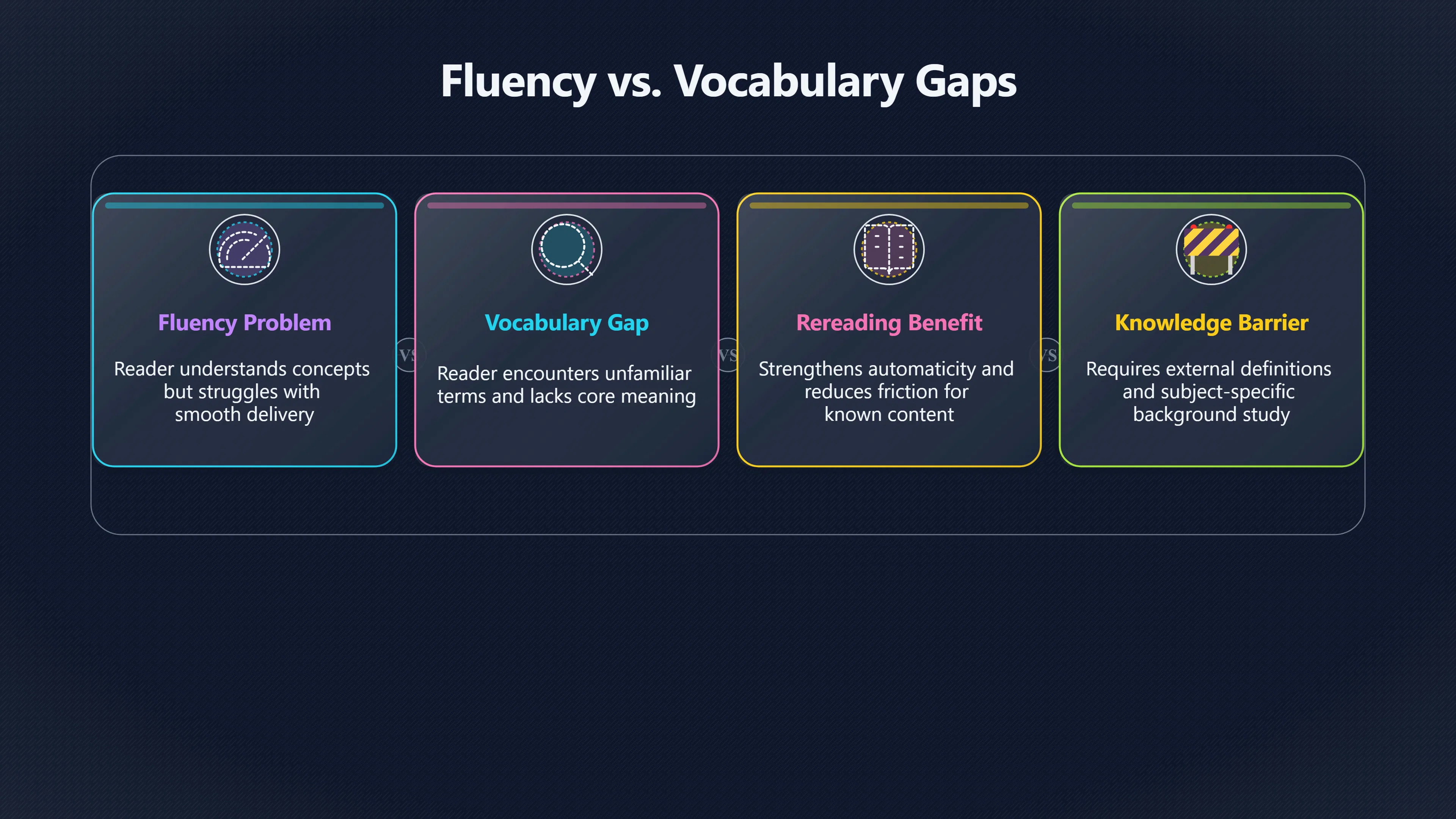
Rereading helps hesitant readers most when the ideas are clear but word recognition, phrasing, or pauses slow them down.
On this page
- The self check that separates fluency from confusion
- Why vocabulary gaps need a different strategy
- Red flags for vision, fatigue, or text difficulty
Page outline Jump by section
Introduction
Rereading is often recommended to increase reading speed, but it only works when it addresses the real bottleneck. For many adults in workplace training, professional reading, or study programmes, slow reading is caused by hesitations in word recognition, awkward phrasing, or frequent pauses rather than confusion about the underlying ideas. In those cases, rereading can improve fluency substantially. However, if the reader does not understand the vocabulary, lacks background knowledge, or cannot follow the argument, rereading the same passage may make it feel more familiar without meaningfully improving comprehension. Research on reading fluency consistently distinguishes between automatic word processing and language understanding; both matter, but they are not the same skill.[Shanahan on Literacy+2Reading Rockets]shanahanonliteracy.comShanahan on LiteracyEverything You Wanted to Know about Repeated ReadingRepeated reading is a particular method proposed by S. Jay Samuel…
 This distinction matters because adults who misdiagnose the problem can spend time practising the wrong solution. Faster eye movement through a page is useful only if understanding keeps pace.
Is the problem fluency or confusion?
The simplest test is to separate understanding from reading delivery.
Imagine an adult employee reading a procedure manual. On the first pass, they stumble over terminology, pause often, and read in a choppy rhythm. Afterwards, however, they can explain the procedure accurately in their own words. That pattern points to a fluency problem. The ideas were understood, but the reading process itself was inefficient.
Now consider a different reader who moves through the text slowly and, when asked to explain it, cannot identify the main point, key terms, or sequence of steps. In this case, the issue is not merely fluency. The reader is struggling to build meaning from the text. Repeating the same passage may increase familiarity with its appearance without solving the underlying comprehension barrier.[Reading Rockets]readingrockets.orgReading RocketsFluency: In DepthFluency is the ability to read a text accurately, at a good pace, and with proper expression and comprehe…
A useful self-check is:
- Can you accurately summarise what you just read?
- Can you explain it aloud without looking at the page?
- Do you recognise most of the vocabulary?
- Does reading become noticeably smoother on a second pass?
If understanding is already present and only the delivery improves, rereading is likely targeting the right mechanism.
Why rereading helps fluent processing
Repeated reading was originally developed to improve automaticity: the ability to recognise and process words rapidly and with little conscious effort. When recognition becomes more automatic, the brain spends less effort on decoding and more on understanding, evaluation, and memory.[Academy Publication+3Shanahan on Literacy+3PMC]shanahanonliteracy.comShanahan on LiteracyEverything You Wanted to Know about Repeated ReadingRepeated reading is a particular method proposed by S. Jay Samuel…
For adults, this often appears as:
- Fewer regressions back to earlier lines.
- Reduced hesitation on technical terms already encountered.
- Better phrasing across long sentences. * More natural reading rhythm.[nichd.nih.gov]nichd.nih.govNational Reading Panel - Reports of the Subgroups - FluencyThe effect of repeated readings on reading rate, speech pauses, and word… * Increased reading rate with maintained accuracy.[nichd.nih.gov]nichd.nih.govNational Reading Panel - Reports of the Subgroups - FluencyThe effect of repeated readings on reading rate, speech pauses, and word…
The important point is that rereading strengthens access to information that is already available to the reader. It reduces friction. It does not automatically create missing knowledge. Research on fluency instruction repeatedly finds benefits for reading rate, accuracy, and automaticity, particularly when readers struggle with efficient word processing.[NICHD+2Sage Journals]nichd.nih.govNational Reading Panel - Reports of the Subgroups - FluencyThe effect of repeated readings on reading rate, speech pauses, and word…
This is why rereading can be highly effective for a university student reviewing a familiar research article before an exam or an employee practising a compliance document that they already understand conceptually.

Why vocabulary gaps need a different strategy
One of the biggest risks is mistaking a vocabulary problem for a fluency problem.
Suppose a finance trainee reads a report containing unfamiliar terms such as “amortisation”, “duration risk”, and “counterparty exposure”. Reading the report three times may make those words look more familiar, but familiarity is not the same as understanding. Unless the meanings are learned, comprehension remains limited.[Illinois Licensure Testing System]il.nesinc.comDifficulties with reading comprehension can stem from different underlying causes.Read more…
The same issue occurs with specialised workplace language, academic jargon, legal terminology, and dense technical writing. Readers sometimes report that a passage feels easier after several readings while still being unable to explain its content accurately. The improvement comes from recognition, not from deeper understanding.
When vocabulary is the obstacle, better interventions include:
- Looking up and recording unfamiliar terms.
- Reading definitions before rereading.
- Building subject-specific background knowledge.
- Discussing the material with a colleague, tutor, or study group.
- Using summaries or explanatory resources before returning to the original text.
Research on comprehension consistently identifies vocabulary and knowledge as major foundations of understanding. When those foundations are weak, fluency practice alone has limited impact.[Illinois Licensure Testing System]il.nesinc.comDifficulties with reading comprehension can stem from different underlying causes.Read more…
The danger of mistaking familiarity for comprehension
Rereading can create a misleading sense of mastery.
Psychologists have long noted that repeated exposure increases familiarity. A passage that felt difficult on first reading may feel comfortable on the third simply because it is no longer new. Yet readers may still struggle to recall key points, apply concepts, or answer questions about the material.
For workplace learning, this distinction is critical. An employee may reread a policy document until it seems familiar but still be unable to apply the policy correctly in a real situation. A student may reread a textbook chapter repeatedly yet perform poorly on application-based exam questions.
A practical safeguard is to replace some rereading with retrieval:
- Close the document.
- Write a short summary.
- Explain the material aloud.
- Answer practice questions.
- Apply the information to a realistic scenario.
If performance improves only while looking at the text, comprehension may still be weak even though fluency has improved.
Red flags that suggest another problem
Not all slow reading is a fluency issue. Several warning signs suggest that rereading is unlikely to be the primary solution.
Persistent vocabulary confusion. If unfamiliar words appear on nearly every page, knowledge-building is likely more important than fluency practice.[Illinois Licensure Testing System]il.nesinc.comDifficulties with reading comprehension can stem from different underlying causes.Read more…
Difficulty explaining the main idea. Readers who cannot identify the central argument after multiple readings may need comprehension strategies rather than repeated exposure.[Reading Rockets]readingrockets.orgReading RocketsFluency: In DepthFluency is the ability to read a text accurately, at a good pace, and with proper expression and comprehe…
Text that is far above current reading level. Research on fluency instruction emphasises that rereading works best with text that is challenging but manageable. Material that remains overwhelmingly difficult often prevents meaningful fluency gains.[Reading Rockets]readingrockets.orgReading RocketsFluency: In DepthFluency is the ability to read a text accurately, at a good pace, and with proper expression and comprehe…
Visual strain or fatigue. Blurred text, headaches, excessive eye fatigue, or concentration problems can slow reading independently of fluency.
Large differences between topics. Someone who reads novels comfortably but struggles with a specialist engineering document may be facing a knowledge issue rather than a general fluency weakness. Reading experts note that even skilled readers slow dramatically when vocabulary and subject matter become unfamiliar.[Reading Rockets]readingrockets.orgReading RocketsFluency: In DepthFluency is the ability to read a text accurately, at a good pace, and with proper expression and comprehe…
The practical takeaway for adults seeking faster reading
For adults trying to increase reading speed, rereading is most useful when understanding is already present but reading remains hesitant. In that situation, repeated exposure can improve automaticity, reduce pauses, and make reading smoother and faster.[Shanahan on Literacy+2Read Naturally]shanahanonliteracy.comShanahan on LiteracyEverything You Wanted to Know about Repeated ReadingRepeated reading is a particular method proposed by S. Jay Samuel…
However, rereading is not a universal remedy. If the text is slow because the vocabulary is unfamiliar, the concepts are unclear, the topic knowledge is missing, or fatigue and visual issues interfere with reading, fluency practice treats the symptom rather than the cause. The key question is not simply “Am I reading slowly?” but “Why am I reading slowly?” Once that distinction is clear, rereading becomes a targeted tool rather than a default habit.
Amazon book picks
Further Reading
Books and field guides related to Is slow reading a fluency problem?. Use these as the next step if you want deeper reading beyond the article.
Make It Stick
Supports accurate diagnosis of learning challenges through effective practice.

Overcoming Dyslexia
Helps distinguish decoding and fluency problems from other causes.
eBay marketplace picks
Marketplace Samples
Example marketplace items related to this page. Use the search link to explore similar finds on eBay.



Endnotes
1.
Source: pmc.ncbi.nlm.nih.gov
Link:https://pmc.ncbi.nlm.nih.gov/articles/PMC8559868/
Source snippet
One reason for this might be a lack of automaticity in word-level lexical processes...
2.
Source: nichd.nih.gov
Link:https://www.nichd.nih.gov/sites/default/files/publications/pubs/nrp/Documents/ch3.pdf
Source snippet
National Reading Panel - [Reports]({{ 'reports/' | relative_url }}) of the Subgroups - FluencyThe effect of repeated readings on reading rate, speech pauses, and word...
3.
Source: shanahanonliteracy.com
Link:https://www.shanahanonliteracy.com/blog/everything-you-wanted-to-know-about-repeated-reading
Source snippet
Shanahan on LiteracyEverything You Wanted to Know about Repeated ReadingRepeated reading is a particular method proposed by S. Jay Samuel...
4.
Source: readingrockets.org
Link:https://www.readingrockets.org/reading-101/reading-101-learning-modules/course-modules/fluency/depth
Source snippet
Reading RocketsFluency: In DepthFluency is the ability to read a text accurately, at a good pace, and with proper expression and comprehe...
5.
Source: il.nesinc.com
Link:https://www.il.nesinc.com/TestView.aspx?f=HTML_FRAG%2FFlex%2Fvocabulary-and-knowledge.html
Source snippet
Difficulties with reading comprehension can stem from different underlying causes.Read more...
6.
Source: academypublication.com
Link:https://www.academypublication.com/issues2/tpls/vol10/04/05.pdf
Source snippet
Academy PublicationTheories and Research on [Oral Reading]({{ 'reading-aloud/' | relative_url }}) FluencyAutomaticity, on the other hand, refers to recognising and decoding words...
7.
Source: journals.sagepub.com
Link:https://journals.sagepub.com/doi/10.1177/01632787241257450
Source snippet
Sage JournalsAnalyzing the Effects of a Repeated Reading Intervention...11 Dec 2024 — The results presented by GLMMs showed that repeate...
8.
Source: readnaturally.com
Link:https://www.readnaturally.com/research/5-components-of-reading
Source snippet
Five (5) Components of ReadingOur programs develop the National Reading Panel 's five (5) components of reading: phonemic awareness, phon...
9.
Source: readingrockets.org
Title: everything you wanted know about repeated reading
Link:https://www.readingrockets.org/blogs/shanahan-on-literacy/everything-you-wanted-know-about-repeated-reading
Source snippet
Everything You Wanted to Know about Repeated ReadingAug 4, 2017 — Repeated reading is a particular method proposed by S. Jay Samuels to d...
10.
Source: readingrockets.org
Link:https://www.readingrockets.org/topics/curriculum-and-instruction/articles/findings-national-reading-panel
Source snippet
Findings of the National Reading PanelThe National Reading Panel found that certain instructional methods are better than others, and tha...
11.
Source: ut.nesinc.com
Title: Test View.aspx
Link:https://www.ut.nesinc.com/TestView.aspx?f=HTML_FRAG%2Fflex%2Fautomaticity-and-fluency.html
Source snippet
and Fluency Can Be Underlying Causes of...Problems with automatic word recognition can contribute to difficulties with fluency, and in t...
Additional References
12.
Source: ndl.go.jp
Link:https://www.ndl.go.jp/en/
Source snippet
National Diet LibraryThe official website of the National Diet Library. The Library collects and conserves materials and information both...
13.
Source: phonicshero.com
Link:https://phonicshero.com/automaticity-in-reading/
Source snippet
Phonics HeroDeveloping Automaticity in ReadingAutomaticity is the ability to rapidly, effortlessly and accurately recognise or decode wor...
14.
Source: greatleaps.com
Link:https://greatleaps.com/pages/research?srsltid=AfmBOorPtEuicR8hrvz5x9o6VbAywQD4W4TlCm33Sv03nrpBBsZnAKkh
Source snippet
ResearchThree key elements of reading fluency are accuracy in word decoding, automaticity in recognizing words, and appropriate use of pr...
15.
Source: irrc.education.uiowa.edu
Title: two buckets same well relationship between reading and writing automaticity
Link:https://irrc.education.uiowa.edu/blog/2026/03/two-buckets-same-well-relationship-between-reading-and-writing-automaticity
Source snippet
The Relationship Between Reading...10 Mar 2026 — Research shows that reading and writing automaticity are associated in upper-elementary...
16.
Source: panasonic.jp
Link:https://panasonic.jp/
Source snippet
パナソニック商品情報パナソニックが提供する、個人のお客様向け商品情報サイトのトップページです。パナソニックのAVC商品、生活家電、美容・健康商品や、カーナビ、パソコン、住宅設備、...
17.
Source: campbellcreatesreaders.com
Link:https://www.campbellcreatesreaders.com/blog/nrpfluency
Source snippet
For the National Reading Panel, their focus was really two questions: does repeated...Read more...
18.
Source: researchgate.net
Link:https://www.researchgate.net/publication/249134643_A_Review_of_the_National_Reading_Panel%27s_Studies_on_Fluency_The_Role_of_Text
Source snippet
test degree of generalization when instructional materials were matched to the...Read more...
19.
Source: fcrr.org
Title: Florida Center for Reading Research Components of Reading
Link:https://fcrr.org/reading-success/components
Source snippet
Florida Center for Reading ResearchComponents of Reading - ResourcesThe components of reading are oral language, phonological awareness...
20.
Source: researchgate.net
Link:https://www.researchgate.net/publication/230301809_Repeated_reading_and_vocabulary-previewing_interventions_to_improve_fluency_and_comprehension_for_struggling_high-school_readers
Source snippet
he same text multiple times to improve both speed and accuracy, and...Read more...
21.
Source: instagram.com
Link:https://www.instagram.com/p/DZGTCM0EUQx/?img_index=2
Source snippet
Literacy skills–such as reading comprehension, vocabulary...IOWA Reading Research Center Why Literacy Matters in Every Subject...
Topic Tree