Within Inference
Can a Good Summary Hide Weak Inference Skills?
Comparing summary quality with inference accuracy can reveal different kinds of comprehension weakness.
On this page
- What Summaries Measure
- What Inference Questions Add
- When the Two Scores Disagree
Page outline Jump by section
Introduction
When people use timed reading exercises to increase reading speed, they often check comprehension afterwards. Two common methods are asking for a one-sentence summary and asking inference questions. Although both assess understanding, they measure different cognitive skills. A reader may produce an accurate summary of the main idea while still struggling to explain implied causes, motivations, or consequences. Conversely, a reader may answer inference questions well despite writing a brief or incomplete summary. Comparing the two can reveal whether faster reading has weakened the ability to connect ideas beneath the surface of the text rather than simply recall its overall message. Research on reading comprehension consistently treats inference-making as a central component of deep understanding because readers must build a coherent mental representation of what the text means, not merely what it says.[Frontiers+2ResearchGate]frontiersin.orgFrontiers Training Inference Making Skills Using a Situation ModelFrontiersTraining Inference Making Skills Using a Situation Model…February 15, 2016 — by LT Bos · 2016 · Cited by 65 — This study show…
What Summaries Measure
A one-sentence summary is primarily a test of compression. The reader must identify the central idea of a passage and express it concisely. After a timed reading exercise, this can be a useful first check because it reveals whether the main topic survived the faster pace.
Consider a passage describing a company that introduced flexible working, saw lower staff turnover, and later expanded the programme. A strong one-sentence summary might be:
The company expanded flexible working after it appeared to improve employee retention.
This response demonstrates that the reader recognised the passage’s core message. It shows topic selection, prioritisation of important information, and an ability to distinguish major ideas from supporting details.
However, summary tasks often allow readers to succeed by focusing on explicit information. A reader may correctly identify the passage’s main point while overlooking relationships between pieces of evidence, unstated assumptions, or implied reasoning. As a result, summary quality can sometimes overestimate comprehension, particularly when the text contains important information that is implied rather than directly stated. Research comparing different comprehension assessments has shown that some tests emphasise retention of explicit information far more than inferential processing.[Pure York]pure.york.ac.ukassessing childrens inference generation what do tests of readingPrevious research suggests that children with specific comprehension difficulties have problems with the generation of inferences.Read more…
For readers trying to increase speed, summary tasks therefore answer a limited question: “Did I grasp the overall message?”
What Inference Questions Add
Inference questions probe a different layer of understanding. Rather than asking for the central idea, they ask the reader to connect pieces of information and derive conclusions that are not explicitly written.
Examples include:
- Why did the managers expand the programme?
- What concern was the company probably trying to address?
- What outcome might have occurred if turnover had increased instead?
To answer these questions, readers must integrate information across sentences and combine textual evidence with relevant background knowledge. Educational and cognitive research describes inferencing as a key process in constructing a coherent understanding of a text, often called a situation model. Readers move beyond individual sentences and build a representation of events, causes, intentions, and consequences.[Frontiers+2PMC]frontiersin.orgFrontiers Training Inference Making Skills Using a Situation ModelFrontiersTraining Inference Making Skills Using a Situation Model…February 15, 2016 — by LT Bos · 2016 · Cited by 65 — This study show…
This distinction becomes especially important after speed-focused reading. A reader moving quickly may still identify the main point but fail to establish the links that explain why events occurred or how ideas relate to one another. Inferential comprehension is often described as “reading between the lines”, requiring readers to fill in information left implicit by the author.[Lexia+2Bedrock Learning]lexialearning.comLexia3 Types of Reading Comprehension ComparedLexia9 Feb 2026 — Inferential comprehension asks students to read between the lines. They must use context clues and their own knowledge…
Evidence from reading-comprehension research suggests that difficulties with inference generation can exist even when readers perform adequately on tasks focused on literal information. In other words, the ability to recall what was stated and the ability to derive what was implied are related but not identical skills.[Pure York]pure.york.ac.ukassessing childrens inference generation what do tests of readingPrevious research suggests that children with specific comprehension difficulties have problems with the generation of inferences.Read more…
When the Two Scores Disagree
The most revealing results often occur when summary performance and inference performance diverge.
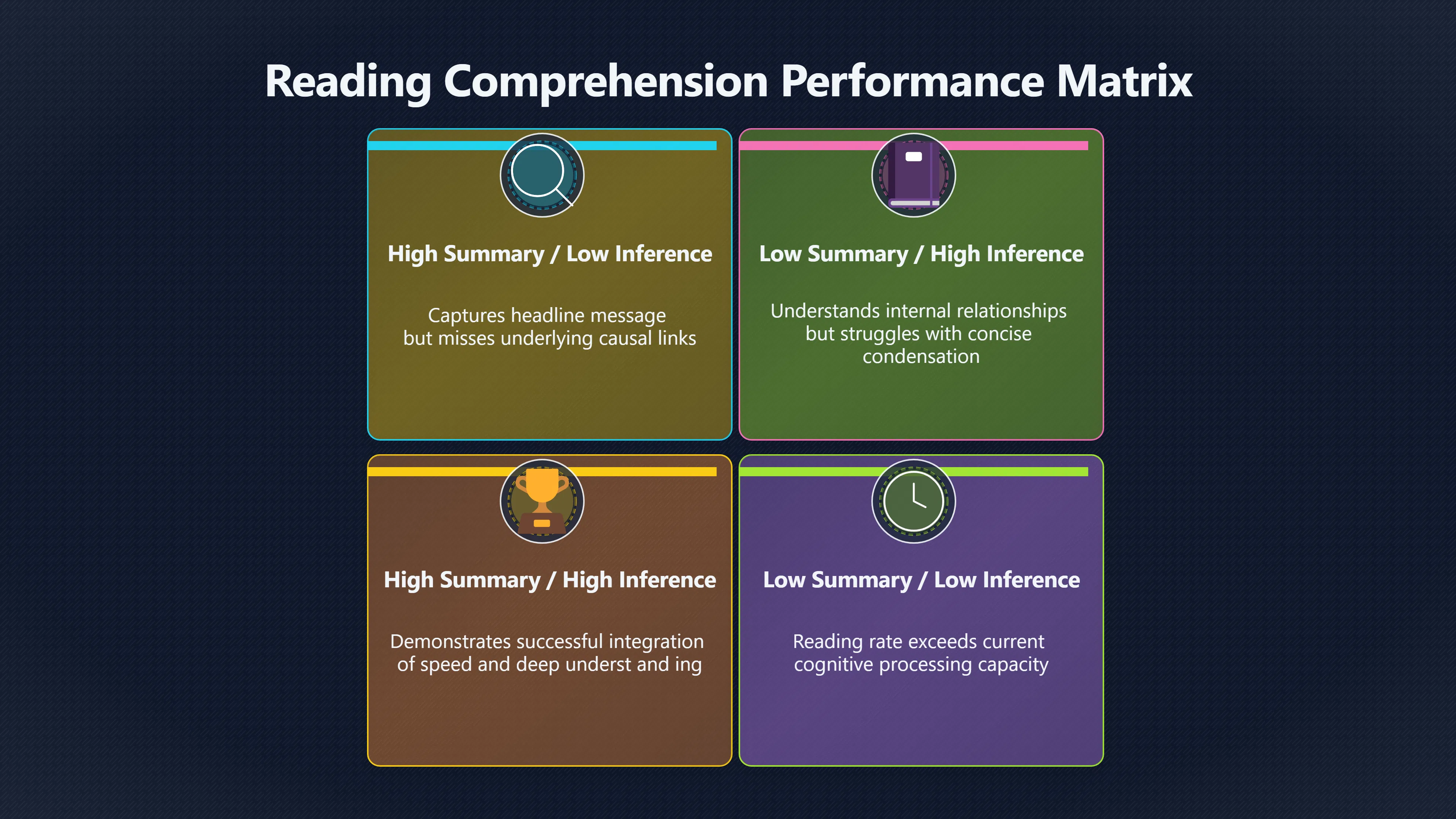
Good Summary, Weak Inference
This pattern is common among readers who have increased speed aggressively.
Imagine a reader completes a timed article about urban transport and writes:
The article argues that expanding cycle infrastructure reduces congestion and improves public health.
The summary is accurate. Yet the same reader struggles with questions such as:
- Why did local businesses initially oppose the project?
- What evidence suggests public opinion changed over time?
- Why might health improvements appear gradually rather than immediately?
In this case, the reader captured the headline message but failed to construct a deeper understanding of relationships and implications. The speed increase may have preserved gist while weakening integration across the text.
Research examining comprehension difficulties has found that some readers perform relatively well on questions requiring literal recall yet struggle when questions demand knowledge-based or elaborative inferences.[Pure York]pure.york.ac.ukassessing childrens inference generation what do tests of readingPrevious research suggests that children with specific comprehension difficulties have problems with the generation of inferences.Read more…

Weak Summary, Strong Inference
The opposite pattern can also occur.
A reader may produce an awkward or incomplete one-sentence summary yet answer inference questions accurately. This often happens when the reader understands relationships within the text but struggles to condense information into a concise statement.
For speed-training purposes, this pattern is generally less concerning than the reverse. The reader’s mental model of the text may still be intact even if summary-writing skill is underdeveloped.
Both Strong
When readers can produce a concise summary and answer inference questions accurately, there is stronger evidence that increased reading speed has not compromised comprehension. They appear able both to identify the central message and to understand how supporting ideas fit together.
Both Weak
If both measures deteriorate as reading speed rises, comprehension is probably being sacrificed. The reading rate may simply exceed the reader’s current processing capacity.
Why Inference Questions Often Detect Hidden Weaknesses
A one-sentence summary can sometimes be produced from memory of a few key sentences. Inference questions are harder to answer through isolated recall because they require relationships among ideas.
This difference has become important enough that researchers designing reading-comprehension assessments frequently distinguish literal questions from inferential ones. Modern assessment work often treats inference questions as diagnostic tools because they reveal specific weaknesses in coherence-building, causal reasoning, and integration of background knowledge.[ACL Anthology+2arXiv]aclanthology.org2025.bea 1.31ACL AnthologyAutomatic Generation of Inference Making Questions for…July 7, 2025 — by WA Ma · Cited by 1 — This paper demonstrates our…
For readers focused on increasing speed, this means that summaries and inference questions should not be viewed as competing measures. They are complementary. A summary checks whether the reader captured the destination of the text. Inference questions check whether the reader followed the route that led there.
Which Measure Is More Useful After Timed Reading?
If only one comprehension check can be used, inference questions often provide the more demanding test of whether understanding survived faster reading. They are more likely to expose losses in causal reasoning, coherence, and integration that can remain hidden behind a competent summary.[Frontiers+2ResearchGate]frontiersin.orgFrontiers Training Inference Making Skills Using a Situation ModelFrontiersTraining Inference Making Skills Using a Situation Model…February 15, 2016 — by LT Bos · 2016 · Cited by 65 — This study show…
However, the strongest evaluation combines both approaches:

- Read under time pressure.
- Write a one-sentence summary.
- Answer two or three inference questions.
- Compare performance across sessions.
This combination separates understanding of the main idea from understanding of implied meaning. For anyone trying to read faster without sacrificing comprehension, that distinction is often where the most useful diagnostic information appears.
Amazon book picks
Further Reading
Books and field guides related to Can a Good Summary Hide Weak Inference Skills?. Use these as the next step if you want deeper reading beyond the article.
How to Read a Book
Rating: 4.0/5 from 41 Google Books ratings
Distinguishes surface summary from analytical understanding.

Language at the Speed of Sight
First published 2017. Subjects: Reading (higher education), Language experience approach in education, Cognition disorders, Psycholinguis...

The Writing Revolution
First published 2017. Subjects: Academic writing, Critical thinking, Écriture savante, Pensée critique, Literature.
Understanding and Teaching Reading Comprehension
First published 2014. Subjects: Reading comprehension.
eBay marketplace picks
Marketplace Samples
Example marketplace items related to this page. Use the search link to explore similar finds on eBay.
Endnotes
1.
Source: researchgate.net
Link:https://www.researchgate.net/publication/371290077_Inferencing_in_Reading_Comprehension_Examining_Variations_in_Definition_Instruction_and_Assessment
Source snippet
(PDF) Inferencing in Reading Comprehension: Examining...2 Jun 2023 — Theoretical [models]({{ 'models/' | relative_url }}) of reading comprehension have consistently highl...
2.
Source: pmc.ncbi.nlm.nih.gov
Link:https://pmc.ncbi.nlm.nih.gov/articles/PMC4753814/
Source snippet
Therefore, we tested a reading strategy training...
3.
Source: arxiv.org
Link:https://arxiv.org/html/2506.08260v1
Source snippet
Some inferences require resolving references across sentences...
4.
Source: arxiv.org
Link:https://arxiv.org/abs/2204.02908
5.
Source: pmc.ncbi.nlm.nih.gov
Link:https://pmc.ncbi.nlm.nih.gov/articles/PMC8189006/
Source snippet
inference making and comprehension monitoring in...by H Joseph · 2021 · Cited by 32 — In this study, we used [eye movement]({{ 'eye-tradeoff/' | relative_url }}) methodology to...
6.
Source: researchgate.net
Link:https://www.researchgate.net/publication/230205539_Children%27s_inference_generation_across_media
Source snippet
(PDF) Children's inference generation across mediaPDF | In the present study, we investigated the degree to which children's inference ge...
7.
Source: youtube.com
Title: Reading Comprehension
Link:https://www.youtube.com/watch?v=bECo6zmykHg
Source snippet
Making inferences in informational texts (video) - Khan Academy...
8.
Source: frontiersin.org
Title: Frontiers Training Inference Making Skills Using a Situation Model
Link:https://www.frontiersin.org/journals/psychology/articles/10.3389/fpsyg.2016.00116/full
Source snippet
FrontiersTraining Inference Making Skills Using a Situation Model...February 15, 2016 — by LT Bos · 2016 · Cited by 65 — This study show...
Published: February 15, 2016
9.
Source: pure.york.ac.uk
Title: assessing childrens inference generation what do tests of reading
Link:https://pure.york.ac.uk/portal/en/publications/assessing-childrens-inference-generation-what-do-tests-of-reading/
Source snippet
Previous research suggests that children with specific comprehension difficulties have problems with the generation of inferences.Read more...
10.
Source: lexialearning.com
Title: Lexia3 Types of Reading Comprehension Compared
Link:https://www.lexialearning.com/blog/3-types-of-reading-comprehension-compared-inferential-literal-and-evaluative
Source snippet
Lexia9 Feb 2026 — Inferential comprehension asks students to read between the lines. They must use context clues and their own knowledge...
11.
Source: bedrocklearning.org
Title: inference in reading comprehension
Link:https://bedrocklearning.org/literacy-blogs/inference-in-reading-comprehension/
Source snippet
It is the process of making a guess about something you don't know for sure, based on...
12.
Source: aclanthology.org
Title: 2025.bea 1.31
Link:https://aclanthology.org/2025.bea-1.31.pdf
Source snippet
ACL AnthologyAutomatic Generation of Inference Making Questions for...July 7, 2025 — by WA Ma · Cited by 1 — This paper demonstrates our...
Published: July 7, 2025
Additional References
13.
Source: readnaturally.com
Link:https://www.readnaturally.com/research/5-components-of-reading/comprehension
Source snippet
Reading Comprehension: Strategies, Skills & InstructionEvidence-based methods for teaching reading comprehension, including key strategie...
14.
Source: nciea.org
Link:https://www.nciea.org/wp-content/uploads/2024/02/Recognizing-the-Difference-Between-Inference-and-Analysis_Presentation-Slides_FINAL.pdf
Source snippet
Recognizing the Difference between Inference and AnalysisBasic Reading Comprehension - demonstrate general understanding of reading eleme...
15.
Source: infonomics-society.org
Title: Primary School Inference Making Strategies From Research to [Practice]({{ ‘practice/’ | relative_url }})
Link:https://infonomics-society.org/wp-content/uploads/Primary-School-Inference-Making-Strategies-From-Research-to-Practice
Source snippet
Primary School Inference Making Strategies5 Feb 2021 — Research shows that students with higher levels of inferencing skills score higher...
16.
Source: oneeducation.co.uk
Link:https://www.oneeducation.co.uk/teaching-reading-skills-and-strategies-inference/
Source snippet
Learn strategies to help children develop thinking, enhance comprehension and be confident readers...
17.
Source: cambridge.org
Link:https://www.cambridge.org/core/books/inferences-during-reading/inference-generation-in-text-comprehension-automatic-and-strategic-processes-in-the-construction-of-a-mental-representation/EFA45901F7644F194715C0A098AA24C9
Source snippet
d comprehension, in three sections organized around three aspects of inference...Read more...
18.
Source: voyagersopris.com
Title: It’s vital for deep comprehension in reading and everyday life.Read more
Link:https://www.voyagersopris.com/vsl/blog/what-does-inference-mean-in-reading
Source snippet
Voyager Sopris LearningReading Between the Lines: What Does Inference Mean in...12 Aug 2024 — Inference is the art of deducing informati...
19.
Source: readlite.in
Link:https://readlite.in/concepts/three-levels-comprehension
Source snippet
The Three Levels of Comprehension: Literal, Inferential...Evaluative comprehension means judging the text—assessing accuracy, quality...
20.
Source: educationendowmentfoundation.org.uk
Link:https://educationendowmentfoundation.org.uk/education-evidence/teaching-learning-toolkit/reading-comprehension-strategies
Source snippet
The strategies focus mainly on language comprehension...Read more...
21.
Source: files.eric.ed.gov
Link:https://files.eric.ed.gov/fulltext/EJ1266300.pdf
Source snippet
ERICby C Hall · 2020 · Cited by 128 — The current study investigated the effects of small-group inference instruction on the inference ge...
22.
Source: youtube.com
Title: How to Make Inferences in Reading? Use Text Evidence Like This
Link:https://www.youtube.com/watch?v=yg6HalYLM5Q
Source snippet
Introduction to Reading Skills: Fact vs Opinion vs Inference...
Topic Tree