Within Unseen Texts
The Checks That Keep Speed Honest
Summaries, supporting details, and inference questions help confirm that faster reading has not turned into shallow skimming.
On this page
- One sentence summaries for main idea understanding
- Detail recall without turning the test into trivia
- Inference questions that expose shallow skimming
Page outline Jump by section
Introduction
Reading speed only matters if understanding survives the increase in pace. An unseen-passage test therefore needs more than a words-per-minute score: it needs a short set of comprehension checks that reveal whether the reader grasped the text, retained important information, and drew reasonable conclusions from what was read. Research on reading fluency consistently finds that reading rate and comprehension are linked but distinct. Faster reading can support comprehension when it reflects greater fluency, yet speed gains are not meaningful if readers miss central ideas or rely on superficial scanning. Cambridge University Press & Assessment+2Cambridge University Press & Assessment[cambridge.org]cambridge.orgUniversity Press & Assessment17Cambridge University Press & Assessment17 - Reading Fluency, Reading Rate, and ComprehensionThis chapter reviews research on the role of…
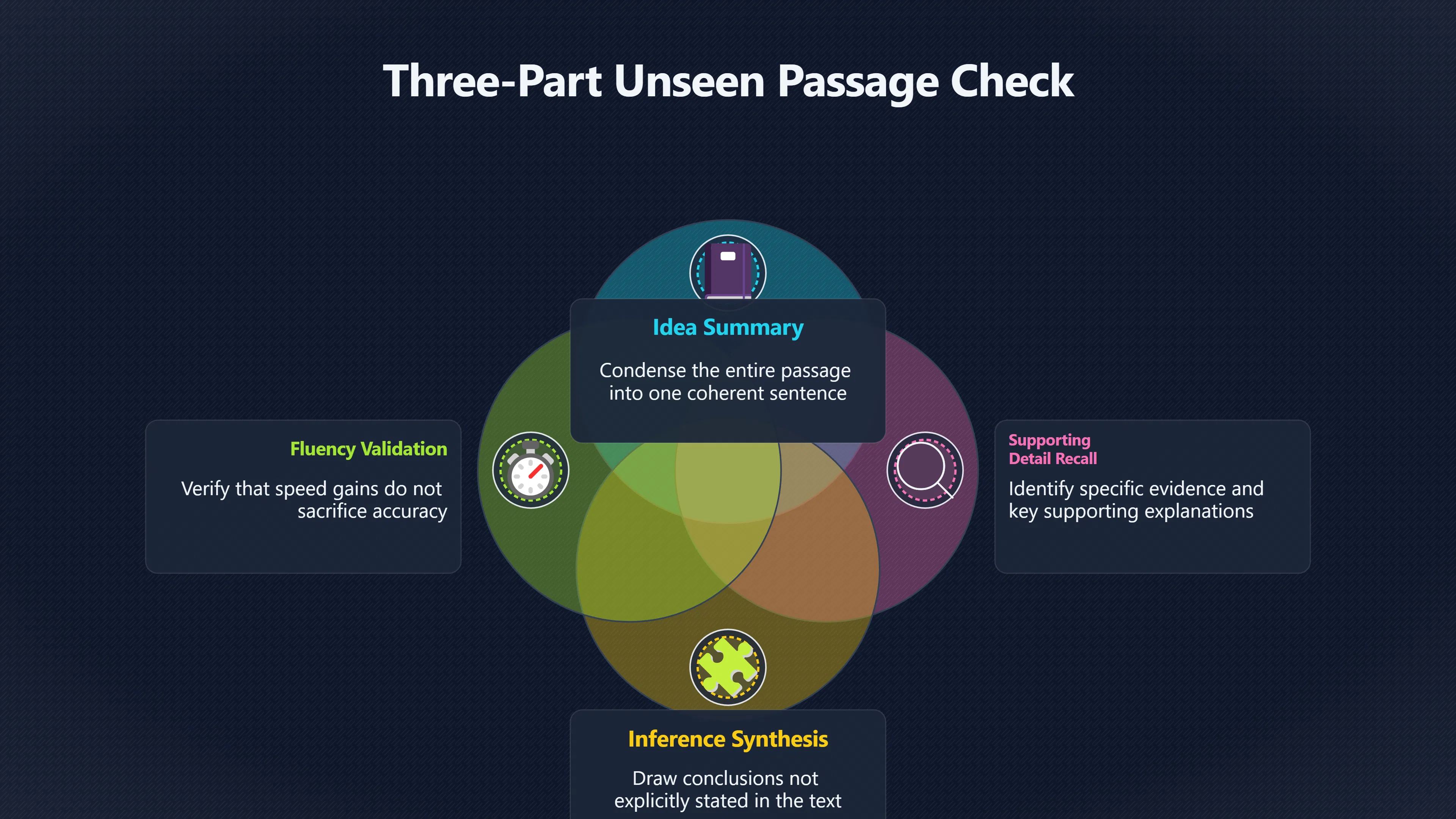
 For honest progress checks, the most useful assessments are usually a combination of three question types: a summary task to test understanding of the main idea, a small number of detail questions to verify accurate recall, and inference questions that require the reader to connect information that is not stated directly. Together, these checks make it much harder for shallow skimming to masquerade as genuine reading improvement.[Lexia+2Shanahan on Literacy]lexialearning.comLexia3 Types of Reading Comprehension ComparedLexia9 Feb 2026 — Explore the three main levels of reading comprehension: literal, inferential, and evaluative. Develop instructional str…
One-Sentence Summaries for Main-Idea Understanding
The quickest way to test whether a reader understood an unseen passage is to ask for a one-sentence summary.
A summary forces the reader to identify the text’s central message while filtering out less important information. Reading-comprehension assessments have long treated main-idea recognition as a core indicator of understanding because readers who cannot identify the central point often retain disconnected facts without understanding how those facts fit together.[Wayne Community College | Goldsboro, NC]waynecc.eduWayne Community College | Goldsboro, NCReading Review Tests of Reading ComprehensionSeptember 19, 2007 — On reading tests, main idea ques…
For reading-speed measurement, a summary task has several advantages:
- It takes little time to administer.
- It discourages memorisation of isolated details.
- It reveals whether the reader constructed a coherent understanding of the passage.
- It works across fiction, non-fiction, essays, and informational texts.
A useful benchmark is whether the summary captures the author’s primary point without becoming a list of examples. Consider a passage about urban tree planting. A weak summary might mention specific statistics or city names. A strong summary would explain that the passage argues urban trees provide environmental and public-health benefits that justify investment.
| This distinction matters because fast readers who merely skim often remember striking details while missing the organising idea that gives those details meaning. Research and assessment practice consistently treat main-idea identification as a higher-value indicator than simple fact recall for this reason. Wayne Community College | Goldsboro, NC+2The Hechinger Report[waynecc.edu]waynecc.eduWayne Community College | Goldsboro, NCReading Review Tests of Reading ComprehensionSeptember 19, 2007 — On reading tests, main idea ques… |
Detail Recall Without Turning the Test into Trivia
Main-idea understanding alone is not enough. A reader can sometimes infer the overall message while overlooking important supporting information.
That is why effective unseen-passage checks usually include a small number of literal comprehension questions. Literal comprehension focuses on information explicitly stated in the text, such as facts, examples, sequences, or explanations.[Lexia]lexialearning.comLexia3 Types of Reading Comprehension ComparedLexia9 Feb 2026 — Explore the three main levels of reading comprehension: literal, inferential, and evaluative. Develop instructional str…
The challenge is avoiding trivia.
Poor detail questions ask readers to remember insignificant facts that contribute little to understanding. Better questions target information that supports the author’s argument or explanation.
For example:
- Weak question: “What colour was the vehicle mentioned in paragraph four?”
- Strong question: “What reason did the author give for the increase in public transport use?”
The second question checks whether the reader retained evidence that supports the passage’s main point.
For personal speed tracking, two or three detail questions are usually enough. If a reader answers the summary question well but misses every supporting-detail question, the apparent speed gain may reflect superficial processing rather than improved reading efficiency.
Inference Questions That Expose Shallow Skimming
Inference questions are often the most revealing part of an unseen reading test.
Unlike literal questions, inference questions require readers to combine pieces of information, interpret implications, recognise relationships, or identify conclusions that the author leaves unstated. Reading researchers commonly distinguish inferential comprehension from literal comprehension because it requires readers to build a deeper mental representation of the text rather than simply retrieve facts.[Lexia]lexialearning.comLexia3 Types of Reading Comprehension ComparedLexia9 Feb 2026 — Explore the three main levels of reading comprehension: literal, inferential, and evaluative. Develop instructional str…
Examples include:
- Why did a character make a particular decision?
- What assumption appears to underlie the author’s argument?
- Which conclusion is most strongly supported by the evidence presented?
- What outcome is most likely if the trend described continues?
These questions are valuable because they are difficult to answer through skimming alone. A reader may notice keywords and major headings while moving rapidly through a passage, but inference questions require integration of information across sentences and paragraphs.
Evidence from reading-comprehension research shows that inference-making is a critical component of deeper understanding and a key factor in constructing a meaningful representation of a text.[Erasmus University Rotterdam]pure.eur.nlTherefore, we tested a reading…Read more…
In practical terms, inference questions often reveal the difference between:
- Reading quickly and understanding.[readingrockets.org]readingrockets.orgUnderstanding and Assessing FluencyLearn what reading fluency is, why it is critical to make sure that students have sufficient fluency…
- Reading quickly and merely recognising words.
That distinction is exactly what an honest progress check is trying to measure.
A Simple Three-Part Check for Unseen Passages
A balanced comprehension check does not need to be long.
After reading an unfamiliar passage, ask:
- Main idea: Summarise the passage in one sentence.
- Supporting details: Answer two or three questions about key evidence or explanations.
- Inference: Answer one question that requires drawing a conclusion beyond the text’s explicit wording.
This structure samples the three major levels of comprehension commonly recognised in reading assessment: literal understanding, inferential understanding, and broader interpretation.[Lexia]lexialearning.comLexia3 Types of Reading Comprehension ComparedLexia9 Feb 2026 — Explore the three main levels of reading comprehension: literal, inferential, and evaluative. Develop instructional str…
A reader who increases from 220 to 280 words per minute while continuing to perform well across all three checks has stronger evidence of genuine improvement than a reader whose speed rises while summary quality, detail recall, or inference accuracy declines.

What Counts as Success?
For unseen reading tests, the goal is not perfect recall. Real-world reading rarely requires remembering every fact.
Instead, success means maintaining a stable level of understanding while reading faster. A useful pattern is:
- Accurate identification of the main idea.
- Strong performance on most supporting-detail questions.
- Reasonable success on inference questions.
When these outcomes remain consistent across multiple unseen passages, the reader has evidence that higher reading speed reflects improved fluency rather than reduced comprehension. Research on reading fluency repeatedly emphasises that appropriate reading rate should support meaning-making, not replace it.[Cambridge University Press & Assessment+2readingrockets.org]cambridge.orgUniversity Press & Assessment17Cambridge University Press & Assessment17 - Reading Fluency, Reading Rate, and ComprehensionThis chapter reviews research on the role of…
Amazon book picks
Further Reading
Books and field guides related to The Checks That Keep Speed Honest. Use these as the next step if you want deeper reading beyond the article.
How to Read a Book
Rating: 4.0/5 from 41 Google Books ratings
Teaches extracting central ideas and evaluating understanding.
The Reading Strategies Book
First published 2015. Subjects: Reading, Books and reading, nyt:education=2016-03-13, New York Times bestseller.

Reading Reconsidered
First published 2016. Subjects: Reading, Reading comprehension, Correlation with content subjects, Language arts, EDUCATION / Teaching Me...
eBay marketplace picks
Marketplace Samples
Example marketplace items related to this page. Use the search link to explore similar finds on eBay.



Endnotes
1.
Source: cambridge.org
Title: University Press & Assessment17
Link:https://www.cambridge.org/core/books/reading-in-a-second-language/reading-fluency-reading-rate-and-comprehension/CDE08FC24601451D78C5CE08D38BD2E8
Source snippet
Cambridge University Press & Assessment17 - Reading Fluency, Reading Rate, and ComprehensionThis chapter reviews research on the role of...
2.
Source: resolve.cambridge.org
Link:https://resolve.cambridge.org/core/services/aop-cambridge-core/content/view/216DADCE833E8A3E270EDD2DE21EF16C/9781139150484c14_p289-310_CBO.pdf/reading_fluency_reading_rate_and_comprehension.pdf
Source snippet
Cambridge University Press & Assessment14 Reading fluency, reading rate, and comprehensionIn almost all reviews of reading fluency, the r...
3.
Source: waynecc.edu
Link:https://www.waynecc.edu/wp-content/uploads/reading-review.pdf
Source snippet
Wayne Community College | Goldsboro, NCReading Review Tests of Reading ComprehensionSeptember 19, 2007 — On reading tests, main idea ques...
Published: September 19, 2007
4.
Source: readingrockets.org
Link:https://www.readingrockets.org/topics/assessment-and-evaluation/articles/understanding-and-assessing-fluency
5.
Source: readingrockets.org
Link:https://www.readingrockets.org/topics/comprehension/articles/seven-strategies-teach-students-text-comprehension
6.
Source: lexialearning.com
Title: Lexia3 Types of Reading Comprehension Compared
Link:https://www.lexialearning.com/blog/3-types-of-reading-comprehension-compared-inferential-literal-and-evaluative
Source snippet
Lexia9 Feb 2026 — Explore the three main levels of reading comprehension: literal, inferential, and evaluative. Develop instructional str...
7.
Source: shanahanonliteracy.com
Title: how to analyze or assess reading comprehension
Link:https://www.shanahanonliteracy.com/blog/how-to-analyze-or-assess-reading-comprehension
Source snippet
9 Nov 2019 — All these standards or question types aimed at main idea, central message, key details, supporting details, inferencing, app...
8.
Source: hechingerreport.org
Title: proof points reading comprehension main idea
Link:https://hechingerreport.org/proof-points-reading-comprehension-main-idea/
Source snippet
The Hechinger ReportWhat happens to reading comprehension when students...26 May 2025 — Some researchers say students need to be explici...
Published: May 2025
9.
Source: pure.eur.nl
Link:https://pure.eur.nl/ws/portalfiles/portal/174198957/Training_Inference_Making_Skills_Using_a_Situation_Model_Approach_Improves_Reading_Comprehension.pdf
Source snippet
Therefore, we tested a reading...Read more...
Additional References
10.
Source: lincs.ed.gov
Link:https://lincs.ed.gov/publications/html/mcshane/chapter7.html
Source snippet
7: Comprehension-Strategy InstructionWe define reading comprehension as the process of simultaneously extracting and constructing meaning...
11.
Source: researchgate.net
Link:https://www.researchgate.net/publication/372036593Reading_comprehension_processes_a_review_based_on_theoretical[models
Source snippet
(PDF) Reading comprehension processes: a review based...17 Mar 2026 — This study provides comprehensive insights, based on theory, on th...
12.
Source: facebook.com
Link:https://www.facebook.com/groups/1120922196519412/posts/1182537390357892/
Source snippet
Assessing reading comprehension and fluency in studentsIn the test in this study, students fluency assessment had the strongest correlati...
13.
Source: education.vic.gov.au
Link:https://www.education.vic.gov.au/Documents/school/teachers/teachingresources/discipline/english/literacy/Oral_Reading_Fluency_Oct2023.pdf
Source snippet
Oral Reading Fluency | EducationWhy is reading fluency important? Reading is a complex cognitive process whereby skilled readers decode t...
14.
Source: readnaturally.com
Link:https://www.readnaturally.com/research/5-components-of-reading/comprehension
Source snippet
Reading Comprehension: Strategies, Skills & InstructionEvidence-based methods for teaching reading comprehension, including key strategie...
15.
Source: minotstateu.edu
Link:https://www.minotstateu.edu/teu/documents/Reading.pdf
Source snippet
ReadingIt states: The [purpose]({{ 'purpose/' | relative_url }}) of the goal is for David to read grade level material with fluency and understanding. David will read grade...
16.
Source: gallaudet.edu
Link:https://gallaudet.edu/student-success/tutorial-center/english-center/reading-esl/types-of-reading-comprehension-questions-and-tests/6-types-of-reading-questions/
Source snippet
Gallaudet University6 Types of reading questionsThere are six kinds of reading questions: Comprehension; Detail Questions; Following Dire...
17.
Source: fivefromfive.com.au
Link:https://fivefromfive.com.au/fluency/components-of-fluency/
Source snippet
ponents of fluencyText or passage reading fluency is generally defined as having three components: accuracy, rate, and prosody (or exp...
18.
Source: fndusa.org
Title: A Strategy to Improve Reading Comprehension Through Inferential Thinking
Link:https://fndusa.org/wp-content/uploads/2015/06/A-Strategy-to-Improve-Reading-Comprehension-Through-Inferential-Thinking.pdf
Source snippet
Family Network on DisabilitiesA-Strategy-to-Improve-Reading-Comprehension-Through-...9 Jun 2015 — This article introduces the Main Idea...
19.
Source: school-page.com
Link:https://www.school-page.com/articles/crafting-effective-reading-comprehension-questions-guide
Source snippet
"Generate questions that require students to identify the main idea and supporting details.Read more...
Topic Tree