Within Rereading
Why hard texts punish forced forward reading
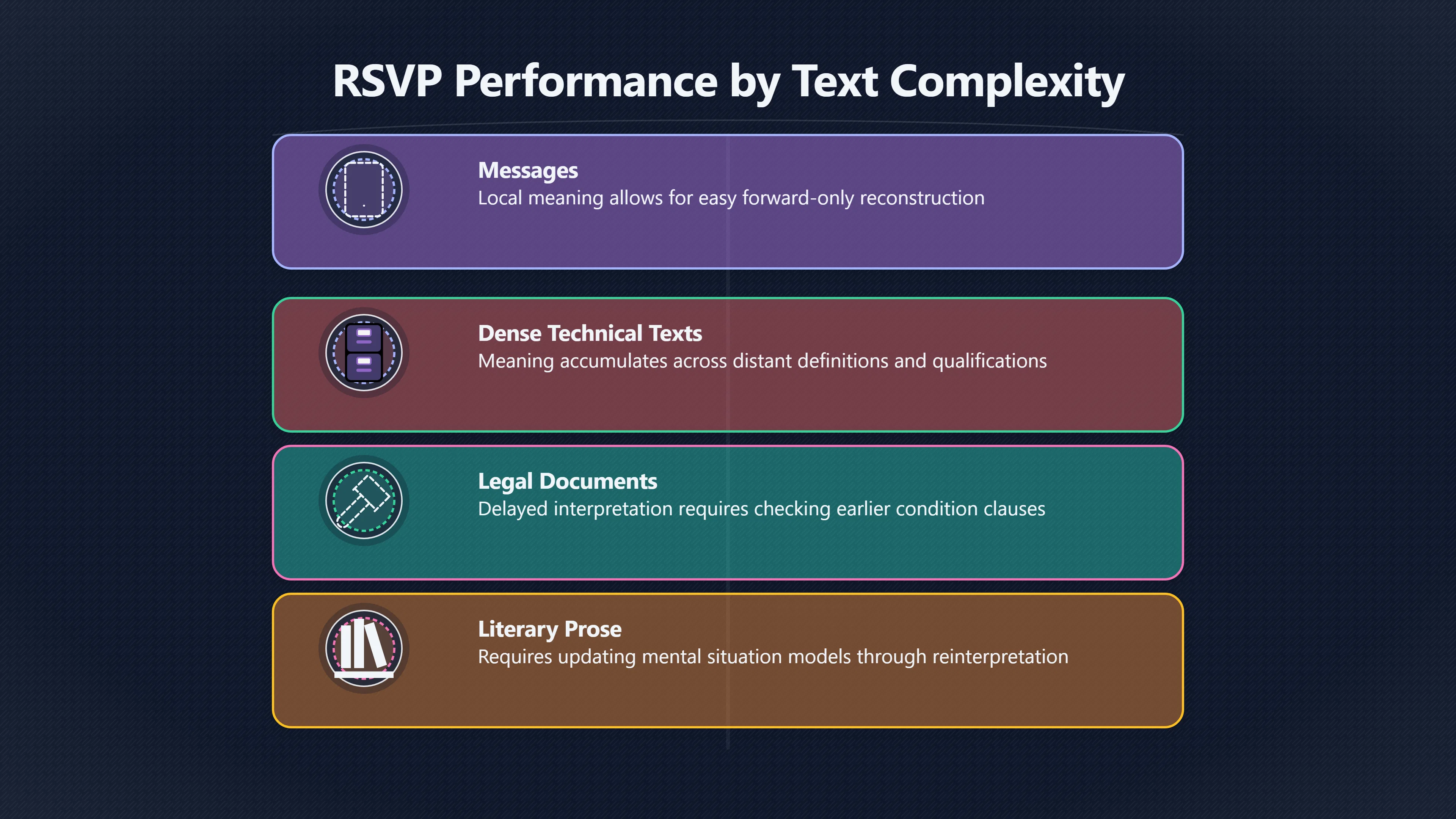
Technical, legal, literary, and analytical texts depend more on rereading because meaning often builds across earlier definitions and clauses.
On this page
- Why simple messages can hide the cost of RSVP
- How technical and legal sentences depend on earlier details
- Why literary and analytical reading needs flexible repair
Page outline Jump by section
Introduction
Dense texts expose a weakness in Rapid Serial Visual Presentation (RSVP) reading that may remain hidden when the material is simple. A straightforward email, news brief, or conversational passage can often be understood on the first pass because each sentence carries most of its meaning locally. Technical reports, legal documents, academic articles, and complex literature work differently. Their meaning accumulates across definitions, qualifications, references, and inferences that may be separated by several lines or paragraphs. When readers encounter difficulty, they often solve it by briefly looking back. Research on eye movements shows that such regressions are a normal part of skilled reading and support comprehension rather than merely reflecting failure. Preventing rereading can reduce understanding, particularly when texts demand integration of information across multiple parts of a passage.[ResearchGate]researchgate.netResearch Gate(PDF) Don't Believe What You Read (Only OnceResearchGate(PDF) Don't Believe What You Read (Only Once)April 18, 2014 — These data suggest that regressions contribute to the ability t…
 For people interested in increasing reading speed, this distinction matters. RSVP may feel effective on easy material, yet the cost of forced forward reading becomes much more visible when the text requires careful reasoning, interpretation, or cross-referencing.
Why simple messages can hide the cost of RSVP
Many everyday texts are designed to minimise ambiguity. Instructions such as “Turn left at the next junction” or short news updates usually place the key information close together. If a reader misses a detail, the surrounding context often allows a quick reconstruction of meaning without revisiting earlier words.
Because of this, RSVP systems can appear more successful than they really are. The reader experiences continuous forward motion and may feel fluent because the material itself places relatively low demands on memory. Fluency, however, is not the same as deep comprehension. The real test comes when information introduced earlier must be actively maintained and connected to later material.[ResearchGate]researchgate.netResearch Gate(PDF) Working Memory and High- Level TextResearchGate(PDF) Working Memory and High- Level Text…November 21, 2024 — 22 Apr 2026 — We review some of the literature showing how t…
Eye-tracking studies consistently show that readers make backward movements even during ordinary reading. Around 10–15% of saccades are regressions, and these movements become especially relevant when readers encounter ambiguity, complexity, or unexpected information.[UTUPub]utupub.fiTracking Measures to Predict Reading ComprehensionTracking Measures to Predict Reading ComprehensionJune 15, 2023 — by DC Mézière · 2023 · Cited by 143 — Although most saccades move…
A simple text may rarely trigger those repairs. A dense text triggers them repeatedly.
How technical and legal sentences depend on earlier details
Technical and legal writing often delays full interpretation until the end of a sentence or paragraph. A definition introduced earlier may determine the meaning of every sentence that follows. A single exception clause can reverse the apparent meaning of a rule.
Consider a legal sentence containing multiple conditions:
A requirement applies unless a specified exemption is met, except in circumstances defined elsewhere.
A reader may initially form one interpretation and then revise it after encountering a later clause. In normal reading, a brief glance back can confirm exactly which condition modified which requirement. In RSVP, the earlier wording is gone, forcing the reader to rely on memory rather than direct inspection.
This is not merely a convenience issue. Research on working memory and text comprehension shows that understanding complex material requires readers to maintain, update, suppress, and integrate multiple pieces of information simultaneously. As these demands increase, the burden on memory rises as well.[ResearchGate]researchgate.netResearch Gate(PDF) Working Memory and High- Level TextResearchGate(PDF) Working Memory and High- Level Text…November 21, 2024 — 22 Apr 2026 — We review some of the literature showing how t…
Scientific and analytical texts create similar challenges. A reader may encounter:
- A specialised term defined several sentences earlier.
- A statistical result whose significance depends on a previous assumption.
- A conclusion that refers back to an earlier experiment or argument.
- A qualification that changes how a finding should be interpreted.
When these connections become difficult to track, rereading functions as a rapid verification tool. The reader checks the source rather than trusting an increasingly fragile memory trace.

Why literary and analytical reading needs flexible repair
Literary and analytical texts often demand something beyond factual recall. They require interpretation.
A novel may introduce a character, shift perspective, and later reveal that an earlier assumption was incorrect. An essay may present an argument, introduce a counterargument, and then reconcile the two. Readers frequently revise their mental representation of the text as new information arrives. Research on comprehension monitoring and inference revision shows that readers continuously update what researchers call a situation model—the evolving mental picture of what a text means.[CentAUR]centaur.reading.ac.ukEvaluation and revision of inferential comprehension in…October 28, 2015 — by A Perez · 2016 · Cited by 57 — To our knowledge…
This process rarely unfolds in a perfectly linear fashion.
When a later sentence changes the significance of an earlier one, readers often return to the relevant passage and reinterpret it. The rereading may last only a fraction of a second, yet it helps align old information with the new understanding. Studies examining regressions suggest that these backward movements are used to reanalyse text and support comprehension.[PubMed]pubmed.ncbi.nlm.nih.govThe function of regressions in reading: backward eye…by RW Booth · 2013 · Cited by 134 — These results suggest that readers use…
Literary texts provide especially clear examples. Pronouns, implied motives, unreliable narrators, and subtle thematic connections may not become fully meaningful until later. A reader who can freely revisit earlier lines can test interpretations against the text itself. A reader restricted to forward-only presentation must rely more heavily on memory and inference.
Why dense texts create a memory problem
The central issue is not that difficult texts contain longer words. It is that they require more information to remain active at once.
Researchers studying working memory and comprehension have found that readers must maintain relevant ideas, retrieve earlier information, generate inferences, monitor for inconsistencies, and update their understanding as new information arrives. These processes become more demanding as text complexity increases.[ResearchGate]researchgate.netResearch Gate(PDF) Working Memory and High- Level TextResearchGate(PDF) Working Memory and High- Level Text…November 21, 2024 — 22 Apr 2026 — We review some of the literature showing how t…
Dense writing often combines several challenges:
- Long dependency chains between ideas.
- Multiple competing interpretations.
- Embedded clauses and qualifications.
- Technical vocabulary.
- Information that must be integrated across paragraphs.
When rereading is available, readers can offload part of this burden onto the page itself. The text acts as an external memory aid. When rereading is restricted, more of the burden shifts to internal memory.
This helps explain why readers frequently report that RSVP feels manageable for light material but exhausting for complex material. The underlying difficulty is not speed alone. It is the loss of a mechanism that normally compensates for limited working memory.

What research suggests about forced forward reading
Experiments that restrict readers’ ability to revisit previously read text provide useful evidence because they mimic an important aspect of RSVP. Studies by Elizabeth Schotter and colleagues found that preventing normal regressions impaired comprehension. Notably, the negative effect was not limited to obviously ambiguous sentences. Readers benefited from having the option to return to earlier text even when difficulties were not immediately apparent.[ResearchGate]researchgate.netResearch Gate(PDF) Don't Believe What You Read (Only OnceResearchGate(PDF) Don't Believe What You Read (Only Once)April 18, 2014 — These data suggest that regressions contribute to the ability t…
This finding is important for speed-reading claims. If rereading only mattered when readers became visibly confused, removing it might be a minor inconvenience. The evidence suggests something broader: regressions appear to be woven into normal comprehension itself. Readers do not merely reread after failure; they reread as part of successful understanding.[ResearchGate+2PubMed]researchgate.netResearch Gate(PDF) Don't Believe What You Read (Only OnceResearchGate(PDF) Don't Believe What You Read (Only Once)April 18, 2014 — These data suggest that regressions contribute to the ability t…
As text complexity rises, the value of that flexibility rises with it.
Why hard texts punish forced forward reading
The strongest case against relying exclusively on RSVP emerges when the goal is not simply to finish text quickly but to understand demanding material accurately.
Simple passages can often survive a forward-only reading style because their meaning is local, predictable, and easy to reconstruct. Dense texts are different. Technical documents depend on earlier definitions. Legal writing depends on qualifications and exceptions. Analytical prose depends on linking arguments across a passage. Literary works often depend on reinterpretation and delayed understanding.
In all of these cases, rereading is not a sign that reading has gone wrong. It is part of how skilled readers make complex texts make sense. When that option disappears, the cost is usually small for easy material and much larger for demanding material. That is why RSVP may seem smoothest precisely where comprehension is easiest, while its limitations become most visible when readers encounter the kinds of texts that benefit most from flexible, selective rereading.[Cambridge University Press & Assessment+3ResearchGate+3ResearchGate]researchgate.netResearch Gate(PDF) Don't Believe What You Read (Only OnceResearchGate(PDF) Don't Believe What You Read (Only Once)April 18, 2014 — These data suggest that regressions contribute to the ability t…
Amazon book picks
Further Reading
Books and field guides related to Why hard texts punish forced forward reading. Use these as the next step if you want deeper reading beyond the article.
How to Read a Book
Rating: 4.0/5 from 41 Google Books ratings
Teaches analytical and inspectional reading strategies that align with the need to revisit, question, and integrate complex material.
Proust and the Squid
Explains how the reading brain develops and processes complex text, supporting discussion of comprehension and rereading.

Language at the Speed of Sight
Directly addresses how skilled reading works, including why comprehension, language knowledge, and rereading matter more than speed-readi...

Reader, Come Home
Explores deep reading, attention, and the challenges of maintaining comprehension when reading is accelerated or fragmented.
eBay marketplace picks
Marketplace Samples
Example marketplace items related to this page. Use the search link to explore similar finds on eBay.


Endnotes
1.
Source: researchgate.net
Title: Research Gate(PDF) Don’t Believe What You Read (Only Once)
Link:https://www.researchgate.net/publication/261761989_Don%27t_Believe_What_You_Read_Only_Once_Comprehension_Is_Supported_by_Regressions_During_Reading
Source snippet
ResearchGate(PDF) Don't Believe What You Read (Only Once)April 18, 2014 — These data suggest that regressions contribute to the ability t...
Published: April 18, 2014
2.
Source: researchgate.net
Title: Research Gate(PDF) Working Memory and High- Level Text
Link:https://www.researchgate.net/publication/385999682_Working_Memory_and_High-_Level_Text_Comprehension_Processes
Source snippet
ResearchGate(PDF) Working Memory and High- Level Text...November 21, 2024 — 22 Apr 2026 — We review some of the literature showing how t...
Published: November 21, 2024
3.
Source: cambridge.org
Title: University Press & Assessment21
Link:https://www.cambridge.org/core/books/cambridge-handbook-of-working-memory-and-language/working-memory-and-highlevel-text-comprehension-processes/1A72ADB8B7EC327E33BFDD96511EB115
Source snippet
Cambridge University Press & Assessment21 - Working Memory and High-Level Text Comprehension...Since then, extensive research has corrob...
4.
Source: utupub.fi
Title: Tracking Measures to Predict Reading Comprehension
Link:https://www.utupub.fi/bitstream/handle/10024/190693/Reading%20Research%20Quarterly%20-%202023%20-%20M%20zi%20re%20-%20Using%20Eye%20Tracking%20Measures%20to%20Predict%20Reading%20Comprehension.pdf?sequence=1
Source snippet
Tracking Measures to Predict Reading ComprehensionJune 15, 2023 — by DC Mézière · 2023 · Cited by 143 — Although most saccades move...
Published: June 15, 2023
5.
Source: pubmed.ncbi.nlm.nih.gov
Link:https://pubmed.ncbi.nlm.nih.gov/22886737/
Source snippet
The function of regressions in reading: backward eye...by RW Booth · 2013 · Cited by 134 — These results suggest that readers use...
6.
Source: centaur.reading.ac.uk
Link:https://centaur.reading.ac.uk/45762/1/2015_PerezJosephBajoNation_accepted_Oct2015.pdf
Source snippet
Evaluation and revision of inferential comprehension in...October 28, 2015 — by A Perez · 2016 · Cited by 57 — To our knowledge...
Published: October 28, 2015
Additional References
7.
Source: papers.ssrn.com
Link:https://papers.ssrn.com/sol3/papers.cfm?abstract_id=5405257
Source snippet
Eye Movements in Reading Go from Easy to...by AT Lopes Rego — One prevailing hypothesis is that regressions reflect comprehension proces...
8.
Source: mdpi.com
Title: Eye-tracking studies indicate that genre shapes eye movement patterns at a local
Link:https://www.mdpi.com/1995-8692/18/6/60
Source snippet
The Influence of Text Genre on Eye Movement Patterns...by M Markevich · 2025 — Successful reading comprehension depends on many factors...
9.
Source: readlite.in
Link:https://readlite.in/concepts/regressions-reading
Source snippet
These regressions aren't mistakes — they're essential comprehension repairs that skilled...
10.
Source: tmalsburg.github.io
Link:https://tmalsburg.github.io/MeziereEtAl2021MS.pdf
Source snippet
accades are regressions, which move the eyes back to a previous part of the...
11.
Source: cognitivetrain.com
Title: Some readers regress even more
Link:https://cognitivetrain.com/regression-in-reading/
Source snippet
Regression in Reading: Why Your Eyes Keep Going...Eye-tracking research shows that regressions account for 10-15% of all eye movements d...
12.
Source: scholarlypublications.universiteitleiden.nl
Title: nl Learning from texts
Link:https://scholarlypublications.universiteitleiden.nl/access/item%3A2885524/view
Source snippet
from texts - Scholarly Publications Leiden University2 Mar 2026 — In addition, measures of reading comprehension ability and working memo...
13.
Source: tandfonline.com
Link:https://www.tandfonline.com/doi/full/10.1080/0163853X.2022.2142459
Source snippet
Keeping an Eye on the Refutation Effect: The Role of Prior...by L Catrysse · 2022 · Cited by 16 — This study examined the relationship b...
14.
Source: link.springer.com
Link:https://link.springer.com/article/10.1007/s11251-024-09686-4
Source snippet
the effectiveness of multiple text reading and...by P Seban · 2025 · Cited by 10 — The goal of the present study is to investigate the s...
15.
Source: pubs.asha.org
Link:https://pubs.asha.org/doi/10.1044/2025_JSLHR-25-00187
Source snippet
Sentence Reading Comprehension With Increased...by R Ning · 2026 — The current study aimed to compare sentence reading comprehension per...
16.
Source: ila.onlinelibrary.wiley.com
Link:https://ila.onlinelibrary.wiley.com/doi/full/10.1002/rrq.70023
Source snippet
Eye Movements From a “Read‐Only” Task to Predict...by DC Mézière · 2025 · Cited by 5 — This suggests that eye movements related to re-re...
Topic Tree