Within Rereading
Why Slower Reading Can Finish Faster
Difficult material often rewards a slower first pass because rushing can create confusion that costs more time later.
On this page
- Difficulty, working memory, and regressions
- When rushing creates extra backtracking
- Matching pace to text type and stakes
Page outline Jump by section
Introduction
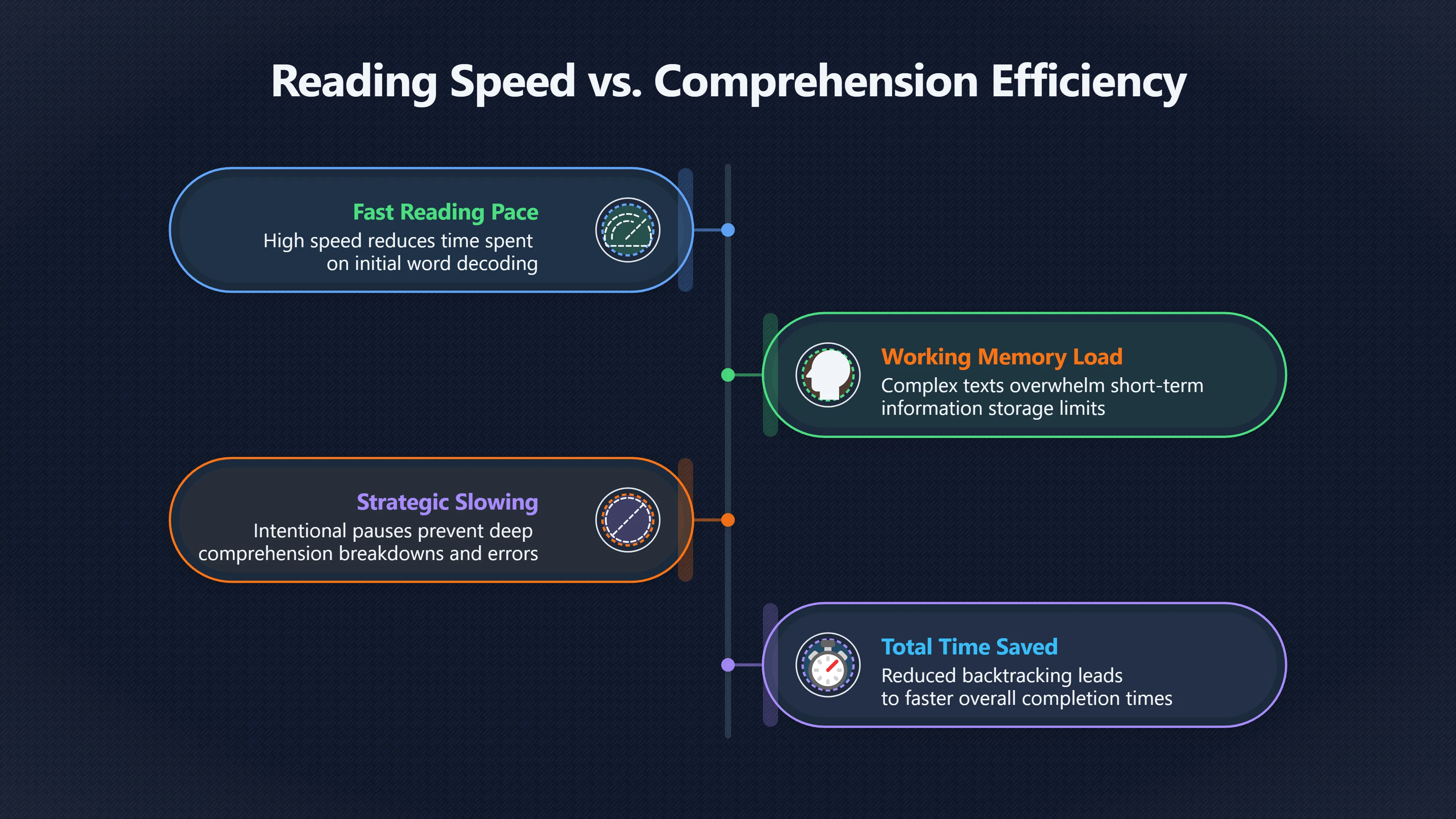
When people try to increase reading speed, they often assume that faster eye movement always saves time. For straightforward material, that can be true. For complex texts, however, reading too quickly can create misunderstandings that force repeated backtracking later. A slower first pass may feel less efficient in the moment, yet it often reduces the need to reread paragraphs, reconstruct arguments, or verify details afterwards. The result is that total reading time can be lower even when the initial pace is slower.
 This trade-off is especially important for technical manuals, legal documents, academic papers, contracts, scientific reports, and other high-stakes texts. These materials place heavier demands on working memory and comprehension than familiar narrative prose. In such cases, matching reading speed to difficulty is often more effective than trying to maintain a uniformly fast pace throughout.[PMC+2PMC]pmc.ncbi.nlm.nih.govPMCHow working memory relates to children's readingby S Nouwens · 2016 · Cited by 200 — Abstract. Working memory is considered a well-established predictor of individual variation in re…
Difficulty, Working Memory, and Regressions
Reading is not simply decoding words. Readers must hold information in working memory while connecting new ideas to what came before. Working memory is strongly associated with reading comprehension because it supports the simultaneous storage and processing of information during reading. When too much information accumulates too quickly, comprehension becomes more fragile.[PMC+2PMC]pmc.ncbi.nlm.nih.govPMCHow working memory relates to children's readingby S Nouwens · 2016 · Cited by 200 — Abstract. Working memory is considered a well-established predictor of individual variation in re…
This matters because difficult texts often contain:
- Long chains of reasoning.
- Unfamiliar terminology.
- Definitions that affect later interpretation.
- References to earlier sections.
- Conditional statements and exceptions.
If a reader rushes through such material, working memory can become overloaded before key relationships are fully integrated. The reader may continue moving forward but later discover that a crucial definition, assumption, or qualification was missed. At that point, regression becomes necessary.[Utrecht University+2ResearchGate]research-portal.uu.nl222 Nimwegen BCSHCI25Utrecht UniversityThe Real Cost of the Trick Wording Deceptive Patternby C van Nimwegen · 2025 — This involves the interaction between te…
Eye-tracking research shows that regressions—backward eye movements—are a normal part of reading. Around 10–15% of eye movements during ordinary reading are regressions, and they become more likely when readers encounter difficult or confusing material. These movements often serve a comprehension-repair function rather than representing failure.[Cambridge Assets+2Reading Research]assets.cambridge.orgCambridge AssetsChapter 1 Introduction to Eye-TrackingAbout 10–15 per cent of the time, readers move their eyes back (regress) to previou…
The practical implication is straightforward: if slowing down slightly prevents a misunderstanding from forming, it can eliminate a much larger rereading cost later.
When Rushing Creates Extra Backtracking
The hidden cost of excessive speed is that errors in understanding often remain invisible until several sentences or pages later.
Consider a reader working through a scientific paper. A statistical term is introduced early, but the reader skims past it. Several pages later, the argument becomes confusing because later claims depend on that definition. The reader must then return to locate the original explanation and reconstruct the chain of reasoning.
A similar pattern appears in legal and regulatory reading. Missing a single exception clause may require revisiting multiple pages to understand how a rule actually applies. In technical documentation, overlooking a prerequisite can force the reader to retrace an entire procedure.
In each case, the apparent time saving from faster reading is offset by:
- Locating the relevant passage again.
- Re-establishing context.
- Reconstructing the mental model.
- Correcting any mistaken interpretation.
Research on regressions suggests that readers use backward eye movements to reread and reprocess information, not merely to trigger memory of what they previously saw. When comprehension breaks down, genuine reprocessing is often required.[PubMed]pubmed.ncbi.nlm.nih.govThe function of these "regressions" is still largely unknownThe function of regressions in reading: backward eye…by RW Booth · 2013 · Cited by 134 — Standard text reading involves frequent…
This helps explain why some readers feel trapped in cycles of rereading. The problem is not always that they look back too much. Sometimes they move forward before understanding is sufficiently stable, creating larger repair costs later.
Why Strategic Slowing Is Different from Slow Reading
Slowing down is not the same as reading everything cautiously.
The goal is selective adjustment. Skilled readers typically vary their pace according to the demands of the text. Eye-movement research consistently shows that readers naturally spend more time on difficult words, ambiguous passages, and information-rich sections.[Reading Research+2Pitt Web Sites]research.reading.ac.uk2025 03 Tromso Eye Tracking Workshop Session 1 Handout➢ About 10-15% of eye-movements are regressions to earlier portions of…Read more…
Strategic slowing involves:[tandfonline.com]tandfonline.comThe Role of Strategic Backtracking When Reading Digital…by YE Haverkamp · 2024 · Cited by 19 — Strategic backtracking involves that re…
- Pausing at definitions that will be reused later.
- Paying closer attention to transitions such as “however”, “unless”, and “therefore”.
- Spending extra time on diagrams, formulas, and tables.
- Verifying key assumptions before moving on.
- Slowing when several new concepts are introduced at once.
By contrast, inefficient slow reading often involves giving equal attention to every sentence regardless of importance.
The distinction matters because the objective is not to maximise time spent reading. It is to minimise total time required to reach accurate understanding.
Matching Pace to Text Type and Stakes
Different texts justify different speeds.
Familiar and Low-Stakes Material
News articles, routine emails, familiar topics, and light nonfiction often allow relatively fast reading because the reader already possesses the background knowledge needed to fill gaps. Minor misunderstandings carry little cost and can usually be corrected quickly.
In these situations, occasional regressions are unlikely to create significant delays.
Academic and Technical Material
Research papers, textbooks, engineering documents, and specialist reports place greater demands on working memory and inferential reasoning. Readers must integrate new information, maintain relationships across multiple sections, and often connect text with figures or equations.[PMC+2PMC]pmc.ncbi.nlm.nih.govPMCHow working memory relates to children's readingby S Nouwens · 2016 · Cited by 200 — Abstract. Working memory is considered a well-established predictor of individual variation in re…
For these texts, a slower first pass frequently improves efficiency because it reduces later reconstruction work.
Legal and Compliance Documents
Contracts, policies, regulations, and procedural guidance often contain conditions, exceptions, and precise language. Missing one qualifying phrase can alter the meaning of an entire section.
The cost of misunderstanding is high, making preventive comprehension more valuable than maximum reading speed.
High-Consequence Reading
Whenever future decisions depend on accurate interpretation, slowing down becomes a risk-management strategy. The question shifts from “How fast can I read?” to “How quickly can I understand correctly?”
Signs You Should Slow Down Before Continuing
Many readers only realise they were reading too quickly after confusion has already developed. Several warning signs indicate that a temporary reduction in pace may save time overall:
- You are encountering multiple unfamiliar terms in a short span.
- New information is no longer connecting smoothly with earlier material.
- You have read several paragraphs but cannot summarise the main point.
- You repeatedly lose track of references, variables, or definitions.
- You feel compelled to reread large sections later.
These signals suggest that comprehension is approaching the limits of working memory rather than that the material necessarily requires wholesale rereading. A modest reduction in pace at the point of difficulty may be sufficient to prevent a larger breakdown.[PMC+2PMC]pmc.ncbi.nlm.nih.govPMCHow working memory relates to children's readingby S Nouwens · 2016 · Cited by 200 — Abstract. Working memory is considered a well-established predictor of individual variation in re…

Faster Overall Through Better Timing
The paradox of reading speed is that the quickest route through difficult material is not always the fastest-looking one. Reading slightly more carefully at critical points can reduce the need for extensive regressions, reconstruction, and verification later.
For simple texts, speed can be increased with little penalty. For demanding texts, however, comprehension becomes the limiting factor. In those situations, slowing down is not abandoning efficiency—it is often the most efficient choice available. By matching pace to difficulty, readers can spend less time recovering from misunderstandings and more time moving steadily forward.[PubMed+2tandfonline.com]pubmed.ncbi.nlm.nih.govThe function of these "regressions" is still largely unknownThe function of regressions in reading: backward eye…by RW Booth · 2013 · Cited by 134 — Standard text reading involves frequent…
Amazon book picks
Further Reading
Books and field guides related to Why Slower Reading Can Finish Faster. Use these as the next step if you want deeper reading beyond the article.
Deep Work
Supports sustained attention and deliberate engagement with difficult material.
Thinking, Fast and Slow
Provides a framework for understanding when slower processing improves accuracy.
Reading Mind
Explains comprehension limits and why slower reading can improve outcomes.
Endnotes
1.
Source: pmc.ncbi.nlm.nih.gov
Title: PMCHow working memory relates to children’s reading
Link:https://pmc.ncbi.nlm.nih.gov/articles/PMC5247542/
Source snippet
by S Nouwens · 2016 · Cited by 200 — Abstract. Working memory is considered a well-established predictor of individual variation in re...
2.
Source: pmc.ncbi.nlm.nih.gov
Link:https://pmc.ncbi.nlm.nih.gov/articles/PMC9856821/
Source snippet
Is Working Memory Related to Reading Comprehension...by M Orsolini · 2022 · Cited by 20 — This study explored how working memory resourc...
3.
Source: pmc.ncbi.nlm.nih.gov
Link:https://pmc.ncbi.nlm.nih.gov/articles/PMC3309419/
Source snippet
Processing speed deficits affect reading efficiency, even among individuals who recognize and decode words accurately.Read more...
4.
Source: researchgate.net
Link:https://www.researchgate.net/publication/340324786_Working_Memory_Capacity_but_Not_Prior_Knowledge_Impact_on_Readers%27_Attention_and_Text_Comprehension
Source snippet
(PDF) Working Memory Capacity but Not Prior Knowledge...31 Mar 2020 — In addition, working memory capacity (WMC) and prior knowledge of...
5.
Source: assets.cambridge.org
Link:https://assets.cambridge.org/97811084/15354/excerpt/9781108415354_excerpt.pdf
Source snippet
Cambridge AssetsChapter 1 Introduction to Eye-TrackingAbout 10–15 per cent of the time, readers move their eyes back (regress) to previou...
6.
Source: sites.pitt.edu
Link:https://sites.pitt.edu/~perfetti/Eye%20Movements%20During%20Reading.htm
Source snippet
Pitt Web SitesEye Movements During Reading10-15% of saccades consist of regressions, or movements back to earlier parts of the text. Regr...
7.
Source: pmc.ncbi.nlm.nih.gov
Link:https://pmc.ncbi.nlm.nih.gov/articles/PMC12461752/
Source snippet
and Cognitive Correlates Underlying Inferencing...by AE Barth · 2025 — Using path analyses, the current study evaluated the relations of...
8.
Source: tandfonline.com
Link:https://www.tandfonline.com/doi/full/10.1080/19388071.2022.2155271
Source snippet
The Role of Strategic Backtracking When Reading Digital...by YE Haverkamp · 2024 · Cited by 19 — Strategic backtracking involves that re...
9.
Source: tandfonline.com
Link:https://www.tandfonline.com/doi/full/10.1080/20445911.2015.1005095
Source snippet
Working memory, reading ability and the effects of distance...by HSSL Joseph · 2015 · Cited by 41 — Previous research has shown that les...
10.
Source: researchgate.net
Title: 334364752 Regressions during Reading
Link:https://www.researchgate.net/publication/334364752_Regressions_during_Reading
Source snippet
(PDF) Regressions during ReadingOct 29, 2025 — Readers occasionally move their eyes to prior text. We distinguish two types of these move...
11.
Source: researchgate.net
Link:https://www.researchgate.net/publication/372036593Reading_comprehension_processes_a_review_based_on_theoretical[models
Source snippet
(PDF) Reading comprehension processes: a review based...17 Mar 2026 — This study provides comprehensive insights, based on theory, on th...
12.
Source: cambridge.org
Link:https://www.cambridge.org/core/books/cambridge-handbook-of-working-memory-and-language/working-memory-and-highlevel-text-comprehension-processes/1A72ADB8B7EC327E33BFDD96511EB115
Source snippet
21 - Working Memory and High-Level Text Comprehension...An influential approach in the field of individual differences and reading compr...
13.
Source: research-portal.uu.nl
Title: 222 Nimwegen BCSHCI25
Link:https://research-portal.uu.nl/ws/files/277810776/222-Nimwegen-BCSHCI25.pdf
Source snippet
Utrecht UniversityThe Real Cost of the Trick Wording Deceptive Patternby C van Nimwegen · 2025 — This involves the interaction between te...
14.
Source: research.reading.ac.uk
Title: 2025 03 Tromso Eye Tracking Workshop Session 1 Handout
Link:https://research.reading.ac.uk/psylinglab/wp-content/uploads/sites/25/2025/03/2025-03-Tromso-Eye-Tracking-Workshop-Session-1-Handout.pdf
Source snippet
➢ About 10-15% of eye-movements are regressions to earlier portions of...Read more...
15.
Source: pubmed.ncbi.nlm.nih.gov
Title: The function of these “regressions” is still largely unknown
Link:https://pubmed.ncbi.nlm.nih.gov/22886737/
Source snippet
The function of regressions in reading: backward eye...by RW Booth · 2013 · Cited by 134 — Standard text reading involves frequent...
16.
Source: pmc.ncbi.nlm.nih.gov
Link:https://pmc.ncbi.nlm.nih.gov/articles/PMC10389090/
Source snippet
by P López-Resa · 2023 · Cited by 20 — The aim of this research was to study the relationship between semantic updating ability and re...
Additional References
17.
Source: reddit.com
Link:https://www.reddit.com/r/PromptEngineering/comments/1mjhdk8/i_reverseengineered_chatgpts_reasoning_and_found/
Source snippet
I reverse-engineered ChatGPT's "reasoning" and found the...It generates responses based on patterns seen during training — including aca...
18.
Source: pure.ewha.ac.kr
Title: verbal working memory and its relationship to sentence level read
Link:https://pure.ewha.ac.kr/en/publications/verbal-working-memory-and-its-relationship-to-sentence-level-read/
Source snippet
working memory and its relationship to sentence-...by JE Sung · 2009 · Cited by 115 — Dive into the research topics of 'Verbal working m...
19.
Source: shanahanonliteracy.com
Link:https://www.shanahanonliteracy.com/blog/dont-confuse-reading-comprehension-and-learning-to-read-and-to-reread
Source snippet
ense to reread a text in its entirety or to reread specific parts of a text.Read more...
20.
Source: thereadingape.com
Link:https://www.thereadingape.com/single-post/the-eyes-have-it-what-eye-movements-can-tell-us-about-reading-instruction
Source snippet
what eye movements can tell us about reading instruction.25 Feb 2023 — However, while most saccades move forward, 10-15% are regressive s...
21.
Source: papers.ssrn.com
Link:https://papers.ssrn.com/sol3/papers.cfm?abstract_id=5405257
Source snippet
Regressive Eye Movements in Reading Go from Easy to...by AT Lopes Rego — Our results suggest that readers tend to regress from easy...
22.
Source: journals.sagepub.com
Link:https://journals.sagepub.com/doi/10.1080/17470218.2017.1363258
Source snippet
comprehension and its relationship with working...Results showed that literal comprehension can be reasonably well maintained with scrol...
23.
Source: youtube.com
Title: 4 Steps to Read Difficult Texts Faster (Academic [Speed Reading]({{ ‘myths/’ | relative_url }}) Comprehension)
Link:http://www.youtube.com/watch?v=f1k4eXELEIE
Source snippet
Why Do I Forget Information After Speed Reading? - Ultimate Study Hacks...
24.
Source: youtube.com
Title: 5 Tips and Tricks to Finish Challenging Books
Link:http://www.youtube.com/watch?v=LjDfKfg4URY
Source snippet
"Speed reading" "slowing down" comprehension difficulty LSAT Reading Comprehension | Slowing Down to Speed Up LSAT Demon...
25.
Source: youtube.com
Title: Slow Is Smooth, Smooth Is Fast | LSAT Demon Daily, Ep. 596
Link:http://www.youtube.com/watch?v=Wkrx8PXdrrY
Source snippet
4 Steps to Read Difficult Texts Faster (Academic Speed Reading Comprehension)...
26.
Source: ferreiralab.faculty.ucdavis.edu
Link:https://ferreiralab.faculty.ucdavis.edu/wp-content/uploads/sites/222/2020/05/BlottRoddFerreiraWarren_2019_Manuscript_Semantic-ambiguity-resolution-during-sentence-comprehension-is-more-efficient-in-individuals-with-greater-lexical-expertise.pdf
Source snippet
The aims of the present...Read more...
Topic Tree