Within Lookbacks
Why Confusing Sentences Make Eyes Look Back
Ambiguous sentences can make readers look back to repair a first interpretation that no longer fits the words on the page.
On this page
- Garden path sentences and broken predictions
- Where readers look when meaning collapses
- Why forced forward motion can preserve the wrong meaning
Page outline Jump by section
Introduction
When people think about reading speed, they often assume that every backward eye movement is wasted time. Research on sentence processing suggests the opposite for a particular class of regressions: those triggered by ambiguity. When a sentence initially appears to mean one thing and later words reveal a different structure, readers frequently look back to earlier text. These lookbacks help repair a mistaken interpretation before it becomes part of the reader’s understanding. Eye-tracking studies consistently show that ambiguity increases regressions because the reading system is not merely recognising words; it is continuously building and testing meaning. When that meaning collapses, a brief return to the source of the problem can be more efficient than continuing forward with an incorrect interpretation.[tmalsburg.github.io]tmalsburg.github.ioEyetracking research has addressed a wide range of questions.Read moreWhat eye movements can tell us about sentence…January 28, 2013 — by S Vasishth · Cited by 130 — Eye movement data have proven to be ve…

Garden-Path Sentences and Broken Predictions
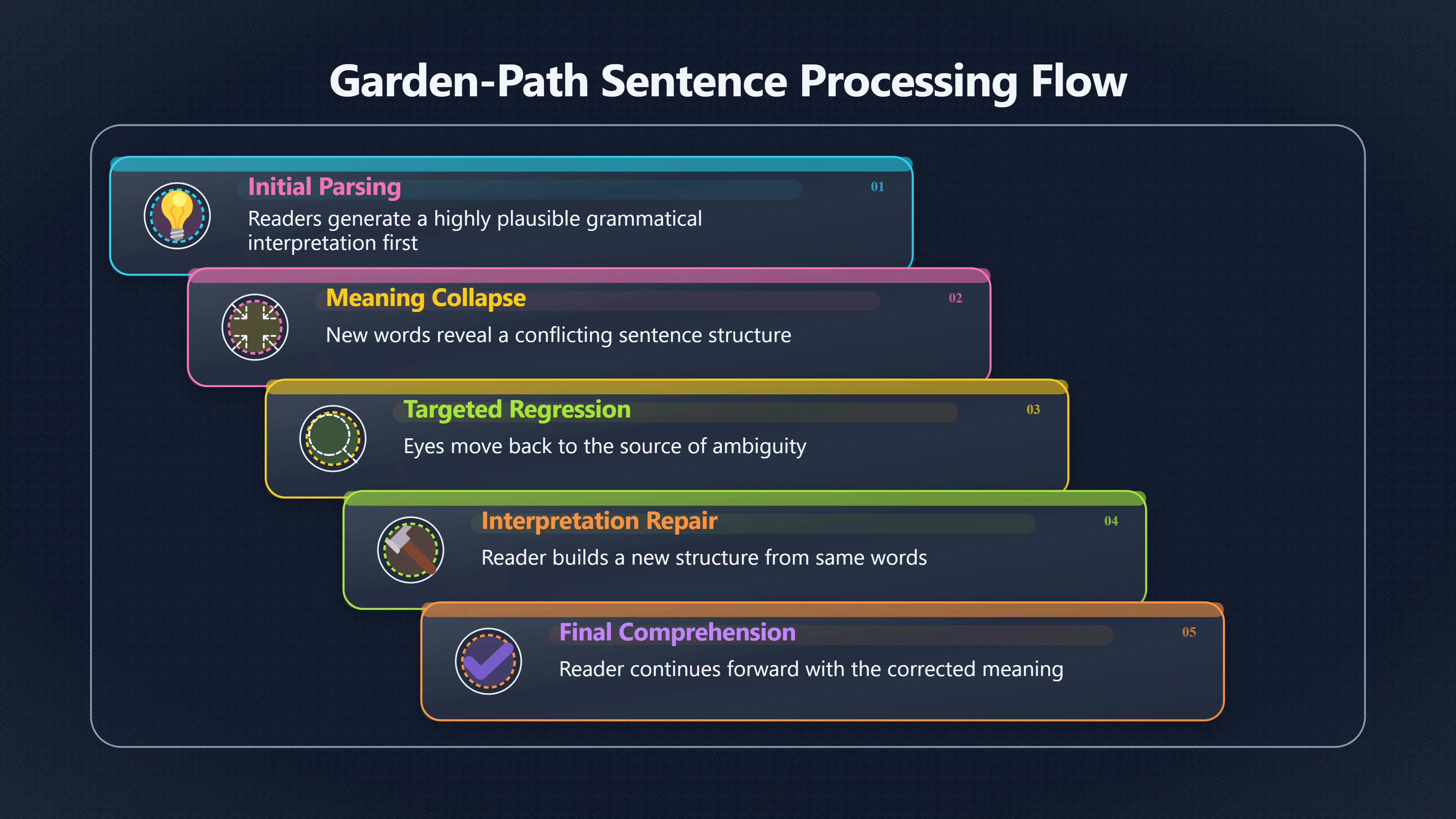
The clearest demonstration of ambiguity-driven lookbacks comes from so-called garden-path sentences. These sentences encourage a highly plausible interpretation that later turns out to be wrong.
Consider:
While the man hunted the deer ran into the woods.
Many readers initially treat “the deer” as the object of “hunted”. The word “ran” then reveals that “the deer” is actually the subject of a new clause. The reader’s original interpretation no longer fits the sentence, creating a need for reanalysis. Psycholinguistic research has used such sentences for decades because they reveal how readers construct meaning incrementally rather than waiting until the end of a sentence.[Wikipedia]WikipediaGarden-path sentenceGarden-path sentence
The key mechanism is prediction. As words arrive, readers generate expectations about grammar and meaning. Most of the time these predictions are helpful because they speed comprehension. However, when a prediction is wrong, the reading system must repair it. Garden-path sentences expose this repair process in a highly visible form. Eye-tracking studies show increased reading times and frequent regressions near the point where the sentence becomes disambiguated.[Wikipedia]WikipediaGarden-path sentenceGarden-path sentence
Importantly, the slowdown is not caused by unfamiliar vocabulary. It occurs because the reader must abandon a previously constructed interpretation and build a new one from the same words. This makes ambiguity-driven regressions fundamentally different from simple word-recognition difficulties.[MDPI]mdpi.comWe distinguish two types of these movements (regressions). One type consists of relatively large…Read more…
Where Readers Look When Meaning Collapses
When comprehension breaks down, regressions are not random. Readers tend to return to locations that can resolve the ambiguity.
Research on eye movements during sentence processing shows that readers often direct their gaze back toward the region that created the mistaken interpretation. In garden-path sentences, this may be the verb, noun phrase, or clause boundary that originally supported the incorrect parse. These targeted lookbacks suggest that regressions are part of a controlled repair strategy rather than a sign of aimless rereading.[Wikipedia]WikipediaGarden-path sentenceGarden-path sentence
Several patterns commonly appear:
- Readers regress to the word or phrase that now seems inconsistent with later information.
- They spend additional fixation time on the ambiguous region.
- They then move forward again with a revised interpretation.
- The more severe the ambiguity, the more extensive the rereading tends to be.[Wikipedia+2tmalsburg.github.io]WikipediaGarden-path sentenceGarden-path sentence
Eye-tracking reviews distinguish these comprehension-driven regressions from small corrective eye movements caused by visual targeting errors. The former are closely linked to language understanding and become more likely when readers need to revise linguistic content.[MDPI]mdpi.comWe distinguish two types of these movements (regressions). One type consists of relatively large…Read more…
This distinction matters for reading speed. A reader who briefly revisits a critical phrase to repair meaning may lose a second or two. A reader who fails to repair the interpretation may misunderstand an entire paragraph.

Why Reanalysis Is Often Better Than Pressing Ahead
A tempting response to ambiguity is to keep moving forward and hope that later context resolves the confusion. Research suggests that this strategy has limits.
Studies examining the role of regressions in reading comprehension have found that preventing or severely restricting rereading can reduce understanding. When readers cannot return to earlier text, they become more dependent on memory representations that may already contain the wrong interpretation.[ResearchGate]researchgate.netResearch Gate(PDF) Don't Believe What You Read (Only OnceResearchGate(PDF) Don't Believe What You Read (Only Once)April 18, 2014 — These data suggest that regressions contribute to the ability t…
This is especially important because reanalysis is not always perfect. Research on garden-path processing has shown that initial misinterpretations can linger even after readers encounter information that should correct them. In some cases, people continue to retain traces of the original, incorrect meaning.[Wikipedia]WikipediaGarden-path sentenceGarden-path sentence
A useful lookback helps counter this problem by allowing the reader to inspect the actual words again rather than relying solely on memory. The text itself becomes an external reference that supports reconstruction of the sentence’s intended meaning. This is one reason comprehension-driven regressions are often viewed as a beneficial component of skilled reading rather than evidence of failure.[MDPI]mdpi.comWe distinguish two types of these movements (regressions). One type consists of relatively large…Read more…
Why Ambiguity Matters for Reading Speed
From a speed perspective, ambiguity creates a trade-off. Every regression adds time, but refusing to regress can produce larger comprehension costs later.
Skilled readers generally do not eliminate ambiguity-driven lookbacks. Instead, they appear to use them selectively. When the reading system detects that an interpretation no longer fits incoming information, a short regression can prevent a much larger misunderstanding from spreading through the rest of the text. Eye-movement research consistently links these larger regressions to comprehension repair rather than inefficient reading habits.[MDPI]mdpi.comWe distinguish two types of these movements (regressions). One type consists of relatively large…Read more…
For readers seeking greater speed, the lesson is not that all regressions are desirable. Habitual rereading of easy text can certainly slow progress. However, regressions triggered by genuine ambiguity perform a different function. They help the brain recover from incorrect predictions, rebuild sentence structure, and preserve accurate comprehension when meaning briefly goes off course.[PubMed+2MDPI]pubmed.ncbi.nlm.nih.govThe function of these "regressions" is still largely unknownThe function of regressions in reading: backward eye…by RW Booth · 2013 · Cited by 134 — Standard text reading involves frequent…
The Core Mechanism in One Sentence
Ambiguity triggers useful reading lookbacks because readers construct meaning before a sentence is complete; when later words reveal that the original interpretation was wrong, regressions allow the eyes to revisit the critical text and rebuild a more accurate understanding.[tmalsburg.github.io+2MDPI]tmalsburg.github.ioEyetracking research has addressed a wide range of questions.Read moreWhat eye movements can tell us about sentence…January 28, 2013 — by S Vasishth · Cited by 130 — Eye movement data have proven to be ve…
Amazon book picks
Further Reading
Books and field guides related to Why Confusing Sentences Make Eyes Look Back. Use these as the next step if you want deeper reading beyond the article.
How to Read a Book
Rating: 4.0/5 from 41 Google Books ratings
Focuses on understanding meaning rather than rushing forward.
eBay marketplace picks
Marketplace Samples
Example marketplace items related to this page. Use the search link to explore similar finds on eBay.




Endnotes
1.
Source: tmalsburg.github.io
Title: Eyetracking research has addressed a wide range of questions.Read more
Link:https://tmalsburg.github.io/VasishthEtAl2013.pdf
Source snippet
What eye movements can tell us about sentence...January 28, 2013 — by S Vasishth · Cited by 130 — Eye movement data have proven to be ve...
Published: January 28, 2013
2.
Source: mdpi.com
Link:https://www.mdpi.com/2411-5150/3/3/35
Source snippet
We distinguish two types of these movements (regressions). One type consists of relatively large...Read more...
3.
Source: Wikipedia
Title: Garden-path sentence
Link:https://en.wikipedia.org/wiki/Garden-path_sentence
4.
Source: researchgate.net
Title: Research Gate(PDF) Don’t Believe What You Read (Only Once)
Link:https://www.researchgate.net/publication/261761989_Don%27t_Believe_What_You_Read_Only_Once_Comprehension_Is_Supported_by_Regressions_During_Reading
Source snippet
ResearchGate(PDF) Don't Believe What You Read (Only Once)April 18, 2014 — These data suggest that regressions contribute to the ability t...
Published: April 18, 2014
5.
Source: Wikipedia
Link:https://en.wikipedia.org/wiki/Eye
Source snippet
EyeAn eye is a sensory organ that allows an organism to perceive visual information. It detects light and converts it into electro-che...
6.
Source: pubmed.ncbi.nlm.nih.gov
Title: The function of these “regressions” is still largely unknown
Link:https://pubmed.ncbi.nlm.nih.gov/22886737/
Source snippet
The function of regressions in reading: backward eye...by RW Booth · 2013 · Cited by 134 — Standard text reading involves frequent...
7.
Source: pmc.ncbi.nlm.nih.gov
Link:https://pmc.ncbi.nlm.nih.gov/articles/PMC5735033/
Source snippet
Comprehension of Ambiguous Sentences by School...by MM Davidson · 2017 · Cited by 44 — Results indicated that children with ASD, similar...
8.
Source: nei.nih.gov
Title: how eyes work
Link:https://www.nei.nih.gov/eye-health-information/healthy-vision/how-eyes-work
Source snippet
the Eyes Work - National Eye Institute - NIHApr 20, 2022 — All the different part of your eyes work together to help you see. Learn the j...
9.
Source: betterhealth.vic.gov.au
Link:https://www.betterhealth.vic.gov.au/health/conditionsandtreatments/eyes
Source snippet
Eyes explainedThe eye is our organ of vision. Its complicated design means that an image can pass through its many layers and end up cris...
Additional References
10.
Source: nature.com
Link:https://www.nature.com/eye/
Source snippet
EyeEye is the official journal of the Royal College of Ophthalmologists. It aims to provide the practising ophthalmologist with informati...
11.
Source: aao.org
Link:https://www.aao.org/eye-health
Source snippet
Eye HealthThe Academy's EyeSmart website provides ophthalmologist-reviewed information about eye diseases and treatments, eye health news...
12.
Source: research-portal.uu.nl
Link:https://research-portal.uu.nl/ws/files/266642627/Grammatical_understanding_predicts_reading_comprehension_in_secondary-level_students_insights_from_a_Finnish_national_survey.pdf
Source snippet
understanding predicts reading...by J Marjokorpi · 2025 · Cited by 13 — The study encourages further research on the benefits of explici...
13.
Source: webmd.com
Link:https://www.webmd.com/eye-health/picture-of-the-eyes
Source snippet
The Eyes (Human Anatomy): Diagram, Optic Nerve, Iris...WebMD's Eyes Anatomy Pages provide a detailed picture and definition of the human...
14.
Source: oars.uos.ac.uk
Link:https://oars.uos.ac.uk/1044/1/Stella___Engelhardt__2019__OARS_version.pdf
Source snippet
ambiguity resolution in dyslexiaby M Stella · Cited by 21 — They showed that dyslexics had a greater number of fixations on a target word...
15.
Source: dictionary.cambridge.org
Link:https://dictionary.cambridge.org/dictionary/english/eye
Source snippet
English meaning - Cambridge Dictionary6 days ago — one of the two organs in your face that are used for seeing: He has no sight in his...
16.
Source: readlite.in
Title: Strategic regressions improve reading outcomes
Link:https://readlite.in/concepts/regressions-reading
Source snippet
Regressions in Reading: Why Your Eyes Jump Back (And...Studies show that forcing yourself not to regress leads to worse comprehension, e...
17.
Source: akjournals.com
Title: There are two possible cognitive
Link:https://www.akjournals.com/view/journals/2059/8/1/article-p77.xml
Source snippet
Error detection in reading in English: A validation study of a...by T Gostiukhin · 2025 — The presence of regressions may indicate sever...
18.
Source: videnomlaesning.dk
Title: reading for understanding
Link:https://www.videnomlaesning.dk/media/2526/reading-for-understanding.pdf
Source snippet
Toward an R&D Program in Reading Comprehensionby C Snow · 2002 · Cited by 5123 — Understanding how to improve reading comprehension outco...
19.
Source: educationaldatamining.org
Title: 2022.EDM long papers.13
Link:https://educationaldatamining.org/edm2022/proceedings/2022.EDM-long-papers.13/
Source snippet
Going Deep and Far: Gaze-based [Models]({{ 'models/' | relative_url }}) Predict Multiple...by M Caruso · 2022 · Cited by 15 — Gaze-based student-independent computational...
Topic Tree