Within Easy Trap
The Small Words Fast Readers Miss
Small words such as however, except, and under certain conditions often carry the parts of a familiar text most worth slowing for.
On this page
- Why caveats disappear during confident skimming
- Common signal words that change the claim
- How to mark exceptions without losing speed
Page outline Jump by section
Introduction
One of the fastest ways to misread a familiar text is to skip the smallest words in it. When readers already know a topic, they often move quickly through sentences that seem predictable. The problem is that the most important limitation, exception or reversal is frequently carried by a short qualification word: however, except, although, unless, only if, under certain conditions, or in most cases.
 In the context of increasing reading speed, this matters because efficient reading depends on distinguishing low-value text from high-value text. Qualification words are high-value text. They often mark the exact place where an author narrows a claim, introduces an exception or signals that a familiar idea does not apply as broadly as readers expect. Research on metacognitive monitoring and overconfidence consistently shows that readers can overestimate how well they understand a text, particularly when familiarity encourages prediction instead of careful verification.[Springer+2Frontiers]link.springer.comWhat Makes Learners Overestimate Their Text…by S Golke · 2022 · Cited by 33 — It is frequently assumed that learner characteri…
Why Caveats Disappear During Confident Skimming
Fast reading relies heavily on prediction. Skilled readers do not process every word equally; they use prior knowledge to anticipate what comes next. Most of the time this is efficient. The difficulty arises when prediction becomes so strong that the reader effectively substitutes an expected sentence for the sentence that is actually on the page.
A familiar nonfiction article often contains long stretches that match what the reader already believes. As confidence rises, attention shifts toward major nouns, verbs and conclusions. Small connective words receive less scrutiny. Yet those words frequently determine the logical meaning of the entire passage.
Consider the difference between these statements:
- Exercise improves health.
- Exercise improves health for most people.
- Exercise improves health except in certain medical conditions.
- Exercise improves health, however the benefits vary substantially by intensity and population.
The topic remains familiar, but the claim changes each time. The misunderstanding comes not from missing the main idea but from overlooking the qualification.
Research on metacognition in reading shows that readers are not always accurate judges of their own comprehension. People commonly believe they understand a text more completely than they actually do, especially when they can easily recognise its subject matter.[Taylor & Francis Online+2Springer]tandfonline.comTaylor & Francis OnlineFull article: Reading comprehension and metacognitionby C Soto · 2019 · Cited by 211 — We explored relations betwe…
This creates a specific danger for speed readers: the more familiar the subject, the less likely they may be to notice the sentence that limits the conclusion.
Common Signal Words That Change the Claim
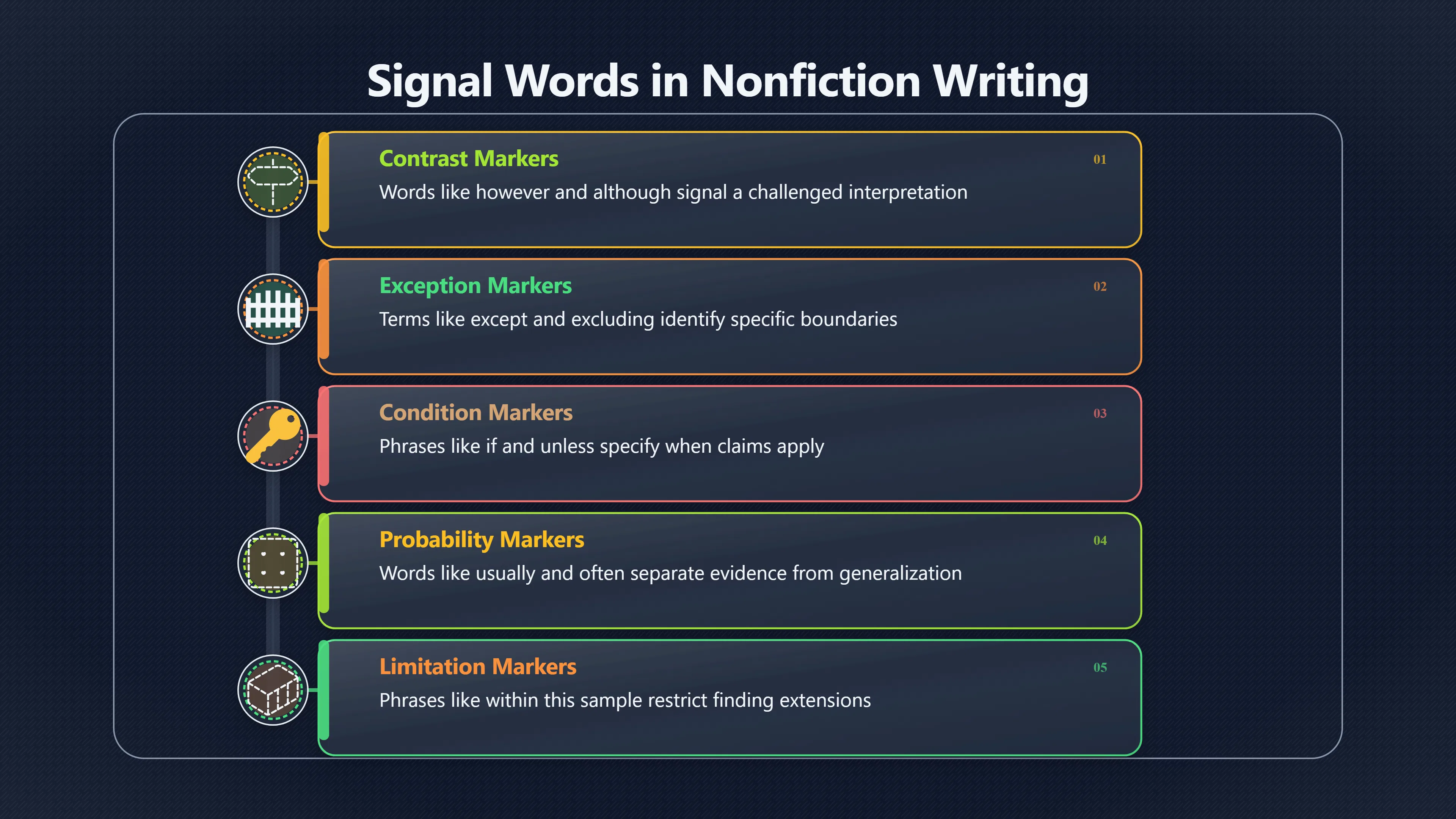
Qualification words perform a structural role in nonfiction writing. They tell readers where the author’s claim becomes narrower, weaker, conditional or more precise.
Contrast Markers
Words such as however, although, yet, nevertheless, and despite indicate that a straightforward interpretation is about to be challenged.
For example:
The treatment was effective. However, the effect was observed only in patients under 50.
A reader who remembers only the first sentence has misunderstood the result.
These markers are especially important because they often appear after the reader believes they already know the conclusion.
Exception Markers
Words such as except, apart from, excluding, and with the exception of identify boundaries.
For example:
All participants improved except those who missed more than half the sessions.
The exception may apply to a minority of cases, but it is frequently the most informative part of the finding.
Condition Markers
Words such as if, unless, provided that, only if, and under certain conditions specify when a claim is true.
For example:
The strategy improves reading speed if the reader already possesses background knowledge of the topic.
Removing the condition changes the meaning entirely.
Probability and Scope Markers
Words such as usually, often, typically, generally, in many cases, and may are easy to skim past because they appear modest and unremarkable.
Yet they separate evidence-based claims from overgeneralisation.
Compare:
- “This method improves comprehension.”[pmc.ncbi.nlm.nih.gov]pmc.ncbi.nlm.nih.govMonitoring in Reading Comprehension - PMCby V Markovich · 2026 — This study examined associations between vocabulary knowledge, reading f…
- “This method often improves comprehension.”
The second statement is substantially more cautious and usually more accurate.
Limitation Markers
Phrases such as within this sample, in this study, for these participants, or under these circumstances restrict how far a finding can be extended.
Scientific and technical writing frequently places its most important caution in these phrases. Missing them can turn a local observation into a universal rule.
What Reading Research Suggests About Small Words
Eye-tracking research shows that reading is not a smooth left-to-right sweep. Readers continually adjust attention, pause on difficult material and revisit sections when processing becomes demanding. Eye movements reveal that comprehension depends not simply on seeing words but on allocating attention to the words that carry critical meaning.[PMC+2PsychArchives]pmc.ncbi.nlm.nih.govIn recent years, it has been employed increasingly for reading studies.Read moreEditorial: Eye-tracking while reading for psycholinguistic and…by M Palmović · 2023 · Cited by 4 — Eye-tracking is a powerful techn…
Studies of reading comprehension and metacomprehension also show that readers frequently exhibit monitoring errors. They may feel confident about their understanding while missing key constraints embedded in the text. This gap between perceived and actual understanding is one of the central findings in metacognitive research.[Frontiers+2Taylor & Francis Online]frontiersin.orgThe ability to assess and monitor one's own understanding of a written text is fundamental for learning and academic achievement.Read more…
Qualification words are particularly vulnerable because they are:
- Short and visually unobtrusive.
- Highly frequent in written language.
- Often grammatically functional rather than content-rich.
- Commonly placed after readers think they have already grasped the main point.
The result is a paradox. The words that seem least important during rapid reading often determine the accuracy of the final interpretation.

How to Mark Exceptions Without Losing Speed
The solution is not to slow down everywhere. It is to slow down selectively.
A useful speed-reading habit is to treat qualification words as visual signposts. Rather than reading every sentence at maximum attention, reserve extra attention for sentences containing logical modifiers.
Practical techniques include:
- Pause briefly after however, although, except, and unless.
- Mentally ask: “What limitation is being introduced?”
- Underline or mentally tag conditional phrases when reading dense nonfiction.
- Check whether the qualification changes the scope of the claim or merely adds detail.
- When reviewing notes, record the exception alongside the main idea.
For example, instead of noting:
“Background knowledge improves reading speed.”
Record:
“Background knowledge improves reading speed, but can increase overconfidence if exceptions and qualifications are skimmed.”
The second note preserves the actual argument rather than a simplified version.
The Fast Reader’s Hidden Advantage
Many readers assume speed and caution are opposites. In practice, strong readers often combine both by varying attention strategically.
Most sentences in a familiar text can be processed quickly because they confirm known information. Qualification words identify the minority of sentences that deserve closer inspection. These small markers frequently contain the author’s disagreement, limitation, exception or warning.
For readers seeking greater speed, the goal is not to slow down for everything. It is to recognise that words such as however, except, unless and under certain conditions are often carrying more meaning than the paragraph’s most impressive technical terms. Missing them can turn a correct understanding into an incorrect one, even when the rest of the text feels completely familiar.[Springer+2Utrecht University]link.springer.comWhat Makes Learners Overestimate Their Text…by S Golke · 2022 · Cited by 33 — It is frequently assumed that learner characteri…
Amazon book picks
Further Reading
Books and field guides related to The Small Words Fast Readers Miss. Use these as the next step if you want deeper reading beyond the article.
How to Read a Book
Rating: 4.0/5 from 41 Google Books ratings
Promotes active reading rather than assumption-driven skimming.


eBay marketplace picks
Marketplace Samples
Example marketplace items related to this page. Use the search link to explore similar finds on eBay.


Endnotes
1.
Source: link.springer.com
Link:https://link.springer.com/article/10.1007/s10648-022-09687-0
Source snippet
What Makes Learners Overestimate Their Text...by S Golke · 2022 · Cited by 33 — It is frequently assumed that learner characteri...
2.
Source: pmc.ncbi.nlm.nih.gov
Title: In recent years, it has been employed increasingly for reading studies.Read more
Link:https://pmc.ncbi.nlm.nih.gov/articles/PMC10715244/
Source snippet
Editorial: Eye-tracking while reading for psycholinguistic and...by M Palmović · 2023 · Cited by 4 — Eye-tracking is a powerful techn...
3.
Source: psycharchives.org
Link:https://www.psycharchives.org/en/item/f5070adb-055e-4f79-8454-a399b5def1a5
Source snippet
While there are machine learning...Read more...
4.
Source: frontiersin.org
Link:https://www.frontiersin.org/journals/psychology/articles/10.3389/fpsyg.2018.02253/full
Source snippet
The ability to assess and monitor one's own understanding of a written text is fundamental for learning and academic achievement.Read more...
5.
Source: research-portal.uu.nl
Title: fcomm 06 661801
Link:https://research-portal.uu.nl/ws/files/228265016/fcomm-06-661801.pdf
Source snippet
Utrecht UniversityUtrecht University Repositoryby S Gaillard · 2021 · Cited by 60 — They concluded that there are cognitive and metacogni...
6.
Source: tandfonline.com
Link:https://www.tandfonline.com/doi/full/10.1080/2331186X.2019.1565067
Source snippet
Taylor & Francis OnlineFull article: Reading comprehension and metacognitionby C Soto · 2019 · Cited by 211 — We explored relations betwe...
7.
Source: pmc.ncbi.nlm.nih.gov
Link:https://pmc.ncbi.nlm.nih.gov/articles/PMC13027792/
Source snippet
Monitoring in Reading Comprehension - PMCby V Markovich · 2026 — This study examined associations between vocabulary knowledge, reading f...
8.
Source: pmc.ncbi.nlm.nih.gov
Link:https://pmc.ncbi.nlm.nih.gov/articles/PMC11507242/
Source snippet
the Word Level Skill and Reading Comprehension...by CL Richmond · 2023 · Cited by 7 — This study examined the heterogeneity of literacy...
9.
Source: studocu.id
Title: reading comprehension
Link:https://www.studocu.id/id/document/universitas-sebelas-maret/english-language-education/reading-comprehension-skimming-[scanning
Source snippet
Harmer (2001: 202). - Scanning is the strategy for quickly finding...Read more...
Additional References
10.
Source: researchgate.net
Link:https://www.researchgate.net/publication/398282916_An_Analysis_of_Skimming_and_Scanning_Strategies_in_Teaching_Reading_Skill_Used_by_the_English_Teacher_at_the_Eighth_Grade_of_UPTD_SMP_Negeri_1_Mandrehe_Barat
Source snippet
(PDF) An Analysis of Skimming and Scanning Strategies in...6 Sept 2025 — This study aims to examine the use of skimming and scanning tec...
11.
Source: sr-research.com
Link:https://www.sr-research.com/reading-language-publications/
Source snippet
Reading and Language Eye-Tracking PublicationsComprehensive list of reading and language research peer-reviewed journal article publicati...
12.
Source: scispace.com
Link:https://scispace.com/pdf/the-analysis-of-skimming-and-scanning-technique-to-improve-3nxbe3x05j.pdf
Source snippet
Skimming and Scanning in reading comprehension and to find out the advantages and disadvantages of skimming and...Read more...
13.
Source: reunir.unir.net
Title: Eye tracking contribution on processing OF reading comprehension
Link:https://reunir.unir.net/bitstream/handle/123456789/18055/Eye-tracking%20contribution%20on%20processing%20OF%20reading%20comprehension.pdf?isAllowed=y&sequence=1
Source snippet
unir.netEye-tracking contribution on processing of (implicit)...by C de-la-Peña · 2024 · Cited by 15 — The aim is to understand the role...
14.
Source: revistaocnos.com
Link:https://www.revistaocnos.com/index.php/ocnos/article/download/488/897/8687
Source snippet
n Spanish, in dyslexic children and typical readers based on their eye movements...Read more...
15.
Source: research.reading.ac.uk
Title: 2025 03 Tromso Eye Tracking Workshop Session 2 Handout
Link:https://research.reading.ac.uk/psylinglab/wp-content/uploads/sites/25/2025/03/2025-03-Tromso-Eye-Tracking-Workshop-Session-2-Handout.pdf
Source snippet
reading.ac.ukEYE-TRACKING DURING READING IN PSYCHOLINGUISTICS28 Mar 2025 — Corpus-based eye-tracking has been used widely in L1 research...
16.
Source: tefl-tesol-certification.com
Link:https://tefl-tesol-certification.com/blog/types-of-reading
Source snippet
Types of Reading (ESL): Skimming, Scanning & More4 Sept 2024 — Discover the four essential types of reading: scanning, skimming, extensiv...
17.
Source: pdfs.semanticscholar.org
Link:https://pdfs.semanticscholar.org/8a97/4a025e15830f62dc3dc72f1066e160540711.pdf
Source snippet
Students' Reading Comprehension Through...by PVV Mokalu · Cited by 6 — According to the results, the researchers try to draw a conclusio...
18.
Source: tmalsburg.github.io
Link:https://tmalsburg.github.io/MeziereEtAl2021MS.pdf
Source snippet
eye-tracking reading comprehensionby DC Mézière · Cited by 143 — To date, eye-movement markers of successful reading comprehension have n...
19.
Source: rsisinternational.org
Link:https://rsisinternational.org/journals/ijriss/uploads/vol9-iss10-pg4423-4431-202511_pdf.pdf
Source snippet
Relationship Between Cognitive Biases and Reading...12 Nov 2025 — This study explored the relationship between cognitive biases and read...
Topic Tree