Within Inner Rhythm
Should you really silence the inner voice?
Trying to silence the inner voice may increase pace briefly, but it can also remove the phrasing readers use to follow arguments.
On this page
- The speed reading claim versus reading evidence
- Why phonological coding still matters
- Signs that speed is outrunning comprehension
Page outline Jump by section
Introduction
Many speed-reading programmes present the inner voice as a bottleneck. The promise is simple: stop mentally “hearing” words and you can move through text far faster. The problem is that the same internal speech many readers try to eliminate often helps them understand what they are reading. Research on silent reading, phonological coding, and implicit prosody suggests that the inner voice is not merely a habit left over from reading aloud. It is part of how readers organise sentences, maintain information in working memory, and track the structure of complex arguments. Suppressing it may produce a short-term increase in pace, but the gain can come at the cost of comprehension, especially when material becomes dense, unfamiliar, or logically demanding.[ILA+2PMC]ila.onlinelibrary.wiley.comILAEvidence for Prosody in Silent ReadingGross - 201418 Dec 2013 — Recent brain activation research reveals that skilled, adult readers activate phonological features during the…
Should you really silence the inner voice?
The speed-reading claim versus reading evidence
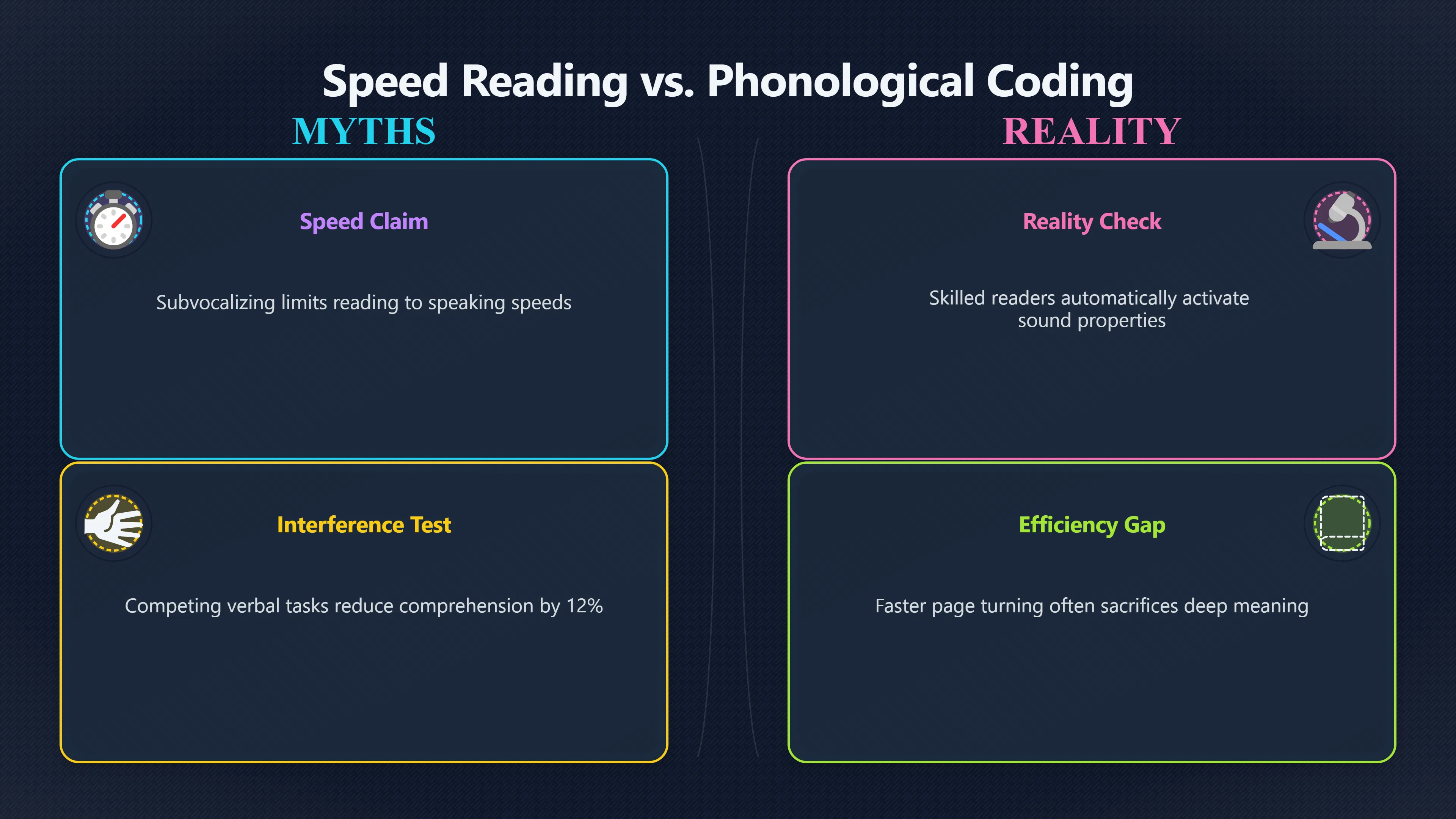
The traditional speed-reading argument is that subvocalisation—the tendency to generate an internal voice while reading—limits reading speed to something close to speaking speed. If readers could bypass sound and process words as pure visual symbols, they could supposedly read much faster. This idea became a central feature of many commercial speed-reading systems.[Scott H. Young]scotthyoung.comScott HYoungI Was Wrong About Speed Reading: Here are the FactsJanuary 19, 2015 — 19 Jan 2015 — Speed reading experts claim that subvocalization…
However, reading research has repeatedly found that skilled readers automatically activate phonological information—the sound-related properties of words—even during silent reading. Rather than being an unnecessary extra step, phonological processing appears deeply integrated with word recognition and meaning construction. Studies reviewed by reading researchers show that phonological information is activated extremely early during visual word recognition, suggesting it helps guide comprehension rather than merely following it.[ILA+2CORE]ila.onlinelibrary.wiley.comILAEvidence for Prosody in Silent ReadingGross - 201418 Dec 2013 — Recent brain activation research reveals that skilled, adult readers activate phonological features during the…
The strongest challenge to the “eliminate the inner voice” advice comes from experiments that deliberately interfere with speech-based processing. When readers are forced to perform competing verbal tasks that disrupt internal speech, comprehension typically declines. One study found that interfering with speech recoding during silent reading reduced comprehension performance by roughly 10–12% on average.[Springer]link.springer.comAssessing the importance of subvocalization during normal…by M Daneman · 1992 · Cited by 72 — Interfering with speech recoding…
This does not mean readers must consciously pronounce every word in their minds. It does mean that removing phonological support altogether is rarely a free speed gain.
Why phonological coding still matters
The most important misunderstanding in many speed-reading discussions is the assumption that phonological coding and spoken speech are the same thing.
Skilled readers do not usually recreate full spoken sentences internally at conversational speed. Instead, they activate compact sound-based representations that help connect spelling, word identity, syntax, and meaning. Researchers often describe this process as phonological coding.[PMC]pmc.ncbi.nlm.nih.govPMCPhonological coding during readingNIHby M Leinenger · 2014 · Cited by 170 — This inner voice is a subjective manifestation of phonological coding, the recoding of or…
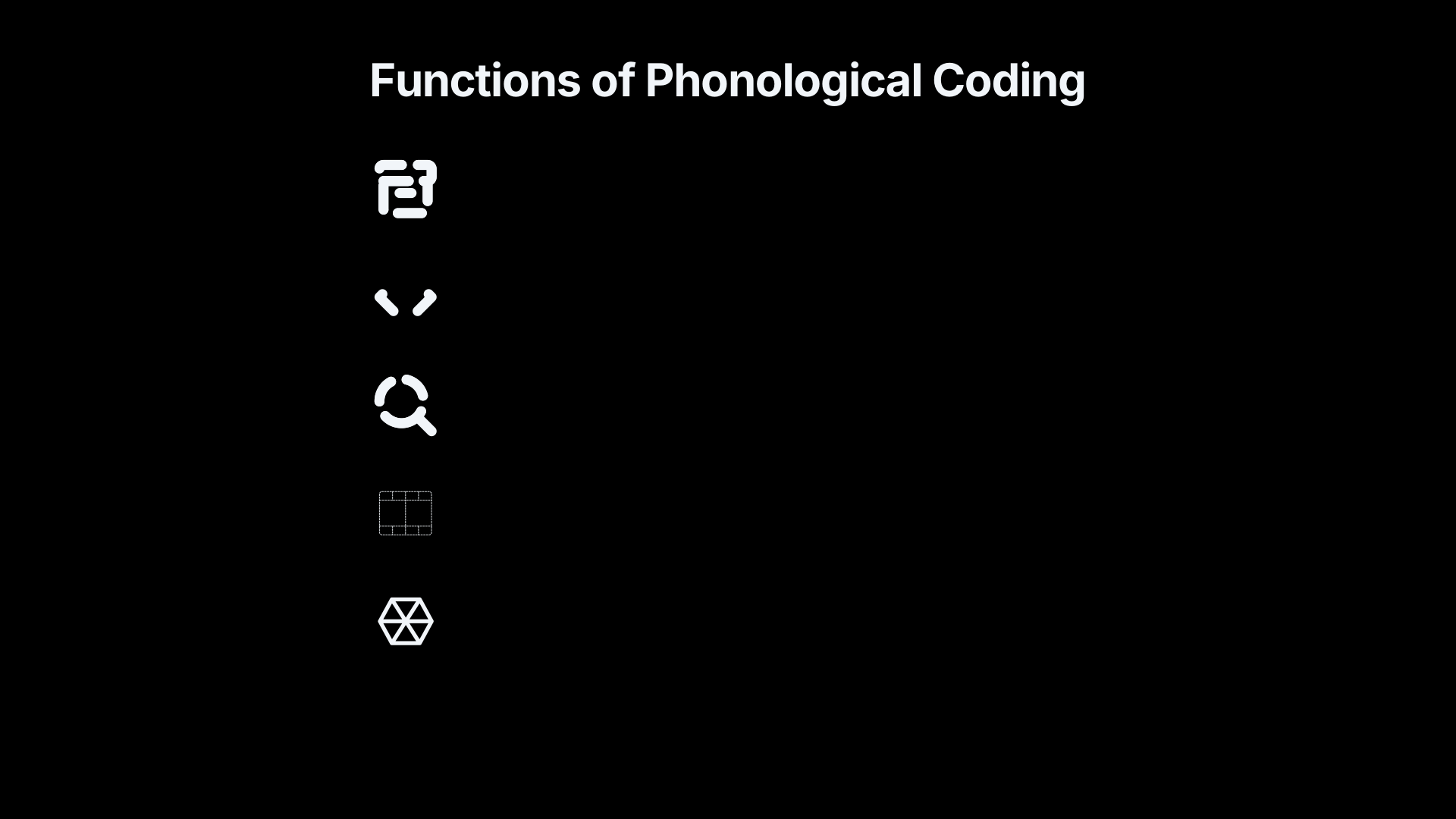
Within silent reading, this phonological layer supports several comprehension functions:
Maintaining word order in working memory. Written language unfolds across time. Readers must temporarily retain earlier words and phrases while integrating new information. Sound-based representations appear to help preserve that sequence, making it easier to combine words into meaningful units.[ORA]ora.ox.ac.ukAugust 12, 2023 — by E Mok · 2023 · Cited by 1 — subvocalization, or “inner speech” during comprehension is to aid higher-level comprehen…
Grouping sentences into phrases. Silent readers often impose an internal rhythm or prosodic structure on text. This implicit phrasing helps identify clause boundaries, relationships between ideas, and the intended structure of a sentence.[MDPI+2eScholarship]mdpi.comImplicit Prosody and Contextual Bias in Silent Readingby K McCurdy · 2013 · Cited by 21 — Eye-movement research on implicit prosody h…
Resolving ambiguity. Many sentences can be interpreted in more than one way until later words clarify the meaning. Research on implicit prosody suggests that readers use internally generated stress patterns and phrase boundaries to guide interpretation before all information is available.[MDPI]mdpi.comImplicit Prosody and Contextual Bias in Silent Readingby K McCurdy · 2013 · Cited by 21 — Eye-movement research on implicit prosody h…
Supporting memory and retention. Translating visual text into a partially phonological form creates an additional coding route for information. This can improve retention and later recall, particularly when material must be remembered rather than merely scanned.[Wikipedia]WikipediaOpen source on wikipedia.org.
These functions become more important as texts become more demanding. A simple shopping list places minimal demands on syntax and working memory. A legal document, scientific paper, or philosophical argument does not.
What happens when the inner rhythm disappears?
The risks of suppressing the inner voice are easiest to see in complex reading.
Consider a sentence containing multiple clauses, qualifications, and contrasts. Readers normally use an internal sense of phrasing to determine which ideas belong together and which ideas modify others. When that phrasing weakens, words may still be recognised individually, but the larger structure becomes harder to track.[MDPI]mdpi.comImplicit Prosody and Contextual Bias in Silent Readingby K McCurdy · 2013 · Cited by 21 — Eye-movement research on implicit prosody h…
The result is often a misleading feeling of speed. Eyes continue moving across the page, and word recognition remains intact, but comprehension begins to lag behind. Readers may reach the end of a paragraph only to discover that they cannot accurately explain the argument they just read.
This distinction matters because reading speed and reading efficiency are not identical. Efficient reading means obtaining meaning quickly. If comprehension falls enough to require rereading, the apparent speed gain disappears.
Research evaluating speed-reading claims has repeatedly found this trade-off. Reviews of reading science have concluded that attempts to eliminate subvocalisation and other natural reading processes typically reduce comprehension as speed increases.[WIRED]wired.comBasic calculations based on the properties of eyes and texts indicate that an average reading speed is around 280 words per minute, a val…
Signs that speed is outrunning comprehension
Readers experimenting with faster reading often need practical indicators that comprehension is being sacrificed.
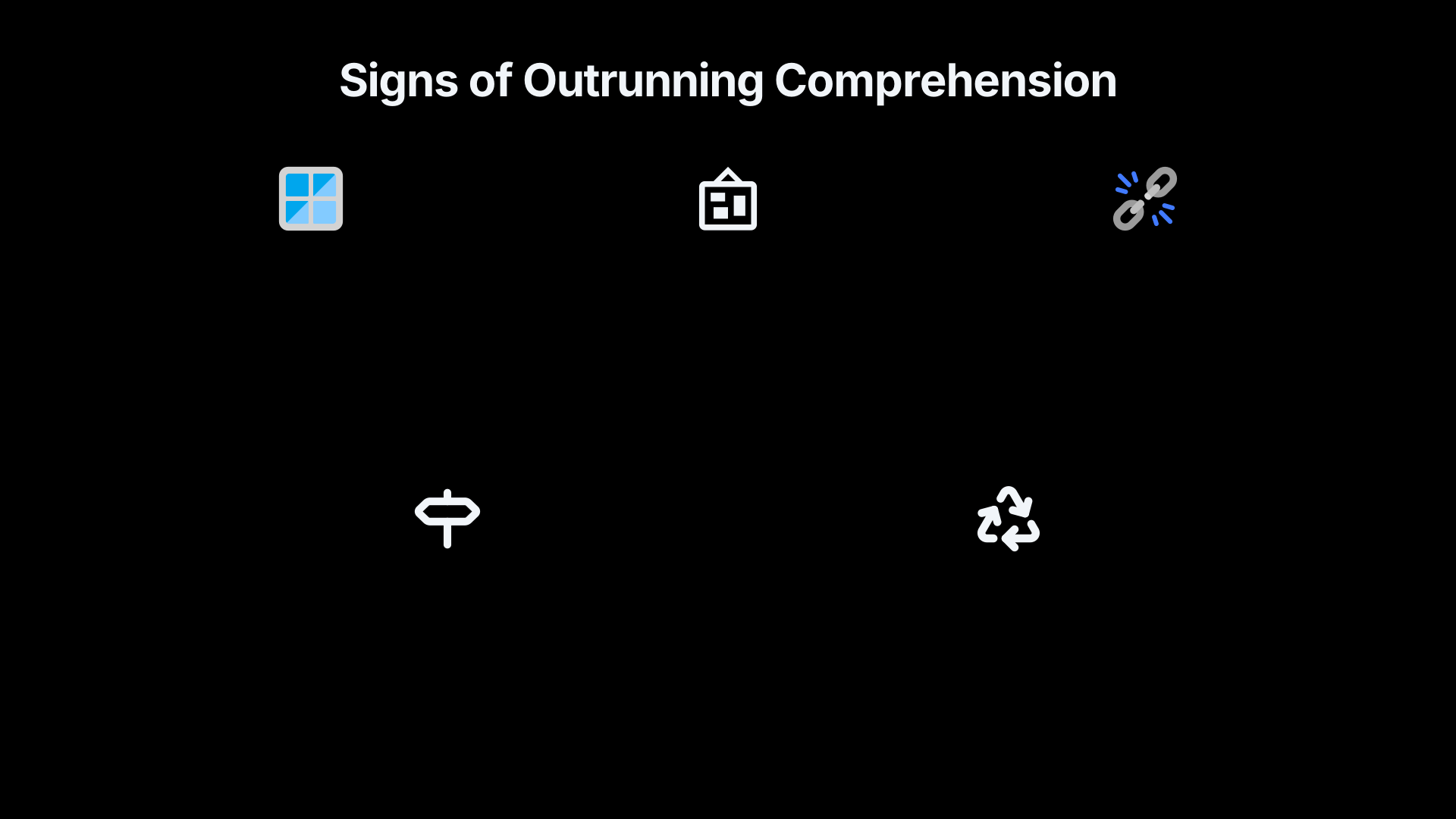
Common warning signs include:
- Reaching the end of a page with only a vague sense of the argument.
- Remembering isolated facts but not the relationships between them.
- Losing track of pronouns, references, or causal chains.
- Missing contrasts signalled by words such as “however”, “although”, or “despite”.
- Frequently needing to reread dense passages.
- Feeling that reading is fast while recall immediately afterwards is weak.
These symptoms often appear first in complex nonfiction because such material depends heavily on phrase structure, working memory, and logical integration—the very processes supported by phonological coding and implicit prosody.[ORA+2MDPI]ora.ox.ac.ukAugust 12, 2023 — by E Mok · 2023 · Cited by 1 — subvocalization, or “inner speech” during comprehension is to aid higher-level comprehen…
A better goal than eliminating subvocalisation
For readers seeking greater speed, the evidence points towards a different target. Rather than trying to silence the inner voice completely, skilled reading appears to involve making phonological processing more efficient.
Experienced readers typically move through familiar material rapidly while still maintaining an internal sense of phrasing. They process larger chunks of language, recognise words more automatically, and allocate attention according to difficulty. The inner voice becomes streamlined, not eliminated.[ResearchGate+2ILA]researchgate.netResearch Gate(PDF) Why Does Prosody Accompany Fluency?Re …May 12, 2016 — Recent eye movement data from skilled readers indicate that automatically processing prosodic phonological informati…
In that sense, the question is not whether the inner voice exists. The more useful question is whether it continues to support meaning. Silent reading research suggests that for most readers, the internal rhythm of language remains a valuable guide. Removing it entirely may increase page-turning speed, but it can also remove one of the tools the brain uses to understand what those pages actually say.[ILA+2PMC]ila.onlinelibrary.wiley.comILAEvidence for Prosody in Silent ReadingGross - 201418 Dec 2013 — Recent brain activation research reveals that skilled, adult readers activate phonological features during the…
Amazon book picks
Further Reading
Books and field guides related to Should you really silence the inner voice?. Use these as the next step if you want deeper reading beyond the article.

Proust and the Squid
Explores how the brain processes written language, supporting discussion of inner speech and phonological coding.
Reading in the Brain
Provides evidence on the neural systems involved in reading and word recognition.
The Shallows
Examines deep reading, attention, and the trade-off between speed and comprehension.
Reading Mind
Directly addresses cognitive processes involved in reading, including comprehension rather than speed-only approaches.
eBay marketplace picks
Marketplace Samples
Example marketplace items related to this page. Use the search link to explore similar finds on eBay.


Endnotes
1.
Source: ila.onlinelibrary.wiley.com
Title: ILAEvidence for Prosody in Silent Reading
Link:https://ila.onlinelibrary.wiley.com/doi/10.1002/rrq.67
Source snippet
Gross - 201418 Dec 2013 — Recent brain activation research reveals that skilled, adult readers activate phonological features during the...
2.
Source: pmc.ncbi.nlm.nih.gov
Title: PMCPhonological coding during reading
Link:https://pmc.ncbi.nlm.nih.gov/articles/PMC4211933/
Source snippet
NIHby M Leinenger · 2014 · Cited by 170 — This inner voice is a subjective manifestation of phonological coding, the recoding of or...
3.
Source: link.springer.com
Link:https://link.springer.com/article/10.1007/BF01027072
Source snippet
Assessing the importance of subvocalization during normal...by M Daneman · 1992 · Cited by 72 — Interfering with speech recoding...
4.
Source: scotthyoung.com
Title: Scott H
Link:https://www.scotthyoung.com/blog/2015/01/19/speed-reading-redo/
Source snippet
YoungI Was Wrong About Speed Reading: Here are the FactsJanuary 19, 2015 — 19 Jan 2015 — Speed reading experts claim that subvocalization...
Published: January 19, 2015
5.
Source: wired.com
Link:https://www.wired.com/2017/01/make-resolution-read-speed-reading-wont-help
Source snippet
Basic calculations based on the properties of eyes and texts indicate that an average reading speed is around 280 words per minute, a val...
6.
Source: core.ac.uk
Link:https://core.ac.uk/download/pdf/32451732.pdf
Source snippet
Evidence for Prosody in Silent Readingby J Gross · 2013 · Cited by 49 — Recent brain activation research reveals that skilled, adult read...
7.
Source: mdpi.com
Link:https://www.mdpi.com/1995-8692/6/2/9
Source snippet
Implicit Prosody and Contextual Bias in Silent Readingby K McCurdy · 2013 · Cited by 21 — [Eye-movement]({{ 'eye-tradeoff/' | relative_url }}) research on implicit prosody h...
8.
Source: escholarship.org
Link:https://escholarship.org/uc/item/3nw5828p
Source snippet
The role of prosodic phrasing in silent readingby R Murakami · 2024 — Prosodic phrasing plays a crucial role in sentence comprehension be...
9.
Source: Wikipedia
Link:https://en.wikipedia.org/wiki/Subvocalization
10.
Source: researchgate.net
Title: Research Gate(PDF) Why Does Prosody Accompany Fluency?
Link:https://www.researchgate.net/publication/302973404Why_Does_Prosody_Accompany_Fluency_Re-conceptualizing_the_Role_of[Phonology
Source snippet
12, 2016 — Recent eye movement data from skilled readers indicate that automatically processing prosodic phonological informati...
Published: May 12, 2016
11.
Source: pmc.ncbi.nlm.nih.gov
Link:https://pmc.ncbi.nlm.nih.gov/articles/PMC12194486/
Source snippet
the Prosodic Structure of Texts Reflected in Silent Reading...by M Palmović · 2025 — This study provides indirect evidence in favour of...
12.
Source: youtube.com
Title: The Science Behind Reading Speed
Link:https://www.youtube.com/watch?v=jv2BdHXRD3Q
Source snippet
Subvocalization | Things About Speed Reading Nobody Tells You...
13.
Source: youtube.com
Title: Subvocalization | Things About Speed Reading Nobody Tells You
Link:https://www.youtube.com/watch?v=DGDkTyOt7gQ
Source snippet
Read Faster by Reducing Subvocalization - Speed Reading Tips...
14.
Source: ora.ox.ac.uk
Link:https://ora.ox.ac.uk/objects/uuid%3Adfe9f411-fa39-48db-9fc3-b61ed41deb1e/files/dsf2685900
Source snippet
August 12, 2023 — by E Mok · 2023 · Cited by 1 — subvocalization, or “inner speech” during comprehension is to aid higher-level comprehen...
Published: August 12, 2023
Additional References
15.
Source: ies.ed.gov
Link:https://ies.ed.gov/use-work/awards/development-oral-and-silent-reading-fluency-and-their-relation-reading-comprehension-first-through
Source snippet
of Oral and Silent Reading Fluency and Their...The goals of this study were to: (1) explore development of oral and silent reading fluen...
16.
Source: reddit.com
Link:https://www.reddit.com/r/books/comments/oet3ym/the_false_promise_of_speed_reading_why_you_should/
17.
Source: instagram.com
Link:https://www.instagram.com/reel/DWcMWhQDqOg/
Source snippet
Researchers found that people who subvocalize, who hear an inner voice while reading, showed 42% higher...
18.
Source: reddit.com
Title: Researchers are still trying to understand those who don’t need it.Read more
Link:https://www.reddit.com/r/books/comments/plkx2r/the_never_ending_use_of_subvocalization_when/
Source snippet
The never ending use of subvocalization, when reading.Studies have shown that for 90+% of readers, subvocalization is essential for compr...
19.
Source: baos.pub
Title: the myth of speed reading why faster isnt better cd8bb57b7420
Link:https://baos.pub/the-myth-of-speed-reading-why-faster-isnt-better-cd8bb57b7420
Source snippet
That inner voice helps most readers with comprehension, especially for complex material. Studies...Read more...
20.
Source: mtholyoke.edu
Title: professor studies silent inner voice
Link:https://www.mtholyoke.edu/news/news-stories/professor-studies-silent-inner-voice
Source snippet
13 Jan 2016 — Mara Breen studies how one's “inner voice” can affect reading comprehension. how we “hear” the words we read, interpreting...
21.
Source: readlite.in
Title: Should You Stop Subvocalizing?
Link:https://readlite.in/concepts/stop-subvocalization-myth
Source snippet
The Truth About Inner...Speed reading gurus say eliminate your inner voice to read faster. But research shows subvocalization supports c...
22.
Source: irisreading.com
Title: Is Speed Reading a Myth?
Link:https://irisreading.com/is-speed-reading-a-myth-important-facts/
Source snippet
(Important Facts)11 Sept 2022 — Speed reading is not a myth. It's possible to accelerate your reading speed by practicing, reading chunks...
23.
Source: jumpspeak.com
Link:https://www.jumpspeak.com/blog/how-to-double-your-reading-speed-without-losing-comprehension
Source snippet
How to Double Your Reading Speed (Without Losing...30 Jan 2021 — Subvocalization is necessary to understand what we're reading...
24.
Source: janetdeanfodor.wordpress.com
Link:https://janetdeanfodor.wordpress.com/wp-content/uploads/2016/06/fodor-2002-prosodic-disambiguation-in-silent-reading.pdf
Source snippet
Janet Dean FodorProsodic Disambiguation In Silent Readingby JD Fodor · 2002 — Finally, there is considerable evidence of phonological enc...
Topic Tree