Within Reading Clusters
Why random hard reading stays slow
Jumping between unrelated hard subjects can reset the learning curve before vocabulary and background knowledge have time to consolidate.
On this page
- How each new field resets background knowledge
- Why scattered vocabulary does not consolidate
- When variety helps and when it interrupts fluency
Page outline Jump by section
Introduction
Many people try to increase their reading speed by sampling challenging material from a wide range of subjects. The assumption is that difficult reading is difficult reading, so any exposure should help. In practice, constant topic switching often has the opposite effect. Every new field brings unfamiliar vocabulary, different assumptions, and its own way of organising information. Instead of becoming fluent in one knowledge area, the reader repeatedly returns to the starting line.
 This matters because reading speed is not just a visual skill. It depends heavily on background knowledge and vocabulary. When readers already understand a field’s concepts and language, they can recognise patterns quickly and devote more attention to meaning. When they jump between unrelated subjects before that knowledge has consolidated, every text feels like a first encounter. Research consistently shows that prior knowledge improves reading fluency and comprehension, while unfamiliar topics increase rereading and processing effort.[PMC+2Great Minds]pmc.ncbi.nlm.nih.govby SJ Priebe · 2011 · Cited by 157 — Prior knowledge of the passage topic was found to significantly increase fluency and reduce readi…
How Each New Field Resets Background Knowledge
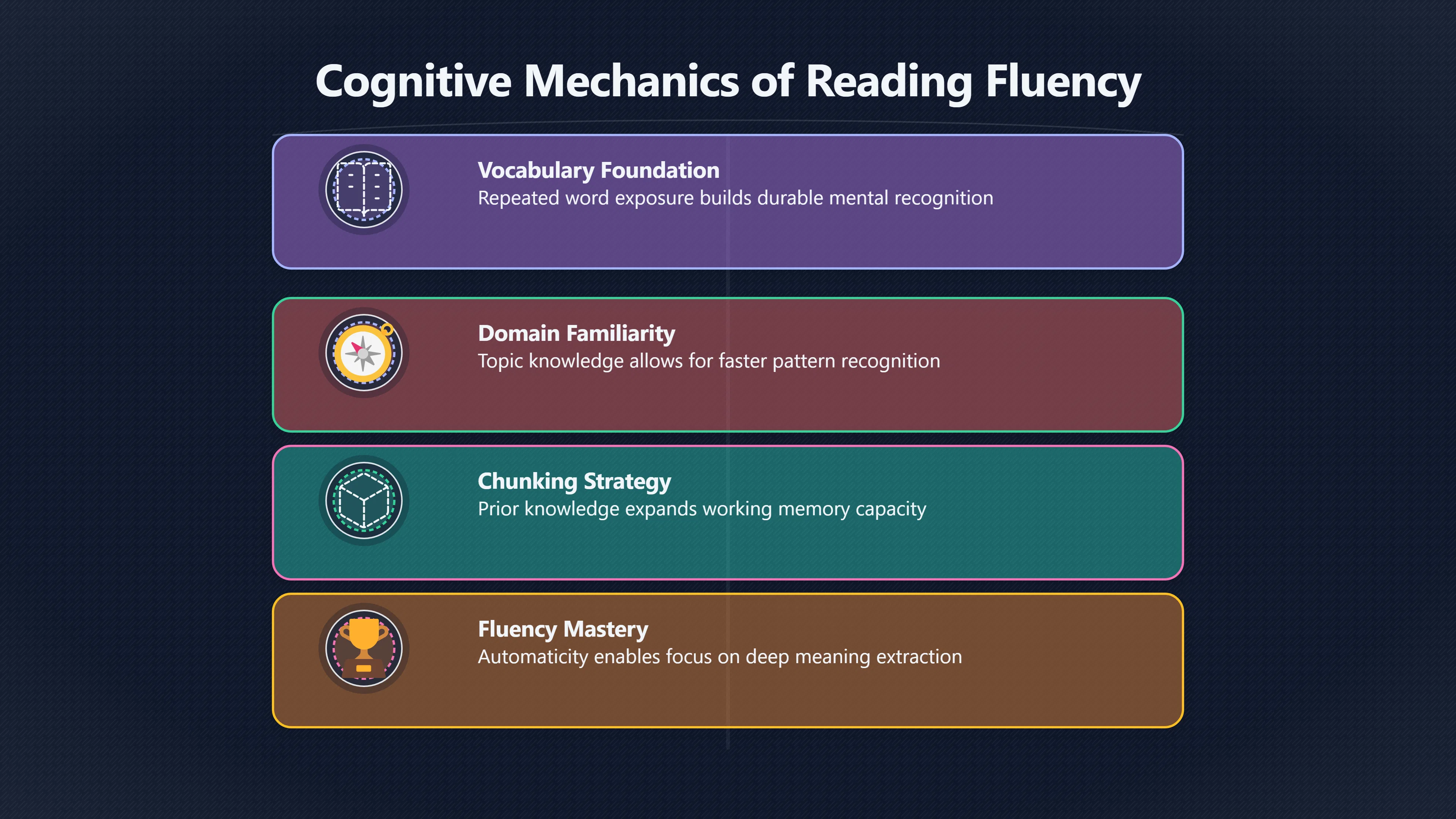
A reader who spends a week reading articles about climate policy gradually learns the language of that field. Terms such as carbon pricing, emissions trading, and net-zero targets stop requiring conscious interpretation. The next article can be read more quickly because much of the groundwork has already been done.
Switch to molecular biology, however, and the situation changes. The reader now faces a new vocabulary, different evidence standards, unfamiliar diagrams, and a separate set of assumptions. Cognitive effort that could have been spent understanding arguments is redirected towards orientation.
Research on reading comprehension repeatedly finds that background knowledge is a major contributor to successful reading. Prior knowledge helps readers connect new information to existing mental frameworks, reducing the amount of interpretation required during reading. It also reduces errors and improves fluency, particularly when texts are demanding.[PMC+2Cris]pmc.ncbi.nlm.nih.govby SJ Priebe · 2011 · Cited by 157 — Prior knowledge of the passage topic was found to significantly increase fluency and reduce readi…
The practical consequence is that reading speed often appears inconsistent across subjects. A reader may move rapidly through a complex economics article yet struggle with a simpler paper in neuroscience. The difference is not necessarily reading ability. It is often familiarity.
As cognitive scientist Daniel Willingham has argued, background knowledge effectively expands working memory by allowing readers to chunk information into meaningful units. Without that knowledge, understanding the text itself can consume most of the reader’s available mental resources.[American Federation of Teachers]aft.orgAmerican Federation of TeachersHow Knowledge Helpsby DT Willingham · Cited by 240 — prior knowledge helps reading: It allows you to chunk…
Why Scattered Vocabulary Does Not Consolidate
Vocabulary growth depends heavily on repeated encounters. Seeing a specialised term once rarely produces durable knowledge. Seeing it repeatedly across related texts gradually transforms recognition into fluency.
When readers jump between unrelated hard subjects, specialised terms are encountered too infrequently to become automatic. A finance article introduces yield curves and duration. The next day’s psychology paper introduces cognitive dissonance and executive function. A legal essay introduces judicial review. Each term appears briefly and then disappears before it can become familiar.
Research on vocabulary acquisition has consistently found that repeated exposure strengthens word learning and retention. Vocabulary knowledge is also one of the strongest predictors of reading comprehension. The more readily readers recognise words and concepts, the less effort they spend decoding them during reading.[Reading Universe+3THE EDUCATION HUB+3PMC]theeducationhub.org.nzTHE EDUCATION HUBEffective vocabulary instructionFebruary 16, 2023 — 16 Feb 2023 — Vocabulary knowledge is the best predictor of reading…
This creates a hidden trap for ambitious readers. Wide sampling feels productive because many subjects are being touched. Yet from a fluency perspective, the reader may remain permanently stuck in the introductory stage of dozens of fields.
A clustered approach produces a different outcome. After encountering the same vocabulary across multiple articles, reports, or chapters, recognition becomes increasingly automatic. The reader begins anticipating terminology instead of deciphering it.
Why Random Hard Reading Often Feels Permanently Slow
Readers sometimes conclude that they are naturally slow when the real issue is that they never remain in one field long enough to become fluent.
Consider two different reading habits:
- Reader A spends two weeks reading materials related to energy policy.
- Reader B spends the same two weeks alternating between philosophy, epidemiology, constitutional law, behavioural economics, and astrophysics.
Both readers may spend the same amount of time reading. However, Reader A continually benefits from accumulated knowledge. Reader B repeatedly pays the cost of orientation.
Studies examining topic familiarity show that readers process familiar subjects more efficiently and often require less rereading to establish meaning. When the topic is unfamiliar, readers are more likely to revisit earlier sections and search for missing context.[Great Minds]greatminds.orgthe science of reading what is prior knowledge and why is it importantGreat MindsThe Science of Reading: What is prior knowledge and why…24 Feb 2022 — The study found that prior knowledge of the passage t…
This explains why some people feel that difficult texts never become easier despite reading regularly. They are repeatedly encountering the early-stage friction of new domains rather than progressing towards domain fluency.
When Variety Helps and When It Interrupts Fluency
The criticism of topic switching is not an argument against intellectual variety. Variety serves important purposes. It broadens knowledge, encourages creativity, and exposes readers to new ideas.
The question is one of timing.
Variety tends to help when:
- A reader already has moderate familiarity with a field.
- The goal is exploration rather than speed.
- Different topics share overlapping concepts or vocabulary.
- The reader is deliberately comparing perspectives across domains.
Variety tends to interrupt fluency when:
- Every text belongs to a completely different specialist field.
- The reader has not yet acquired core vocabulary.
- Reading sessions are too short for concepts to accumulate.
- The primary goal is increasing reading speed in difficult material.
An instructive example comes from research on knowledge and comprehension. Readers with stronger topic knowledge often outperform readers with stronger general reading skills when the topic is familiar. The well-known baseball comprehension studies demonstrated that domain knowledge can substantially influence understanding, sometimes narrowing differences between stronger and weaker readers.[Wikipedia]WikipediaBaseball StudyBaseball Study
The implication is straightforward: reading skill does not operate independently from knowledge. Speed and comprehension emerge from the interaction between the two.
A Better Alternative: Rotate Clusters, Not Individual Texts
Readers seeking greater speed in demanding material do not need to abandon variety. They simply benefit from grouping it.
Instead of reading one article from five unrelated fields, a reader might spend a week or two reading several pieces within the same domain before moving on. This allows vocabulary, concepts, and background assumptions to stabilise.
A cluster could include:
- Several articles on monetary policy.
- Multiple chapters on evolutionary biology.
- A sequence of reports on cybersecurity.
- A collection of essays on a single philosophical tradition.
By the third, fourth, or fifth text, much of the introductory friction has disappeared. The reader begins recognising recurring ideas, anticipating terminology, and understanding arguments with less effort.
The result is not merely better comprehension. It is a genuine increase in reading fluency within that field. Rather than repeatedly restarting the learning curve, the reader builds momentum and carries it from one text to the next. That accumulated familiarity is one of the most reliable ways difficult reading becomes faster. Harvard Graduate School of Education+3PMC+3THE EDUCATION HUB[pmc.ncbi.nlm.nih.gov]pmc.ncbi.nlm.nih.govby SJ Priebe · 2011 · Cited by 157 — Prior knowledge of the passage topic was found to significantly increase fluency and reduce readi…

Amazon book picks
Further Reading
Books and field guides related to Why random hard reading stays slow. Use these as the next step if you want deeper reading beyond the article.
How to Read a Book
Rating: 4.0/5 from 41 Google Books ratings
Promotes structured subject immersion and syntopical reading across related texts.
Make It Stick
Shows why repeated exposure within a domain improves retention and fluency.
A Mind for Numbers
Demonstrates how familiarity with a domain reduces cognitive load during learning and reading.
eBay marketplace picks
Marketplace Samples
Example marketplace items related to this page. Use the search link to explore similar finds on eBay.



Endnotes
1.
Source: pmc.ncbi.nlm.nih.gov
Link:https://pmc.ncbi.nlm.nih.gov/articles/PMC3142886/
Source snippet
by SJ Priebe · 2011 · Cited by 157 — Prior knowledge of the passage topic was found to significantly increase fluency and reduce readi...
2.
Source: gse.harvard.edu
Title: building background knowledge science improves reading comprehension
Link:https://www.gse.harvard.edu/ideas/usable-knowledge/23/03/building-background-knowledge-science-improves-reading-comprehension
Source snippet
“Background knowledge matters for helping kids [transfer]({{ 'transfer/' | relative_url }}) their...Read more...
3.
Source: theeducationhub.org.nz
Link:https://theeducationhub.org.nz/effective-vocabulary-instruction/
Source snippet
THE EDUCATION HUBEffective vocabulary instructionFebruary 16, 2023 — 16 Feb 2023 — Vocabulary knowledge is the best predictor of reading...
Published: February 16, 2023
4.
Source: pmc.ncbi.nlm.nih.gov
Link:https://pmc.ncbi.nlm.nih.gov/articles/PMC4031673/
Source snippet
and Reading Comprehension: Direct, Indirect, and...by RK Wagner · 2010 · Cited by 51 — A more complete story of how vocabulary and readi...
5.
Source: Wikipedia
Title: [Baseball Study]({{ ‘baseball-study/’ | relative_url }})
Link:https://en.wikipedia.org/wiki/Baseball_Study
6.
Source: greatminds.org
Title: the science of reading what is prior knowledge and why is it important
Link:https://greatminds.org/english/blog/witwisdom/the-science-of-reading-what-is-prior-knowledge-and-why-is-it-important
Source snippet
Great MindsThe Science of Reading: What is prior knowledge and why...24 Feb 2022 — The study found that prior knowledge of the passage t...
7.
Source: aft.org
Link:https://www.aft.org/ae/spring2006/willingham
Source snippet
American Federation of TeachersHow Knowledge Helpsby DT Willingham · Cited by 240 — prior knowledge helps reading: It allows you to chunk...
8.
Source: readinguniverse.org
Link:https://readinguniverse.org/skill-explainer/word-meanings-relationships/vocabulary-skill-explainer/overview-of-building-word-knowledge
Source snippet
Teachers' Guide: Building Word Knowledge for…Vocabulary instruction must produce depth of word knowledge to produce measurable gains in r...
9.
Source: education.qld.gov.au
Link:https://education.qld.gov.au/curriculums/Documents/literature-review.pdf
Source snippet
An overview of the literature effective teaching of readingStudents are taught to integrate phonological (sounds), orthographic (spelling...
Additional References
10.
Source: researchgate.net
Link:https://www.researchgate.net/publication/309343707_The_effects_of_context_and_word_exposure_frequency_on_incidental_vocabulary_acquisition_and_retention_through_reading
Source snippet
(PDF) The effects of context and word exposure frequency...20 Oct 2016 — This study was conducted to explore the impact of context types...
11.
Source: medium.com
Link:https://medium.com/inspired-ideas-prek-12/how-knowledge-supports-reading-comprehension-a4069a4f1541
Source snippet
How Knowledge Supports Reading ComprehensionExperts argue that if students have some knowledge about the contents of a text before they r...
12.
Source: cris.tuni.fi
Link:https://cris.tuni.fi/ws/portalfiles/portal/113799327/Reading_Comprehension_Skills_and_Prior_Topic_Knowledge_Serve_as_Resources_When_Adolescents_Justify_the_Credibility_of_Multiple_Online_Texts.pdf
Source snippet
Comprehension Skills and Prior Topic Knowledge...by C Kiili · 2024 · Cited by 31 — This means that the more prior knowledge students had...
13.
Source: edutopia.org
Link:https://www.edutopia.org/video/background-knowledge-reading-comprehension-elementary/
Source snippet
Why Prior Knowledge Wins the GameNatalie Wexler shares a study that gives evidence that prior knowledge is more important than general sk...
14.
Source: sci-hub.box
Link:https://sci-hub.box/10.1177/1362168811431377
Source snippet
l effects of the variables 'word exposure frequency' and 'elaboration of word...Read more...
15.
Source: thoughtco.com
Title: prior knowledge improves reading comprehension 3111202
Link:https://www.thoughtco.com/prior-knowledge-improves-reading-comprehension-3111202
Source snippet
Prior Knowledge Improves Reading Comprehension5 Apr 2019 — Using prior knowledge is an important strategy to help students with dyslexia...
16.
Source: my.chartered.college
Title: deepening knowledge through vocabulary learning
Link:https://my.chartered.college/impact_article/deepening-knowledge-through-vocabulary-learning/
Source snippet
knowledge through vocabulary learning22 Feb 2018 — In this article, we provide some of the research and theory that eventually coalesced...
17.
Source: keystoliteracy.com
Link:https://keystoliteracy.com/wp-content/pdfs/orc-publications/Effective%20Vocabulary%20Instruction.pdf
Source snippet
sential to successfully teach children how to read.Read more...
18.
Source: researchgate.net
Link:https://www.researchgate.net/publication/349506620_The_Role_of_Background_Knowledge_in_Reading_Comprehension_A_Critical_Review
Source snippet
In the first meeting of Cycle I, the mean...
19.
Source: youtube.com
Title: The Role of Background Knowledge in Reading Comprehension with Reid Smith
Link:https://www.youtube.com/watch?v=vy3VIpFArsQ
Source snippet
Unraveling the Reading Rope: Background Knowledge...
Topic Tree