Within Rereading
Why one backward glance can save a sentence
A quick backward glance can rebuild a confusing sentence before the wrong meaning spreads through the passage.
On this page
- How sentence ambiguity creates false starts
- What eye regressions do during repair
- When to reread a phrase instead of the whole paragraph
Page outline Jump by section
Introduction
When a sentence is temporarily ambiguous, readers often build an interpretation that later turns out to be wrong. A single backward eye movement, known as a regression, can prevent that error from spreading into the rest of the passage. Rather than restarting an entire paragraph, skilled readers frequently return to a specific phrase, repair the sentence structure, and continue reading with a more accurate understanding. Eye-tracking research shows that these targeted regressions are a normal part of comprehension, especially when readers encounter ambiguity, unexpected grammar, or information that forces a reinterpretation of earlier words.[Coli]coli.uni-saarland.deColi Structurally Ambiguous SentencesStructurally Ambiguous SentencesSeptember 27, 2007 — by LYN FRAZIER · 1982 · Cited by 2875 — In this study we explore the garden-path…
 Within the broader goal of increasing reading speed, this matters because a short, well-placed reread is often faster than carrying a mistaken interpretation forward and later having to untangle a larger misunderstanding.
How Sentence Ambiguity Creates False Starts
Many difficult sentences reveal their true structure only after several more words have been read. Until then, the brain makes a best guess.
Consider a sentence such as:
“While Anna dressed the baby played on the floor.”
Many readers initially interpret “the baby” as the object of “dressed”. When they reach “played”, that interpretation collapses. The sentence actually means that Anna was dressing herself while the baby played. Psycholinguists call such constructions garden-path sentences because they lead readers down an initially plausible but incorrect path. Research using eye tracking has repeatedly shown that readers slow down and often move their eyes backwards when the disambiguating information appears.[Coli+2CentAUR]coli.uni-saarland.deColi Structurally Ambiguous SentencesStructurally Ambiguous SentencesSeptember 27, 2007 — by LYN FRAZIER · 1982 · Cited by 2875 — In this study we explore the garden-path…
The key point is that the problem is not vocabulary. Every word may be familiar. The difficulty arises because the reader has assigned the wrong relationships between the words. Without repair, that incorrect structure can contaminate the interpretation of everything that follows.
What Eye Regressions Do During Repair
A targeted regression is not random wandering across the page. It is usually directed toward the part of the sentence most likely to contain the source of the confusion.
Research on reading eye movements distinguishes regressions used for comprehension repair from small backward movements that merely correct visual or eye-movement errors. The comprehension-related type tends to revisit earlier text so that the reader can revise the sentence representation already built in memory.[MDPI]mdpi.comRegressions during Readingby AW Inhoff · 2019 · Cited by 74 — Readers occasionally move their eyes to prior text. We distinguish two…
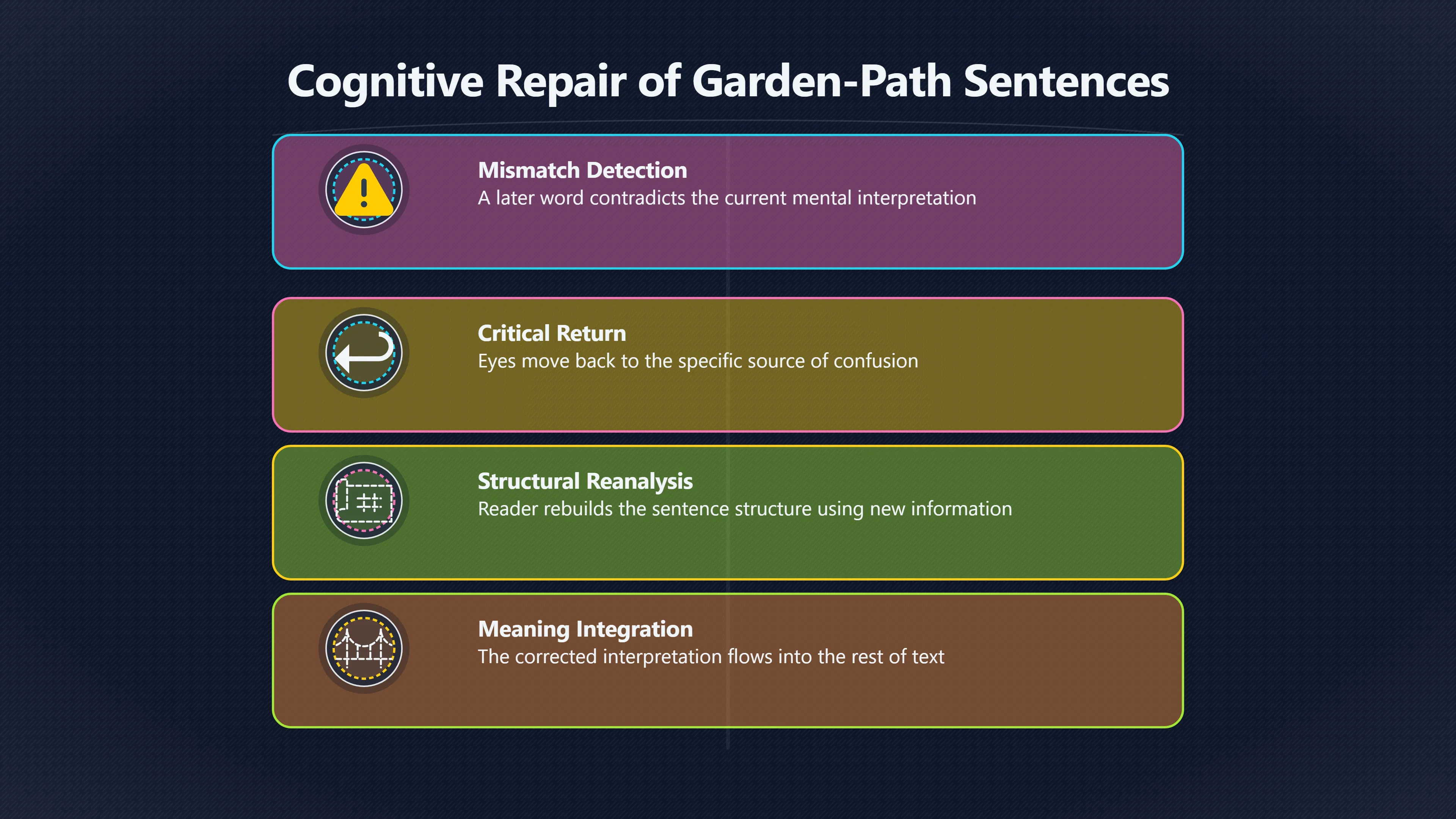
The repair process typically unfolds in three stages:
- Detection of a mismatch. A later word does not fit the interpretation currently being maintained.
- Return to a critical region. The eyes move back to the phrase most likely to explain the conflict.
- Reanalysis. The reader rebuilds the sentence structure using the newly available information.
Classic studies of structurally ambiguous sentences found that readers show distinctive regression patterns when recovering from an initial misanalysis. The backward movement is part of the reanalysis process rather than a sign that comprehension has completely failed.[Coli]coli.uni-saarland.deColi Structurally Ambiguous SentencesStructurally Ambiguous SentencesSeptember 27, 2007 — by LYN FRAZIER · 1982 · Cited by 2875 — In this study we explore the garden-path…
Evidence also suggests that the value of regressions comes from actual rereading, not merely from returning the eyes to a previous location. Experimental work that restricted effective rereading reduced comprehension performance, supporting the view that readers use regressions to inspect earlier words again and revise meaning.[Springer]link.springer.comThe function of regressions in reading: Backward eye…by RW Booth · 2013 · Cited by 134 — These results suggest that readers us…
Why One Backward Glance Can Save a Sentence
The efficiency of targeted regressions comes from their precision.
When readers encounter a contradiction, they rarely need to reread an entire page. Often only one clause, modifier, or attachment point needs to be reconsidered. Eye-tracking studies show that regressions are frequently directed toward linguistically important regions rather than being distributed randomly through previously read text.[ResearchGate]researchgate.netResearchGate(PDF) Overt reanalysis strategies and eye movements…July 1, 2002 — Among other measures, we examined regressive eye moveme…
Imagine reading:
“The detective examined the evidence from the witness that was damaged.”
At first glance, “that was damaged” may seem to describe the witness. Later context may reveal that the damaged item was the evidence. A brief return to the attachment point can repair the sentence immediately. Without that repair, subsequent information may be interpreted incorrectly because the reader is still operating from the wrong assumption.
Recent work on ambiguity and reanalysis has found evidence that readers often direct regressions towards locations that are most likely to resolve the emerging problem. The eye movement itself appears to reflect an attempt to identify the source of the interpretation error.[arXiv]arxiv.orgReaders make targeted regressions to plausible errors in reanalysis of "noisy-channel garden-path" sentencesMay 18, 2026…
When to Reread a Phrase Instead of the Whole Paragraph
For readers interested in speed as well as comprehension, the practical lesson is not to eliminate regressions entirely. The goal is to make them selective.
A phrase-level reread is often worthwhile when:
- A sentence suddenly stops making grammatical sense.
- A later word forces an unexpected interpretation.
- Two possible meanings seem equally plausible.
- A technical sentence contains several nested clauses or modifiers.
- You recognise that the confusion originates in a specific earlier phrase.
A paragraph-level restart is more useful when attention has drifted, when the argument structure has been lost, or when multiple sentences depend on one another.
Eye-movement research consistently shows that regressions are a normal component of skilled reading. Roughly a tenth or more of eye movements during reading are backward movements, and many occur in response to comprehension demands rather than simple visual correction.[PMC+2Research Reading]pmc.ncbi.nlm.nih.govby JR Folk · 2018 · Cited by 9 — The method described in this paper was designed to investigate the role of inhibition of return (IOR)…
From a speed perspective, the most efficient strategy is often a brief, targeted repair. Spending a second revisiting the exact phrase that caused ambiguity can prevent much longer delays later, when an entire chain of reasoning would otherwise need to be reconstructed.
Amazon book picks
Further Reading
Books and field guides related to Why one backward glance can save a sentence. Use these as the next step if you want deeper reading beyond the article.
How to Read a Book
Rating: 4.0/5 from 41 Google Books ratings
Directly covers resolving confusion, rereading strategically, and understanding difficult passages.
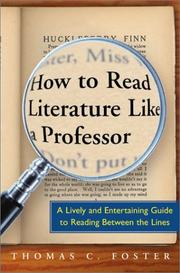
How to read literature like a professor
Focuses on noticing hidden structure and meaning when initial interpretations are incomplete.
Make It Stick
Explains why corrective review and revisiting misunderstood material improves learning.
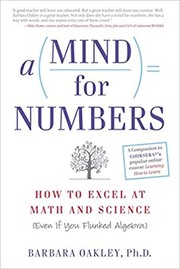
A Mind for Numbers
Discusses mental processing, error correction, and techniques for overcoming comprehension obstacles.
Endnotes
1.
Source: mdpi.com
Link:https://www.mdpi.com/2411-5150/3/3/35
Source snippet
Regressions during Readingby AW Inhoff · 2019 · Cited by 74 — Readers occasionally move their eyes to prior text. We distinguish two...
2.
Source: pmc.ncbi.nlm.nih.gov
Link:https://pmc.ncbi.nlm.nih.gov/articles/PMC6235565/
Source snippet
by JR Folk · 2018 · Cited by 9 — The method described in this paper was designed to investigate the role of inhibition of return (IOR)...
3.
Source: link.springer.com
Link:https://link.springer.com/article/10.3758/bf03194956
Source snippet
reanalysis strategies and eye movements during the...by E Meseguer · 2002 · Cited by 189 — In an eye movement experiment, we examined th...
4.
Source: link.springer.com
Link:https://link.springer.com/article/10.3758/s13421-012-0244-y
Source snippet
The function of regressions in reading: Backward eye...by RW Booth · 2013 · Cited by 134 — These results suggest that readers us...
5.
Source: researchgate.net
Link:https://www.researchgate.net/publication/11202102_Overt_reanalysis_strategies_and_eye_movements_during_the_reading_of_mild_garden_path_sentences
Source snippet
ResearchGate(PDF) Overt reanalysis strategies and eye movements...July 1, 2002 — Among other measures, we examined regressive eye moveme...
Published: July 1, 2002
6.
Source: arxiv.org
Link:https://arxiv.org/abs/2605.18563
Source snippet
Readers make targeted regressions to plausible errors in reanalysis of "noisy-channel garden-path" sentencesMay 18, 2026...
Published: May 18, 2026
7.
Source: researchgate.net
Title: (PDF) Regressions during Reading
Link:https://www.researchgate.net/publication/334364752_Regressions_during_Reading
Source snippet
May 20, 2026 — One type consists of relatively large regressions that seek to re-process prior text and to revise represented...
Published: May 20, 2026
8.
Source: researchgate.net
Title: The function of these “regressions” is still largely unknown.Read more
Link:https://www.researchgate.net/publication/230658181_The_function_of_regressions_in_reading_Backward_eye_movements_allow_rereading
Source snippet
(PDF) The function of regressions in reading: Backward...Standard text reading involves frequent eye movements that go against normal re...
9.
Source: researchgate.net
Title: 237130150 Eye Movements in Reading Words and Sentences
Link:https://www.researchgate.net/publication/237130150_Eye_Movements_in_Reading_Words_and_Sentences
Source snippet
The experiments tested readers...Read more...
10.
Source: mdpi.com
Link:https://www.mdpi.com/2227-7102/14/4/375
Source snippet
What Can Eye Movements Tell Us about Reading in a...by JF Quiñonez-Beltran · 2024 · Cited by 5 — This review focuses on the research don...
11.
Source: coli.uni-saarland.de
Title: Coli Structurally Ambiguous Sentences
Link:https://www.coli.uni-saarland.de/~masta/WS15/FrazierRayner1982.pdf
Source snippet
Structurally Ambiguous SentencesSeptember 27, 2007 — by LYN FRAZIER · 1982 · Cited by 2875 — In this study we explore the garden-path...
Published: September 27, 2007
12.
Source: centaur.reading.ac.uk
Title: Cent AUROn the parsing of garden-path sentences
Link:https://centaur.reading.ac.uk/97834/21/23273798.2021.pdf
Source snippet
the parsing of garden-path sentences - CentAURby H Fujita · 2021 · Cited by 29 — Previous studies have reported that temporarily ambiguou...
13.
Source: journals.eikipub.com
Link:https://journals.eikipub.com/index.php/blls/article/view/518
Source snippet
EikiPub JournalsPsycholinguistic Perspectives on Garden-Path Sentence...by A Gunawan · 2025 — This study explores how readers process sy...
14.
Source: pubmed.ncbi.nlm.nih.gov
Link:https://pubmed.ncbi.nlm.nih.gov/22886737/
Source snippet
function of regressions in reading: backward eye movements...These results suggest that readers use regressions to reread words and not...
15.
Source: research.reading.ac.uk
Title: 2025 03 Tromso Eye Tracking Workshop Session 1 Handout
Link:https://research.reading.ac.uk/psylinglab/wp-content/uploads/sites/25/2025/03/2025-03-Tromso-Eye-Tracking-Workshop-Session-1-Handout.pdf
Source snippet
➢ About 10-15% of eye-movements are regressions to earlier portions of...Read more...
16.
Source: pmc.ncbi.nlm.nih.gov
Link:https://pmc.ncbi.nlm.nih.gov/articles/PMC5290069/
Source snippet
by A Koornneef · 2016 · Cited by 30 — Novel evidence for the general idea that the eye-movement profile of readers reveals valuable in...
Additional References
17.
Source: papersflow.ai
Link:https://papersflow.ai/research/topics/reading-and-literacy-development/eye-movements-in-reading
Source snippet
Eye Movements in Reading: Research Guide & PapersEye Movements in Reading studies saccades, fixations, regressions, and [perceptual span]({{ 'perceptual-span/' | relative_url }}) d...
18.
Source: papers.ssrn.com
Link:https://papers.ssrn.com/sol3/papers.cfm?abstract_id=5405257
Source snippet
Eye Movements in Reading Go from Easy to...by AT Lopes Rego — One prevailing hypothesis is that regressions reflect comprehension proces...
19.
Source: reddit.com
Link:https://www.reddit.com/r/books/comments/ixtt4a/is_it_normal_to_have_reread_lines_several_times/
Source snippet
September 22, 2020 — I'm reading Dune right now and I just feel like there's several times I have to go back to the beginning of the page...
Published: September 22, 2020
20.
Source: experts.illinois.edu
Title: retracing the garden path nonselective rereading and no reanalysi
Link:https://experts.illinois.edu/en/publications/retracing-the-garden-path-nonselective-rereading-and-no-reanalysi/
Source snippet
Illinois ExpertsRetracing the garden-path: Nonselective rereading and no...by K Christianson · 2024 · Cited by 23 — When people read tem...
21.
Source: facebook.com
Title: Rereading strategies for improved reading comprehension
Link:https://www.facebook.com/groups/907060703274275/posts/1710166289630375/
Source snippet
October 26, 2025 — Retelling and rereading strategies improve reading comprehension, with techniques like verbalizing gist statem...
Published: October 26, 2025
22.
Source: sr-research.com
Link:https://www.sr-research.com/developmental-publications/
Source snippet
These publications are solely peer-reviewed journal articles...
23.
Source: scribd.com
Title: It challenges the Selective Reanalysis
Link:https://www.scribd.com/document/974784104/Retracing-the-Garden-Path-Nonselective-Rereading-2024-Journal-of-Memory-And
Source snippet
Rereading Garden-Path Sentences: Insights | PDF | ParsingThe study investigates how readers engage with garden-path sentences, focusing o...
24.
Source: readlite.in
Link:https://readlite.in/concepts/regressions-reading
Source snippet
he science behind regressions in reading for better reading...
25.
Source: eprints.bournemouth.ac.uk
Link:https://eprints.bournemouth.ac.uk/22639/3/SlatteryetalJML3final.docx.pdf
Source snippet
Misinterpretations of Garden Path Sentences...by T Slattery · 2013 · Cited by 247 — Making and correcting errors during sentence compreh...
26.
Source: youtube.com
Title: Things About [Speed-Reading]({{ ‘myths/’ | relative_url }}) People Often Miss
Link:https://www.youtube.com/watch?v=fx1a6Dm64kA
Source snippet
April 5, 2021 — regressions #speedreading #rereading Speed reading claims "avoid doing regressions" - if you don't re-read you wil...
Published: April 5, 2021
Topic Tree