Within Easy Trap
When Easy Reading Should Slow Down
Fast readers need practical checkpoints that reveal when a familiar passage has stopped being straightforward.
On this page
- Signals that prediction has replaced reading
- The one sentence summary checkpoint
- How to resume speed after verifying understanding
Page outline Jump by section
Introduction
Increasing reading speed does not mean maintaining maximum speed at all times. The fastest effective readers know when to slow down. Familiar subjects are especially risky because they create a strong sense of understanding before comprehension has actually been verified. Research on metacognition and the illusion of explanatory depth shows that people frequently overestimate how well they understand topics they recognise, particularly when those topics involve explanations, systems, or causal relationships.[PMC+2Wiley Online Library]pmc.ncbi.nlm.nih.govby L Rozenblit · 2002 · Cited by 1493 — We argue that the illusion of depth seen with explanatory knowledge is a separate phenomenon f…
 The practical challenge is not identifying difficult passages. Most readers naturally slow down when they become confused. The harder task is recognising when a passage feels easy but understanding has quietly been replaced by assumption. The following slowdown triggers act as checkpoints that help fast readers detect overconfidence before it turns into misunderstanding.
Signals That Prediction Has Replaced Reading
Overconfidence often appears when the brain starts completing the author’s argument before the author has actually made it. Familiarity makes prediction efficient, but prediction can eventually crowd out attention to the text itself.
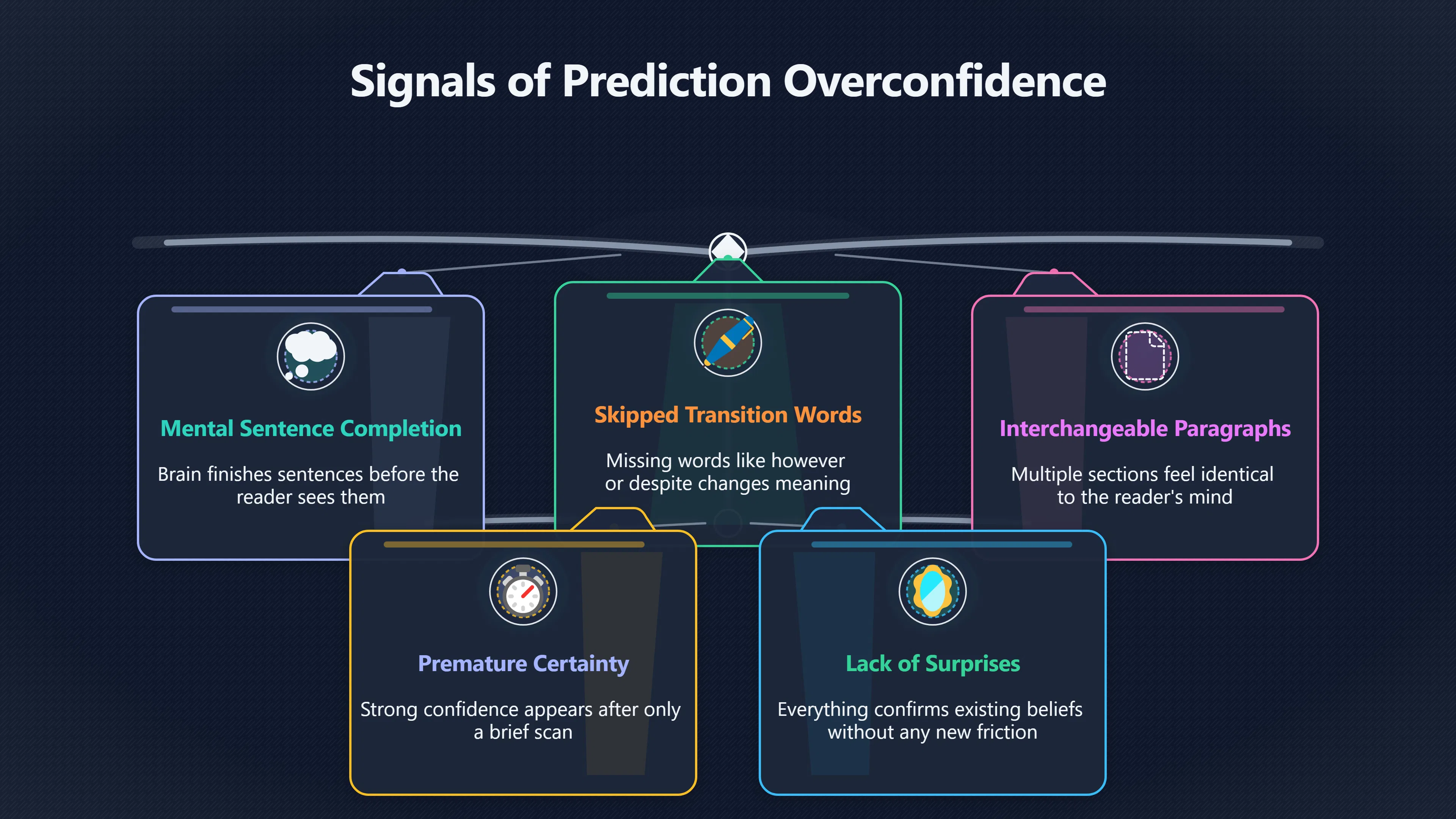
Several warning signs deserve an immediate reduction in reading speed:
- You begin finishing sentences mentally. If you find yourself assuming the next point before reading it, you may be processing expectations rather than evidence.
- You skip transition words. Terms such as “however”, “although”, “except”, “despite”, and “under certain conditions” frequently contain the information that contradicts prior assumptions. Missing these words is a common way to misunderstand a familiar topic.
- Paragraphs seem interchangeable. When multiple paragraphs feel as though they are saying the same thing, readers sometimes stop distinguishing between the author’s actual claims and their own background knowledge.
- You feel certain unusually early. Strong confidence after only a brief scan is often a metacognitive warning sign rather than proof of comprehension. Research on the illusion of explanatory depth repeatedly finds that confidence can exceed genuine understanding.[PMC+2Wiley Online Library]pmc.ncbi.nlm.nih.govby L Rozenblit · 2002 · Cited by 1493 — We argue that the illusion of depth seen with explanatory knowledge is a separate phenomenon f…
- You stop noticing surprises. Good comprehension monitoring involves detecting inconsistencies, shifts, and unexpected information. When everything appears to confirm what you already believe, it is worth checking whether you are still reading carefully.[Springer]link.springer.comReading behavior as an indicator of comprehension…by C Tibken · 2025 · Cited by 2 — Research on comprehension monitoring and r…
A useful rule is simple: whenever the text feels completely predictable, assume there is a higher risk of overconfidence and briefly slow down.
The One-Sentence Summary Checkpoint
The most efficient slowdown trigger is not re-reading entire sections. It is forcing a short explanation.
Research on the illusion of explanatory depth shows that people discover gaps in understanding when they attempt to explain something rather than merely recognise it. Confidence often drops once explanation is required.[Cambridge University Press & Assessment+2PMC]cambridge.orgCambridge University Press & AssessmentExplaining an unrelated phenomenon exposes the illusion…by EA Meyers · 2023 · Cited by 13 — Whe…
At natural breaks in a text, pause for a few seconds and ask:
“Can I summarise the author’s point in one sentence without looking back?”
This checkpoint works because it tests understanding instead of familiarity.
If the summary comes easily and includes the author’s actual claim, reading can continue at speed.
Slow down when any of the following occur:
- The summary turns into a statement of what you already believed rather than what the author argued.
- You can remember examples but not the central claim.
- You recall conclusions but not the reasoning.
- Your explanation depends on vague phrases such as “it’s basically saying” or “something about”.
These failures are valuable signals. They reveal comprehension problems while the text is still fresh enough to correct.

When Qualifications Signal a Need to Slow Down
Readers moving quickly through familiar material often miss qualifications. Yet qualifications are frequently where authors place their most important distinctions.
Slow down whenever you encounter:
- Boundary conditions
- Counterexamples
- Statistical caveats
- Changes in scope
- Comparisons between similar ideas
For example, a reader familiar with productivity advice might skim an article and assume a recommendation is universal. A single phrase such as “for beginners”, “in most cases”, or “under controlled conditions” may completely change the meaning.
Comprehension monitoring research emphasises the importance of detecting inconsistencies and evaluating whether understanding remains accurate as new information arrives.[Frontiers+2PMC]frontiersin.orgFrontiers Metacognitive Monitoring of Text ComprehensionFrontiersMetacognitive Monitoring of Text ComprehensionNovember 20, 2018 — by C Mirandola · 2018 · Cited by 30 — The ability to assess an…
The practical implication is that familiar content should often be read fastest at the beginning and slowest at the points where the author introduces limitations.
The Moments Most Likely to Hide Misunderstanding
Certain passage types deserve automatic caution because they frequently create an illusion of comprehension.
Explanations of How Something Works
People consistently overestimate their understanding of mechanisms and causal systems. This is the core finding behind the illusion of explanatory depth. A reader may recognise terms and concepts while lacking a genuine grasp of how the parts fit together.[PMC+2Wiley Online Library]pmc.ncbi.nlm.nih.govby L Rozenblit · 2002 · Cited by 1493 — We argue that the illusion of depth seen with explanatory knowledge is a separate phenomenon f…
When a text explains how a process works, slow down long enough to verify that you could reconstruct the chain of reasoning.
Arguments That Support a Familiar Conclusion
Agreement can create a false sense of comprehension. If an article reaches a conclusion you already accept, it becomes easier to skim the supporting evidence because the destination feels known.
The slowdown trigger here is agreement itself. The more strongly you agree, the more carefully the supporting reasoning should be checked.
Dense Examples
Examples often look easier than abstract explanations because they are concrete and familiar. However, readers frequently remember the example while missing the principle it was meant to illustrate.
Whenever a paragraph contains an extended example, briefly identify the rule or idea that the example is supposed to support.
How to Resume Speed After Verifying Understanding
The purpose of a slowdown trigger is not to create permanent caution. It is to perform a quick verification and then return to efficient reading.
A practical cycle looks like this:
- Notice a trigger.
- Reduce speed briefly.
- Perform a one-sentence summary or explanation check.
- Confirm that the author’s meaning is clear.
- Accelerate again.
This approach aligns with research on metacognitive monitoring, which treats effective reading as an ongoing process of checking, evaluating, and adjusting rather than maintaining a single fixed pace.[My College+2EEF]my.chartered.collegeMy CollegeMetacognition and readingMetacognitive regulation: involves cognitive activities such as planning, monitoring, evaluating and r…
Fast readers are not those who never slow down. They are those who slow down selectively. Familiar topics often feel safest, yet they are where prediction, recognition, and confidence most easily disguise weak understanding. Well-chosen slowdown triggers prevent that confidence from becoming a costly reading error.
Amazon book picks
Further Reading
Books and field guides related to When Easy Reading Should Slow Down. Use these as the next step if you want deeper reading beyond the article.
Thinking, Fast and Slow
Explains when intuitive fast processing should give way to analysis.


eBay marketplace picks
Marketplace Samples
Example marketplace items related to this page. Use the search link to explore similar finds on eBay.
![Listing image for JOOHONEY [LIGHTS] Mini Album JEWEL 3 Ver SET/ 3CD+3 Photo Book+3 Card+3 Poster](/assets/images/marketplace-covers/cd4dfb70e968e7f19393.jpg)



Endnotes
1.
Source: pmc.ncbi.nlm.nih.gov
Link:https://pmc.ncbi.nlm.nih.gov/articles/PMC3062901/
Source snippet
by L Rozenblit · 2002 · Cited by 1493 — We argue that the illusion of depth seen with explanatory [knowledge]({{ 'knowledge/' | relative_url }}) is a separate phenomenon f...
2.
Source: onlinelibrary.wiley.com
Link:https://onlinelibrary.wiley.com/doi/abs/10.1207/s15516709cog2605_1
Source snippet
Wiley Online LibraryThe misunderstood limits of folk science: an illusion...by L Rozenblit · 2002 · Cited by 1458 — We demonstrate the i...
3.
Source: link.springer.com
Link:https://link.springer.com/article/10.1007/s11409-025-09440-2
Source snippet
Reading behavior as an indicator of comprehension...by C Tibken · 2025 · Cited by 2 — Research on comprehension monitoring and r...
4.
Source: cambridge.org
Link:https://www.cambridge.org/core/journals/judgment-and-decision-making/article/broad-effects-of-shallow-understanding-explaining-an-unrelated-phenomenon-exposes-the-illusion-of-explanatory-depth/9B9B8927C3E530EBCF0453504730E3F3
Source snippet
Cambridge University Press & AssessmentExplaining an unrelated phenomenon exposes the illusion...by EA Meyers · 2023 · Cited by 13 — Whe...
5.
Source: pmc.ncbi.nlm.nih.gov
Title: PMCMetacognitive Monitoring of Text Comprehension
Link:https://pmc.ncbi.nlm.nih.gov/articles/PMC6255937/
Source snippet
Monitoring of Text Comprehension - PMCby C Mirandola · 2018 · Cited by 30 — The ability to assess and monitor one's own understanding of...
6.
Source: pmc.ncbi.nlm.nih.gov
Link:https://pmc.ncbi.nlm.nih.gov/articles/PMC6071415/
Source snippet
However, comprehension monitoring did not uniquely predict reading...Read mo...
7.
Source: educationendowmentfoundation.org.uk
Link:https://educationendowmentfoundation.org.uk/education-evidence/teaching-learning-toolkit/metacognition-and-self-regulation
Source snippet
Metacognition and self-regulation | EEFMetacognition and self-regulation approaches to teaching support pupils to think about their own l...
8.
Source: my.chartered.college
Link:https://my.chartered.college/research-hub/metacognition-and-reading/
Source snippet
My CollegeMetacognition and readingMetacognitive regulation: involves cognitive activities such as planning, monitoring, evaluating and r...
9.
Source: frontiersin.org
Title: Frontiers Metacognitive Monitoring of Text Comprehension
Link:https://www.frontiersin.org/journals/psychology/articles/10.3389/fpsyg.2018.02253/full
Source snippet
FrontiersMetacognitive Monitoring of Text ComprehensionNovember 20, 2018 — by C Mirandola · 2018 · Cited by 30 — The ability to assess an...
Published: November 20, 2018
10.
Source: assets.publishing.service.gov.uk
Link:https://assets.publishing.service.gov.uk/media/664f600c05e5fe28788fc437/The_reading_framework_.pdf
Source snippet
reading frameworkactivating and using background knowledge. • generating and asking questions. • making predictions. • visualising. • mon...
11.
Source: Wikipedia
Title: Illusion of explanatory depth
Link:https://en.wikipedia.org/wiki/Illusion_of_explanatory_depth
Source snippet
Illusion of explanatory depthThe illusion of explanatory depth (IOED) is cognitive bias or an illusion where people tend to believe th...
Additional References
12.
Source: merriam-webster.com
Link:https://www.merriam-webster.com/dictionary/illusion
Source snippet
ILLUSION Definition & Meaning4 days ago — delusion, illusion, hallucination, mirage mean something that is believed to be true or real bu...
13.
Source: linkedin.com
Link:https://www.linkedin.com/pulse/illusion-explanatory-depth-arvind-saraswat-5t1sc
Source snippet
Illusion of Explanatory DepthThe illusion of explanatory depth reveals that our confident sense of understanding the world is thinner tha...
14.
Source: pages.stern.nyu.edu
Link:https://pages.stern.nyu.edu/~aalter/jpspioed.pdf
Source snippet
Stern School of BusinessA Construal Level Account of the Illusion of Explanatory Depthby AL Alter · Cited by 263 — An illusion of explana...
15.
Source: thedecisionlab.com
Link:https://thedecisionlab.com/biases/the-illusion-of-explanatory-depth
Source snippet
The Illusion of Explanatory DepthThe illusion of explanatory depth (IOED) describes our belief that we understand more about the world th...
16.
Source: readingrockets.org
Link:https://www.readingrockets.org/topics/about-reading/articles/simple-view-reading
Source snippet
The Simple View of ReadingResearch studies show that a student's reading comprehension score can be predicted if decoding skills and lang...
17.
Source: linkedin.com
Link:https://www.linkedin.com/pulse/what-i-learnt-today-illusion-explanatory-depth-young-ca-sa–ioawf
Source snippet
What I Learnt Today About the Illusion of Explanatory DepthOverconfidence in Expertise: People often believe they understand political, e...
18.
Source: eprints.lancs.ac.uk
Link:https://eprints.lancs.ac.uk/id/eprint/86770/2/LARRC_Yeomans_Maldonado_ReadWrite_2_.pdf
Source snippet
Head: COMPREHENSION MONITORINGVocabulary knowledge is a powerful predictor of reading comprehension and comprehension monitoring skill (A...
19.
Source: ukla.org
Link:https://ukla.org/wp-content/uploads/2020/01/View_Reading_Comprehension.pdf
20.
Source: researchgate.net
Link:https://www.researchgate.net/publication/352704150_Illusion_of_explanatory_depth_and_social_desirability_of_historical_knowledge
Source snippet
Illusion of explanatory depth and social desirability...Jun 23, 2021 — The Illusion of Explanatory Depth (IOED) occurs when people overe...
21.
Source: renascence.io
Title: illusion of explanatory depth overestimating understanding of complex systems
Link:https://www.renascence.io/journal/illusion-of-explanatory-depth-overestimating-understanding-of-complex-systems
Source snippet
Illusion of Explanatory Depth: Overestimating...23 Aug 2024 — The Illusion of Explanatory Depth occurs when individuals believe they und...
Topic Tree