Within Set purpose
Do You Understand It or Just Recognize It?
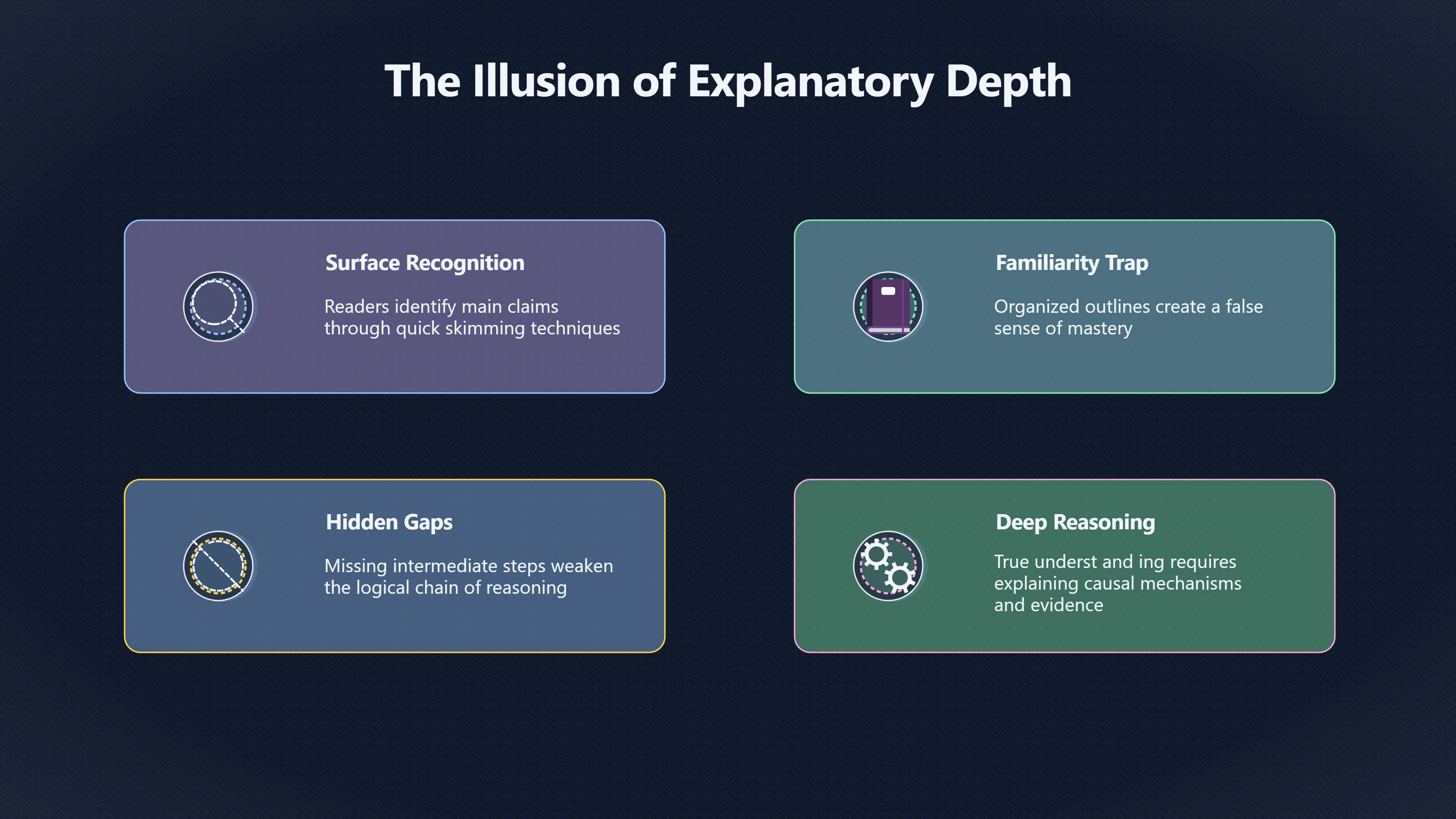
Recognizing a conclusion or heading is not the same as understanding the reasoning behind it.
On this page
- Why familiarity feels convincing
- What skims reliably miss
- Knowing when deeper reading is required
Page outline Jump by section
Introduction
Skimming is valuable because it helps you decide quickly whether a text deserves more attention. The danger appears when that decision stage is mistaken for genuine understanding. After a fast pass through headings, summaries, and conclusions, many readers feel they “know” the material even though they have only recognised its structure and key claims. The result is a false sense of understanding: confidence rises faster than comprehension. Research on the illusion of explanatory depth shows that people routinely believe they understand complex topics more deeply than they actually do, especially when they have only a surface-level grasp of how the underlying reasoning works.[PMC]pmc.ncbi.nlm.nih.govby L Rozenblit · 2002 · Cited by 1499 — We argue here that people's limited knowledge and their misleading intuitive epistemology comb…
 For anyone trying to increase reading speed, this is one of the most important risks to recognise. Fast reading saves time only when you remain honest about what a skim can and cannot deliver.
Why Familiarity Feels Convincing
A skim is highly effective at creating familiarity. You see the title, the section headings, the main conclusion, and perhaps a few highlighted examples. These elements create a coherent outline in memory. Because the outline feels organised, the mind often interprets that feeling as understanding.
Psychologists describe a related phenomenon as the illusion of explanatory depth. People frequently believe they understand a system or idea until they are asked to explain it in detail. At that point, gaps in knowledge become obvious. The problem is not simple overconfidence; it is the tendency to confuse recognition with explanation.[PMC+2The Decision Lab]pmc.ncbi.nlm.nih.govby L Rozenblit · 2002 · Cited by 1499 — We argue here that people's limited knowledge and their misleading intuitive epistemology comb…
This happens particularly easily during skimming because:
- Headings reveal the structure of an argument without revealing its full logic.
- Conclusions reveal what the author believes without showing how the conclusion was reached.
- Familiar terms create a feeling of competence even when definitions remain vague.
- Repeated exposure to an idea makes it seem clearer than it actually is.
A reader who skims an article about nutrition, economics, or climate science may accurately identify the author’s position within minutes. That does not mean they could explain the evidence, assumptions, counterarguments, or causal mechanisms behind the claim.
Recognition Is Not Explanation
Consider two different statements:
- “I recognise the author’s conclusion.”
- “I can explain why the author reached that conclusion.”
The first is often achievable through skimming. The second usually requires deeper reading.
Research on explanatory knowledge suggests that people are especially prone to overestimating understanding when topics involve causal relationships and interconnected mechanisms. In other words, the very subjects that require explanation are the ones most likely to create an illusion of mastery.[PMC+2PhilPapers]pmc.ncbi.nlm.nih.govby L Rozenblit · 2002 · Cited by 1499 — We argue here that people's limited knowledge and their misleading intuitive epistemology comb…
A useful test is simple: if someone removed the article and asked you to explain the reasoning from memory, could you do it without repeating slogans, headings, or conclusions? If not, recognition has probably been mistaken for comprehension.
What Skims Reliably Miss
Skimming is designed to extract main ideas. It is not designed to capture every detail, qualification, or logical connection. Universities and academic learning centres consistently describe skimming as a method for obtaining an overview rather than a complete understanding of a text. The Learning Center+2University of Tennessee at Chattanooga[learningcenter.unc.edu]learningcenter.unc.eduThe Learning Center SkimmingThe Learning CenterSkimming - The Learning CenterSkimming is a strategic, selective reading method in which you focus on the main ideas o…
The most important omissions tend to fall into several categories.
The chain of reasoning.
A skim often reveals where an argument begins and ends but not how it travels between those points. Missing intermediate steps can make weak arguments appear stronger than they are.
Limitations and qualifications.
Authors frequently place important caveats in the body of a discussion rather than in the headline conclusion. A skim can capture the claim while missing the conditions under which it is true.
Evidence quality.
Seeing that evidence exists is different from evaluating its strength. A reader may notice references, charts, or studies without examining whether they actually support the conclusion.
Contradictions and uncertainty.
Complex texts often contain competing explanations, unresolved questions, or exceptions. These details are precisely the parts most likely to disappear during rapid reading.
Definitions.
Many disagreements arise because readers assume they understand key terms. Skimming encourages movement past definitions even though those definitions often determine the meaning of the entire argument.
The result is a common failure mode: the reader accurately remembers what was said but poorly understands why it was said.
The Confidence Gap Created by Fast Reading
The danger is not merely incomplete knowledge. The greater risk is misplaced confidence.
Research on the illusion of explanatory depth found that people often lower their self-ratings of understanding when they are forced to produce a detailed explanation. Attempting explanation exposes weaknesses that were invisible during passive exposure.[PMC+2JSaw]pmc.ncbi.nlm.nih.govby L Rozenblit · 2002 · Cited by 1499 — We argue here that people's limited knowledge and their misleading intuitive epistemology comb…
Skimming can therefore produce an unusual combination:
- High confidence.
- Moderate familiarity.
- Shallow understanding.
This combination is problematic because it discourages further reading. If readers believe they already understand a text, they are less likely to investigate evidence, revisit difficult passages, or check whether they have interpreted the argument correctly.
In practical terms, the danger grows with topic complexity. A skim of a straightforward announcement may be sufficient. A skim of a technical report, legal document, scientific paper, or policy proposal can leave major explanatory gaps hidden behind a comforting feeling of familiarity.
Knowing When Deeper Reading Is Required
The solution is not to abandon skimming. It is to recognise the point at which skimming has completed its job.
A skim is usually sufficient when your goal is:
- Determining relevance.
- Identifying the main topic.
- Locating a specific section.
- Deciding whether further reading is worthwhile.
A skim is usually insufficient when your goal is:
- Explaining the argument to someone else.
- Evaluating whether the reasoning is sound.
- Making an important decision based on the content.
- Comparing competing viewpoints.
- Applying the information in practice.
One useful checkpoint is the explanation test. After skimming, try answering three questions without looking back:

- What is the main claim?
- What evidence supports it?
- Why does that evidence justify the conclusion?
Most false understanding becomes visible at the second or third question. People often remember the claim but struggle to reconstruct the reasoning that supports it.
Treat Confusion as Useful Information
Many readers see confusion as a sign of failure. In reality, confusion can be evidence that deeper reading is doing its job.
A skim often feels smooth because it skips complexity. Careful reading feels slower because it encounters complexity directly. When an argument suddenly becomes difficult to explain, that difficulty may reveal exactly where genuine learning needs to occur.
The goal of increasing reading speed is not to eliminate effort. It is to spend effort where it matters most. Skimming works best when it helps you decide what deserves deeper attention, not when it persuades you that attention is no longer necessary.
Amazon book picks
Further Reading
Books and field guides related to Do You Understand It or Just Recognize It?. Use these as the next step if you want deeper reading beyond the article.
How to Read a Book
Rating: 4.0/5 from 41 Google Books ratings
Distinguishes inspectional reading from genuine comprehension.
Mistakes Were Made (but Not by Me) Third Edition
Explores self-justification and misplaced confidence.
eBay marketplace picks
Marketplace Samples
Example marketplace items related to this page. Use the search link to explore similar finds on eBay.



Endnotes
1.
Source: pmc.ncbi.nlm.nih.gov
Link:https://pmc.ncbi.nlm.nih.gov/articles/PMC3062901/
Source snippet
by L Rozenblit · 2002 · Cited by 1499 — We argue here that people's limited knowledge and their misleading intuitive epistemology comb...
2.
Source: philpapers.org
Title: Phil Papersan illusion of explanatory depth
Link:https://philpapers.org/rec/ROZTML
Source snippet
We demonstrate the illusion...Read more...
3.
Source: thedecisionlab.com
Link:https://thedecisionlab.com/biases/the-illusion-of-explanatory-depth
Source snippet
That is, they often mistake...Read more...
4.
Source: learningcenter.unc.edu
Title: The Learning Center Skimming
Link:https://learningcenter.unc.edu/tips-and-tools/skimming/
Source snippet
The Learning CenterSkimming - The Learning CenterSkimming is a strategic, selective reading method in which you focus on the main ideas o...
5.
Source: utc.edu
Link:https://www.utc.edu/enrollment-management-and-student-affairs/center-for-academic-support-and-advisement/tips-for-academic-success/skimming
Source snippet
University of Tennessee at ChattanoogaSkimming and [Scanning]({{ 'scanning-vs-reading/' | relative_url }}) | University of Tennessee at...With skimming, your overall understanding is...
Additional References
6.
Source: researchgate.net
Title: Research Gate The Misunderstood Limits of Folk Science
Link:https://www.researchgate.net/publication/50868445_The_Misunderstood_Limits_of_Folk_Science_An_Illusion_of_Explanatory_Depth
Source snippet
The Misunderstood Limits of Folk Science - Illusions23 May 2026 — Leon Rozenblit and Frank Keil introduced this concept in 20...
Published: May 2026
7.
Source: takeielts.britishcouncil.org
Title: Take IELTSA Guide to Skimming vs
Link:https://takeielts.britishcouncil.org/blog/skimming-and-scanning-for-ielts-reading
Source snippet
Scanning for IELTS Reading2 Sept 2025 — Skimming helps you understand the overall meaning of the text.; Skimming is useful for answering...
8.
Source: youtube.com
Title: The Illusion of Explanatory Depth: You Don’t Understand It Like You Think
Link:https://www.youtube.com/watch?v=yDJuCWUC5P8
Source snippet
You Don't Know How Toilets Work - The Illusion Of Explanatory Depth...
9.
Source: scienceblogs.com
Link:https://scienceblogs.com/mixingmemory/2006/11/16/the-illusion-of-explanatory-de
Source snippet
The "Illusion of Explanatory Depth": How Much Do We Know...16 Nov 2006 — Rozenblit and Keil also found that in adults, the i...
10.
Source: youtube.com
Title: You Don’t Know How Toilets Work
Link:https://www.youtube.com/watch?v=9CodKUa4F2o
Source snippet
The Knowledge Illusion with Steven Sloman...
11.
Source: youtube.com
Title: Re-Reading Is Useless (The Research Is Clear)
Link:https://www.youtube.com/watch?v=JATdos-SST4
Source snippet
The Illusion of Explanatory Depth: You Don't Understand It Like You Think...
12.
Source: jsaw.lib.lehigh.edu
Link:https://jsaw.lib.lehigh.edu/campbell/Wilson.pdf
Source snippet
Strength and Persistence of the Illusion of Explanatory Depthby J Wilson — These findings led Rozenblit and Keil (2002) to conclude t...
13.
Source: youtube.com
Title: The Knowledge Illusion with Steven Sloman
Link:https://www.youtube.com/watch?v=02h7f2T_6mA
Source snippet
You Don't Know Anything - The Illusion of Explanatory Depth - FutureIQ...
14.
Source: youtube.com
Title: You Don’t Know Anything
Link:https://www.youtube.com/watch?v=_ak0k7GNCjM
Topic Tree