Within Inference
Why Questions Often Fail First at Higher Speeds
Cause-and-motivation questions often reveal comprehension breakdown before factual recall starts to fail.
On this page
- Cause Versus Fact Recall
- Linking Evidence Across a Passage
- Using Why Questions to Find Your Speed Limit
Page outline Jump by section
Introduction
When people try to increase reading speed, factual recall often survives longer than deeper understanding. A reader may still remember who did what, when an event occurred, or which argument was presented, yet struggle to explain why something happened. That is why “Why?” questions are one of the most useful checks after a timed reading exercise. They probe causal understanding rather than surface memory and frequently reveal comprehension loss before ordinary fact-based questions do. Research on reading comprehension consistently identifies inference-making—especially causal inference—as a core component of genuine understanding rather than an optional higher-level skill.[NFER+2ResearchGate]nfer.ac.ukNFEREffective teaching of inference skills for readingOctober 8, 2009 — by A Kispal · 2008 · Cited by 126 — A key finding of the review was that the ability to draw inferences predetermines r…
 In the context of increasing reading speed, this makes Why questions an early warning system. They can expose the point at which faster reading begins to weaken the reader’s ability to connect events, motives, evidence, and consequences, even while factual recall remains relatively intact.
Cause Versus Fact Recall
A key reason Why questions fail first is that they demand a different type of mental processing from factual questions.
Consider two questions about the same passage:
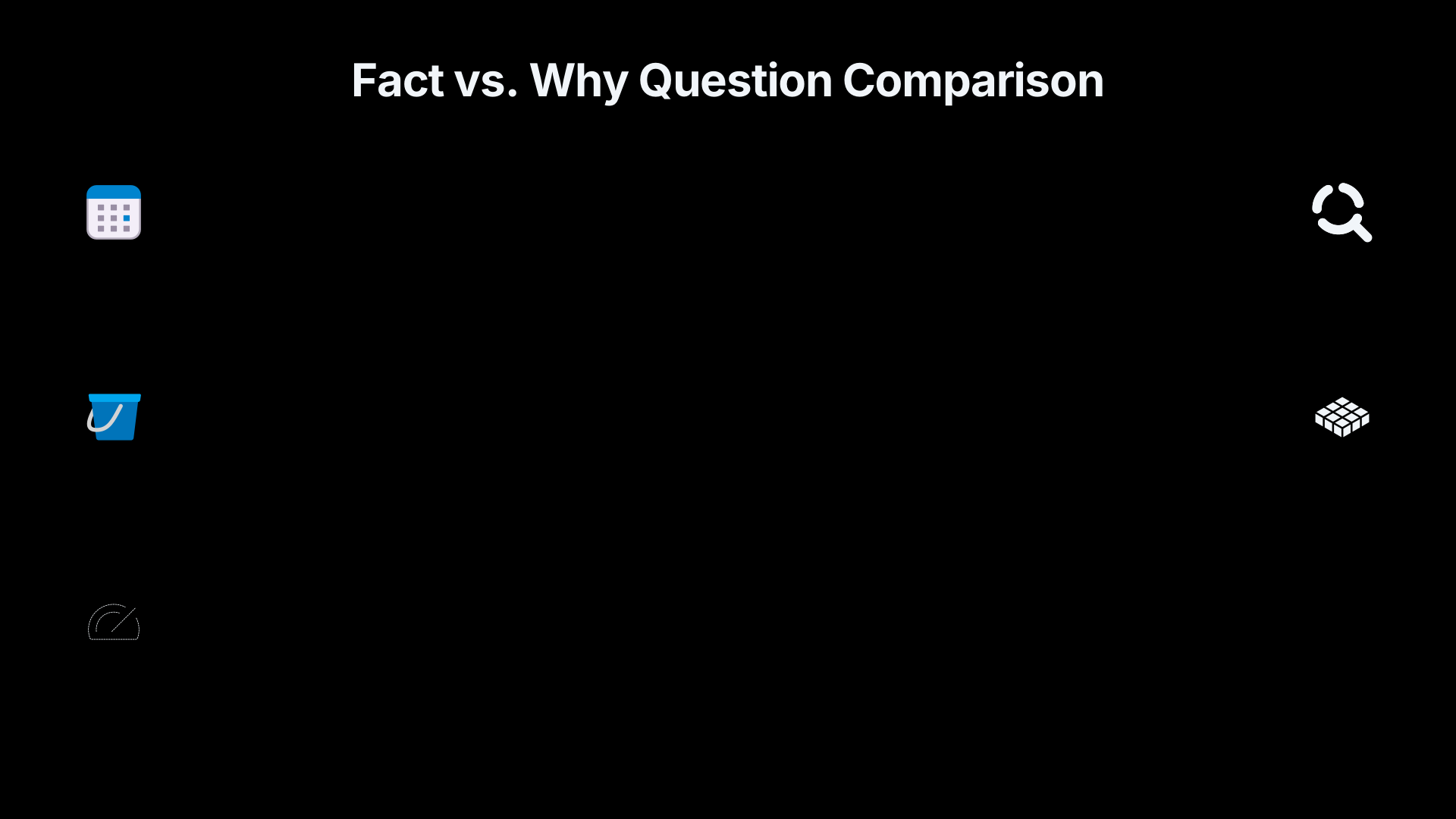
- What happened after the policy was introduced?
- Why did support for the policy decline?
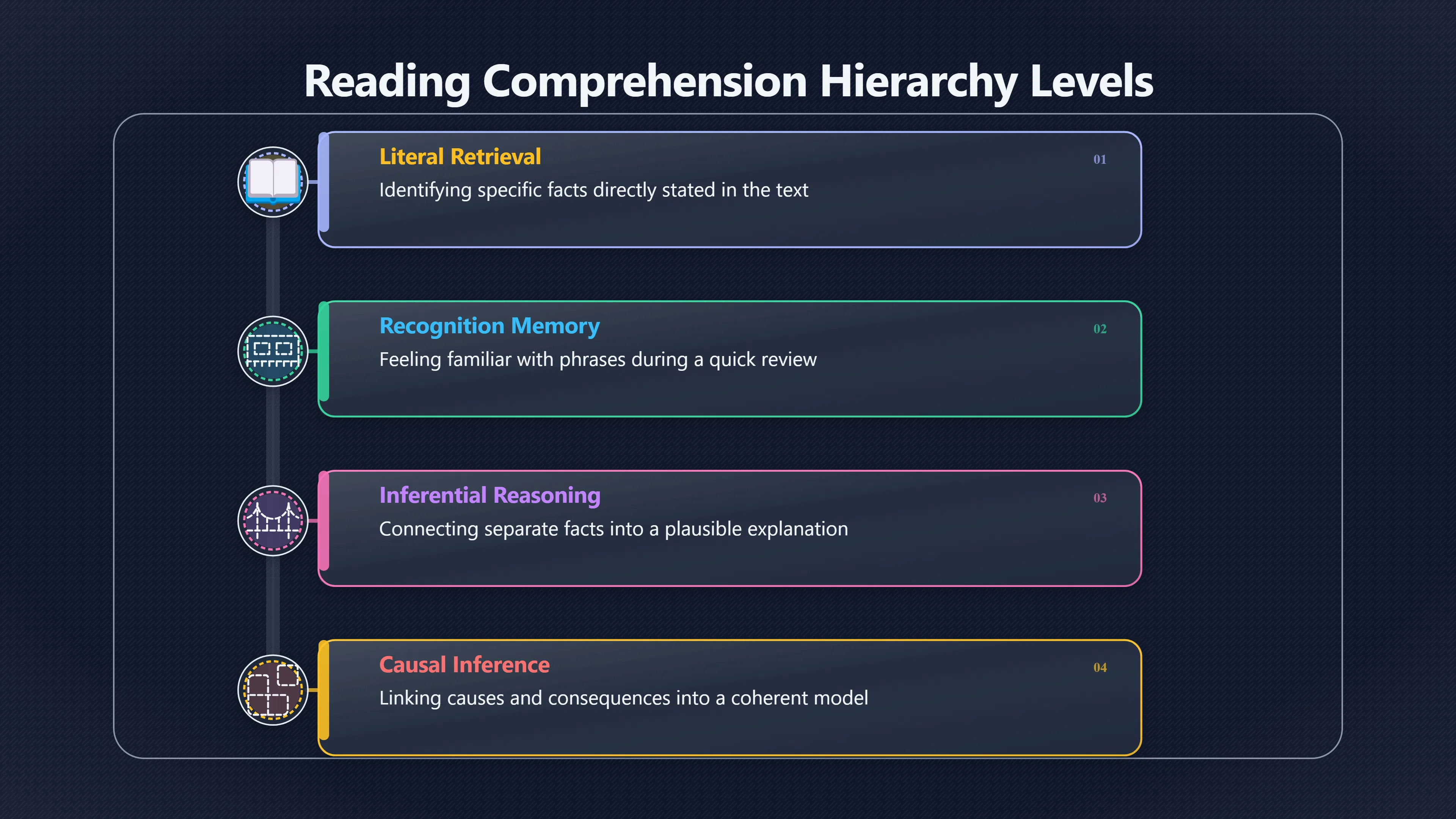
The first can often be answered from a remembered detail. The second requires the reader to connect multiple pieces of information, identify causal relationships, and construct an explanation. Research on inferencing repeatedly shows that comprehension depends on building connections that are not always stated directly in the text.[NFER+2ResearchGate]nfer.ac.ukNFEREffective teaching of inference skills for readingOctober 8, 2009 — by A Kispal · 2008 · Cited by 126 — A key finding of the review was that the ability to draw inferences predetermines r…
This distinction matters during speed increases. When readers push their pace higher, they may continue encoding isolated facts while spending less time integrating those facts into a coherent explanation. The result is a common illusion of comprehension: “I remember the passage, therefore I understood it.” Why questions test whether that understanding actually exists.
Studies of causal inference in reading suggest that strong comprehenders actively generate explanations as they read, linking causes and consequences into a coherent mental representation of the text. Weaker comprehension is often associated with reduced success in generating those causal connections.[ERIC]files.eric.ed.govERICEffects of Comprehension Skill on Inference GenerationSeptember 2, 2014 — by SE Carlson · 2014 · Cited by 69 — The purpose of this study was to investigate differences between readers with di…
Why Questions Often Reveal the First Cracks
The earliest comprehension losses usually occur in the connections between ideas rather than in the ideas themselves.
A reader moving too quickly through a passage may successfully remember:
- A company adopted remote work.
- Staff turnover decreased.
- Managers expanded the programme.
Yet the reader may hesitate when asked why managers expanded it.
The answer is not explicitly stated. It requires combining separate facts into a causal explanation. If that explanation cannot be produced, the problem is not memory alone. It is a breakdown in the construction of meaning across the passage. Research reviews have found that inferencing ability is strongly tied to overall reading comprehension and may even predict comprehension success rather than merely result from it.[NFER]nfer.ac.ukNFEREffective teaching of inference skills for readingOctober 8, 2009 — by A Kispal · 2008 · Cited by 126 — A key finding of the review was that the ability to draw inferences predetermines r…
This makes Why questions particularly valuable during reading-speed training. They target the exact process most likely to deteriorate first: the integration of information into a coherent model of what is happening and why.
Linking Evidence Across a Passage
Most Why questions cannot be answered from a single sentence.
Instead, they require readers to gather evidence from different parts of a text and combine it into a plausible explanation. This process is sometimes described as building a “situation model” of the passage—a mental representation that goes beyond individual sentences and captures the relationships among events, goals, and outcomes.[Frontiers]frontiersin.orgFrontiers Training Inference Making Skills Using a Situation ModelFrontiersTraining Inference Making Skills Using a Situation Model…February 15, 2016 — by LT Bos · 2016 · Cited by 65 — This study show…
For example, imagine a passage stating that:
- Sales fell for three consecutive quarters.
- The company delayed several product launches.
- Investors became increasingly concerned.
A factual question might ask how many quarters sales declined.
A Why question might ask why investor confidence weakened.
Answering correctly requires connecting multiple statements and recognising a causal pattern. If a reader has skimmed quickly enough to retain the individual facts but not their relationship, the Why question exposes that weakness immediately.
This explains why inference-oriented assessments are often considered more diagnostic than simple retrieval questions. They force readers to demonstrate that they have linked information together rather than merely collected it.[ACL Anthology+2ERIC]aclanthology.orgSome inferences require resolving references across.Read moreACL AnthologyAutomatic Generation of Inference Making Questions for…July 7, 2025 — by WA Ma · Cited by 1 — Inference making is an esse…
The Risk of Mistaking Recognition for Understanding
One danger in speed training is overreliance on factual accuracy as a measure of success.
Readers often experience strong recognition memory. When reviewing a passage, details feel familiar. Familiarity can create the impression that comprehension remains intact even when causal understanding has declined.
Why questions help counter this problem because they require explanation rather than recognition. A reader cannot rely solely on remembering a phrase from the text. Instead, they must reconstruct the logic behind the passage.
This distinction resembles a broader finding in reading-comprehension research: literal understanding and inferential understanding are related but not identical. Readers can perform reasonably well on literal questions while struggling with inferential reasoning that requires connections beyond what is directly stated.[Lexia+2MDPI]lexialearning.comLexia3 Types of Reading Comprehension ComparedLexia9 Feb 2026 — Explore the three main levels of reading comprehension: literal, inferential, and evaluative. Develop instructional str…
For someone increasing reading speed, that difference matters. Literal questions may continue producing reassuring scores long after deeper comprehension has begun to erode.
Using Why Questions to Find Your Speed Limit
The practical value of Why questions is that they help identify a personal comprehension threshold.
After a timed reading exercise, ask several causal questions:
- Why did the author support the proposed solution?
- Why did a character change behaviour?
- Why did the results differ from expectations?
- Why did one event lead to another?
Then compare performance with factual questions from the same passage.
A common pattern during speed increases is:
- Factual questions remain strong.
- Why-question accuracy begins to decline.
- Broader comprehension problems appear later.
When that middle stage appears consistently, it often signals that reading speed has started to exceed the pace at which causal relationships can be integrated effectively. The reader may still feel fluent, but comprehension is becoming shallower. This aligns with broader evidence that comprehension and speed do not increase indefinitely together; beyond a certain point, faster reading can reduce the processing needed to connect ideas meaningfully.[GEM Report SCOPE]education-progress.orgGEM Report SCOPEDoes reading speed matter?GEM Report SCOPEComprehension has a non-linear relationship with reading speed. Read too slowly, and you forget how a sentence started…
Rather than treating this as failure, it can be used as feedback. The speed at which Why-question performance starts dropping is often close to the reader’s current comprehension-preserving limit.
What Makes a Good Why Question?
Not all Why questions are equally useful.
The best ones focus on explanations that require evidence from the passage rather than personal opinion. Effective examples include:
- Why did the researcher change the methodology?
- Why was the proposal rejected?
- Why did the conflict escalate?
- Why did the author present the evidence in that order?
Poorer questions invite speculation or rely heavily on outside knowledge.
The goal is not literary interpretation or debate. It is to test whether the reader successfully connected causes, motivations, and consequences within the text itself. Diagnostic reading assessments frequently emphasise this kind of inference because it reveals whether readers are constructing meaning rather than simply extracting facts.[NFER+2ACL Anthology]nfer.ac.ukNFEREffective teaching of inference skills for readingOctober 8, 2009 — by A Kispal · 2008 · Cited by 126 — A key finding of the review was that the ability to draw inferences predetermines r…
Why Questions Often Fail First at Higher Speeds
The reason Why questions are such an effective early warning signal is simple: causal understanding is more fragile than factual recognition. As reading speed increases, readers can often continue collecting details while gradually losing the links that make those details meaningful.
Because Why questions depend on those links, they tend to expose comprehension loss earlier than recall questions. A reader who can still answer factual questions but cannot explain causes, motives, or consequences has likely crossed from understanding the passage to merely remembering parts of it. In reading-speed training, recognising that transition early is one of the most reliable ways to protect comprehension while pursuing greater speed.
Amazon book picks
Further Reading
Books and field guides related to Why Questions Often Fail First at Higher Speeds. Use these as the next step if you want deeper reading beyond the article.
How to Read a Book
Rating: 4.0/5 from 41 Google Books ratings
Teaches readers to follow arguments, causes, and reasoning chains.
The Knowledge GAP
First published 2019. Subjects: Language arts (elementary), Education, elementary, curricula, Educational change, Children with social di...
Understanding and Teaching Reading Comprehension
First published 2014. Subjects: Reading comprehension.
eBay marketplace picks
Marketplace Samples
Example marketplace items related to this page. Use the search link to explore similar finds on eBay.


Endnotes
1.
Source: nfer.ac.uk
Title: NFEREffective teaching of inference skills for reading
Link:https://www.nfer.ac.uk/media/1aafth05/edr01.pdf
Source snippet
October 8, 2009 — by A Kispal · 2008 · Cited by 126 — A key finding of the review was that the ability to draw inferences predetermines r...
Published: October 8, 2009
2.
Source: researchgate.net
Link:https://www.researchgate.net/publication/371290077_Inferencing_in_Reading_Comprehension_Examining_Variations_in_Definition_Instruction_and_Assessment
Source snippet
(PDF) Inferencing in Reading Comprehension: Examining...2 Jun 2023 — Theoretical [models]({{ 'models/' | relative_url }}) of reading comprehension have consistently highl...
3.
Source: researchgate.net
Link:https://www.researchgate.net/publication/279433519_Causal_Inferences_and_The_Comprehension_of_Narrative_Texts
Source snippet
Causal Inferences and The Comprehension of Narrative...Causal inferences, including causal antecedents and consequences, provide connect...
4.
Source: files.eric.ed.gov
Title: ERICEffects of Comprehension Skill on Inference Generation
Link:https://files.eric.ed.gov/fulltext/EJ1038007.pdf
Source snippet
September 2, 2014 — by SE Carlson · 2014 · Cited by 69 — The [purpose]({{ 'purpose/' | relative_url }}) of this study was to investigate differences between readers with di...
Published: September 2, 2014
5.
Source: files.eric.ed.gov
Link:https://files.eric.ed.gov/fulltext/ED501868.pdf
Source snippet
ERICEffective Teaching of Inference Skills for Readingby A Kispal · 2008 · Cited by 126 — A key finding of the review was that the abilit...
6.
Source: files.eric.ed.gov
Title: ERICThe Effects of Inference Instruction on the Reading
Link:https://files.eric.ed.gov/fulltext/EJ1266300.pdf
Source snippet
ERICby C Hall · 2020 · Cited by 128 — The primary purpose of this study was to expand the research base on inference instruction for midd...
7.
Source: mdpi.com
Link:https://www.mdpi.com/2227-7102/15/6/654
Source snippet
Inferential Reading Skills in High School: A Study on...by A Nadalini · 2025 · Cited by 17 — Reading comprehension of connected texts is...
8.
Source: education-progress.org
Title: GEM Report SCOPEDoes reading speed matter?
Link:https://www.education-progress.org/focus/24-readingspeed
Source snippet
GEM Report SCOPEComprehension has a non-linear relationship with reading speed. Read too slowly, and you forget how a sentence started...
9.
Source: researchgate.net
Link:https://www.researchgate.net/publication/276245088_The_Effects_of_Retelling_Upon_Reading_Comprehension_and_Recall_of_Text_Information
Source snippet
ion and recall of text information for 93 fourth-grade students.Read more...
10.
Source: frontiersin.org
Title: Frontiers Training Inference Making Skills Using a Situation Model
Link:https://www.frontiersin.org/journals/psychology/articles/10.3389/fpsyg.2016.00116/full
Source snippet
FrontiersTraining Inference Making Skills Using a Situation Model...February 15, 2016 — by LT Bos · 2016 · Cited by 65 — This study show...
Published: February 15, 2016
11.
Source: aclanthology.org
Title: Some inferences require resolving references across.Read more
Link:https://aclanthology.org/2025.bea-1.31.pdf
Source snippet
ACL AnthologyAutomatic Generation of Inference Making Questions for...July 7, 2025 — by WA Ma · Cited by 1 — Inference making is an esse...
Published: July 7, 2025
12.
Source: lexialearning.com
Title: Lexia3 Types of Reading Comprehension Compared
Link:https://www.lexialearning.com/blog/3-types-of-reading-comprehension-compared-inferential-literal-and-evaluative
Source snippet
Lexia9 Feb 2026 — Explore the three main levels of reading comprehension: literal, inferential, and evaluative. Develop instructional str...
13.
Source: assets.publishing.service.gov.uk
Link:https://assets.publishing.service.gov.uk/media/664f600c05e5fe28788fc437/The_reading_framework_.pdf
Source snippet
reading frameworkInference and prediction depend upon knowledge, and knowledge depends upon reading a lot. For readers like Jamal, these...
Additional References
14.
Source: my.chartered.college
Link:https://my.chartered.college/research-hub/reading-developing-comprehension-and-inference/
Source snippet
My CollegeReading: Developing comprehension and inferenceOver time, readers' confidence will improve so that comprehension and inference...
15.
Source: facebook.com
Title: why retrieval and inference are unsatisfactory means of determining how children
Link:https://www.facebook.com/michael.rosen.5496/posts/why-retrieval-and-inference-are-unsatisfactory-means-of-determining-how-children/10154747395082225/
Source snippet
Why 'retrieval' and 'inference' are unsatisfactory means of...15 Dec 2016 — Why 'retrieval' and 'inference' are unsatisfactory means of...
16.
Source: oneeducation.co.uk
Link:https://www.oneeducation.co.uk/teaching-reading-skills-and-strategies-inference/
Source snippet
Learn strategies to help children develop thinking, enhance comprehension and be confident readers...
17.
Source: structural-learning.com
Link:https://www.structural-learning.com/post/inference-deduction-reading-skills-teachers
Source snippet
It means "reading between the lines" to understand what the author...Read more...
18.
Source: hal.science
Link:https://hal.science/hal-05001737/document
Source snippet
The impact of reading time constraints on text...by N Vibert · 2025 · Cited by 3 — 444) pointed out, “While faster readers may often be...
19.
Source: bedrocklearning.org
Title: inference in reading comprehension
Link:https://bedrocklearning.org/literacy-blogs/inference-in-reading-comprehension/
Source snippet
17 Oct 2022 — Explore how teaching inference skills can improve reading comprehension skills for students, boosting attainment across the...
20.
Source: youtube.com
Link:https://www.youtube.com/watch?v=Pvtg579yY_k
Source snippet
Mastering Reading Comprehension Skills | Kathleen Jasper...
21.
Source: arxiv.org
Link:https://arxiv.org/html/2506.08260v1
Source snippet
Automatic Generation of Inference Making Questions for...9 Jun 2025 — This paper demonstrates our effort in leveraging a large language...
22.
Source: pmc.ncbi.nlm.nih.gov
Link:https://pmc.ncbi.nlm.nih.gov/articles/PMC5547909/
Source snippet
the Impact of a Multistrategy Inference Intervention...by AE Barth · 2017 · Cited by 81 — We examined the effectiveness of a multistrate...
23.
Source: pmc.ncbi.nlm.nih.gov
Link:https://pmc.ncbi.nlm.nih.gov/articles/PMC6681044/
Source snippet
comprehension of 3–6 year olds within the context...by P Filiatrault‐Veilleux · 2015 · Cited by 57 — The ability to make inferences play...
Topic Tree