Within Faster Reading
When Should You Slow Down or Skim?
Good readers change pace depending on whether they need orientation, selection, detail, pleasure, or risk control.
On this page
- Matching pace to purpose
- Documents that deserve close reading
- Fast triage for low stakes text
Page outline Jump by section
Introduction
Reading faster is not one skill applied evenly to every page. It is a decision about purpose. The same person may skim a routine email, scan a report for one figure, read a contract line by line, slow down for a medicine leaflet, and relax into fiction without timing themselves at all. Good readers increase their effective speed by changing pace before they change eye movement: they ask what the document is for, what they need from it, and what the cost of missing something would be.
That matters because research on speed reading repeatedly shows a trade-off between pace and understanding. A major review concluded that people are unlikely to double or triple reading speed while preserving the same comprehension; faster movement usually becomes skimming, which can be useful when full detail is not required.[PubMed]pubmed.ncbi.nlm.nih.govPub Med How Do We Read, and Can Speed Reading Help?by K Rayner · 2016 · Cited by 535 — The research shows that there is a trade-off between speed and accuracy. It is unlikely that re… The practical lesson is not “never skim”. It is “skim the right things, and slow down when the document can change a decision, a risk, a payment, a diagnosis, or a relationship”.
Matching Pace to Purpose
Purpose-based reading starts with a simple question: what job is this document doing? A document may be giving orientation, helping selection, providing exact instructions, creating legal obligations, entertaining, persuading, or warning. Each purpose calls for a different speed.
Skimming is best when the aim is orientation: finding the main point, structure, relevance, or tone. The University of North Carolina’s Learning Center defines skimming as a strategic, selective method focused on main ideas rather than details, using features such as introductions, summaries, first and last sentences, headings, bold terms, and layout cues.[The Learning Center]learningcenter.unc.eduThe Learning Center SkimmingThe Learning CenterSkimming - The Learning CenterSkimming is a strategic, selective reading method in which you focus on the main ideas o… Scanning is different: it is for locating a particular fact, such as a date, name, amount, definition, dosage, clause number, or deadline. The University of Birmingham’s guide describes skimming and scanning as ways to get a quick overview and decide relevance, with scanning used to find specific information.[University of Birmingham LibGuides]libguides.bham.ac.ukUniversity of Birmingham LibGuidesA short guide: Scanning and skim reading26 Sept 2024 — Scanning and skim reading enable you to get a qu…
A useful pace decision looks like this:
- Orientation: skim headings, opening paragraphs, summaries, charts, and repeated terms.
- Selection: skim enough to decide whether the document deserves deeper reading.
- Extraction: scan for a target fact, then read the surrounding sentences closely.
- Comprehension: read at normal pace, pausing to paraphrase important points.
- Risk control: slow down, reread, check definitions, and compare related sections.
- Pleasure: let pace vary naturally; speed is less important than attention and enjoyment.
This is why “reading speed” is often misleading as a single number. A reader who spends five minutes deciding that a 40-page report only has four relevant pages may be far more efficient than someone who reads all 40 pages quickly but cannot say which pages matter. The skill is not constant acceleration; it is knowing when not to spend equal attention on unequal text.
What Different Documents Ask of You
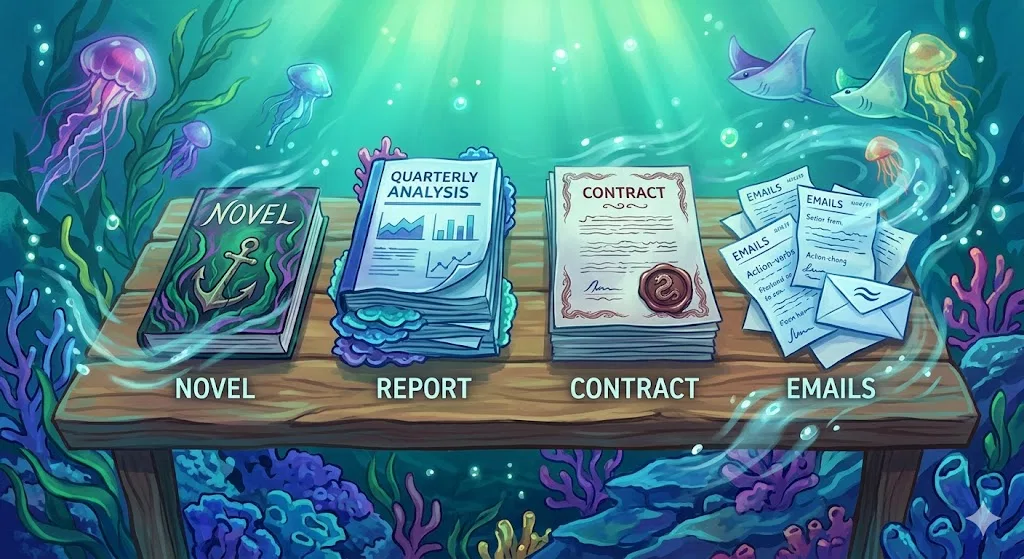
Different documents hide their important information in different places. Purpose-based reading works because it treats format as a clue.
For emails, the first task is usually triage: who sent it, what action is required, by when, and what happens if it is ignored? Email overload is a real workplace problem, with research linking perceived email importance and urgency to overload.[OUP Academic]academic.oup.comOUP AcademicMeasurement of Perceived Importance and Urgency of Emailby A Lanctot · 2022 · Cited by 26 — This article presents two scales… A sensible email pace is fast for routine updates, slower for anything involving commitments, complaints, money, HR, legal issues, or tone-sensitive replies. Read the subject line, sender, first paragraph, action verbs, dates, attachments, and final request before deciding whether to archive, reply, schedule, delegate, or read closely.
For reports, start with the executive summary, contents page, introduction, conclusion, recommendations, headings, tables, and figures. The Open University recommends using scanning and skimming to understand scope and content, including first and last paragraphs, first sentences of paragraphs, and summaries.[Open University Help]help.open.ac.ukOpen University HelpUse an efficient approach: Critical reading techniquesScanning and skimming · get an indication of the scope and cont… After that, slow down only where the report affects your decision: assumptions, evidence, methods, caveats, financial figures, risk sections, or recommendations.
For technical material, do not read documentation like a novel unless you are deliberately learning the whole system. Technical documentation is often split into conceptual, task-based, and reference information. The UK Home Office engineering guidance explicitly recommends breaking documentation into conceptual, task-based, and reference material around user needs.[Engineering Home Office]engineering.homeoffice.gov.ukwrite effective documentationEngineering Home OfficeWrite effective documentation6 Nov 2024 — Start with User Needs; Make your content accessible and inclusive; Writ… That implies three speeds: skim conceptual pages for the system map, follow task pages step by step when implementing, and scan reference pages for exact syntax, parameters, exceptions, or limits.
For academic and scientific texts, a layered approach is usually better than ploughing through from the first word. University study guidance commonly recommends surveying the text first, then selecting priority sections for deeper engagement. Sheffield’s academic reading guidance, for example, describes academic reading as a strategic process of scanning, skimming, selecting priority texts, and engaging more deeply with the most important parts.[University of Sheffield]sheffield.ac.ukUniversity of SheffieldHow to read efficiently | StudySkills@SheffieldInstead, academic reading is usually a strategic process of scannin… For a research paper, this often means reading the title, abstract, introduction, figures, discussion, and conclusion before deciding whether the methods or results need close reading.
For fiction and essays read for pleasure, the purpose is different. Speed is not always the point. If the value lies in atmosphere, voice, suspense, humour, or emotional immersion, forcing a faster pace may reduce the very benefit the reading is meant to provide. Fiction can sometimes be read faster than dense non-fiction because it often has more familiar structure and narrative momentum, but it still rewards slowing down when style, ambiguity, or emotional detail matters.
Documents That Deserve Close Reading
Some documents punish skimming. They contain obligations, warnings, exceptions, instructions, or definitions that change the meaning of everything around them. These are the documents where “saving time” by reading quickly can become expensive.
Contracts are the obvious case. A contract’s most important parts are not always the most readable parts: definitions, exclusions, liability limits, renewal terms, cancellation rules, payment triggers, warranties, indemnities, dispute clauses, and “subject to” wording often carry the real risk. Legal commentary on contract reading stresses that risk allocation provisions deserve careful attention because they can limit recovery when something goes wrong.[In-House Counsel Essentials]tenthings.blogIn-House Counsel Essentials Ten Things – How to Read a ContractIn-House Counsel Essentials Ten Things – How to Read a Contract Research on legal-document summarisation also notes that contracts are long, domain-specific, and difficult because the rights and duties requiring review vary by party.[arXiv]arxiv.orgOpen source on arxiv.org.
Medicine information is another slow-reading category. In the UK, medicines must include a patient information leaflet where the label does not contain all necessary information, and the Medicines and Healthcare products Regulatory Agency approves packaging and labelling information for medicines sold in the UK.[GOV.UK]GOV.UKpackaging, labelling and patient information leafletspackaging, labelling and patient information leaflets Patient information leaflets exist to explain administration, precautions, and potential side effects; research on leaflets notes this purpose while also showing that patients may find them alarming or difficult to interpret.[PMC]pmc.ncbi.nlm.nih.govOpen source on nih.gov. The practical reading rule is simple: skim for headings first, but read closely around dosage, timing, interactions, side effects requiring urgent action, pregnancy warnings, storage, missed-dose instructions, and “do not take if” sections.
Financial documents also require deliberate slowing. A bank statement can be scanned for unusual transactions, but a loan agreement, insurance policy, pension form, or tax notice deserves close attention to definitions, exclusions, fees, deadlines, assumptions, and penalties. In these texts, the danger is not only missing a fact; it is misunderstanding a condition.
Technical instructions deserve the same respect when the cost of error is high. A software tutorial can be skimmed if you are exploring, but installation steps, migration guides, security settings, command-line options, safety instructions, and hardware manuals should be read in sequence. For these documents, speed comes from preparation, not haste: first identify the version, platform, prerequisites, warnings, and rollback path, then proceed slowly through the actionable steps.
Fast Triage for Low-Stakes Text
Low-stakes reading is where speed gains are easiest and safest. The aim is not to absorb everything; it is to decide what deserves attention.
A practical triage pass takes less effort than full reading because it uses document signals:
- Check the source and purpose. Who wrote it, and why does it exist?
- Read the title, heading, first paragraph, and final paragraph. These often reveal the main claim or request.
- Look for dates, deadlines, figures, names, and action verbs. These tell you whether the text affects your calendar, money, work, or responsibilities.
- Sample the middle. Read a few topic sentences, captions, bullets, or chart labels.
- Choose a next action. Ignore, save, forward, scan for a fact, read later, or read closely now.
This works especially well for newsletters, routine meeting notes, promotional pages, general updates, search results, long comment threads, and reports that may not be relevant. It also reduces the false guilt of “not reading properly”. Skimming is proper reading when the task is selection rather than comprehension.
The key is to stop skimming once the stakes rise. A newsletter paragraph about an event can be skimmed; the booking conditions should not be. A report’s background section may be skimmed; the recommendation that affects a budget should not. A software changelog can be scanned; the breaking-change note needs attention. Purpose-based readers do not worship speed. They use speed as a filter.
A Simple Decision Cluster for Everyday Reading
A good pace decision can be made before opening the document fully. Ask four questions:
What do I need from this?
If you need a broad sense, skim. If you need one fact, scan. If you need to explain, apply, sign, challenge, or rely on it, read closely.
What happens if I miss something?
Low consequence supports faster reading. High consequence calls for slower reading, rereading, and sometimes outside advice.
How dense is the text?
Dense writing, unfamiliar vocabulary, legal definitions, technical steps, and compressed arguments all require more time. Eye-tracking research comparing regular reading, thorough reading, skimming, and spell checking found that thorough reading involved longer reading times and more rereading, and produced higher comprehension scores.[PMC]pmc.ncbi.nlm.nih.govOpen source on nih.gov.
Where is the value located?
In emails, value may sit in the request and deadline. In contracts, it may sit in definitions and exceptions. In reports, it may sit in findings and assumptions. In technical documentation, it may sit in prerequisites and parameters. In fiction, it may sit in voice and sequence.
This decision cluster keeps reading speed connected to judgement. Instead of asking “How fast can I read this?”, ask “How much attention does this document deserve?”
Common Pace Mistakes
The most common mistake is using one speed for everything. Some readers read every document as if it were a novel, which wastes time on low-value text. Others skim everything as if it were a feed, which creates errors in documents that require accuracy.
Another mistake is confusing familiarity with safety. A familiar-looking document can still contain a changed clause, a new price, a revised dose, a hidden deadline, or an exception. When reading updates, policies, contracts, medicine leaflets, or software release notes, look specifically for what has changed.
A third mistake is treating summaries as substitutes for source text. Summaries can help orient the reader, but they can omit conditions, nuance, or exceptions. This is especially important in legal, medical, financial, and technical material. Research into plain-English contract summarisation highlights how difficult it is to compress legal text because useful summaries require abstraction, simplification, and preservation of meaning.[arXiv]arxiv.orgarXiv Plain English Summarization of ContractsarXiv Plain English Summarization of Contracts A summary may tell you where to look; it should not always decide for you.
Finally, readers often slow down too late. They skim until confused, then reread the whole passage. A better method is to slow down at predictable friction points: definitions, exceptions, dense evidence, unfamiliar terms, diagrams, formulae, warnings, and instructions. This is not slower overall. It prevents the more expensive slowdown of repairing misunderstanding afterwards.
A Practical Pace Map
Purpose-based reading becomes easier when each document type has a default pace and a slowdown trigger.
Document typeDefault paceSlow down whenRoutine emailFast triageIt asks for action, commitment, payment, apology, approval, or a sensitive replyNewsletter or updateSkimIt affects a date, opportunity, deadline, or obligationReportSkim structure, then selectYou reach recommendations, assumptions, figures, methods, caveats, or risksContract or termsSlow, section by sectionDefinitions, liability, fees, renewal, cancellation, data use, or dispute clauses appearMedicine leafletSkim headings, then read key warnings closelyDosage, interactions, side effects, pregnancy, missed doses, or urgent symptoms are mentionedTechnical documentationScan structure, then read task steps closelyYou are installing, migrating, configuring security, or using exact syntaxAcademic paperSurvey first, then read selected sectionsYou need to evaluate evidence, methods, limitations, or apply the findingsFictionNatural paceStyle, ambiguity, emotional detail, or plot complexity rewards attention
The fastest readers in real life are often not the people who push every page to maximum speed. They are the people who stop giving premium attention to disposable text, and start giving full attention to text that can change what they do next.
Amazon book picks
Further Reading
Books and field guides related to When Should You Slow Down or Skim?. Use these as the next step if you want deeper reading beyond the article.
How to Read a Book
Rating: 4.0/5 from 41 Google Books ratings
Directly addresses different reading goals and speeds.
Breakthrough rapid reading
Discusses when faster reading is useful and when it is not.
The Effective Executive
Supports decision-making about information intake and attention.
eBay marketplace picks
Marketplace Samples
Example marketplace items related to this page. Use the search link to explore similar finds on eBay.



Endnotes
1.
Source: academic.oup.com
Link:https://academic.oup.com/jcmc/article/27/2/zmac001/6548841
Source snippet
OUP AcademicMeasurement of Perceived Importance and Urgency of Emailby A Lanctot · 2022 · Cited by 26 — This article presents two scales...
2.
Source: engineering.homeoffice.gov.uk
Title: write effective documentation
Link:https://engineering.homeoffice.gov.uk/patterns/write-effective-documentation/
Source snippet
Engineering Home OfficeWrite effective documentation6 Nov 2024 — Start with User Needs; Make your content accessible and inclusive; Writ...
3.
Source: arxiv.org
Link:https://arxiv.org/abs/2212.09825
4.
Source: GOV.UK
Title: packaging, labelling and patient information leaflets
Link:https://www.gov.uk/guidance/medicines-packaging-labelling-and-patient-information-leaflets
5.
Source: pmc.ncbi.nlm.nih.gov
Link:https://pmc.ncbi.nlm.nih.gov/articles/PMC4287479/
6.
Source: pmc.ncbi.nlm.nih.gov
Link:https://pmc.ncbi.nlm.nih.gov/articles/PMC7198234/
7.
Source: arxiv.org
Title: arXiv Plain English Summarization of Contracts
Link:https://arxiv.org/abs/1906.00424
8.
Source: assets.publishing.service.gov.uk
Link:https://assets.publishing.service.gov.uk/media/5fe086c18fa8f5149718d66a/Best_[practice
9.
Source: reading.com
Link:https://www.reading.com/
10.
Source: products.mhra.gov.uk
Title: mhra.gov.uk Patient Information Leaflet
Link:https://products.mhra.gov.uk/search/?page=1&search=valproate
11.
Source: patient.info
Link:https://patient.info/
12.
Source: tus.libguides.com
Link:https://tus.libguides.com/reading_scholarly_articles/keyreadingstrategies
13.
Source: open.edu
Link:https://www.open.edu/openlearn/ocw/mod/oucontent/view.php?id=85812§ion=2
14.
Source: youtube.com
Link:http://www.youtube.com/watch?v=wrhgcqBShJQ
Source snippet
Scanning and Skimming | Things About Speed Reading Nobody Tells You...
15.
Source: pubmed.ncbi.nlm.nih.gov
Title: Pub Med How Do We Read, and Can Speed Reading Help?
Link:https://pubmed.ncbi.nlm.nih.gov/26769745/
Source snippet
by K Rayner · 2016 · Cited by 535 — The research shows that there is a trade-off between speed and accuracy. It is unlikely that re...
16.
Source: learningcenter.unc.edu
Title: The Learning Center Skimming
Link:https://learningcenter.unc.edu/tips-and-tools/skimming/
Source snippet
The Learning CenterSkimming - The Learning CenterSkimming is a strategic, selective reading method in which you focus on the main ideas o...
17.
Source: libguides.bham.ac.uk
Link:https://libguides.bham.ac.uk/c.php?g=689902&p=4942995
Source snippet
University of Birmingham LibGuidesA short guide: Scanning and skim reading26 Sept 2024 — Scanning and skim reading enable you to get a qu...
18.
Source: help.open.ac.uk
Link:https://help.open.ac.uk/critical-reading-techniques/use-an-efficient-approach
Source snippet
Open University HelpUse an efficient approach: Critical reading techniquesScanning and skimming · get an indication of the scope and cont...
19.
Source: sheffield.ac.uk
Link:https://sheffield.ac.uk/study-skills/research/reading/efficiently
Source snippet
University of SheffieldHow to read efficiently | StudySkills@SheffieldInstead, academic reading is usually a strategic process of scannin...
20.
Source: tenthings.blog
Title: In-House Counsel Essentials Ten Things – How to Read a Contract
Link:https://tenthings.blog/2019/08/28/ten-things-how-to-read-a-contract/
21.
Source: butte.edu
Title: Skimming and Scanning
Link:https://www.butte.edu/departments/cas/tipsheets/readingstrategies/skimming_scanning.html
22.
Source: utc.edu
Link:https://www.utc.edu/enrollment-management-and-student-affairs/center-for-academic-support-and-advisement/tips-for-academic-success/skimming
23.
Source: queensonlineschool.com
Title: skimming and scanning
Link:https://queensonlineschool.com/skimming-and-scanning/
24.
Source: pmc.ncbi.nlm.nih.gov
Link:https://pmc.ncbi.nlm.nih.gov/articles/PMC12801452/
25.
Source: pmc.ncbi.nlm.nih.gov
Link:https://pmc.ncbi.nlm.nih.gov/articles/PMC3579520/
26.
Source: pmc.ncbi.nlm.nih.gov
Link:https://pmc.ncbi.nlm.nih.gov/articles/PMC5800719/
Additional References
27.
Source: youtube.com
Title: Skimming v. Close Reading, SAT Critical Reading Bootcamp #6
Link:http://www.youtube.com/watch?v=sUMkK_BajUc
Source snippet
Reading pace to purpose speed reading trade off Subvocalization | Things About Speed Reading Nobody Tells You How to Genius...
28.
Source: youtube.com
Link:http://www.youtube.com/watch?v=X5yJRAOlA1U
Source snippet
5 Ways to Read Faster That ACTUALLY Work - College Info Geek...
29.
Source: youtube.com
Title: 5 Ways to Read Faster That ACTUALLY Work
Link:http://www.youtube.com/watch?v=kmDMrxUSXKY
Source snippet
Lesson 7: Reading Styles (Skimming, Scanning, Intensive Reading, Extensive Reading) ENGLISH 7...
30.
Source: researchgate.net
Link:https://www.researchgate.net/publication/381339621_The_Effectiveness_of_Using_Skimming_and_Scanning_Techniques_in_Improving_Reading_Comprehension_A_Systematic_Literature_Review
31.
Source: researchgate.net
Link:https://www.researchgate.net/publication/337256453_THE_ANALYSIS_OF_SKIMMING_AND_SCANNING_TECHNIQUE_TO_IMPROVE_STUDENTS_IN_TEACHING_READING_COMPREHENSION
32.
Source: researchgate.net
Link:https://www.researchgate.net/publication/386467270_E-mail_overload_Exploring_employees%27_experiences_using_e-mail_during_worktime_and_leisure_time_and_consequences_for_their_subjective_well-being
33.
Source: researchgate.net
Link:https://www.researchgate.net/publication/394297308_Survey_Question_Read_Recite_Review_SQ3R_Method_Improves_Reading_Comprehension_of_Descriptive_Texts_for_Tenth_Grade_Students
34.
Source: researchgate.net
Link:https://www.researchgate.net/publication/399897944_Testing_the_Speed-Accuracy_Trade-Off_in_Reading_Effects_of_Reading_Speed_on_Comprehension_and_Eye_Movements
35.
Source: facebook.com
Link:https://www.facebook.com/WelcometoRLP/posts/phone-contracts-as-contracts-often-come-with-pages-of-conditions-and-laws-are-di/1809386019369157/
36.
Source: researchgate.net
Link:https://www.researchgate.net/publication/354868298_Considering_the_Speed_and_Comprehension_Trade-Off_in_Reading_Mediated_by_Typography
Topic Tree
Follow this branch
Parent topic
Faster ReadingRelated pages 11
- Benchmarks How Fast Do Adults Really Read?
- Dense Texts Why Hard Texts Need Slower Reading
- Inner Voice Should You Silence Your Inner Voice?
- Knowledge Why Familiar Topics Feel Faster to Read
- Measure The Reading Speed Test That Actually Helps
- Myths Why Speed Reading Promises Fall Apart
- Phrases Read Phrases, Not Just Words
- Practice Can Rereading Make You Faster?
- +3 more in sidebar