Within Visual span
Why Your Peripheral Vision Misses Words
Peripheral vision is useful for layout and motion, but it lacks the detail needed to identify many similar words accurately.
On this page
- How sharp vision drops outside the fovea
- Why letter level detail matters for reading
- Why enlarged peripheral text does not solve the problem
Page outline Jump by section
Introduction
Many speed-reading claims assume that peripheral vision can be trained to read entire lines of text at once. The evidence from vision science points in a different direction. Peripheral vision is valuable for guiding eye movements, detecting page layout, and providing limited preview information about upcoming words, but it lacks the precision needed to identify large amounts of text accurately. Reading depends on recognising fine letter patterns, and that ability falls off rapidly outside the centre of gaze. As a result, even highly skilled readers still move their eyes through a line of text rather than extracting every word from the visual periphery. Research on perceptual span, visual acuity, and crowding helps explain why reading whole lines through peripheral vision remains biologically unrealistic.[PMC]pmc.ncbi.nlm.nih.govPMCEye movements, the perceptual span, and reading speedby K Rayner · 2010 · Cited by 467 — The main findings were that fast readers (reading at about 330 wpm) had a larger perceptual span t…

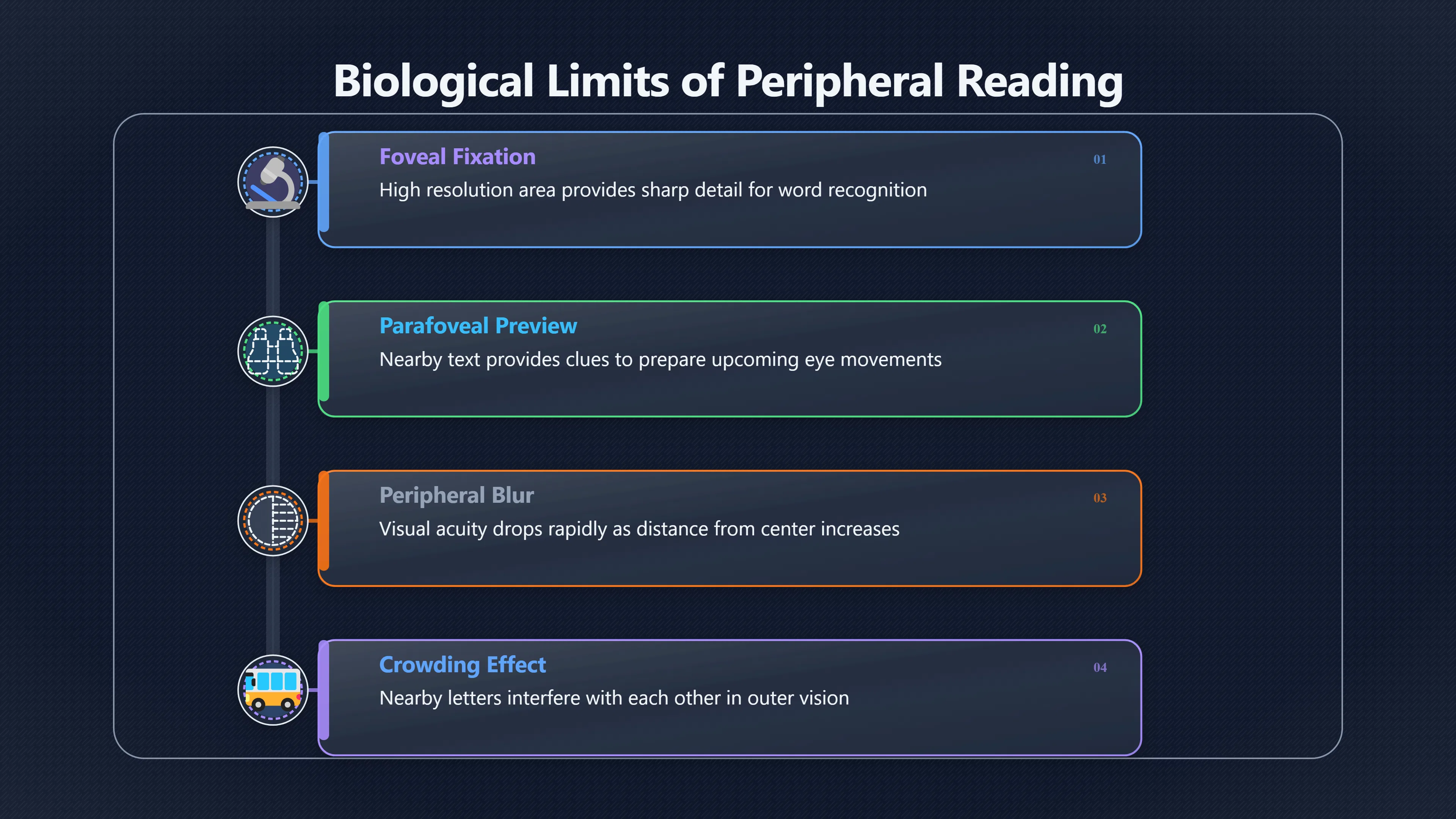
How Sharp Vision Drops Outside the Fovea
The key limitation is the structure of human vision itself. Detailed vision is concentrated in a tiny central retinal region called the fovea. When reading, the word being fixated falls on this high-resolution area. As distance from the point of fixation increases, visual acuity declines and fine detail becomes progressively harder to distinguish.[Verywell Health]verywellhealth.comVerywell Health What Is Central Vision?It is the type of vision typically associated with having "good vision," often measured as 20/20 visual acuity. Central vision depends on…
This decline is not a minor inconvenience. Reading requires distinguishing highly similar visual patterns. The difference between words such as “from” and “form”, or “trail” and “trial”, depends on precise letter identities and positions. Peripheral vision is much less reliable at extracting this level of detail because letter shapes become blurrier and less distinct as they move away from the centre of gaze.[Springer Link]link.springer.comSpringer LinkThe role of visual crowding in eye movements during readingby TY Chiu · 2023 · Cited by 19 — Visual crowding, generally defi…
The consequences can be seen in eye-tracking research. Skilled readers do obtain information beyond the currently fixated word, but the useful region is limited. For English text, the effective perceptual span extends only a few characters to the left and roughly 14–15 characters to the right of fixation, far less than a full line of text. Even fast readers continue to rely on multiple overlapping fixations to process a sentence.[PMC]pmc.ncbi.nlm.nih.govPMCEye Movements in Reading: Models and DataNIHFirst, the perceptual span (or region of effective vision during a fixation) extends 3–4 letter spaces to the left of fixation t…
Why Letter-Level Detail Matters for Reading
Reading is unusual among visual tasks because it demands extremely precise identification of small, densely packed symbols. Peripheral vision performs well for detecting movement, broad shapes, and spatial layout, but text recognition is a different challenge.
A major reason is that reading depends on accurate letter coding. The brain must determine:
- Which letters are present.[pmc.ncbi.nlm.nih.gov]pmc.ncbi.nlm.nih.govof Reading Speed on Letter Spacing in Central…by STL Chung · 2012 · Cited by 25 — Increased letter spacing beyond the standard size, w…
- The order of those letters.
- Where word boundaries occur.
- Which of several visually similar words is correct.
Errors at any of these stages can change meaning. A reader may infer that a peripheral word is short or long, or gain clues about its general shape, but that is not equivalent to reading it. Research on parafoveal preview shows that peripheral information helps prepare the next eye movement and speeds later recognition, yet direct fixation remains crucial for reliable word identification.[Europe PMC]europepmc.orgThe lack of parafoveal…Read more…
This distinction is important because some speed-reading systems blur the difference between “getting clues about a word” and “reading the word”. The scientific evidence supports the former but not the latter. Readers gain partial information from upcoming text; they do not accurately decode entire lines through peripheral vision alone.[PMC]pmc.ncbi.nlm.nih.govPMCEye movements, the perceptual span, and reading speedby K Rayner · 2010 · Cited by 467 — The main findings were that fast readers (reading at about 330 wpm) had a larger perceptual span t…
The Hidden Problem: Crowding
Even if peripheral vision were sharper, another obstacle remains: crowding.
Crowding occurs when nearby visual elements interfere with one another. In peripheral vision, letters that are easy to recognise individually become much harder to identify when surrounded by other letters. Since text consists of densely packed strings of characters, crowding becomes a major bottleneck for reading.[PMC]pmc.ncbi.nlm.nih.govPMCCrowding in peripheral vision: why bigger is betterNIHby DM Levi · 2009 · Cited by 217 — Here we uncover and explain a paradox in peripheral crowding: under certain conditions increa…
Researchers now regard crowding as one of the central reasons peripheral reading is slow. The problem is not merely that letters become smaller or blurrier away from fixation. Rather, neighbouring letters begin to interfere with each other, making their identities difficult to separate. A reader may detect that a cluster of letters exists without being able to determine exactly which letters are present.[PMC+2Springer Link]pmc.ncbi.nlm.nih.govPMCReading Speed Benefits from Increased Vertical Wordby STL CHUNG · 2004 · Cited by 123 — Crowding, the adverse spatial interaction due to proximity of adjacent targets, has been suggeste…
This helps explain why reading performance declines much faster than simple object detection as text moves into the periphery. Peripheral vision can notice that a word is there, but recognising the exact word is another matter entirely.
Why Enlarged Peripheral Text Does Not Solve the Problem
A common response is that larger text should eliminate the limitation. The research shows that enlargement helps, but only up to a point.
Studies of peripheral reading consistently find that larger print improves performance because it compensates for reduced acuity. However, increasing size does not restore peripheral reading to normal foveal reading levels. Reading remains substantially slower than when text is viewed directly.[Gordon Legge Lab]legge.psych.umn.eduGordon Legge Lab Psychophysics of readingXVIII. The effect of print size on…by STL Chung · 1998 · Cited by 387 — The purpose of this study, therefore, was to measure the effec…
The reason is that crowding persists. Making letters larger does not fully remove interference between neighbouring letters. Researchers have tested modifications such as increased letter spacing and altered text layouts. Some adjustments can produce modest gains under specific conditions, particularly for readers who rely heavily on peripheral vision because of central vision loss. Yet these improvements do not transform peripheral vision into a substitute for foveal reading.[iovs.arvojournals.org+2PLOS]iovs.arvojournals.orgThe Effect of Letter Spacing on Reading Speed in Central and…by STL Chung · 2002 · Cited by 281 — The purpose of this study was to exa…
In practical terms, enlarging text may make a peripheral word easier to recognise, but it does not enable accurate, simultaneous reading of an entire line. The underlying constraints remain.
What This Means for Speed-Reading Claims
The idea of reading whole lines through peripheral vision assumes that the outer visual field can perform the same detailed analysis as the centre of gaze. Decades of research suggest otherwise.
Peripheral vision contributes useful information during reading. It helps readers anticipate upcoming words, maintain orientation on the page, and guide future eye movements. Faster readers may extract slightly more information from the parafoveal region than slower readers, but even they remain constrained by the same basic architecture of the visual system. Their perceptual span is larger, not unlimited.[PMC]pmc.ncbi.nlm.nih.govPMCEye movements, the perceptual span, and reading speedby K Rayner · 2010 · Cited by 467 — The main findings were that fast readers (reading at about 330 wpm) had a larger perceptual span t…
The practical implication is straightforward: improving reading speed is more likely to come from better language processing, familiarity with the material, and efficient eye-movement patterns than from attempts to teach peripheral vision to read entire lines. Peripheral vision is an important assistant in reading, but it is not a hidden high-resolution channel waiting to be unlocked.[PMC+2PMC]pmc.ncbi.nlm.nih.govPMCEye movements, the perceptual span, and reading speedby K Rayner · 2010 · Cited by 467 — The main findings were that fast readers (reading at about 330 wpm) had a larger perceptual span t…
Amazon book picks
Further Reading
Books and field guides related to Why Your Peripheral Vision Misses Words. Use these as the next step if you want deeper reading beyond the article.
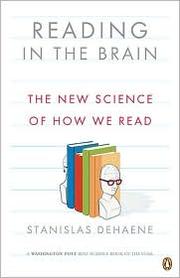
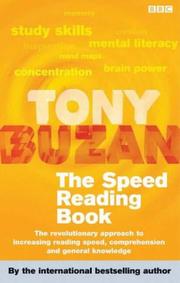
The Speed Reading Book
Represents common speed-reading claims about wider visual intake.
eBay marketplace picks
Marketplace Samples
Example marketplace items related to this page. Use the search link to explore similar finds on eBay.


Endnotes
1.
Source: pmc.ncbi.nlm.nih.gov
Title: PMCEye movements, the perceptual span, and reading speed
Link:https://pmc.ncbi.nlm.nih.gov/articles/PMC3075059/
Source snippet
by K Rayner · 2010 · Cited by 467 — The main findings were that fast readers (reading at about 330 wpm) had a larger perceptual span t...
2.
Source: pmc.ncbi.nlm.nih.gov
Title: PMCEye Movements in Reading: [Models]({{ ‘models/’ | relative_url }}) and Data
Link:https://pmc.ncbi.nlm.nih.gov/articles/PMC2906818/
Source snippet
NIHFirst, the perceptual span (or region of effective vision during a fixation) extends 3–4 letter spaces to the left of fixation t...
3.
Source: link.springer.com
Link:https://link.springer.com/article/10.3758/s13414-023-02787-1
Source snippet
Springer LinkThe role of visual crowding in eye movements during readingby TY Chiu · 2023 · Cited by 19 — Visual crowding, generally defi...
4.
Source: europepmc.org
Link:https://europepmc.org/article/med/22361955
Source snippet
The lack of parafoveal...Read more...
5.
Source: pmc.ncbi.nlm.nih.gov
Title: PMCCrowding in peripheral vision: why bigger is better
Link:https://pmc.ncbi.nlm.nih.gov/articles/PMC3045113/
Source snippet
NIHby DM Levi · 2009 · Cited by 217 — Here we uncover and explain a paradox in peripheral crowding: under certain conditions increa...
6.
Source: pmc.ncbi.nlm.nih.gov
Title: PMCReading Speed Benefits from Increased Vertical Word
Link:https://pmc.ncbi.nlm.nih.gov/articles/PMC2734885/
Source snippet
by STL CHUNG · 2004 · Cited by 123 — Crowding, the adverse spatial interaction due to proximity of adjacent targets, has been suggeste...
7.
Source: iovs.arvojournals.org
Link:https://iovs.arvojournals.org/article.aspx?articleid=2200181
Source snippet
The Effect of Letter Spacing on Reading Speed in Central and...by STL Chung · 2002 · Cited by 281 — The [purpose]({{ 'purpose/' | relative_url }}) of this study was to exa...
8.
Source: journals.plos.org
Link:https://journals.plos.org/plosone/article?id=10.1371%2Fjournal.pone.0080325
Source snippet
Enhanced Text Spacing Improves Reading Performance in...by S Blackmore-Wright · 2013 · Cited by 43 — The results of this study sugge...
9.
Source: pmc.ncbi.nlm.nih.gov
Link:https://pmc.ncbi.nlm.nih.gov/articles/PMC3429790/
Source snippet
of Reading Speed on Letter Spacing in Central...by STL Chung · 2012 · Cited by 25 — Increased letter spacing beyond the standard size, w...
10.
Source: verywellhealth.com
Title: Verywell Health What Is Central Vision?
Link:https://www.verywellhealth.com/central-vision-5209526
Source snippet
It is the type of vision typically associated with having "good vision," often measured as 20/20 visual acuity. Central vision depends on...
11.
Source: legge.psych.umn.edu
Title: Gordon Legge Lab Psychophysics of reading
Link:https://legge.psych.umn.edu/sites/legge.psych.umn.edu/files/2020-08/psychophysics_of_reading._xviii._the_effect_of_print_size_on_reading_speed_in_normal_peripheral_vision_chung_mansfield_legge_1998.pdf
Source snippet
XVIII. The effect of print size on...by STL Chung · 1998 · Cited by 387 — The purpose of this study, therefore, was to [measure]({{ 'measure/' | relative_url }}) the effec...
12.
Source: pmc.ncbi.nlm.nih.gov
Link:https://pmc.ncbi.nlm.nih.gov/articles/PMC7540203/
Source snippet
It is determined by many factors, including reading proficiency...
13.
Source: pmc.ncbi.nlm.nih.gov
Link:https://pmc.ncbi.nlm.nih.gov/articles/PMC12972110/
Source snippet
Effects of visual span on reading speed and parafoveal processing in eye movements during sentence reading.Read more...
Additional References
14.
Source: researchgate.net
Link:https://www.researchgate.net/publication/49694262_Eye_movements_the_perceptual_span_and_reading_speed
Source snippet
Eye movements, the perceptual span, and reading speedThe main findings were that fast readers (reading at about 330 wpm) had a larger per...
15.
Source: scispace.com
Link:https://scispace.com/papers/eye-movements-the-perceptual-span-and-reading-speed-4k5g3c1jka
Source snippet
Eye movements, the perceptual span, and reading speed.TL;DR: The main findings were that fast readers had a larger perceptual span than d...
16.
Source: reddit.com
Link:https://www.reddit.com/r/askscience/comments/4uitp1/why_cant_we_read_with_our_peripheral_vision/
Source snippet
Why can't we read with our peripheral vision?: r/askscienceBecause rod cells are more sensitive to light/dark and less sensitive to deta...
17.
Source: researchgate.net
Link:https://www.researchgate.net/publication/259361726_Eye_movements_in_reading_Models_and_data
18.
Source: speedreading.com
Link:https://speedreading.com/research/eye-movements-visual-processing.php
Source snippet
Eye Movements in Reading | SpeedReading.comClassic findings place effective perceptual span at about 3-4 letters to the left of fixation...
19.
Source: researchgate.net
Link:https://www.researchgate.net/publication/11442506_The_effect_of_letter_spacing_on_reading_speed_in_central_and_peripheral_vision
Source snippet
(PDF) The effect of letter spacing on reading speed in...8 Feb 2026 — The purpose of this study was to examine whether reading speed can...
20.
Source: research.aston.ac.uk
Title: enhanced text spacing improves reading performance in individuals
Link:https://research.aston.ac.uk/en/publications/enhanced-text-spacing-improves-reading-performance-in-individuals/
Source snippet
text spacing improves reading performance in...by S Blackmore-Wright · 2013 · Cited by 43 — Enhanced text spacing improves reading perfo...
21.
Source: scirp.org
Link:https://www.scirp.org/journal/paperinformation?paperid=51379
Source snippet
4 characters to the left and 14 - 15 characters to the right of fixation among native...Read more...
22.
Source: youtube.com
Link:https://www.youtube.com/watch?v=zQmf5TkJrJ8
Source snippet
Dr. Keith Rayner - What Eye Movements Tell Us About the Processing Involved In Reading...
23.
Source: youtube.com
Link:https://www.youtube.com/watch?v=lZRTMLjYTMM
Source snippet
The Brain's Challenge: Processing: What Eye Movements During Reading Reveal About Processing Speed - YouTube The Children of the Code Pro...
Topic Tree