Within Sound coding
Can Sound Cues Speed Word Recognition?
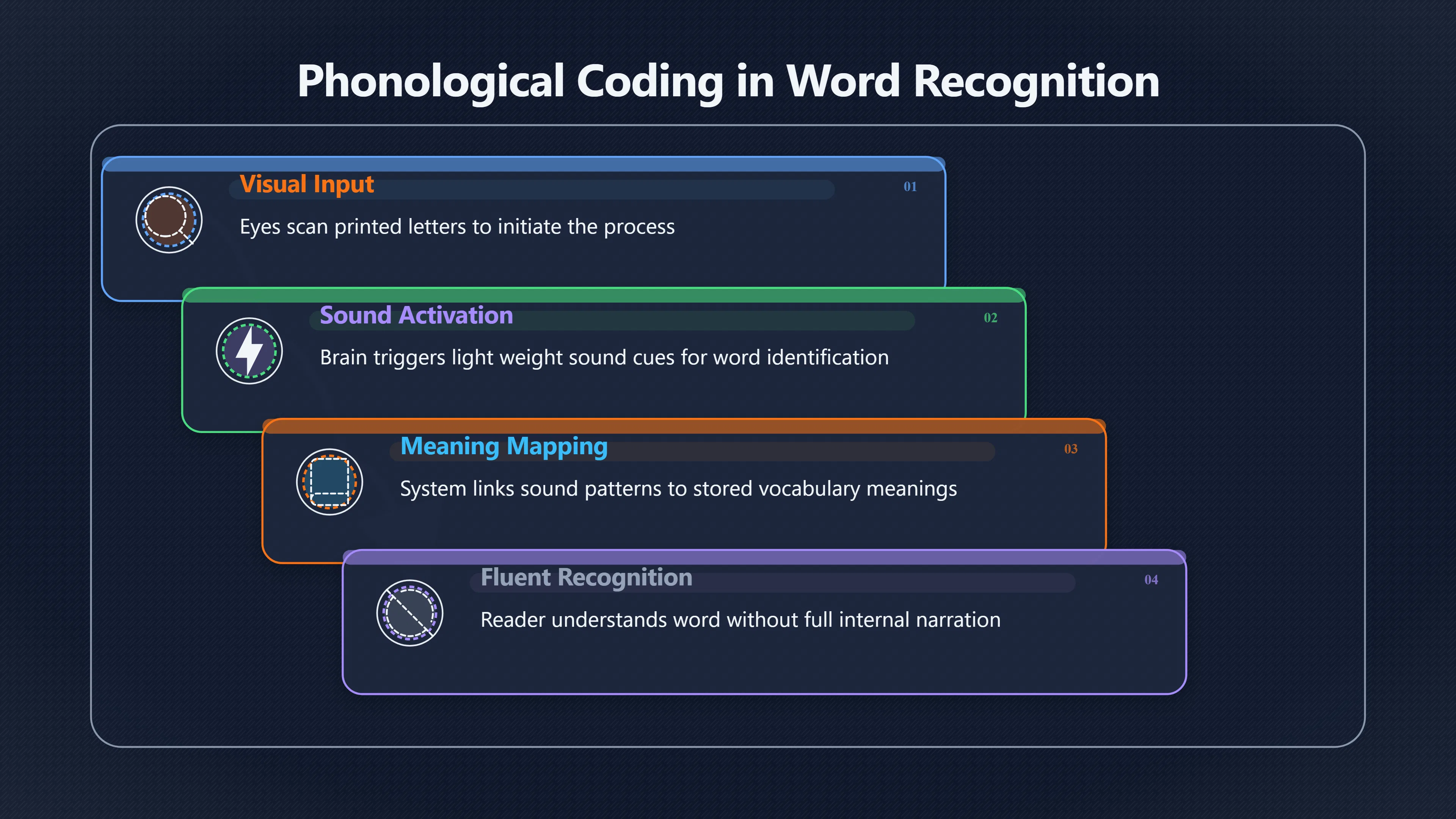
Silent readers can use lightweight sound cues to recognize words without mentally saying every word at speaking speed.
On this page
- What phonological coding adds before full pronunciation
- Why familiar words do not need a private audiobook
- How fast recognition differs from saying words internally
Page outline Jump by section
Introduction
Many discussions about increasing reading speed assume there are only two options: either you mentally “say” every word, or you eliminate sound entirely. Research on silent reading suggests a more nuanced picture. Skilled readers often use brief sound-based information—known as phonological coding—to help identify words rapidly without generating a full inner narration for each one. In other words, the brain can make use of sound cues without running a private audiobook at speaking speed. This distinction helps explain how experienced readers can recognise words efficiently while reading substantially faster than they could speak aloud.[PMC]pmc.ncbi.nlm.nih.govPMCPhonological coding during readingAutomatic (prelexical) phonetic activation in silent word…Read more…

Can Sound Cues Speed Word Recognition?
The key role of phonological coding is not to rehearse every word internally. Instead, it helps the reading system connect printed letters with stored word knowledge quickly and automatically. Researchers have found that sound-related information often becomes active very early in word recognition, sometimes before a reader would have time to construct a detailed internal pronunciation.[PMC+2ResearchGate]pmc.ncbi.nlm.nih.govPMCPhonological coding during readingAutomatic (prelexical) phonetic activation in silent word…Read more…
For reading speed, this matters because recognition is the bottleneck that must be solved first. A reader cannot understand a word until the brain identifies it. Lightweight sound coding can accelerate that identification process by providing an additional cue alongside spelling and meaning. Rather than slowing reading down, this rapid activation can support fluent recognition.[blackwellpublishing.com+2ResearchGate]blackwellpublishing.comIf word recognition processes do not operatePART I Word Recognition Processes in ReadingFebruary 21, 2005 — 21 Feb 2005 — Word recognition is the foundation of reading; all other pr…
A useful analogy is facial recognition. You do not consciously analyse every feature of a familiar face before recognising it. Multiple cues become available almost simultaneously. Likewise, familiar words can trigger visual, semantic, and phonological information together, allowing recognition to occur rapidly without a deliberate act of internal speech.
What Phonological Coding Adds Before Full Pronunciation
One of the most important findings in reading research is that phonological information can become available at an early stage of processing. Studies using masked priming, lexical decision tasks, and eye-tracking have repeatedly shown that readers are sensitive to sound relationships even when they are not intentionally pronouncing words.[ResearchGate+2PMC]researchgate.netResearchGate(PDF) Word Recognition II: Phonological Coding in ReadingMay 16, 2022 — This chapter considers key questions and issues conce…
This early activation provides several advantages:
- Disambiguation of similar spellings. Sound patterns help distinguish among visually similar words.
- Faster access to stored vocabulary. The brain can match a printed word against both its visual form and its associated sound structure.
- Support for prediction. During sentence reading, partial phonological information can contribute to anticipating upcoming words.
- Error checking. Sound-based activation offers an additional route for detecting mismatches or unusual word combinations.[ResearchGate+2ResearchGate]researchgate.net264988471 Phonological Coding During ReadingResearchGate(PDF) Phonological Coding During Reading25 Aug 2014 — The varying theories surrounding the function of phonological coding (e…
Importantly, these benefits do not require constructing a detailed spoken version of the word. The phonological code can function as a compressed representation rather than a complete pronunciation. Researchers reviewing the literature have argued that skilled readers routinely apply orthography-to-phonology knowledge very early during word recognition, even when reading silently and fluently.[ResearchGate]researchgate.net300781402 The Roles of Phonology in Silent Reading A Selective ReviewThe Roles of Phonology in Silent Reading: A Selective…Jun 7, 2016 — This chapter presents a selective review of evidence a…

Why Familiar Words Do Not Need a Private Audiobook
A common misconception is that every recognised word must first be mentally spoken. Evidence from skilled reading suggests otherwise.
High-frequency words become highly familiar through repeated exposure. Their visual forms are strongly linked to meaning and associated sound patterns. As a result, recognition can occur extremely quickly. Educational and cognitive models of word recognition describe familiar words as being identified with minimal decoding effort compared with unfamiliar words.[ASHA Publications]pubs.asha.orgASHA PublicationsThe Path to Proficient Word RecognitionFamiliar high frequency words are recognized visually with minimal phonetic decod…
This does not mean phonology disappears. Instead, the sound information associated with the word may be activated automatically and efficiently, without being expanded into a vivid inner voice. The difference is similar to recognising a friend’s name instantly when you see it written. You know how it sounds, but you do not necessarily replay the full spoken form in your mind before understanding it.
Research also shows that silent reading speed is not tightly linked to articulation speed. If readers had to internally pronounce every word in full, silent reading rates should closely track speaking rates. They do not. Silent reading is typically faster, suggesting that the underlying sound-related processing is more compressed than actual speech production.[PMC]pmc.ncbi.nlm.nih.govPMCNo Correlation Between Articulation Speed and Silentby M Brysbaert · 2023 · Cited by 12 — Another reason to think that articulation is not involved in phonological recoding, is that sile…
How Fast Recognition Differs From Saying Words Internally
The distinction between recognition and narration becomes clearer when comparing their likely time demands.
When readers engage in full inner speech, they often experience a sense of hearing or saying the words. This can involve stress patterns, rhythm, accent, and other speech-like qualities. Studies of silent reading have shown that readers sometimes activate accent-specific or voice-like features, indicating that richer forms of inner speech can occur under certain conditions.[PMC]pmc.ncbi.nlm.nih.govInner Speech during Silent Reading Reflects the Reader's…by R Filik · 2011 · Cited by 113 — The rationale underlying the current st…
However, richer inner speech is not the same thing as the minimal phonological activation needed for word recognition.
Fast recognition typically involves:
- Rapid activation of a word’s sound structure.
- Immediate interaction between spelling, sound, and meaning.
- Little or no conscious awareness of pronunciation details.
- Processing that can occur faster than spoken language unfolds.[PMC+2ResearchGate]pmc.ncbi.nlm.nih.govPMCPhonological coding during readingAutomatic (prelexical) phonetic activation in silent word…Read more…
Full inner narration, by contrast, more closely resembles covert speaking. It preserves timing and prosodic characteristics that make it inherently slower than simply recognising words. The reading system appears capable of moving between these modes depending on task demands. Difficult passages, unfamiliar vocabulary, poetry, and dialogue may encourage richer inner speech, while familiar prose often permits much lighter phonological processing.[ResearchGate+2PMC]researchgate.netSilent reading activates inner speechFeb 9, 2026 — The data suggest that acoustic representations activated in silent reading…

What This Means for Increasing Reading Speed
The practical implication is that faster reading does not require eliminating all sound-related processing. Attempts to suppress every trace of phonology may remove mechanisms that normally support efficient word recognition and comprehension. Studies that interfere with speech-related processing during reading often find measurable costs to comprehension, suggesting that some form of phonological support remains useful even for skilled readers.[Springer]link.springer.comAssessing the importance of subvocalization during normal…by M Daneman · 1992 · Cited by 72 — Interfering with speech recoding…
A more realistic goal is reducing unnecessary word-by-word narration while allowing automatic sound cues to do their job. Skilled readers typically do not choose between pure visual reading and constant internal speech. Instead, they rely on fast, lightweight phonological activation that helps recognise words quickly, reserving richer inner narration for moments when the text demands extra attention.[PMC+2ResearchGate]pmc.ncbi.nlm.nih.govPMCPhonological coding during readingAutomatic (prelexical) phonetic activation in silent word…Read more…
Amazon book picks
Further Reading
Books and field guides related to Can Sound Cues Speed Word Recognition?. Use these as the next step if you want deeper reading beyond the article.
Reading in the Brain
Directly addresses rapid word recognition and phonological coding.


Language at the Speed of Sight
Explains how readers recognise words without fully pronouncing them.
eBay marketplace picks
Marketplace Samples
Example marketplace items related to this page. Use the search link to explore similar finds on eBay.


Endnotes
1.
Source: pmc.ncbi.nlm.nih.gov
Title: PMCPhonological coding during reading
Link:https://pmc.ncbi.nlm.nih.gov/articles/PMC4211933/
Source snippet
Automatic (prelexical) phonetic activation in silent word...Read more...
2.
Source: pmc.ncbi.nlm.nih.gov
Title: PMCNo Correlation Between Articulation Speed and Silent
Link:https://pmc.ncbi.nlm.nih.gov/articles/PMC10360968/
Source snippet
by M Brysbaert · 2023 · Cited by 12 — Another reason to think that articulation is not involved in phonological recoding, is that sile...
3.
Source: researchgate.net
Title: 264988471 Phonological Coding During Reading
Link:https://www.researchgate.net/publication/264988471_Phonological_Coding_During_Reading
Source snippet
ResearchGate(PDF) Phonological Coding During Reading25 Aug 2014 — The varying theories surrounding the function of phonological coding (e...
4.
Source: researchgate.net
Title: 300781402 The Roles of Phonology in Silent Reading A Selective Review
Link:https://www.researchgate.net/publication/300781402_The_Roles_of_Phonology_in_Silent_Reading_A_Selective_Review
Source snippet
The Roles of Phonology in Silent Reading: A Selective...Jun 7, 2016 — This chapter presents a selective review of evidence a...
5.
Source: blackwellpublishing.com
Title: If word recognition processes do not operate
Link:https://www.blackwellpublishing.com/content/bpl_images/content_store/sample_chapter/1405114886/Snowling_sample_chapter1.pdf
Source snippet
PART I Word Recognition Processes in ReadingFebruary 21, 2005 — 21 Feb 2005 — Word recognition is the foundation of reading; all other pr...
Published: February 21, 2005
6.
Source: researchgate.net
Link:https://www.researchgate.net/publication/360598815_Word_Recognition_II_Phonological_Coding_in_Reading
Source snippet
ResearchGate(PDF) Word Recognition II: Phonological Coding in ReadingMay 16, 2022 — This chapter considers key questions and issues conce...
Published: May 16, 2022
7.
Source: researchgate.net
Link:https://www.researchgate.net/publication/7210486_Vowel_processing_during_silent_reading_Evidence_from_eye_movements
Source snippet
Vowel Processing During Silent Reading: Evidence From...PDF | Two [eye movement]({{ 'eye-tradeoff/' | relative_url }}) experiments examined whether skilled readers include vowe...
8.
Source: pubs.asha.org
Link:https://pubs.asha.org/doi/10.1044/lle6.1.4
Source snippet
ASHA PublicationsThe Path to Proficient Word RecognitionFamiliar high frequency words are recognized visually with minimal phonetic decod...
9.
Source: pmc.ncbi.nlm.nih.gov
Link:https://pmc.ncbi.nlm.nih.gov/articles/PMC3198452/
Source snippet
Inner Speech during Silent Reading Reflects the Reader's...by R Filik · 2011 · Cited by 113 — The rationale underlying the current st...
10.
Source: pmc.ncbi.nlm.nih.gov
Title: PMCInner Speech: Development, Cognitive Functions
Link:https://pmc.ncbi.nlm.nih.gov/articles/PMC4538954/
Source snippet
by B Alderson-Day · 2015 · Cited by 1151 — In a silent reading study, Filik and Barber (2011) compared eye movements in participants w...
11.
Source: researchgate.net
Link:https://www.researchgate.net/publication/226018892_What_the_reader%27s_eye_tells_the_mind%27s_ear_Silent_reading_activates_inner_speech
Source snippet
Silent reading activates inner speechFeb 9, 2026 — The data suggest that acoustic representations activated in silent reading...
12.
Source: pmc.ncbi.nlm.nih.gov
Title: PMCMental Simulations of Phonological Representations
Link:https://pmc.ncbi.nlm.nih.gov/articles/PMC7792465/
Source snippet
by B Yao · 2021 · Cited by 18 — Recent research shows in silent reading that more vivid speech representations are mentally simulated...
13.
Source: link.springer.com
Link:https://link.springer.com/article/10.1007/BF01027072
Source snippet
Assessing the importance of subvocalization during normal...by M Daneman · 1992 · Cited by 72 — Interfering with speech recoding...
14.
Source: researchgate.net
Link:https://www.researchgate.net/publication/229791497_Phonological_Recoding_in_the_First_and_Second_Language_Reading_of_Skilled_Bilinguals
Source snippet
ish and French bilinguals.Read more...
15.
Source: researchgate.net
Link:https://www.researchgate.net/publication/51753992_Inner_Speech_during_Silent_Reading_Reflects_the_Reader%27s_Regional_Accent
Source snippet
Inner Speech during Silent Reading Reflects the Reader's...Oct 19, 2011 — The exact role that phonological coding (the recoding of writt...
16.
Source: researchgate.net
Link:https://www.researchgate.net/publication/355219233_Phonological_coding_in_visual_language_processing
Source snippet
(PDF) Phonological coding in visual language processingOct 15, 2021 — In this chapter, I review the evidence for a role of phonology in s...
17.
Source: pmc.ncbi.nlm.nih.gov
Link:https://pmc.ncbi.nlm.nih.gov/articles/PMC3739043/
Source snippet
Achievement in Relation to Phonological Coding and...by RI Mayberry · 2010 · Cited by 555 — The relation between reading ability and pho...
18.
Source: frontiersin.org
Link:https://www.frontiersin.org/journals/psychology/articles/10.3389/fpsyg.2016.01265/full
Source snippet
Silent Reading Fluency and Comprehension in Bilingual...by BA O'Brien · 2016 · Cited by 25 — This paper focuses on reading fluency by bi...
Additional References
19.
Source: ies.ed.gov
Link:https://ies.ed.gov/use-work/awards/development-oral-and-silent-reading-fluency-and-their-relation-reading-comprehension-first-through
Source snippet
of Oral and Silent Reading Fluency and Their...The goals of this study were to: (1) explore development of oral and silent reading fluen...
20.
Source: scispace.com
Link:https://scispace.com/papers/assessing-the-importance-of-subvocalization-during-normal-cvorbuv7lc
Source snippet
Assessing the importance of subvocalization during normal...TL;DR: In this article, a concurrent speaking paradigm was used to assess th...
21.
Source: facebook.com
Link:https://www.facebook.com/groups/consciousness.studies/posts/2816846665114549/
Source snippet
Skilled readers use word spelling in silent readingExperienced readers can discern meaning by sounding words out - which takes up quite a...
22.
Source: pure.uva.nl
Link:https://pure.uva.nl/ws/files/2041068/141278_06.pdf
Source snippet
uva.nlUvA-DARE (Digital Academic Repository)Results indicated that silent reading speed was higher than [oral reading]({{ 'reading-aloud/' | relative_url }}) speed. All skills co...
23.
Source: facebook.com
Link:https://www.facebook.com/groups/scienceofreading/posts/1892526944529092/
Source snippet
People with it have no inner voice. A brief search showed that 5 to 10% of people have it. I'm wondering if this would...
24.
Source: reddit.com
Link:https://www.reddit.com/r/Aphantasia/comments/yph28s/for_people_without_an_inner_monologue_can_you/
Source snippet
For people without an inner monologue, can you read in...If you can’t hear an inner voice, can you not read in your head?...
25.
Source: waseda.elsevierpure.com
Title: effects of reading aloud and subvocalization on text comprehensio
Link:https://waseda.elsevierpure.com/en/publications/effects-of-reading-aloud-and-subvocalization-on-text-comprehensio/
Source snippet
Effects of reading aloud and subvocalization on text...by A Morita · 2019 — These results suggest that readers who do minimal subvocaliz...
26.
Source: epistemocritique.org
Link:https://epistemocritique.org/what-the-neurocognitive-study-of-inner-language-reveals-about-our-inner-space/
Source snippet
tivates not only conceptual but also lexical as well as phonological representations.Read more...
27.
Source: ora.ox.ac.uk
Link:https://ora.ox.ac.uk/objects/uuid%3Adfe9f411-fa39-48db-9fc3-b61ed41deb1e/files/dsf2685900
Source snippet
ox.ac.ukL2 readers' experiences of silent reading, reading aloud and...by E Mok · 2023 · Cited by 1 — The findings of this study add to...
28.
Source: infinitemind.io
Title: What Is & How to Stop Subvocalization?
Link:https://infinitemind.io/what-is-subvocalization-definition-meaning-examples-and-how-to-stop-subvocalization-reading/
Source snippet
research with English-language learners, both subvocalization and oral reading led to better comprehension than silent r...
Topic Tree