Within Lost Focus
Where did your focus actually break?
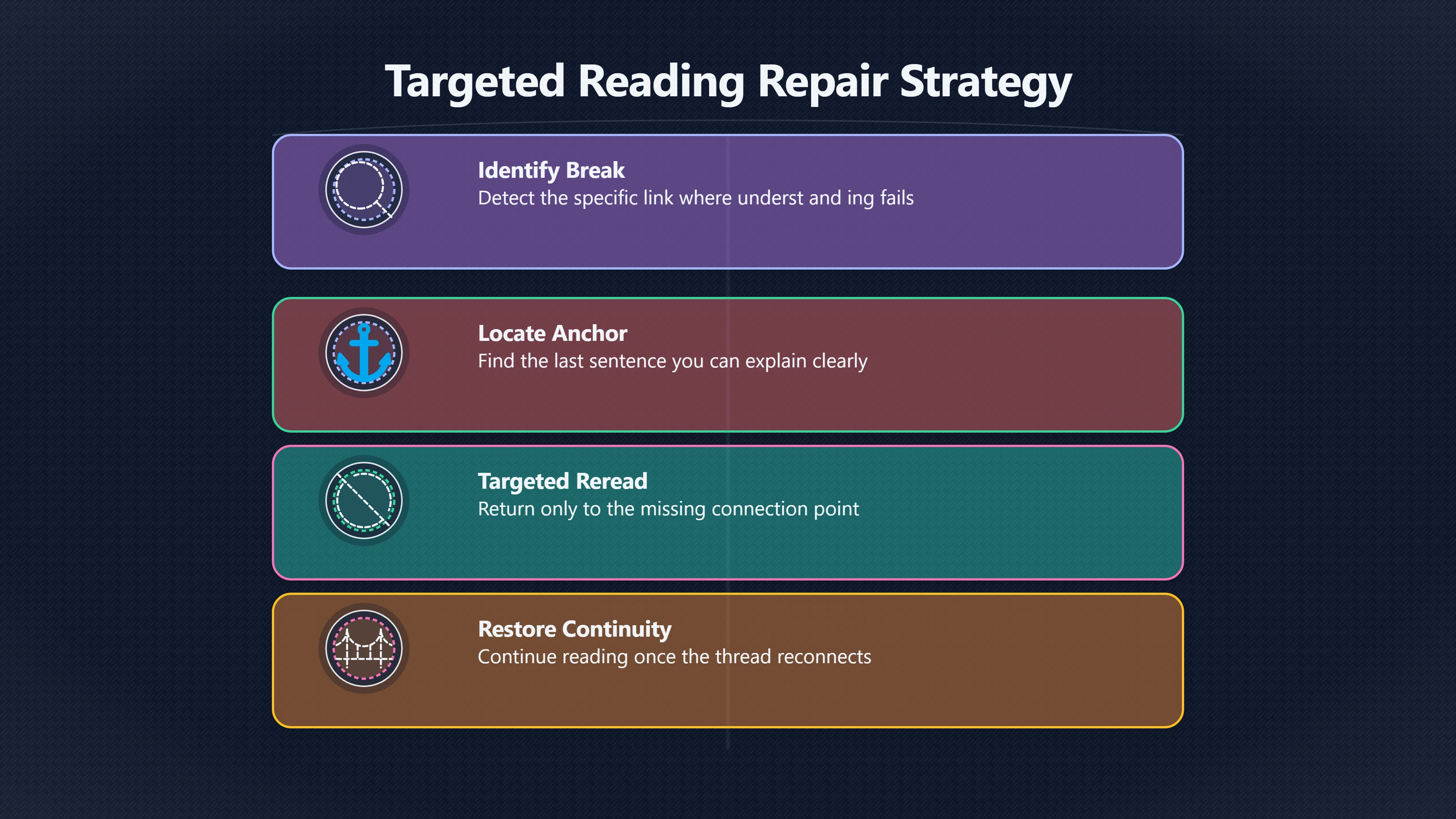
A missed paragraph is easier to repair when you can name the last idea that still feels clear instead of restarting from the top.
On this page
- Why memory usually fails from a point, not everywhere
- How to test the last idea that still holds
- Common mistakes that push readers too far back
Page outline Jump by section
Introduction
When you lose focus while reading, the fastest recovery is often not to restart the paragraph but to identify the last sentence you genuinely understood. Attention lapses are usually local. The ideas that came before them often remain intact. If you can locate the last clear point in the text, you can repair comprehension by rereading only the missing section rather than reprocessing material you already understand.
 This matters for increasing reading speed because unnecessary rereading is expensive. Skilled readers do not avoid looking back altogether; they tend to return to specific points where understanding broke down. Research on eye movements during reading shows that backward movements of the eyes, known as regressions, are commonly used to revisit relevant text and restore comprehension rather than to restart large sections indiscriminately.[PubMed]pubmed.ncbi.nlm.nih.govThe function of these "regressions" is still largely unknownThe function of regressions in reading: backward eye…by RW Booth · 2013 · Cited by 134 — Standard text reading involves frequent…
Where did your focus actually break?
A common mistake is treating comprehension as an all-or-nothing state. You reach the end of a paragraph, realise you cannot summarise it, and conclude that everything since the top of the page must be reread.
In practice, comprehension usually fails at a particular link in the chain.
Imagine reading:
- A cause is introduced.
- Evidence is presented.
- A conclusion follows.
You may clearly remember the cause and the evidence but have no idea how the conclusion was justified. In that case, your understanding did not collapse across the whole paragraph. It failed at the transition between the evidence and the conclusion.
The recovery question is therefore not, “Where should I restart?” It is, “What is the last idea I can still explain in my own words?”
That point becomes your repair anchor.
Research on comprehension monitoring shows that effective reading depends on noticing when understanding has broken down and then applying a targeted repair strategy. The key skill is detecting the boundary between what is still understood and what is not.[PMC+2Reading Universe]pmc.ncbi.nlm.nih.govThe Relations Between Children's Comprehension Monitoring…by E Zargar · 2019 · Cited by 90 — After detection of an error, regulatin…
Why memory usually fails from a point, not everywhere
Reading comprehension is built incrementally. Each sentence connects to a mental representation of what has already been read. When attention drifts, the disruption normally affects the information being processed at that moment rather than erasing the entire representation.
This creates a characteristic pattern:
- Earlier material feels stable.
- One section feels vague or missing.
- Later material becomes difficult because it depends on the missing section.
Readers often misinterpret this pattern. Because the ending of the paragraph no longer makes sense, they assume the whole paragraph has been lost. In reality, the later confusion may be caused by a single missing connection.
A useful analogy is a broken bridge. If one bridge between two ideas collapses, the rest of the road network still exists. Restoring that single connection may be enough to make the entire route usable again.
Eye-tracking studies support this view. Readers frequently make regressions to specific earlier locations when processing difficulties arise, suggesting that comprehension repair often targets particular portions of text rather than broad sections.[MDPI]mdpi.comWe distinguish two types of these movements (regressions). One type consists of relatively large…Read more…
How to test the last idea that still holds
Finding the last clear point is easier if you use a quick self-test instead of relying on a vague feeling of familiarity.
Pause and ask:
Can I explain the previous sentence without looking at it?
If the answer is yes, move forward one sentence and test again.
If the answer is no, move back one sentence and test there.
The goal is not perfect recall. The goal is identifying the last sentence whose meaning is still available to you.
Several signs indicate that a sentence remains understood:
- You can paraphrase its main idea.
- You know how it connects to the previous sentence.
- You could briefly explain it to another reader.
- It feels meaningful rather than merely familiar.
That final distinction matters. Familiarity can be misleading. A sentence may look recognisable because you have already seen it, yet you may not actually know what it means. Genuine understanding includes the ability to restate the idea in different words.
Once you locate the last clear sentence, begin rereading from there and stop as soon as continuity returns.
What this looks like in real reading
Suppose you are reading a science article:
Exercise affects insulin sensitivity. Researchers measured participants over twelve weeks. The intervention group showed a significant improvement. This finding supports the proposed metabolic mechanism.
You realise that the final sentence feels unclear.
Ask yourself what you still understand.
- Do you understand that exercise affects insulin sensitivity? Yes.
- Do you understand that researchers measured participants? Yes.
- Do you understand that the intervention group improved? Yes.
- Can you explain why that improvement supports the proposed mechanism? No.
The break point is not the start of the paragraph. It is the transition into the final interpretation.
Instead of rereading four sentences, reread the last one or two. Often that is enough to reconnect the argument.
The same principle applies to textbooks, reports, novels and online articles. The repair area is usually smaller than it first appears.
Common mistakes that push readers too far back
Restarting from the top because of uncertainty
Many readers restart not because they have lost comprehension, but because they dislike uncertainty.
The page feels safer when reread from the beginning. Yet most of that rereading is devoted to information that was already understood.
Research on regressions suggests that rereading is useful when it revisits the relevant text. The benefit comes from repairing understanding, not from repeatedly reviewing already-comprehended material.[PubMed]pubmed.ncbi.nlm.nih.govThe function of these "regressions" is still largely unknownThe function of regressions in reading: backward eye…by RW Booth · 2013 · Cited by 134 — Standard text reading involves frequent…
Confusing memory failure with comprehension failure
You do not need to remember every sentence verbatim.
Reading comprehension depends on understanding ideas and relationships, not on perfect recall of wording. A reader may forget the exact phrasing of a sentence while still retaining its meaning.
When checking for the last clear point, test understanding rather than memory for exact text.
Going back until the text feels familiar
Familiarity grows every time you reread. That feeling can trick readers into believing they have found the correct restart point.
A better rule is to stop moving backwards once you reach a sentence whose meaning you can confidently explain. Going further back rarely improves comprehension and often slows reading unnecessarily.
The speed advantage of a precise restart point
Readers trying to increase reading speed often focus on moving forward faster. An overlooked alternative is reducing the amount of unnecessary backward movement.
Every time attention drifts, there is a choice:
- Restart a page.
- Restart a paragraph.
- Restart from the last sentence that still makes sense.
The third option is usually the most efficient because it treats comprehension loss as a local problem. By identifying the last clear point, you preserve the understanding that is already intact and limit rereading to the smallest section capable of restoring the thread.
The result is not merely less rereading. It is a more accurate form of rereading—one that repairs understanding where it actually broke instead of where it merely feels uncomfortable.
Amazon book picks
Further Reading
Books and field guides related to Where did your focus actually break?. Use these as the next step if you want deeper reading beyond the article.
How to Read a Book
Rating: 4.0/5 from 41 Google Books ratings
Encourages targeted review rather than wholesale rereading.
eBay marketplace picks
Marketplace Samples
Example marketplace items related to this page. Use the search link to explore similar finds on eBay.


Endnotes
1.
Source: mdpi.com
Link:https://www.mdpi.com/2411-5150/3/3/35
Source snippet
We distinguish two types of these movements (regressions). One type consists of relatively large...Read more...
2.
Source: pmc.ncbi.nlm.nih.gov
Link:https://pmc.ncbi.nlm.nih.gov/articles/PMC7079677/
Source snippet
The Relations Between Children's Comprehension Monitoring...by E Zargar · 2019 · Cited by 90 — After detection of an error, regulatin...
3.
Source: mdpi.com
Title: 2226 471X
Link:https://www.mdpi.com/2226-471X/9/12/360
Source snippet
Tracking Adults' Eye Movements to Study Text...by G Andreou · 2024 · Cited by 7 — The aim of this review is to examine and analyze the c...
4.
Source: pubmed.ncbi.nlm.nih.gov
Title: The function of these “regressions” is still largely unknown
Link:https://pubmed.ncbi.nlm.nih.gov/22886737/
Source snippet
The function of regressions in reading: backward eye...by RW Booth · 2013 · Cited by 134 — Standard text reading involves frequent...
5.
Source: readinguniverse.org
Link:https://readinguniverse.org/skill-explainer/critical-thinking-strategies-2/comprehension-monitoring-skill-explainer/overview-of-comprehension-monitoring
Source snippet
Comprehension Monitoring Skill ExplainerThe report highlighted specific strategies to support comprehension and recommended that they be...
6.
Source: pmc.ncbi.nlm.nih.gov
Link:https://pmc.ncbi.nlm.nih.gov/articles/PMC6802794/
Source snippet
Other small...Read more...
7.
Source: pmc.ncbi.nlm.nih.gov
Link:https://pmc.ncbi.nlm.nih.gov/articles/PMC12409514/
Source snippet
the rereading effect of digital reading through eye...by Y Xu · 2025 — The goal of this study is to investigate the differences in eye m...
Additional References
8.
Source: facebook.com
Link:https://www.facebook.com/groups/138084514895743/posts/1354167439954105/
Source snippet
"Mark R Shinn PhD article on comprehensionWhen Jan Hasbrouck recommends a read it is well worth a look. 😊 [https://open.substack.com/pub/ma..."](https://open.substack.com/pub/ma...")...
9.
Source: readnaturally.com
Link:https://www.readnaturally.com/research/5-components-of-reading/comprehension
Source snippet
Reading Comprehension: Strategies, Skills & InstructionEvidence-based methods for teaching reading comprehension, including key strategie...
10.
Source: utupub.fi
Link:https://www.utupub.fi/bitstream/handle/10024/190693/Reading%20Research%20Quarterly%20-%202023%20-%20M%20zi%20re%20-%20Using%20Eye%20Tracking%20Measures%20to%20Predict%20Reading%20Comprehension.pdf?sequence=1
Source snippet
This study examined the potential of eye- tracking as a tool for assessing reading comprehension. We administered three widely used readi...
11.
Source: papers.ssrn.com
Link:https://papers.ssrn.com/sol3/papers.cfm?abstract_id=5405257
Source snippet
Eye Movements in Reading Go from Easy to...by AT Lopes Rego — One prevailing hypothesis is that regressions reflect comprehension proces...
12.
Source: readingrockets.org
Link:https://www.readingrockets.org/topics/comprehension/articles/seven-strategies-teach-students-text-comprehension
13.
Source: authenticeducation.org
Title: on reading part 4 research on the comprehension strategies a closer look
Link:https://authenticeducation.org/on-reading-part-4-research-on-the-comprehension-strategies-a-closer-look/
Source snippet
On reading, Part 4: research on the comprehension strategies26 Mar 2015 — Only a few strategies are key to reading for understanding, and...
14.
Source: shanahanonliteracy.com
Title: what teachers need to know about sentence comprehension revisited
Link:https://www.shanahanonliteracy.com/blog/what-teachers-need-to-know-about-sentence-comprehension-revisited
Source snippet
What Teacher Need to Know about Sentence...13 Dec 2025 — This blog entry provides an overview of the research that reveals the importanc...
15.
Source: totalvisionranchobernardo.com
Title: how eye tracking problems can lead to difficulty reading
Link:https://totalvisionranchobernardo.com/how-eye-tracking-problems-can-lead-to-difficulty-reading/
Source snippet
Feb 23, 2024 — When you have a problem with your eye tracking, you'll often lose your place, need to re-read sections often, or feel fati...
16.
Source: users.cecs.anu.edu.au
Link:https://users.cecs.anu.edu.au/~Tom.Gedeon/pdfs/Measuring%20reading%20comprehension%20using%20eye%20movements.pdf
Source snippet
This builds on previous work on factors affecting reading...Read more...
17.
Source: educationendowmentfoundation.org.uk
Link:https://educationendowmentfoundation.org.uk/education-evidence/teaching-learning-toolkit/reading-comprehension-strategies
Source snippet
The strategies focus mainly on language comprehension...Read more...
Topic Tree