Within Phrase voice
Can slash marks teach faster phrase reading?
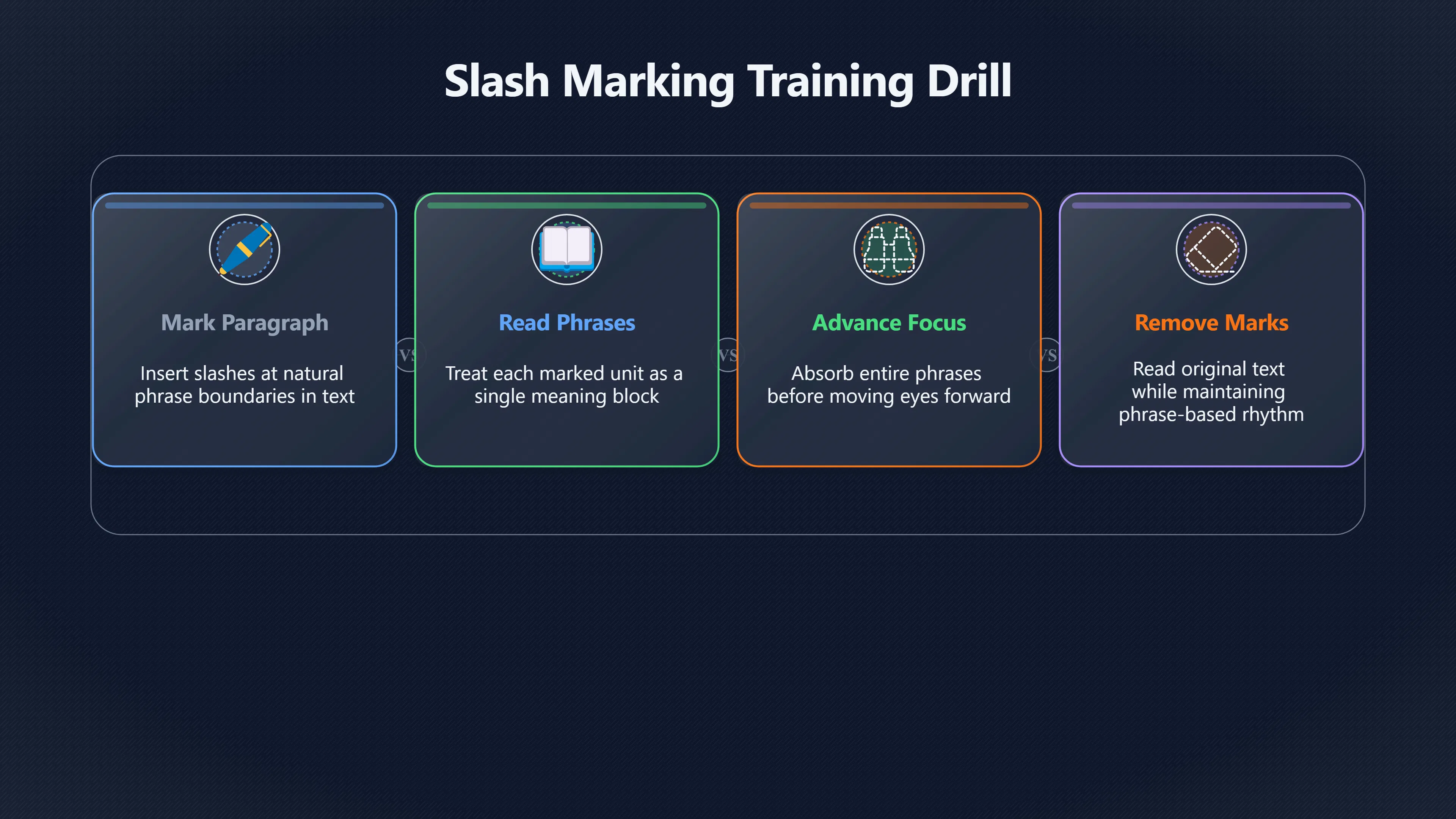
Marking phrase boundaries helps readers practise seeing several words as one meaning unit before removing the marks.
On this page
- How phrase boundaries reduce word by word narration
- A short slash marking drill for everyday paragraphs
- When to remove the marks and read naturally
Page outline Jump by section
Introduction
Slash phrase marking is a simple training method that teaches readers to see groups of words as single meaning units rather than processing every word separately. The technique involves inserting slash marks into ordinary text to show natural phrase boundaries, then reading each phrase as one unit. For readers trying to move beyond slow, word-by-word inner narration, slash marking provides a visible bridge between individual words and fluent phrase-level comprehension.
 The value of the method is not that the slashes remain forever. The marks act as temporary training wheels. They help readers recognise how language naturally clusters into meaningful groups, allowing the eyes and inner voice to track phrases rather than isolated words. Research on chunking, reading fluency, and multi-word processing suggests that skilled reading relies heavily on grouping words into larger units, reducing cognitive load and supporting faster comprehension.[readlite.in+2PMC]readlite.inChunking in Reading: Processing Text in Meaningful UnitsChunking in reading refers to the cognitive process of grouping individual words…
Can slash marks teach faster phrase reading?
Yes, but only as a training aid.
Many readers understand the idea of reading in phrases yet struggle to apply it on a page of normal text. Slash marks solve this practical problem by making phrase boundaries visible. Instead of guessing where to group words, the reader follows a pre-marked structure.
For example:
Word-by-word style:
The / new / research / on / reading / speed / suggests / useful / strategies.
Phrase-marked style:[nexus.aimpa.org]nexus.aimpa.orgAIM Nexus Phrased Text ReadingAIM NexusPhrased Text Reading - AIM NexusPhrased text reading uses reading passages marked to indicate phrase (or unit) boundaries in tex…
The new research / on reading speed / suggests useful strategies.
The second version contains fewer mental units. The reader still sees every word, but attention shifts from individual items to meaningful groups. This aligns with evidence that proficient reading involves processing multi-word units and integrating information across phrases rather than assembling meaning one word at a time.[readlite.in+2PMC]readlite.inChunking in Reading: Processing Text in Meaningful UnitsChunking in reading refers to the cognitive process of grouping individual words…
Educational fluency programmes have long used phrase-cued text, often marked with slashes or phrase scoops, to help readers recognise natural language units. These interventions are designed to improve fluency and comprehension by drawing attention to meaningful boundaries rather than arbitrary pauses.[AIM Nexus]nexus.aimpa.orgAIM Nexus Phrased Text ReadingAIM NexusPhrased Text Reading - AIM NexusPhrased text reading uses reading passages marked to indicate phrase (or unit) boundaries in tex…
How phrase boundaries reduce word-by-word narration
The main purpose of slash marking is to retrain attention.
When readers subvocalise heavily, the inner voice often attempts to pronounce every word as a separate event. Phrase marking encourages a different pattern. Instead of mentally saying:
in / front / of / the / building
the reader learns to process:
in front of the building
as one meaningful expression.
This matters because working memory handles grouped information more efficiently than a long sequence of unrelated elements. Chunking research consistently shows that combining smaller units into larger meaningful structures reduces processing demands and allows information to be retained more effectively.[Wikipedia]WikipediaChunking (psychologyChunking (psychology
Phrase boundaries are especially useful around:
- Prepositional phrases: “at the end of the meeting”
- Common expressions: “as a result of”
- Subject groups: “the newly appointed committee”
- Verb groups: “has been working on”
- Short dependent clauses: “after the report was published”
Repeated exposure teaches the reader to recognise these structures automatically. Eventually the brain begins detecting them without visible markings.
Research on chunk-reading training has found that learners exposed to meaningful phrase segmentation can improve their ability to identify and process word groups. Studies of chunk-based reading instruction have reported gains in chunking skill and aspects of reading fluency compared with conventional text presentation.[ResearchGate+2ERIC]researchgate.netResearchGate(PDF) The Effects of Chunk Reading Strategy Training on…This quasi-experimental study investigates the impact of Chunk Rea…
A short slash-marking drill for everyday paragraphs
The most effective drill is simple enough to use with ordinary reading material.
Step 1: Mark a short paragraph
Choose a paragraph of roughly 100–150 words. Insert slashes only where a natural phrase boundary exists.
For example:
The company announced a new policy / after several months of consultation. The changes will affect employees across multiple departments / and will take effect next year.
Avoid placing a slash after every two or three words. The goal is meaningful grouping, not mechanical spacing.
Step 2: Read phrase by phrase
Read the paragraph once while consciously treating each phrase as a single unit of meaning.
Do not pause at every slash. The mark simply reminds you where one phrase ends and the next begins.
Step 3: Repeat without looking at individual words
On a second pass, focus attention slightly ahead of the current word group. Let the eyes absorb the entire phrase before moving forward.
This encourages broader visual intake and reduces the urge to mentally pronounce each word separately. Eye-movement research shows that skilled reading involves gathering information across multiple words during fixations rather than processing text as a series of isolated items.[PMC]pmc.ncbi.nlm.nih.govPMCIndividual Differences in Eye-Movements During Readingby MJ Traxler · 2012 · Cited by 79 — Theories of eye-movement control in reading should ultimately describe how differences in knowled…
Step 4: Remove the marks
After two or three readings, erase or ignore the slashes and read the original paragraph naturally. Try to maintain the same phrase-based rhythm.
The transition from marked to unmarked text is where the training effect develops.
Common mistakes when using slash phrases
The technique works best when readers avoid several predictable errors.
Marking by word count rather than meaning
A phrase should reflect grammar and meaning. Dividing text into arbitrary three-word groups weakens the training effect because the reader is no longer following the structure of the language.[Nature]nature.comSpecifically, chunks are considered base-level subtrees, allowing…Read more…
Pausing dramatically at every slash
The slash is a visual cue, not a stop sign. Excessive pausing can make reading slower rather than faster.
Using very large chunks too early
Some readers immediately attempt to process entire lines at once. In practice, moderate-sized phrases are more effective because they remain easy to understand while still reducing word-by-word processing.
Keeping the marks forever
The purpose is skill acquisition, not dependence. If a reader never progresses beyond marked text, the training has not transferred to ordinary reading.

When to remove the marks and read naturally
Slash marking should gradually disappear as phrase recognition becomes automatic.
Signs that it is time to remove the markings include:
- You can predict phrase boundaries accurately before seeing them.
- Common word groups feel like single units.
- Your inner voice follows ideas rather than individual words.
- Reading speed increases without a drop in comprehension.
At this stage, continuing to mark every paragraph often provides diminishing returns. The goal is natural reading in which phrase grouping occurs automatically.
Evidence from chunk-based reading research suggests that training can improve the ability to recognise and process meaningful word groups, but long-term fluency depends on internalising those patterns rather than relying on external cues.[ResearchGate+2ERIC]researchgate.netResearchGate(PDF) The Effects of Chunk Reading Strategy Training on…This quasi-experimental study investigates the impact of Chunk Rea…
Why slash marking remains a useful transition tool
Many readers are told to “read in chunks” but receive little guidance on how to develop the skill. Slash phrase marking supplies a concrete intermediate step. It converts an abstract instruction into a visible reading behaviour that can be practised on any article, report, or book passage.
The technique does not eliminate inner speech, nor does it require skipping words. Instead, it teaches the reader to attach that inner speech to phrases and ideas. For people moving from slow word-by-word narration toward faster phrase-level comprehension, that transition is often the most valuable benefit of the method.[AIM Nexus+2readlite.in]nexus.aimpa.orgAIM Nexus Phrased Text ReadingAIM NexusPhrased Text Reading - AIM NexusPhrased text reading uses reading passages marked to indicate phrase (or unit) boundaries in tex…
Amazon book picks
Further Reading
Books and field guides related to Can slash marks teach faster phrase reading?. Use these as the next step if you want deeper reading beyond the article.

10 days to faster reading
Includes exercises that train readers to process larger text units.
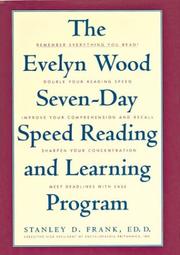
The Evelyn Wood Seven-Day Speed Reading and Learning Program
Uses training drills that resemble phrase-grouping practice.

eBay marketplace picks
Marketplace Samples
Example marketplace items related to this page. Use the search link to explore similar finds on eBay.



Endnotes
1.
Source: readlite.in
Link:https://readlite.in/concepts/chunking-reading
Source snippet
Chunking in Reading: Processing Text in Meaningful UnitsChunking in reading refers to the cognitive process of grouping individual words...
2.
Source: pmc.ncbi.nlm.nih.gov
Link:https://pmc.ncbi.nlm.nih.gov/articles/PMC10613263/
Source snippet
These transitions may indicate the formation of multi-word chunks that allow...Read more...
3.
Source: Wikipedia
Title: Chunking (psychology)
Link:https://en.wikipedia.org/wiki/Chunking_%28psychology%29
4.
Source: nature.com
Link:https://www.nature.com/articles/s41598-023-45536-y
Source snippet
Specifically, chunks are considered base-level subtrees, allowing...Read more...
5.
Source: researchgate.net
Link:https://www.researchgate.net/publication/384171888_The_Effects_of_Chunk_Reading_Strategy_Training_on_the_Word_Chunking_Skills_of_L1-Japanese_English_Learners
Source snippet
ResearchGate(PDF) The Effects of Chunk Reading Strategy Training on...This quasi-experimental study investigates the impact of Chunk Rea...
6.
Source: files.eric.ed.gov
Link:https://files.eric.ed.gov/fulltext/EJ1399504.pdf
Source snippet
Effects of Chunk Reading Training on the Syntactic...by T Kosaka · 2023 · Cited by 7 — The present study investigated the impact of chun...
7.
Source: pmc.ncbi.nlm.nih.gov
Title: PMCIndividual Differences in Eye-Movements During Reading
Link:https://pmc.ncbi.nlm.nih.gov/articles/PMC4467465/
Source snippet
by MJ Traxler · 2012 · Cited by 79 — Theories of eye-movement control in reading should ultimately describe how differences in knowled...
8.
Source: Wikipedia
Link:https://en.wikipedia.org/wiki/Reading
9.
Source: researchgate.net
Link:https://www.researchgate.net/publication/387334334Improving_L2_Reading_Efficiency_Through_Chunk-Based_Reading_An[Eye-Tracking
Source snippet
(PDF) Improving L2 Reading Efficiency Through Chunk-...30 Nov 2025 — This study explores the impact of chunk-based reading and gaze fixa...
10.
Source: researchgate.net
Link:https://www.researchgate.net/publication/289208481_The_influence_of_chunking_on_reading_comprehension_Investigating_the_acquisition_of_chunking_skill
Source snippet
(PDF) The influence of chunking on reading comprehension3 Apr 2018 — Research has shown that chunking the words while reading helps impro...
11.
Source: nexus.aimpa.org
Title: AIM Nexus Phrased Text Reading
Link:https://nexus.aimpa.org/lesson-toolkits/phrased-text-reading
Source snippet
AIM NexusPhrased Text Reading - AIM NexusPhrased text reading uses reading passages marked to indicate phrase (or unit) boundaries in tex...
Additional References
12.
Source: english4tutors.com
Title: reading comprehension strategies techniques to improve student understanding
Link:https://english4tutors.com/reading-comprehension-strategies-techniques-to-improve-student-understanding/
Source snippet
Reading Comprehension Strategies: Techniques to...Jun 24, 2025 — Strategy 3: Chunking and Paragraph Analysis · Divide longer texts into...
13.
Source: ijsmsjournal.org
Link:https://ijsmsjournal.org/2023/volume-6%20issue-1/ijsms-v6i1p107.pdf
Source snippet
h are semantically related groupings of words, confident readers' comprehension improves, especially...Read more...
14.
Source: siue.edu
Link:https://www.siue.edu/sipdc/pdf/reading10.pdf
Source snippet
ks” of language that represent meaning rather than separate words.Read more...
15.
Source: facebook.com
Link:https://www.facebook.com/groups/WorldLanguageTeachers/posts/2209074426240136/
Source snippet
articipate in oral activities, (2) get them warmed up for more demanding...
16.
Source: facebook.com
Link:https://www.facebook.com/OrtonGillinghamOnlineAcademy/videos/many-students-can-decode-the-words-on-the-page-but-still-struggle-to-read-smooth/2480030865770611/
Source snippet
dents begin to see how ideas fit together. Reading becomes less...
17.
Source: forum.artofmemory.com
Title: how to read group of words at a time
Link:https://forum.artofmemory.com/t/how-to-read-group-of-words-at-a-time/29389
Source snippet
Productivity15 Apr 2014 — Start by reading the small columns in the newspapers. Or, use spreeder.com to read texts and to get you brain a...
18.
Source: instagram.com
Title: Alright friends, welcome to Week 2!
Link:https://www.instagram.com/reel/DV6jvK0j8f6/
Source snippet
This week we're focusing...Chunking is a speedreading technique that trains your eyes to take in groups of words at a time instead of st...
19.
Source: lexercise.com
Title: how not to teach reading
Link:https://www.lexercise.com/blog/how-not-to-teach-reading
Source snippet
The Chunking Strategy12 Mar 2015 — Teaching 'chunking' as a reading strategy can result in a haphazard, guessing approach. Learn how stru...
20.
Source: scispace.com
Link:https://scispace.com/pdf/reading-strategies-in-efl-classroom-a-theoretical-review-1y4mj60m2l.pdf
Source snippet
Reading strategies in efl classroom: a theoretical reviewBy applying the bottom-up strategies, readers start to process the text from the...
21.
Source: koreascience.kr
Link:https://koreascience.kr/article/JAKO201003939212472.pdf
Source snippet
Effects of Chunking on Reading Comprehension of EFL...by H Chu · 2010 · Cited by 3 — This study investigates how EFL learners‟ chunking...
Topic Tree