Within WPM Ranges
Why Do Novels Feel Faster Than Reports?
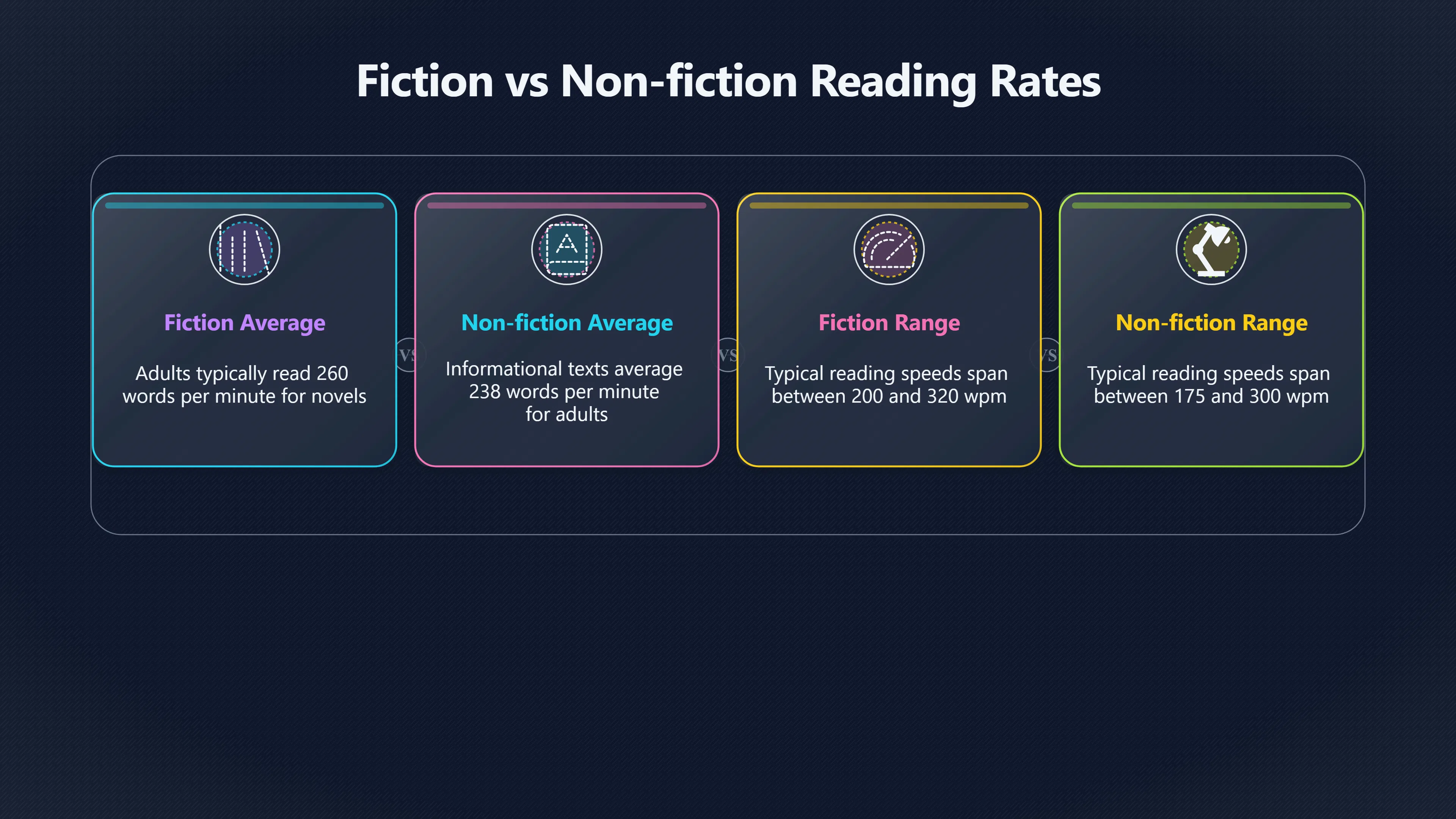
Average adult reading rates are higher for fiction because narrative text tends to be easier to process than information-dense prose.
On this page
- Word Length and Vocabulary
- Narrative Flow and Comprehension
- Typical WPM Differences in Practice
Page outline Jump by section
Introduction
Adults typically read fiction faster than non-fiction, even when their reading skill remains exactly the same. The difference is not merely a matter of preference. Research on reading speed shows that narrative texts such as novels are generally processed more quickly because they use shorter words, rely on familiar language patterns, and present information in a continuous story structure. By contrast, non-fiction often contains specialised vocabulary, denser concepts, and a higher concentration of new information that requires slower, more deliberate processing. A large review of 190 studies found average silent reading rates of about 260 words per minute (wpm) for fiction and 238 wpm for non-fiction, a consistent gap across adult readers.[Ghent University Bibliography]biblio.ugent.beGhent University Bibliography How many words do we read per minute?A review and meta…by M Brysbaert · 2019 · Cited by 873 — we estimate that the average silent reading rate for adults in English is 238…
 Understanding why this gap exists is useful for anyone trying to increase reading speed. It helps distinguish between genuine improvements in reading efficiency and normal variations caused by the type of material being read.
Word Length and Vocabulary
One of the clearest explanations for the fiction advantage is surprisingly simple: fiction tends to contain shorter words.
The major meta-analysis of adult reading rates found that much of the difference between fiction and non-fiction can be predicted by average word length. Non-fiction texts use longer words more frequently, and longer words generally require more visual and linguistic processing. As a result, readers spend slightly more time recognising and integrating each word into the surrounding context.[Ghent University Bibliography+2ResearchGate]biblio.ugent.beGhent University Bibliography How many words do we read per minute?A review and meta…by M Brysbaert · 2019 · Cited by 873 — we estimate that the average silent reading rate for adults in English is 238…
This effect becomes obvious when comparing typical examples:
- A novel may use everyday words associated with dialogue, actions, and emotions.
- A scientific article may contain technical terms, abstract concepts, and specialised vocabulary.
- A business report may repeatedly introduce unfamiliar terminology, acronyms, or numerical information.
Even when readers understand all the words, longer and less common vocabulary tends to slow eye movements and increase the cognitive effort needed to process sentences. Research on reading and language processing consistently finds that word frequency and local language patterns influence reading times, with familiar words generally being processed more quickly than rare ones.[arXiv]arxiv.orgarXiv Local word statistics affect reading times independently of surprisalLocal word statistics affect reading times independently of surprisalMarch 7, 2021…
The result is not a dramatic slowdown on any single sentence. Instead, small delays accumulate across hundreds or thousands of words, producing a measurable difference in overall reading speed.
Why Stories Create Smoother Reading
Vocabulary is only part of the explanation. Narrative structure also changes how readers process text.
A novel usually presents events in a connected sequence. Characters have goals, actions lead to consequences, and each chapter builds on information already established. Once readers become immersed in the story, they can often predict the general direction of events and integrate new details into an existing mental model.
This process reduces the effort required to organise information. Readers are following a developing situation rather than constructing a new conceptual framework every few paragraphs.
Many forms of non-fiction work differently. Informational texts frequently introduce unfamiliar facts, definitions, arguments, statistics, or explanations. The reader must continually evaluate, categorise, and connect new information. Instead of asking “What happens next?”, the reader may be asking:
- What does this concept mean?
- How does this relate to the previous section?
- Is this evidence convincing?
- How should I remember this information?
These additional comprehension demands often encourage slower reading because understanding, rather than page-turning momentum, becomes the priority.
Research comparing narrative and expository texts has long recognised that narrative material is processed differently from informational prose. Scholars studying fiction and non-fiction frequently distinguish between the relatively continuous flow of narrative texts and the more conceptually demanding structure of expository writing.[Kent Academic Repository]kar.kent.ac.ukKent Academic RepositoryThe Effects of Reading Narrative Fiction on Social and Moral…August 15, 2022 — by LF Wimmer · Cited by 23 — So…
Why Comprehension Changes Reading Behaviour
Readers do not simply move their eyes at a fixed speed. They adjust their pace according to what they believe the text requires.
With fiction, many readers feel comfortable maintaining momentum because missing a minor descriptive detail rarely prevents understanding the overall story. Context from previous chapters often fills in gaps naturally.
Non-fiction creates a different incentive structure. A missed definition, formula, or key argument can affect understanding of everything that follows. Readers therefore pause more often, reread passages, and spend additional time integrating information.
This behaviour is not evidence of poor reading ability. In many situations it reflects effective reading. Slowing down for dense material can improve retention and comprehension, which is often the actual goal of reading non-fiction.
The distinction matters because people sometimes compare their speed while reading a novel with their speed while studying a textbook and assume they have become slower readers. In reality, they may simply be adapting appropriately to a more demanding task.
Typical WPM Differences in Practice
The average difference between fiction and non-fiction is meaningful but not enormous. The best-supported estimates suggest:
Reading materialTypical adult silent reading rateFiction~260 wpmNon-fiction~238 wpm
Most adults fall within broader ranges rather than exactly matching the averages:
- Fiction: roughly 200–320 wpm
- Non-fiction: roughly 175–300 wpm
These ranges overlap substantially, but the fiction advantage remains visible across large groups of readers.[Ghent University Bibliography]biblio.ugent.beGhent University Bibliography How many words do we read per minute?A review and meta…by M Brysbaert · 2019 · Cited by 873 — we estimate that the average silent reading rate for adults in English is 238…
In practical terms, a 90,000-word novel read at 260 wpm takes noticeably less time than an equally long informational text read at 238 wpm. Over the course of an entire book, a relatively small difference in pace accumulates into hours of reading time.

What This Means for Increasing Reading Speed
For readers interested in increasing reading speed, the fiction-versus-non-fiction distinction provides an important reality check.
A higher speed while reading novels does not necessarily indicate a superior reading technique. Likewise, a lower speed while reading reports, textbooks, or research papers does not automatically signal a problem. Different materials impose different cognitive demands.
The most useful benchmark is therefore not a single universal words-per-minute target, but a speed that matches the purpose of the reading. Fiction often allows faster movement because language is simpler and narrative structure supports continuous comprehension. Non-fiction frequently requires slower, more deliberate processing because the reader is learning, evaluating, or retaining information.
In other words, novels often feel faster not because readers suddenly become more skilled, but because stories are usually easier for the brain to process efficiently.[Ghent University Bibliography+2ResearchGate]biblio.ugent.beGhent University Bibliography How many words do we read per minute?A review and meta…by M Brysbaert · 2019 · Cited by 873 — we estimate that the average silent reading rate for adults in English is 238…
Amazon book picks
Further Reading
Books and field guides related to Why Do Novels Feel Faster Than Reports?. Use these as the next step if you want deeper reading beyond the article.
How to Read a Book
Rating: 4.0/5 from 41 Google Books ratings
Explains why reading approaches differ across genres.
Proust and the Squid
Provides cognitive background for fiction versus nonfiction reading.

eBay marketplace picks
Marketplace Samples
Example marketplace items related to this page. Use the search link to explore similar finds on eBay.




Endnotes
1.
Source: researchgate.net
Title: Research Gate(PDF) How many words do we read per minute?
Link:https://www.researchgate.net/publication/335174808_How_many_words_do_we_read_per_minute_A_review_and_meta-analysis_of_reading_rate
Source snippet
A review...15 Aug 2019 — We estimate that the average silent reading rate for adults in English is 238 words per minute (wpm) for non-fi...
2.
Source: arxiv.org
Title: arXiv Local word statistics affect reading times independently of surprisal
Link:https://arxiv.org/abs/2103.04469
Source snippet
Local word statistics affect reading times independently of surprisalMarch 7, 2021...
Published: March 7, 2021
3.
Source: researchgate.net
Link:https://www.researchgate.net/publication/357041274_The_Effect_of_Fiction_vs_Nonfiction_in_the_Digital_Era_Text_Comprehension_not_Influenced_by_Genre_Expectations
Source snippet
The Effect of Fiction vs Nonfiction in the Digital Era: Text...Nevertheless, overall, the genres of fiction and nonfiction do not appear...
4.
Source: researchgate.net
Title: (PDF) How many words do we read per minute?
Link:https://www.researchgate.net/publication/332380784_How_many_words_do_we_read_per_minute_A_review_and_meta-analysis_of_reading_rate
Source snippet
A review...by M Brysbaert · Cited by 873 — We estimate that the average silent reading rate for adults in English is 238 word per minute...
5.
Source: researchgate.net
Link:https://www.researchgate.net/figure/Distribution-of-reading-rates-for-fiction-books_fig4_335174808
Source snippet
Figure 5: Distribution of reading rates for fiction booksWe estimate that the average silent reading rate for adults in English is 238 wo...
6.
Source: biblio.ugent.be
Title: Ghent University Bibliography How many words do we read per minute?
Link:https://biblio.ugent.be/publication/8647789
Source snippet
A review and meta...by M Brysbaert · 2019 · Cited by 873 — we estimate that the average silent reading rate for adults in English is 238...
7.
Source: kar.kent.ac.uk
Link:https://kar.kent.ac.uk/id/document/3274299
Source snippet
Kent Academic RepositoryThe Effects of Reading Narrative Fiction on Social and Moral...August 15, 2022 — by LF Wimmer · Cited by 23 — So...
Published: August 15, 2022
8.
Source: speechymusings.com
Title: Fiction Vs
Link:https://speechymusings.com/whats-best-fiction-vs-non-fiction-for-reading-comprehension/
Source snippet
Non-Fiction - Reading Comprehension24 Oct 2022 — According to Topping (2014), kids prefer to read fiction and understand fictional texts...
Additional References
9.
Source: reddit.com
Link:https://www.reddit.com/r/books/comments/oet3ym/the_false_promise_of_speed_reading_why_you_should/
10.
Source: yorku.ca
Title: Why this difference exists is not known. Here we
Link:https://www.yorku.ca/mar/McCreath%20et%20al%20in%20press_DP_Corpus%20Analysis%20word%20frequency%20and%20genre%20differences%20in%20vocab.pdf
Source snippet
Can Differences in Word Frequency Explain Why Narrative...by GA McCreath · 2017 · Cited by 9 — Past studies have found that reading narr...
11.
Source: youtube.com
Title: How To Understand Anything You Read (2 Skills Nobody Taught You)
Link:https://www.youtube.com/watch?v=Iqi-PW9RXq4
Source snippet
The first video, What Speed Readers Won't Tell You, provides empirical evidence on cognitive processing speeds and comprehension dynamics...
12.
Source: blog.edshed.com
Title: reading non fiction bridging the knowledge gap
Link:https://blog.edshed.com/reading-non-fiction-bridging-the-knowledge-gap/
Source snippet
Non-Fiction – Bridging the Knowledge GapReading non-fiction texts linked directly to themes and topics within the fiction texts will allo...
13.
Source: medium.com
Link:https://medium.com/cogni-tiva/4-tips-to-read-faster-than-90-of-people-using-science-add3d880be56
Source snippet
differences are very significant, with ranges from 175...Read more...
14.
Source: medium.com
Link:https://medium.com/%40stevenmonahan777/how-fast-can-you-read-discover-the-average-reading-speed-of-adults-62d75a765674
Source snippet
38–260 wpm for silent reading, depending on the material.Read more...
15.
Source: reader.ku.edu
Title: How many words do we read per minute (1)
Link:https://reader.ku.edu/sites/reader/files/2024-01/How%20many%20words%20do%20we%20read%20per%20minute%20%281%29.pdf
Source snippet
many words do we read per minuteby M Brysbaert · Cited by 873 — we estimate that the average silent reading rate for adults in English is...
16.
Source: medium.com
Link:https://medium.com/%40axel.em.casas/read-faster-using-science-use-these-3-tips-bd94605f3faf
Source snippet
ction. Moreover, individual differences are very...Read more...
17.
Source: accruva.app
Title: What’s the Average Reading Speed?
Link:https://accruva.app/blog/[speed-reading
Source snippet
WPM Benchmarks6 May 2026 — The average adult silent reading speed for general non-fiction is approximately 238 words per minute. This fig...
Published: May 2026
18.
Source: swiftread.com
Title: average reading speed analysis
Link:https://swiftread.com/blog/average-reading-speed-analysis
Source snippet
Everything You Need to Know About Average Reading...15 Sept 2023 — The average adult reading speed is 238 WPM (words per minute) for non...
Topic Tree