Within Self checks
Did You Keep the Evidence or Just Keywords?
Remembering evidence separates real comprehension from simply recognizing nouns, topics, and familiar words after a quick read.
On this page
- Why keywords can feel like comprehension
- Questions that recover examples, data, and reasons
- Warning signs that evidence disappeared
Page outline Jump by section
Introduction
When people try to increase reading speed by reducing heavy inner speech, a common problem appears: they finish a paragraph feeling as though they understood it, yet cannot explain what evidence supported the author’s point. This is the difference between evidence recall and shallow keyword capture.
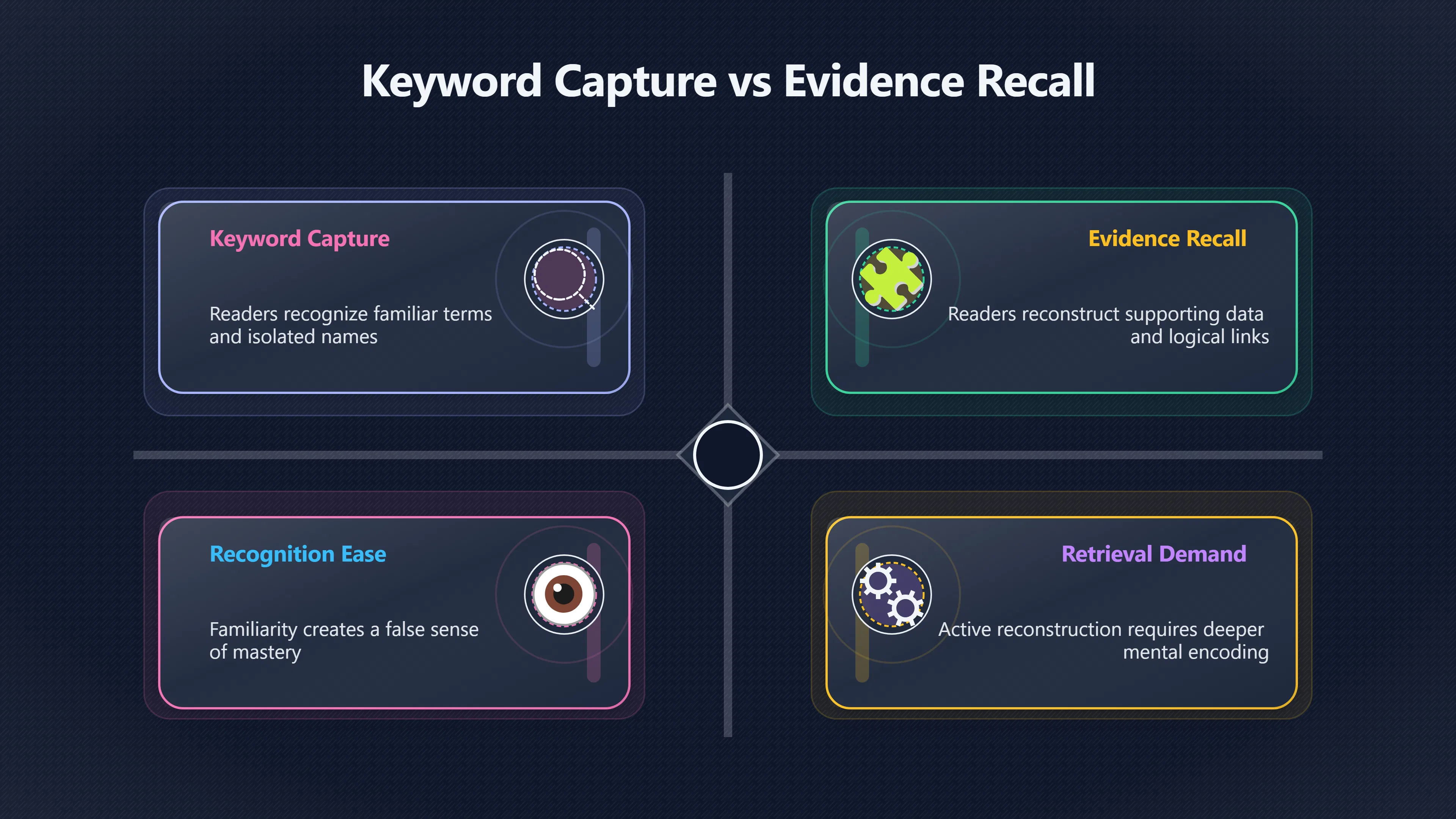
 Keyword capture occurs when the reader remembers topics, names, and familiar terms. Evidence recall occurs when the reader can retrieve the examples, data, comparisons, reasons, or causal explanations that justified the author’s claim. The distinction matters because genuine comprehension depends on relationships between ideas, not merely recognition of words. Research on comprehension monitoring repeatedly shows that readers can experience an illusion of understanding when text feels fluent, even when their grasp of the underlying argument is weak.[PMC]pmc.ncbi.nlm.nih.govMetacognitive Monitoring in Reading Comprehension - PMCby V Markovich · 2026 — This may result in an “illusion of knowing”, particular…
For readers using paragraph self-checks after lighter inner speech, evidence recall is one of the fastest ways to determine whether increased speed preserved understanding or merely produced a feeling of familiarity.
Why Keywords Can Feel Like Comprehension
The brain is remarkably good at recognising information it has just seen. After reading quickly, terms, names, and phrases remain familiar. Familiarity creates confidence, and confidence is often mistaken for understanding.
This is a known problem in metacognitive monitoring research. Readers frequently judge comprehension based on processing fluency—the ease with which information is read or recognised—rather than on whether they can reconstruct the meaning of the text. When fluency and actual understanding diverge, readers become vulnerable to an “illusion of knowing”.[PMC+2Frontiers]pmc.ncbi.nlm.nih.govMetacognitive Monitoring in Reading Comprehension - PMCby V Markovich · 2026 — This may result in an “illusion of knowing”, particular…
Consider two readers who finish the same paragraph about exercise and health:
- Reader A remembers “exercise”, “heart disease”, and “30 minutes”.
- Reader B remembers that the author argued regular exercise lowers cardiovascular risk and supported the claim with evidence comparing active and inactive populations.
Both readers recognise the topic. Only the second reader retained the reasoning.
The danger is that keyword capture often feels successful. Recognition is easy. Reconstructing evidence is harder. Because fast reading tends to increase reliance on familiarity, evidence recall becomes a more demanding and therefore more revealing test.
The Mechanism: Recognition Versus Retrieval
The core difference is not memory quantity but memory type.
Keyword capture relies heavily on recognition. If the reader sees the word again, it feels familiar. Evidence recall requires retrieval. The reader must generate supporting information without seeing the text.
Retrieval places a greater demand on the mental representation built during reading. To recall evidence, the reader must have encoded relationships such as:
- Claim → supporting example
- Cause → effect
- Question → answer
- Problem → solution
- Data → conclusion
If those links were never established, only isolated words remain.
Research on reading comprehension and recall consistently finds that deeper processing is associated with stronger recall of connected information, whereas surface-level processing can support recognition without supporting robust reconstruction of meaning. Studies examining recall, inference, and comprehension monitoring show that measures requiring readers to reproduce information reveal weaknesses that simple recognition-based tasks can miss.[IIER+2PMC]iier.org.auThe role of motivational and cognitive factorsby C Tarchi · 2017 · Cited by 35 — Students' reading comprehension of a history text wa…
This is why a reader may correctly identify a topic but fail when asked, “What evidence did the author use?”
Questions That Recover Examples, Data, and Reasons
A useful paragraph self-check does not ask whether the paragraph was understood. It asks questions that force retrieval of support.
Immediately after reading, try questions such as:
- What was the author’s main claim?
- What example supported it?
- Was there a statistic or observation?
- What reason was given?
- What comparison was made?
- What would the argument lose if that evidence were removed?
Notice that these questions target justification rather than subject matter.
For example, after reading a paragraph about remote work, a keyword-based memory might produce: “remote work, productivity, employees”. An evidence-based memory might produce: “the author cited survey data showing higher productivity ratings among employees who worked remotely at least part of the week.”
The second response demonstrates that the reader retained how the claim was supported, not merely what the paragraph was about.
Research on self-generated questioning and metacognitive monitoring suggests that asking explanatory questions improves the quality of comprehension assessment because it requires active reconstruction rather than passive recognition.[Ovid]ovid.coma0028661~selective benefits of question self generation and answeringSelective Benefits of Question Self-Generation…by JM Bugg · 2012 · Cited by 82 — The present study examined possible memory and met…
Warning Signs That Evidence Disappeared
Several patterns suggest that reading speed has outrun comprehension.
You Can Name the Topic but Not the Support
The most common symptom is being able to summarise the subject in one or two words while being unable to explain the evidence.
A reader says:
“The paragraph was about climate policy.”
But cannot answer:
“What evidence was used to support the policy recommendation?”
This usually indicates topic recognition rather than argument comprehension.
Everything Feels Familiar but Vague
Another warning sign is a strong feeling of recognition paired with weak recall.[openaccess.city.ac.uk]openaccess.city.ac.ukcity.ac.uk False recall and false recognitionrecall and false recognition - City Research Onlineby S Dewhurst · 2009 · Cited by 92 — For example, levels of false recall and false rec…
The paragraph seems known. Looking back at it creates a sense of “I remember this.” Yet when the text is hidden, details disappear. Research on fluency-based judgments shows that familiarity can inflate confidence even when actual retrieval ability is limited.[PMC+2PsychNet]pmc.ncbi.nlm.nih.govMetacognitive Monitoring in Reading Comprehension - PMCby V Markovich · 2026 — This may result in an “illusion of knowing”, particular…
Examples Vanish First
Comprehension-monitoring research has long observed that readers are generally better at tracking main ideas than supporting details. As reading speed rises, examples, qualifications, and evidence often disappear before the central topic does.[IDEALS]ideals.illinois.eduIDEALSComprehension monitoringby L Baker · 1979 · Cited by 508 — Confusions involving main points were detected more frequently than those involving details, and…
This creates a deceptive state in which the reader remembers the conclusion but forgets why the conclusion was presented.
The Argument Cannot Be Rebuilt
A final warning sign appears when the reader remembers several keywords yet cannot connect them.
For example:[pmc.ncbi.nlm.nih.gov]pmc.ncbi.nlm.nih.govMetacognitive Monitoring in Reading Comprehension - PMCby V Markovich · 2026 — This may result in an “illusion of knowing”, particular…
- “sleep”
- “memory”
- “students”
- “performance”
These words may all have appeared in the paragraph, but unless the reader can explain their relationship, comprehension remains incomplete.
Why Evidence Recall Is the Better Speed Check
For someone increasing reading speed, evidence recall serves as a quality-control mechanism.
Many comprehension tests can be passed through recognition. A reader may identify correct answers when options are visible. Evidence recall is harder because it requires rebuilding the paragraph from memory. That difficulty is precisely what makes it useful.
A reader who can state the claim and retrieve the supporting evidence has likely preserved the paragraph’s meaning despite reading faster. A reader who can only reproduce keywords has probably captured the surface of the text while losing much of its reasoning structure.
The practical lesson is simple: after a fast read, do not ask, “Did I understand that?” Ask, “What evidence convinced the author?” If the answer comes easily, comprehension probably survived. If only topics and familiar words remain, speed may have exceeded understanding.
Amazon book picks
Further Reading
Books and field guides related to Did You Keep the Evidence or Just Keywords?. Use these as the next step if you want deeper reading beyond the article.
How to Read a Book
Rating: 4.0/5 from 41 Google Books ratings
Emphasises extracting arguments and supporting evidence.
eBay marketplace picks
Marketplace Samples
Example marketplace items related to this page. Use the search link to explore similar finds on eBay.



Endnotes
1.
Source: pmc.ncbi.nlm.nih.gov
Link:https://pmc.ncbi.nlm.nih.gov/articles/PMC13027792/
Source snippet
Metacognitive Monitoring in Reading Comprehension - PMCby V Markovich · 2026 — This may result in an “illusion of knowing”, particular...
2.
Source: iier.org.au
Link:https://www.iier.org.au/iier27/tarchi.pdf
Source snippet
The role of motivational and cognitive factorsby C Tarchi · 2017 · Cited by 35 — Students' reading comprehension of a history text wa...
3.
Source: pmc.ncbi.nlm.nih.gov
Link:https://pmc.ncbi.nlm.nih.gov/articles/PMC6071415/
Source snippet
Online Comprehension Monitoring Make a Unique...by YSG Kim · 2018 · Cited by 51 — The goal was to investigate the nature of online compr...
4.
Source: ideals.illinois.edu
Title: IDEALSComprehension monitoring
Link:https://www.ideals.illinois.edu/items/17988/bitstreams/64436/data.pdf
Source snippet
by L Baker · 1979 · Cited by 508 — Confusions involving main points were detected more frequently than those involving details, and...
5.
Source: ovid.com
Title: a0028661~selective benefits of question self generation and answering
Link:https://www.ovid.com/journals/jedup/fulltext/10.1037/a0028661~selective-benefits-of-question-self-generation-and-answering
Source snippet
Selective Benefits of Question Self-Generation...by JM Bugg · 2012 · Cited by 82 — The present study examined possible memory and met...
6.
Source: frontiersin.org
Link:https://www.frontiersin.org/journals/psychology/articles/10.3389/fpsyg.2018.02253/full
Source snippet
The ability to assess and monitor one's own understanding of a written text is fundamental for learning and academic achievement.Read more...
7.
Source: psychnet.wustl.edu
Title: Castel et al 2007 PBR
Link:https://psychnet.wustl.edu/memory/wp-content/uploads/2018/04/Castel-et-al-2007_PBR.pdf
Source snippet
of competence and overestimation of associative...by AAD CAstel · 2007 · Cited by 211 — We hypothesized that encoding fluency would caus...
8.
Source: pmc.ncbi.nlm.nih.gov
Link:https://pmc.ncbi.nlm.nih.gov/articles/PMC3153797/
Source snippet
of Higher-Order Cognitive Strategy Training on Gist...by JF Gamino · 2010 · Cited by 62 — The empirical evidence suggests that an indivi...
9.
Source: ouci.dntb.gov.ua
Link:https://ouci.dntb.gov.ua/en/works/9JrGzZL9/
Source snippet
Role of Comprehension Monitoring, Theory of Mind...This study aimed to compare the retelling and story comprehension performance of two...
Additional References
10.
Source: researchgate.net
Link:https://www.researchgate.net/profile/Linda-Baker-2/publication/49176467_Comprehension_Monitoring_Identifying_and_Coping_with_Text_Confusions/links/0fcfd50d1b7e48acc7000000/Comprehension-Monitoring-Identifying-and-Coping-with-Text-Confusions.pdf
Source snippet
Journal of Literacy ResearchThis study explored comprehension monitoring by having college students read and recall text containing inten...
11.
Source: researchgate.net
Link:https://www.researchgate.net/publication/287107488_The_Effect_of_JOLs_and_Free_Recall_on_Reading_Comprehension_and_Study_Choices
Source snippet
(PDF) The Effect of JOLs and Free Recall on Reading...15 Nov 2015 — The aim of this study was to determine if free recall was an effecti...
12.
Source: structural-learning.com
Title: Learners recognise familiar material but cannot always produce it without cues
Link:https://www.structural-learning.com/post/fluency-illusions-students-think-they-know
Source snippet
Fluency Illusions: Why Students Think They Know More4 Jun 2026 — Re-reading builds fluency through recognition, not recall...
13.
Source: teljournal.org
Title: article 182984 eb589fc147be35fda82128cfb3a451e2
Link:https://www.teljournal.org/article_182984_eb589fc147be35fda82128cfb3a451e2.pdf
Source snippet
The Contribution of Working Memory and Word...by A Mahshanian · 2023 · Cited by 1 — Furthermore, studies on the developmental stages of...
14.
Source: openaccess.city.ac.uk
Title: city.ac.uk False recall and false recognition
Link:https://openaccess.city.ac.uk/id/eprint/4766/1/The%20roles%20of%20encoding%20and%20retrieval%20processes%20in%20associative%20and%20categorical%20memory%20illusions.pdf
Source snippet
recall and false recognition - City Research Onlineby S Dewhurst · 2009 · Cited by 92 — For example, levels of false recall and false rec...
15.
Source: youtube.com
Title: Overcoming Illusions of Competence, Dr. Elizabeth Bjork
Link:https://www.youtube.com/watch?v=a6brY4se_WM
Source snippet
This video selection addresses the deep psychological frameworks of processing speed and retrieval. While Shallow vs Deep Processing (Exp...
16.
Source: tandfonline.com
Link:https://www.tandfonline.com/doi/full/10.1080/02702711.2021.1888348
Source snippet
A critical review was conducted to determine the influence [background]({{ 'expertise/' | relative_url }}) [knowledge]({{ 'knowledge/' | relative_url }}) has on the reading comprehension of primary...
17.
Source: bradyrtroberts.ca
Title: Roberts et al., 2024d
Link:https://bradyrtroberts.ca/uploads/Roberts%20et%20al.%2C%202024d.pdf
Source snippet
Reading text aloud benefits memory but not comprehensionby BRT Roberts · 2023 · Cited by 18 — In the context of studying text passages, s...
18.
Source: youtube.com
Title: The Secret To Better Memory: Levels of Processing. Shallow vs. Deep Processing
Link:https://www.youtube.com/watch?v=HIhssiMBcbc
Source snippet
Overcoming Illusions of Competence, Dr. Elizabeth Bjork...
19.
Source: youtube.com
Title: TOP [Speed Reading]({{ ‘myths/’ | relative_url }}) Techniques to Help You Read Faster
Link:https://www.youtube.com/watch?v=nOp9KAXgOOU
Source snippet
The Secret To Better Memory: Levels of Processing. Shallow vs. Deep Processing...
Topic Tree