Within Inner voice
When to Skim and When to Hear Words
The right goal is not eliminating subvocalisation, but adjusting it to the text and the level of understanding needed.
On this page
- Why easy texts tolerate lighter inner speech
- Why dense texts reward deliberate phrasing
- A practical reading speed decision rule
Page outline Jump by section
Introduction
When people try to increase reading speed, they often treat the inner voice as an enemy. A more useful approach is to treat it as a tool. The question is not whether you should subvocalise, but how much and when.
 For quick information gathering, many readers can reduce the vividness of their inner speech and move through text in larger chunks. For demanding material, however, deliberately hearing the wording can improve comprehension, memory, and reasoning. Research on phonological processing and working memory suggests that sound-based language representations help readers hold ideas together, especially when sentences, arguments, or explanations become complex.[PMC+2PMC]pmc.ncbi.nlm.nih.govPhonological working memory and linguistic processing…by DB Candal · 2025 · Cited by 9 — We tested, using simple mediation models…
The practical reading-speed skill is therefore not eliminating the inner voice. It is matching the amount of inner speech to the purpose of the reading task.
Why Easy Texts Tolerate Lighter Inner Speech
Not every reading situation requires deep linguistic processing.
When skimming a news article, scanning an email thread, checking a manual for a specific fact, or reviewing familiar material, the goal is often to extract the gist rather than absorb every detail. In these situations, readers can rely more heavily on visual recognition, prior knowledge, headings, keywords, and document structure.
Because comprehension demands are lower, the inner voice can become less prominent. Readers may notice themselves:
- Taking in phrases rather than individual words.
- Skipping predictable wording.
- Paying attention to topic sentences and key terms.
- Moving quickly through examples or supporting details.
This is not the same as eliminating phonological processing entirely. Skilled readers still activate language knowledge automatically, but they do not necessarily attend to every word with equal care. Research on reading consistently shows that reading speed varies naturally with purpose, text difficulty, and comprehension goals rather than remaining fixed across all materials.[WIRED]wired.comBasic calculations based on the properties of eyes and texts indicate that an average reading speed is around 280 words per minute, a val…
A useful example is reading a familiar business report. If the purpose is to identify major conclusions, reading every sentence with full internal narration may be unnecessary. The reader can move faster because the required level of understanding is lower.
Why Dense Texts Reward Deliberate Phrasing
The situation changes when the material becomes conceptually demanding.
Academic papers, legal documents, technical manuals, philosophy, mathematics explanations, and complex non-fiction often contain long dependencies between ideas. The reader must remember earlier information while interpreting later information. In these cases, the inner voice becomes less of a speed limit and more of a cognitive support system.
Research linked to the phonological loop—the verbal component of working memory—suggests that speech-based representations help maintain information long enough to integrate meanings across sentences and paragraphs. Inner speech functions as a rehearsal mechanism that keeps language active while comprehension unfolds.[PMC+2PMC]pmc.ncbi.nlm.nih.govPMCInner Speech: Development, Cognitive Functionsby B Alderson-Day · 2015 · Cited by 1160 — In this model, the phonological loop is made up of two subcomponents: a passive, phonologic…
Studies examining reading comprehension have also found meaningful relationships between phonological working memory and the ability to make inferences from text. When readers must connect ideas, resolve ambiguities, or follow complex reasoning, verbal working-memory resources become increasingly important.[PMC]pmc.ncbi.nlm.nih.govPhonological working memory and linguistic processing…by DB Candal · 2025 · Cited by 9 — We tested, using simple mediation models…
This helps explain why many readers instinctively slow down when encountering:
- Unfamiliar terminology.
- Dense argumentation.
- Long sentences with multiple clauses.
- Technical definitions.
- Material that must be remembered later.
The slowdown is often adaptive rather than inefficient. The brain is allocating more processing resources because the task requires them.
Hearing the Words Can Improve Understanding
One misconception behind many speed-reading programmes is that the inner voice merely duplicates spoken language. Reading research paints a different picture.
Researchers have argued that skilled readers activate phonological information extremely rapidly and automatically. This activation is deeply connected to word recognition and comprehension rather than functioning as a removable habit. Attempts to suppress it completely can interfere with understanding, particularly when texts become difficult.[WIRED+2speedreading.com]wired.comBasic calculations based on the properties of eyes and texts indicate that an average reading speed is around 280 words per minute, a val…
Evidence discussed in reading and memory research suggests that subvocalisation becomes increasingly valuable as comprehension demands rise from isolated words to sentences and then to extended passages. The need to integrate information over longer stretches of text appears to increase the usefulness of speech-based coding.[Wikipedia]WikipediaOpen source on wikipedia.org.
This creates an important distinction:
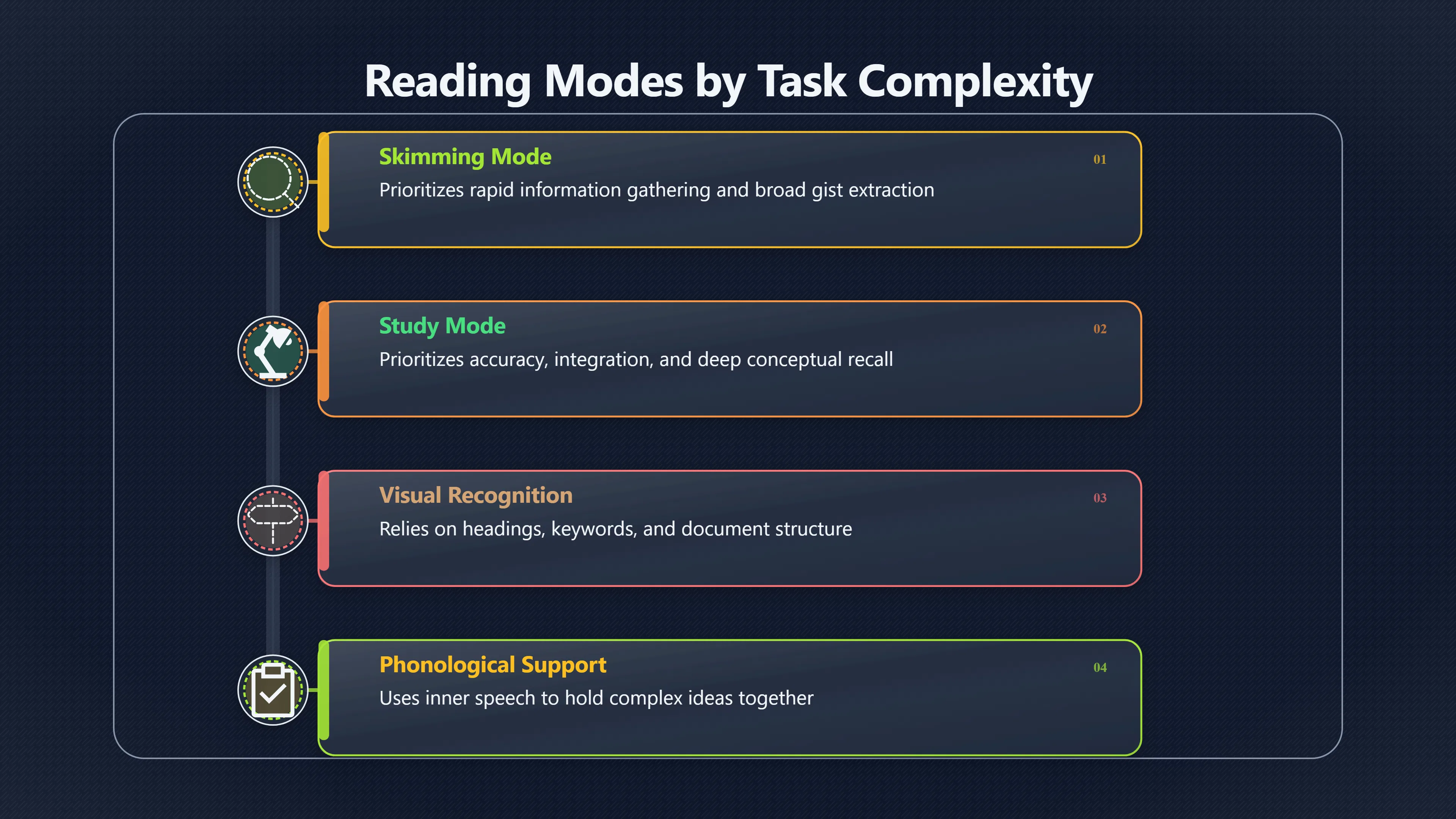
- Skimming prioritises speed and broad understanding.
- Study reading prioritises accuracy, integration, recall, and insight.
Trying to use the same reading style for both tasks often produces disappointing results.
A Practical Reading-Speed Decision Rule
Instead of asking, “How can I stop hearing words?”, ask, “How much understanding do I need from this text?”
A simple decision rule works well:
Use lighter inner speech when
- You are searching for a specific fact.
- You need only the main idea.
- The material is familiar.
- Missing some details has little cost.
- You are reviewing rather than learning.
In these situations, increase speed by focusing on structure, keywords, and major points rather than attempting perfect sentence-by-sentence processing.

Use deliberate inner speech when
- The material is new.
- Concepts build on one another.
- You will need to explain the content later.
- Precision matters.
- You notice confusion, rereading, or poor recall.
Here, consciously slowing down and mentally hearing important passages can improve retention and reduce the need for repeated rereading.
Switch dynamically
The most effective readers often move between modes within the same document.
For example, they may skim an academic paper’s abstract, introduction, and headings to identify relevance. Once they reach the core argument or methodology, they slow down and engage more fully with the wording. After understanding the critical section, they may speed up again through supporting material.
This flexible approach often produces greater overall efficiency than attempting to maintain maximum speed throughout.
The Real Goal: Adaptive Reading
The debate over subvocalisation often assumes a choice between reading slowly with an inner voice or reading quickly without one. In practice, skilled readers usually do neither.
They adapt. They skim when the objective is orientation, filtering, or information gathering. They allow stronger inner speech when comprehension, learning, and memory become the priority. Research on reading and working memory supports this distinction: phonological processing is most valuable when language complexity increases and ideas must be held together across time.[WIRED+3PMC+3PMC]pmc.ncbi.nlm.nih.govPhonological working memory and linguistic processing…by DB Candal · 2025 · Cited by 9 — We tested, using simple mediation models…
For increasing reading speed, the most useful habit is therefore not suppressing the inner voice. It is learning when to let it fade into the background and when to let it guide careful understanding.
Amazon book picks
Further Reading
Books and field guides related to When to Skim and When to Hear Words. Use these as the next step if you want deeper reading beyond the article.
How to Read a Book
Rating: 4.0/5 from 41 Google Books ratings
Teaches matching reading style to reading purpose.


Language at the Speed of Sight
Explains when sound-based processing helps comprehension.
Endnotes
1.
Source: pmc.ncbi.nlm.nih.gov
Link:https://pmc.ncbi.nlm.nih.gov/articles/PMC12214213/
Source snippet
Phonological working memory and linguistic processing...by DB Candal · 2025 · Cited by 9 — We tested, using simple mediation models...
2.
Source: pmc.ncbi.nlm.nih.gov
Title: PMCInner Speech: Development, Cognitive Functions
Link:https://pmc.ncbi.nlm.nih.gov/articles/PMC4538954/
Source snippet
by B Alderson-Day · 2015 · Cited by 1160 — In this model, the phonological loop is made up of two subcomponents: a passive, phonologic...
3.
Source: wired.com
Link:https://www.wired.com/2017/01/make-resolution-read-speed-reading-wont-help
Source snippet
Basic calculations based on the properties of eyes and texts indicate that an average reading speed is around 280 words per minute, a val...
4.
Source: pmc.ncbi.nlm.nih.gov
Link:https://pmc.ncbi.nlm.nih.gov/articles/PMC11783984/
Source snippet
phonological store of working memory: A critique and an...by RW Hughes · 2024 · Cited by 13 — The core structure within the phonological...
5.
Source: pmc.ncbi.nlm.nih.gov
Title: PMCThe role of consciousness in the phonological loop
Link:https://pmc.ncbi.nlm.nih.gov/articles/PMC3737516/
Source snippet
role of consciousness in the phonological loop - PMC - NIHby BR Buchsbaum · 2013 · Cited by 90 — Here we explore how the intuitive appeal...
6.
Source: speedreading.com
Link:https://speedreading.com/research/controversies-and-claims.php
Source snippet
Should I eliminate subvocalization? No. Inner speech often supports...Read more...
7.
Source: Wikipedia
Link:https://en.wikipedia.org/wiki/Subvocalization
9.
Source: youtube.com
Title: Subvocalization | Things About Speed Reading Nobody Tells You
Link:https://www.youtube.com/watch?v=DGDkTyOt7gQ
Source snippet
Read Faster by Reducing Subvocalization - Speed Reading Tips...
10.
Source: encyclopedia.pub
Link:https://encyclopedia.pub/entry/33862
Source snippet
Subvocalization | Encyclopedia MDPI10 Nov 2022 — Subvocalization, or silent speech, is the internal speech typically made when reading; i...
Additional References
11.
Source: magneticmemorymethod.com
Link:https://www.magneticmemorymethod.com/how-to-stop-subvocalizing/
Source snippet
How to Stop Subvocalizing: My Surprising SolutionSpeed reading books often teach how to stop subvocalizing. Learn all about the technique...
12.
Source: medium.com
Link:https://medium.com/curious/speed-reading-is-a-myth-676be05df30c
Source snippet
Speed Reading Is a MythSpeed Reading Is a Myth Research shows speed reading is impossible without sacrificing comprehension I first learn...
13.
Source: reddit.com
Link:https://www.reddit.com/r/books/comments/kztft/subvocalization_vs_speedreadingskimming_your/
14.
Source: ruj.uj.edu.pl
Link:https://ruj.uj.edu.pl/server/api/core/bitstreams/15f66099-2a70-44d8-be73-9daaa6f36327/content
Source snippet
role of phonological mediation in word recognition in readingThis chapter is the outcome of my work as a foreign language teacher. Teachi...
15.
Source: reddit.com
Link:https://www.reddit.com/r/books/comments/oet3ym/the_false_promise_of_speed_reading_why_you_should/
16.
Source: washingtonbeerblog.com
Link:https://washingtonbeerblog.com/speed-reading-myths-what-science-says-about-reading-faster-even-after-a-couple-of-beers/
Source snippet
Speed reading programs tell you to eliminate subvocalization (the internal voice reading along). It has been found...Read more...
17.
Source: researchgate.net
Link:https://www.researchgate.net/publication/264642555_Phonological_working_memory_and_reading_in_students_with_dyslexia
Source snippet
to fluency, reading comprehension and phonological processing (operational and short-term memory) and identify...Read mor...
18.
Source: youtube.com
Link:https://www.youtube.com/watch?v=JC7fDlo7fJA
Source snippet
Is Speed Reading A Hoax? Let's Look At The EvidenceThere are a TON of misconceptions about speed reading. And later this week, you have a...
19.
Source: iflscience.com
Title: subvocalization why do we have a voice in our heads when we read 74659
Link:https://www.iflscience.com/subvocalization-why-do-we-have-a-voice-in-our-heads-when-we-read-74659
Source snippet
Subvocalization: Why Do We Have A Voice In Our Heads...14 Jun 2024 — For instance, research by Alan Baddeley suggests that our working m...
20.
Source: waseda.elsevierpure.com
Title: effects of [reading aloud]({{ ‘reading-aloud/’ | relative_url }}) and subvocalization on text comprehensio
Link:https://waseda.elsevierpure.com/en/publications/effects-of-reading-aloud-and-subvocalization-on-text-comprehensio/
Source snippet
of reading aloud and subvocalization on text...by A Morita · 2019 — The present study examined effects of reading aloud and subvocalizat...
Topic Tree