Within One Sentence
How should you score a one sentence summary?
A simple 0-to-3 score helps readers track whether faster reading is improving comprehension or just rewarding skimming.
On this page
- The 0 to 3 summary scale
- Why unseen passages matter
- Tracking scores beside words per minute
Page outline Jump by section
Introduction
A one-sentence summary is only useful as a reading-speed check if it can be scored consistently. Without a scoring system, readers tend to judge their own summaries too generously, making it difficult to tell whether rising words-per-minute figures reflect genuine comprehension or increasingly superficial skimming. A simple 0-to-3 scale solves this problem by turning each summary into a repeatable measurement.
 The aim is not to grade writing quality. The aim is to judge whether the sentence captures the passage’s main idea. Research on summarisation consistently finds that effective summaries require readers to identify essential ideas, connect them, and discard unimportant details, making summary quality a practical indicator of comprehension.[Reading Rockets+2Reading Rockets]readingrockets.orgReading RocketsSummarizingSummarizing teaches students how to identify the most important ideas in a text, how to ignore irrelevant infor…
The 0-to-3 summary scale
The most useful scoring systems are simple enough to apply immediately after reading. A four-level scale provides enough discrimination to reveal progress without turning speed practice into a marking exercise.
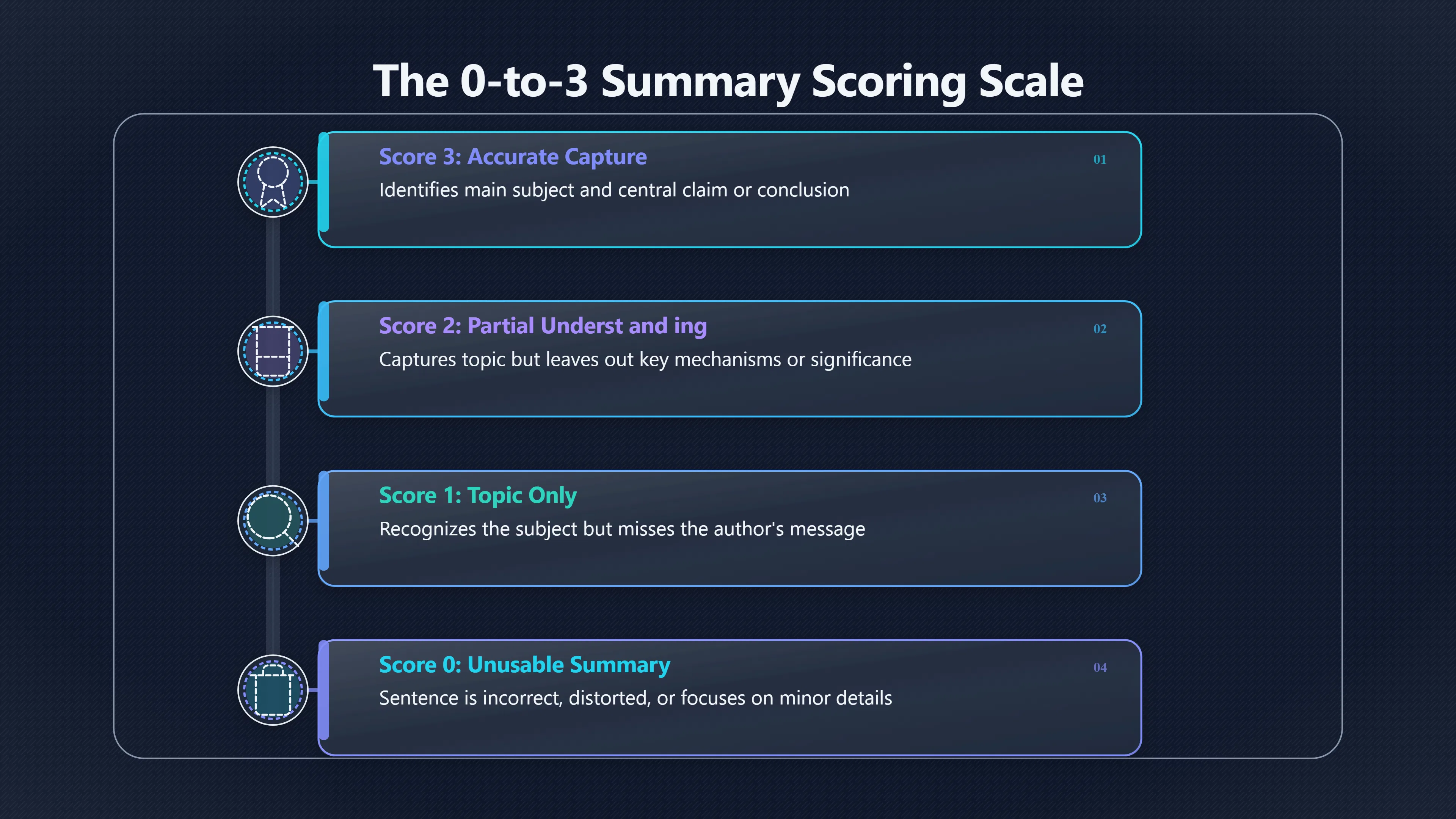
Score 3: Captures the central message accurately
A score of 3 means the summary identifies the passage’s main subject and its central claim, conclusion, explanation, or event. A person who never read the text should be able to understand what the passage was fundamentally trying to communicate.
For example, if a passage explains that urban tree planting reduces summer temperatures by limiting heat absorption, a score-3 summary might be:
Expanding urban tree cover helps lower city temperatures by reducing heat build-up from paved surfaces.
The wording does not need to match the original. What matters is accurate capture of the main idea. This aligns with established summarisation guidance that emphasises identifying central ideas rather than reproducing text.[Reading Rockets+2Reading Rockets]readingrockets.orgReading RocketsSummarizingSummarizing teaches students how to identify the most important ideas in a text, how to ignore irrelevant infor…
Score 2: Mostly correct but incomplete
A score of 2 reflects partial understanding. The summary captures the topic and some of the main point but leaves out an important element, such as the key mechanism, conclusion, or significance.
Example:
Trees provide shade that helps cities stay cooler.
This is directionally correct but less complete than the passage’s broader argument.
Readers often produce many score-2 summaries when increasing speed. This is not necessarily a failure. It may indicate that comprehension remains broadly intact while finer details are beginning to drop away.
Score 1: Topic recognised, message missed
A score of 1 indicates that the reader knows what the passage was about but not what it was saying.
Example:
The passage discussed trees in cities.
The subject is identified, but the central message is absent. Reading researchers often distinguish between recognising a topic and understanding the author’s main idea; summarisation tasks expose that difference effectively.[Reading Ranch Tutorial Centers]readingranch.comReading Ranch Tutorial CentersReading Comprehension: Identifying the Main Idea Made EasySeptember 30, 2023 — To successfully identify the…
Score 0: Incorrect or unusable
A score of 0 is appropriate when the summary is wrong, severely distorted, or too vague to show meaningful understanding.
Examples include:
- A sentence focused on a minor detail rather than the main point.
- A conclusion that contradicts the passage.
- A generic statement that could apply to almost any text.
Repeated score-0 summaries usually indicate that reading speed has exceeded current comprehension capacity.
Why unseen passages matter
The strongest version of this exercise uses passages the reader has never encountered before.
When familiar material is used repeatedly, memory begins to substitute for comprehension. A reader may appear to summarise well because they already know the argument, structure, or conclusion. That makes the score less useful as evidence of current reading performance.
Unseen passages create a cleaner test because they require real-time extraction of meaning. The reader must identify the main idea during the reading process rather than retrieve it from memory. This makes summary scores more sensitive to changes in reading pace.
Using varied topics also reduces the chance that subject expertise inflates scores. Someone who already knows a great deal about climate science may produce strong summaries of climate articles even after reading carelessly. A mixture of unfamiliar subjects creates a more reliable benchmark.

Keep passage difficulty reasonably stable
Unseen does not mean random.
If one session uses a simple news article and the next uses a dense academic paper, changes in summary scores may reflect text difficulty rather than reading performance.
A practical approach is to keep passages broadly similar in:
- Length.
- Vocabulary difficulty.
- Structural complexity.
- Intended audience.
Consistency makes trends easier to interpret across weeks of practice.
How to score quickly without overthinking
The purpose of the scale is monitoring, not literary criticism.
After writing the summary, ask three questions:
- Did I identify the main subject?
- Did I capture the main point or conclusion?
- Would someone unfamiliar with the passage understand its core message?
If all three answers are yes, award a 3.
If one major element is missing, award a 2.
If only the topic is present, award a 1.
If the sentence is inaccurate or largely unrelated to the main idea, award a 0.
The process should take less than a minute. Excessive analysis reduces the value of the exercise as a rapid comprehension check.
Tracking scores beside words per minute
A summary score becomes most useful when paired with reading-speed data.
A simple practice log might contain:
SessionWords per minuteSummary score12503227533300243251
This pattern reveals more than speed alone. Although reading rate is increasing, comprehension quality appears to be declining.
By contrast:
SessionWords per minuteSummary score12502227523300343203
This suggests that both speed and understanding are improving together.
Summarisation has long been used as a comprehension-monitoring technique because it requires readers to identify central ideas, eliminate less important information, and restate meaning in their own words.[Reading Rockets+3Reading Rockets+3Reading Rockets]readingrockets.orgReading RocketsSummarizingSummarizing teaches students how to identify the most important ideas in a text, how to ignore irrelevant infor…
Watch trends, not individual scores
Individual passages vary. Even skilled readers occasionally encounter texts that are unusually difficult, unfamiliar, or poorly organised.
For that reason, a single score matters less than the average of multiple sessions. Looking at ten or twenty readings provides a more dependable picture than reacting to one unusually high or low result.
The goal is gradual movement towards higher reading rates while maintaining an average summary score close to 3. When scores consistently fall from 3 to 2 or from 2 to 1, the data suggest that speed gains are beginning to come at the expense of comprehension.
Common scoring mistakes
Several habits reduce the usefulness of the scale:
- Rewarding elegant writing instead of understanding. A well-written sentence can still miss the main idea.
- Giving full marks for topic recognition. Naming the subject is not the same as explaining the message.
- Using previously read passages. Familiarity can inflate scores.
- Changing standards between sessions. Apply the same criteria every time.
- Treating a score of 2 as failure. A score of 2 often represents useful partial comprehension and can reveal where speed increases are starting to create pressure.
A scoring routine only works when applied consistently. The value comes less from any individual number and more from building a stable record that shows whether faster reading is preserving, improving, or eroding understanding over time.
Amazon book picks
Further Reading
Books and field guides related to How should you score a one-sentence summary?. Use these as the next step if you want deeper reading beyond the article.
How to Read a Book
Rating: 4.0/5 from 41 Google Books ratings
Provides frameworks for judging understanding of a text.
Breakthrough rapid reading
Useful when pairing comprehension scores with speed metrics.
Summarizing, paraphrasing, and retelling
Directly supports evaluating and scoring summaries.
Understanding and Teaching Reading Comprehension
First published 2014. Subjects: Reading comprehension.
eBay marketplace picks
Marketplace Samples
Example marketplace items related to this page. Use the search link to explore similar finds on eBay.
Endnotes
1.
Source: readingrockets.org
Link:https://www.readingrockets.org/classroom/classroom-strategies/summarizing
Source snippet
Reading RocketsSummarizingSummarizing teaches students how to identify the most important ideas in a text, how to ignore irrelevant infor...
2.
Source: readingrockets.org
Title: Reading Rockets Seven Strategies to Teach Students Text Comprehension7
Link:https://www.readingrockets.org/topics/comprehension/articles/seven-strategies-teach-students-text-comprehension
Source snippet
Summarizing · Identify or generate main ideas · Connect the main or central ideas · Eliminate unnecessary information · Remember what the...
3.
Source: readingrockets.org
Title: get the gist comprehension strategy
Link:https://www.readingrockets.org/sites/default/files/migrated/get_the_gist_comprehension_strategy.pdf
Source snippet
Get The Gist'Get the Gist' (Cunningham, 1982) is an acronym for Generating [Interactions]({{ 'interactions/' | relative_url }}) between Schemata and Texts. It is summarising str...
4.
Source: readingranch.com
Link:https://www.readingranch.com/reading-comprehension-identifying-the-main-idea-made-easy/
Source snippet
Reading Ranch Tutorial CentersReading Comprehension: Identifying the Main Idea Made EasySeptember 30, 2023 — To successfully identify the...
Published: September 30, 2023
5.
Source: readingrockets.org
Title: how do i teach main idea
Link:https://www.readingrockets.org/blogs/shanahan-on-literacy/how-do-i-teach-main-idea
Source snippet
?Nov 26, 2018 — For example, teaching summarization as a strategy means teaching students to use summarization to support their reading c...
6.
Source: readingrockets.org
Link:https://www.readingrockets.org/classroom/classroom-strategies/reciprocal-teaching
Source snippet
Reciprocal TeachingSummarizing: Students summarize the main ideas of the text in their own words. This helps reinforce understanding and...
7.
Source: readingrockets.org
Link:https://www.readingrockets.org/topics/curriculum-and-instruction/articles/what-works-comprehension-instruction
Source snippet
What Works in Comprehension InstructionSummarization, where readers are taught to integrate ideas and generalize from the text information...
8.
Source: readingrockets.org
Title: SQ3R. Survey, Question, Read, Recite, Review.Read more
Link:https://www.readingrockets.org/sites/default/files/2023-08/summarizing_Strategies.pdf
Source snippet
Quick Summarizing Strategies to Use in the ClassroomLimit the time, using a timer or other signal, so that students are always left think...
9.
Source: readingrockets.org
Title: how teach summarizing part i
Link:https://www.readingrockets.org/blogs/shanahan-on-literacy/how-teach-summarizing-part-i
Source snippet
How to Teach Summarizing (Part I)Jul 15, 2019 — Various schemes for dealing with summarization have been proposed and they all improve re...
10.
Source: readingrockets.org
Link:https://www.readingrockets.org/videos/classroom/teaching-strategies-using-summarizing-comprehension-reading-lessons
Source snippet
Teaching Strategies for Using Summarizing for...In this video clip from eHow, find out about great teaching strategies for using summari...
11.
Source: readingrockets.org
Link:https://www.readingrockets.org/topics/background-knowledge/articles/strategies-promote-comprehension
Source snippet
· Make connections between and among important ideas in the text. · Integrate new ideas with...Read more...
12.
Source: readingrockets.org
Link:https://www.readingrockets.org/topics/comprehension/articles/key-comprehension-strategies-teach
Source snippet
Key Comprehension Strategies to TeachSummarizing is an important strategy because it can enable readers to recall text quickly.... Readi...
13.
Source: comprehensionfortheclassroom.weebly.com
Link:https://comprehensionfortheclassroom.weebly.com/summarizing.html
Source snippet
weebly.comSummarizingBenefits: According to Reading Rockets, “Summarizing teaches students how to discern the most important ideas in a t...
14.
Source: readingstrategiesmsu.weebly.com
Link:https://readingstrategiesmsu.weebly.com/summarizing.html
Source snippet
teaches students how to discern the most important ideas in a text, how to ignore irrelevant information, and how to integrate the centra...
15.
Source: pathwaystopedagogy.psu.edu
Link:https://pathwaystopedagogy.psu.edu/teaching-activities/one-sentence-summary/
Source snippet
Sentence Summary - Pathways to Pedagogy - Penn StateIn this activity, students will write a one sentence summary of the given topic in or...
Additional References
16.
Source: adlit.org
Link:https://www.adlit.org/in-the-classroom/strategies/summarizing
Source snippet
SummarizingSummarizing teaches students how to take a large selection of text and reduce it to the main points for more concise understan...
17.
Source: thinka.ai
Link:https://www.thinka.ai/en-GB/blogs/VyKVGJwhmxIPGLwoKhAN/The-Gist-Extraction-Hack-Conquering-DSE-English-Reading-Paper-1-Section-B2-via-Skimming-Efficiency
Source snippet
1-sentence summary. The AI analyzes your choice to see if you caught the main idea or got distracted by details. 2. Vocabulary Filtering...
18.
Source: readnaturally.com
Link:https://www.readnaturally.com/research/5-components-of-reading/comprehension
Source snippet
If students can retell or summarize something they have read, they are more likely to comprehend it. Students can be explicitly...Read more...
19.
Source: ereadingworksheets.com
Link:https://www.ereadingworksheets.com/free-reading-worksheets/reading-comprehension-worksheets/summarizing-worksheets-and-activities/
Source snippet
Read four nonfiction paragraphs about trains, highlight or underline important information, and...Read more...
20.
Source: cliffsnotes.com
Link:https://www.cliffsnotes.com/tutors-problems/Literature/53672952-How-can-I-comment-back-to-this-post-3-of-the-most-viable-reading/
Source snippet
3 of the most viable reading comprehension strategies I...Oct 1, 2023 — In my experience, summarizing has proven to be a powerful technique...
21.
Source: lexialearning.com
Title: summarizing strategies for student reading comprehension
Link:https://www.lexialearning.com/blog/summarizing-strategies-for-student-reading-comprehension
Source snippet
31 Mar 2026 — An excellent tool for summarizing all content types, including nonfiction, the Gist method imposes a time or word limit, en...
22.
Source: blog.tcea.org
Title: six strategies reading comprehension
Link:https://blog.tcea.org/six-strategies-reading-comprehension/
Source snippet
Visualizing · 2. Using Context Clues · 3. Making Inferences · 4. Summarizing · 5. Monitoring Comprehension · 6. Activating Prior Knowledg...
23.
Source: rewardlearning.org
Title: READIN G Comprehension Strategies
Link:https://rewardlearning.org/blog/2024/5/25/reading-comprehension-strategies-1
Source snippet
READING Comprehension StrategiesMay 25, 2024 — Ways to support your child's reading comprehension include fluency training, vocabulary in...
Published: May 25, 2024
24.
Source: highlandliteracy.com
Link:https://highlandliteracy.com/wp-content/uploads/2018/02/wraparound-comprehension.pdf
Source snippet
our pupils are reading age and stage...Read more...
25.
Source: keystoliteracy.com
Title: scaffolds support summarizing
Link:https://keystoliteracy.com/blog/scaffolds-support-summarizing/
Source snippet
Scaffolds to Support SummarizingMar 29, 2016 — Summarizing enhances comprehension as students select, condense, and synthesize in their o...
Topic Tree