Within Unseen Texts
Why Rereading Makes Progress Look Bigger
Rereading can improve fluency practice, but it can also make speed and comprehension scores look better than they really are.
On this page
- Memory of structure and ideas reduces reading load
- Why comprehension questions become easier after exposure
- How to separate practice gains from benchmark bias
Page outline Jump by section
Introduction
Rereading usually makes a passage feel easier, faster, and more understandable. That is exactly why it can be a useful training method when the goal is to build fluency. The problem arises when rereading is used to measure progress. A reader who appears to have gained 30, 50, or even 100 words per minute on a familiar passage may not have improved by the same amount on completely new material. The score is being boosted not only by reading skill but also by familiarity. Research on repeated reading consistently shows improvements in fluency and comprehension on previously encountered texts, which is beneficial for practice but can distort benchmark results if the same passages are reused.[Shanahan on Literacy]shanahanonliteracy.comShanahan on Literacy Everything You Wanted to Know about Repeated Reading Hi DrShanahan, My experience with severely dyslexic readers is that repeated reading tends to be demoralizing for them. The emphasis on the sp…
 For anyone trying to increase reading speed, the key question is not whether rereading works. It does. The more important question is whether a higher score reflects a transferable skill or simply growing familiarity with a specific text.
Memory Reduces the Work Required
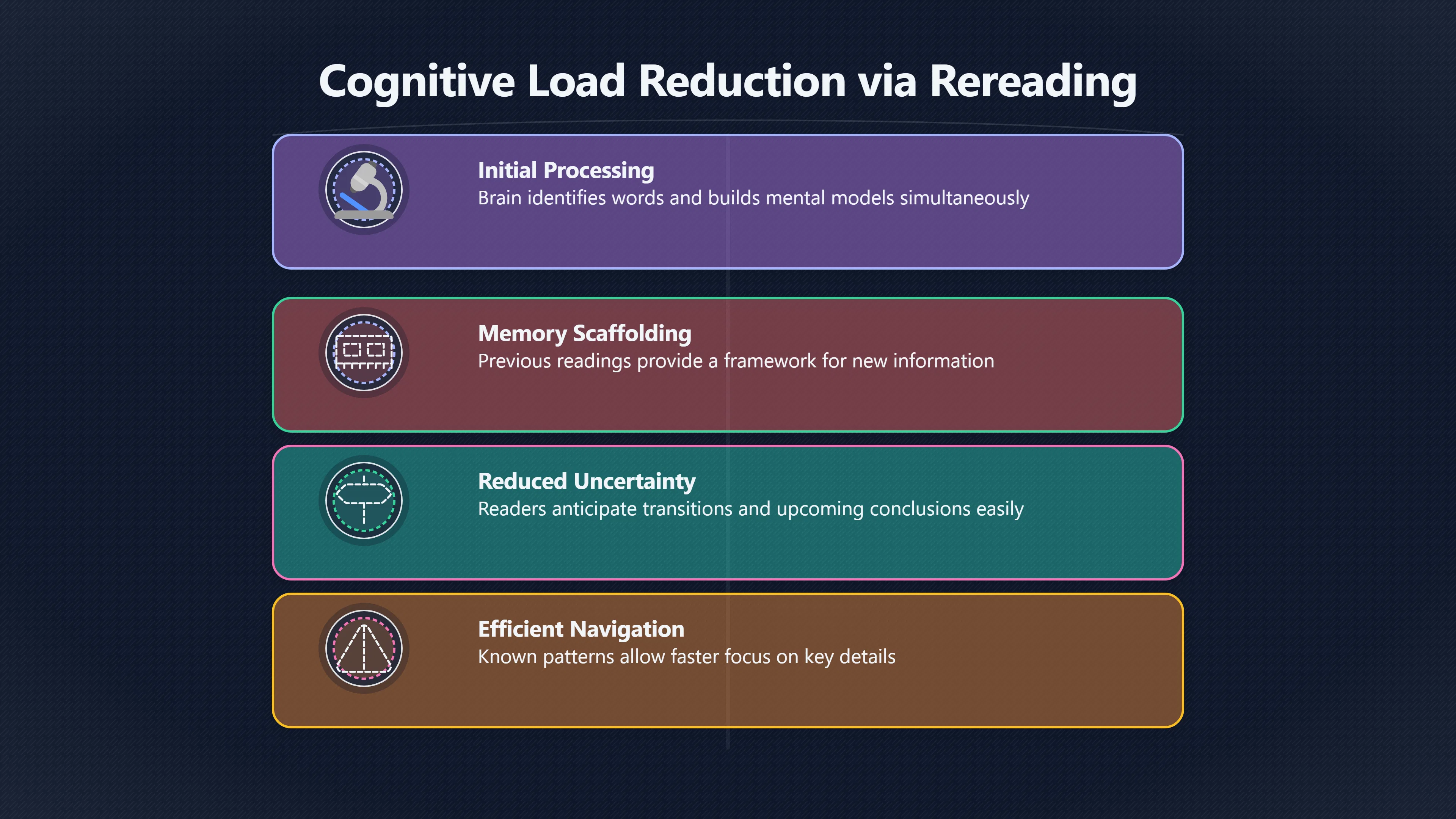
The first time a reader encounters a passage, the brain must perform several tasks at once. It has to recognise words, establish sentence relationships, build a mental model of the text, identify important ideas, and decide how those ideas fit together.
On later readings, much of that work has already been completed.
A familiar passage provides several advantages:
- The overall structure is already known.
- Key vocabulary has been encountered before.
- The location of important information is remembered.
- Uncertainty about what comes next is reduced.
- The reader can anticipate transitions and conclusions.
These shortcuts lower the cognitive load of reading. Timothy Shanahan notes that repeated reading deliberately uses memory as a scaffold. Short passages are often chosen because readers can carry information from one reading into the next, making subsequent readings easier and faster.[Shanahan on Literacy]shanahanonliteracy.comShanahan on Literacy Everything You Wanted to Know about Repeated Reading Hi DrShanahan, My experience with severely dyslexic readers is that repeated reading tends to be demoralizing for them. The emphasis on the sp…
This means that improved speed on a reread is not necessarily evidence that decoding, vocabulary knowledge, or comprehension processes have become more efficient in general. It may simply indicate that the reader already knows much of what the passage contains.
Why Comprehension Scores Rise Alongside Speed
Many readers assume that familiarity only affects words per minute. In reality, it can also influence comprehension results.
When a passage is familiar, readers often remember:
- The main argument.
- Important examples.
- The sequence of events or ideas.
- Previously confusing sections.
- Answers to earlier comprehension questions.
As a result, comprehension tests become easier. The reader is no longer constructing understanding from scratch. Instead, they are partly retrieving information from memory.
Research on background knowledge consistently shows that familiarity with content improves comprehension performance because readers can connect new information to existing mental frameworks.[Taylor & Francis Online]tandfonline.comA critical review was conducted to determine the influence background knowledge has on the reading comprehension of primary school-aged c…
A reread represents an extreme version of familiarity. The reader does not merely know the topic; they have already processed the exact text. Consequently, higher comprehension scores after multiple readings may reflect memory support as much as improved reading ability.
This distinction matters because the purpose of a benchmark is to determine how well someone can understand unfamiliar material. A comprehension gain driven mainly by recall does not answer that question.
The Hidden Advantage of Knowing the Structure
One of the strongest familiarity effects comes from recognising how information is organised.
Readers gradually learn patterns within a text:
- Where definitions appear.
- How evidence is presented.
- When examples are likely to occur.
- How the author transitions between ideas.
- Where conclusions are located.
Once these patterns are known, navigation becomes faster. The reader spends less effort deciding where to focus attention because the structure is already mapped.
Consider a technical article containing a definition, a worked example, and a summary. During the first reading, locating and integrating these pieces requires active processing. During the second reading, the reader already knows where each element sits within the text. Eye movements, attention, and reading pace become more efficient because the organisational work has largely been completed.
The resulting speed increase is real, but it is specific to that passage rather than a guaranteed improvement in handling new texts.
Why Familiarity Can Be Mistaken for Skill Growth
The most misleading aspect of rereading is that the experience feels like genuine improvement.
Several changes occur simultaneously:
- Word recognition becomes easier.
- Prediction becomes more accurate.
- Comprehension feels smoother.
- Confidence increases.
- Reading speed rises.[shanahanonliteracy.com]shanahanonliteracy.comShanahan on Literacy Everything You Wanted to Know about Repeated Reading Hi DrShanahan, My experience with severely dyslexic readers is that repeated reading tends to be demoralizing for them. The emphasis on the sp…
Because all of these changes are visible, readers naturally conclude that their overall reading ability has improved.
Sometimes that conclusion is correct. Repeated reading has been shown to improve fluency and can contribute to broader reading development.[PMC+2PMC]pmc.ncbi.nlm.nih.govby EA Stevens · 2016 · Cited by 370 — Results showed repeated reading (RR), multicomponent interventions, and assisted reading with au…
However, benchmark scores alone cannot reveal how much of the gain comes from transferable skill and how much comes from familiarity with the tested passage. A reader who improves dramatically on a passage after six readings may show only modest improvement when presented with a new text of similar difficulty.
That uncertainty is the source of benchmark bias.
Separating Practice Gains from Benchmark Bias
Repeated reading remains valuable because it strengthens automaticity and fluency. The mistake is treating a practised passage as a neutral test.
A practical way to separate the two effects is to distinguish between practice material and assessment material.
Use rereading for training
Repeated reading is well supported as a fluency-building technique. Research and literacy guidance have repeatedly found benefits for reading fluency and, in many cases, comprehension.[Shanahan on Literacy+2PMC]shanahanonliteracy.comShanahan on Literacy Everything You Wanted to Know about Repeated Reading Hi DrShanahan, My experience with severely dyslexic readers is that repeated reading tends to be demoralizing for them. The emphasis on the sp…
During practice, familiarity is helpful rather than problematic. The goal is to make processing easier.
Use unseen passages for measurement
Benchmark passages should remain unread until the test begins.
When readers move to fresh passages that match the same genre and difficulty level, familiarity advantages disappear. Any improvement is more likely to reflect transferable reading skill rather than memory of specific content.
Compare transfer, not repetition
The most trustworthy sign of progress is improvement that carries over to new material. If reading speed and comprehension increase on unfamiliar passages, the reader has evidence that skill growth extends beyond a single text.
What Familiarity Bias Really Tells You
Familiarity bias does not mean rereading is ineffective. In fact, repeated reading works partly because familiarity reduces processing demands and allows readers to devote more attention to meaning.[Shanahan on Literacy]shanahanonliteracy.comShanahan on Literacy Everything You Wanted to Know about Repeated Reading Hi DrShanahan, My experience with severely dyslexic readers is that repeated reading tends to be demoralizing for them. The emphasis on the sp…
The caution is simply that practice results and benchmark results answer different questions.
A faster reread demonstrates that the passage has become easier for you. A faster first reading of an unseen passage demonstrates that you have become a more efficient reader.
For honest progress checks in reading speed, the second result is the one that matters most.
Amazon book picks
Further Reading
Books and field guides related to Why Rereading Makes Progress Look Bigger. Use these as the next step if you want deeper reading beyond the article.
Why Don't Students Like School?
Covers cognitive mechanisms behind apparent learning gains.

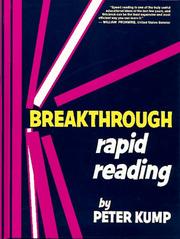
Breakthrough rapid reading
Useful context for measuring reading improvement accurately.
eBay marketplace picks
Marketplace Samples
Example marketplace items related to this page. Use the search link to explore similar finds on eBay.



Endnotes
1.
Source: shanahanonliteracy.com
Title: Shanahan on Literacy Everything You Wanted to Know about Repeated Reading Hi Dr
Link:https://www.shanahanonliteracy.com/blog/everything-you-wanted-to-know-about-repeated-reading
Source snippet
Shanahan, My experience with severely dyslexic readers is that repeated reading tends to be demoralizing for them. The emphasis on the sp...
2.
Source: tandfonline.com
Link:https://www.tandfonline.com/doi/full/10.1080/02702711.2021.1888348
Source snippet
A critical review was conducted to determine the influence background knowledge has on the reading comprehension of primary school-aged c...
3.
Source: frontiersin.org
Link:https://www.frontiersin.org/journals/education/articles/10.3389/feduc.2025.1666454/full
Source snippet
The experimental group demonstrated stronger analytical...Read more...
4.
Source: pmc.ncbi.nlm.nih.gov
Link:https://pmc.ncbi.nlm.nih.gov/articles/PMC5097019/
Source snippet
by EA Stevens · 2016 · Cited by 370 — Results showed repeated reading (RR), multicomponent interventions, and assisted reading with au...
5.
Source: pmc.ncbi.nlm.nih.gov
Link:https://pmc.ncbi.nlm.nih.gov/articles/PMC3320221/
Source snippet
A synthesis of fluency interventions for secondary struggling...by J Wexler · 2008 · Cited by 242 — (2002) reported that using repeat...
6.
Source: shanahanonliteracy.com
Title: teaching fluency faqs
Link:https://www.shanahanonliteracy.com/blog/teaching-fluency-faqs
Source snippet
Jul 27, 2024 — The National Reading Panel concluded that [oral reading]({{ 'reading-aloud/' | relative_url }}) practice with feedback and repetition was valuable in developing fl...
7.
Source: teachingbyscience.com
Title: Repeated Reading | Teaching By Science
Link:https://www.teachingbyscience.com/repeated-reading
Source snippet
May 20, 2022 — Critics of Repeated Reading often suggest we use less repetitive strategies to teach fluency, this seems logical, as it wo...
Published: May 20, 2022
8.
Source: education.qld.gov.au
Link:https://education.qld.gov.au/curriculums/Documents/literature-review.pdf
Source snippet
An overview of the literature effective teaching of readingThe evidence for the effectiveness of phonics instruction is extensive, with p...
9.
Source: etd.ohiolink.edu
Link:https://etd.ohiolink.edu/acprod/odb_etd/ws/send_file/send?accession=miami1245336955&disposition=inline
Source snippet
READINGby E Vincent · 2009 — Repeated reading (RR) is a well established reading intervention to increase fluency. However, few studies h...
Additional References
10.
Source: naeducation.org
Link:https://naeducation.org/wp-content/uploads/2020/06/The-Nature-and-Development-of-Reading-for-Understanding.pdf
Source snippet
2 The Nature and Development of Reading for...by GN Cervetti · Cited by 14 — The RfU studies suggest that listening and reading comprehe...
11.
Source: researchgate.net
Link:https://www.researchgate.net/publication/398253041_Effect_of_Repeated_Reading_for_Developing_Reading_Fluency_and_Reading_Comprehension_in_EFL_Students_Pre_Experimental_Study
Source snippet
(PDF) Effect of Repeated Reading for Developing...29 May 2026 — Based on the results of the study, it was found that repeated reading wa...
Published: May 2026
12.
Source: petaa.edu.au
Link:https://petaa.edu.au/Mp/Mp/Curric-Res/PPs/PETAA-PAPER-232.aspx
Source snippet
Text selection to facilitate reading instructionThis paper breaks down the text selection process for different types of teaching: readin...
13.
Source: files.eric.ed.gov
Link:https://files.eric.ed.gov/fulltext/ED531173.pdf
Source snippet
repeated reading as a strategy to improve reading fluencyby K Berg · 2012 · Cited by 31 — The purpose of this action research project rep...
14.
Source: link.springer.com
Link:https://link.springer.com/article/10.1007/s11881
Source snippet
Springer LinkRepeated reading to enhance fluency: Old approaches and...by MS Meyer · 1999 · Cited by 839 — The effects of repeated readi...
15.
Source: researchgate.net
Link:https://www.researchgate.net/publication/271638628_Repeated_Reading_Effect_on_Reading_Fluency_and_Reading_Comprehension_in_Monolingual_and_Bilingual_EFL_Learners
Source snippet
d comprehension among monolingual and bilingual EFL students.Read more...
16.
Source: s3.amazonaws.com
Title: Repeated Reading Research into Practice
Link:https://s3.amazonaws.com/media.lyrics2learn.com/production/articles/Repeated%20Reading-Research%20into%20Practice.pdf
Source snippet
Repeated Reading: Research Into PracticeMartinez and Roser. (1985) reported that repetitive read-alouds both at school and at home result...
17.
Source: facebook.com
Link:https://www.facebook.com/groups/sharingbestpractice/posts/1018301011836743/
Source snippet
s, not just speed: 1. Automaticity / Word Recognition...
18.
Source: readabilitymatters.org
Title: shanahan speed measure
Link:https://readabilitymatters.org/articles/shanahan-speed-measure
Source snippet
Timothy Shanahan on Speed as a Measure of...May 4, 2020 — Dr. Shanahan notes speed is used to draw inference about decoding and that "gr...
Published: May 4, 2020
19.
Source: fisherpub.sjf.edu
Link:https://fisherpub.sjf.edu/cgi/viewcontent.cgi?article=1225&context=education_ETD_masters
Source snippet
Fisher Digital PublicationsUnderstanding the Relationship between Reading Fluency...by J Cotter · 2012 · Cited by 48 — In this study, st...
Topic Tree