Within Self checks
Can You Name the Paragraph's Main Point?
Claim recall shows whether a faster paragraph left behind a usable main point or only a general feeling of familiarity.
On this page
- Why fluent reading can hide weak claim recall
- A simple no look test for the main point
- When missing the claim means slowing down
Page outline Jump by section
Introduction
When you increase reading speed by reducing inner narration, the key question is not whether the paragraph felt easy. It is whether you can still identify its main claim after you have moved on. Fast reading often creates a sense of familiarity that can be mistaken for understanding. A reader may recognise the topic, remember a few examples, and still be unable to state what the author was actually arguing. Research on comprehension monitoring repeatedly shows that readers are not always accurate judges of their own understanding and that active checks are needed to detect these gaps.[PMC+2IDEALS]pmc.ncbi.nlm.nih.govThe goal was to investigate the nature of online comprehension monitoring, its predictors, and its relation to reading comprehension.Read…
 A brief claim-recall test is one of the most efficient safeguards. It requires only a few seconds, fits naturally into faster reading, and directly measures whether the paragraph left behind a usable idea rather than a vague feeling of fluency.
Why Fluent Reading Can Hide Weak Claim Recall
The danger of faster paragraph reading is not necessarily misunderstanding every sentence. More often, the problem is that the reader retains fragments without retaining the central point that connects them.
Psychologists studying comprehension monitoring describe a common mismatch between perceived understanding and actual understanding. Readers frequently feel confident because the text flowed smoothly, yet later struggle to explain what it meant. This is a form of fluency illusion: processing feels successful, so comprehension is assumed rather than verified.[PMC+2EEF]pmc.ncbi.nlm.nih.govThe goal was to investigate the nature of online comprehension monitoring, its predictors, and its relation to reading comprehension.Read…
Consider a paragraph that argues:
Remote work improves productivity because it reduces commuting time and allows more control over work environments.
A reader moving quickly might later remember “remote work”, “commuting”, and “productivity”. However, remembering those words is not the same as recalling the claim. The actual claim is that productivity improves because of specific mechanisms. If those relationships disappear, the reader has retained keywords rather than meaning.
This distinction matters because comprehension depends heavily on recognising how ideas fit together. Research on text structure and main-idea generation shows that readers who can identify the central idea and its organisation generally achieve deeper understanding and stronger recall than readers who merely remember isolated details.[ERIC]files.eric.ed.govERIC“What's the Main Idea?”: Using Text Structure to BuildERICApril 26, 2022 — by AK Hudson · 2021 · Cited by 23 — The structure of a text can be used as a framework for accelerating students' co…
A Simple No-Look Test for the Main Point
The most practical test is performed immediately after finishing a paragraph.
Without looking back, answer a single question:
What was the author’s main point?
The answer should be expressible in one sentence. The goal is not to reproduce wording. The goal is to reconstruct the meaning.
A useful implementation sequence is:
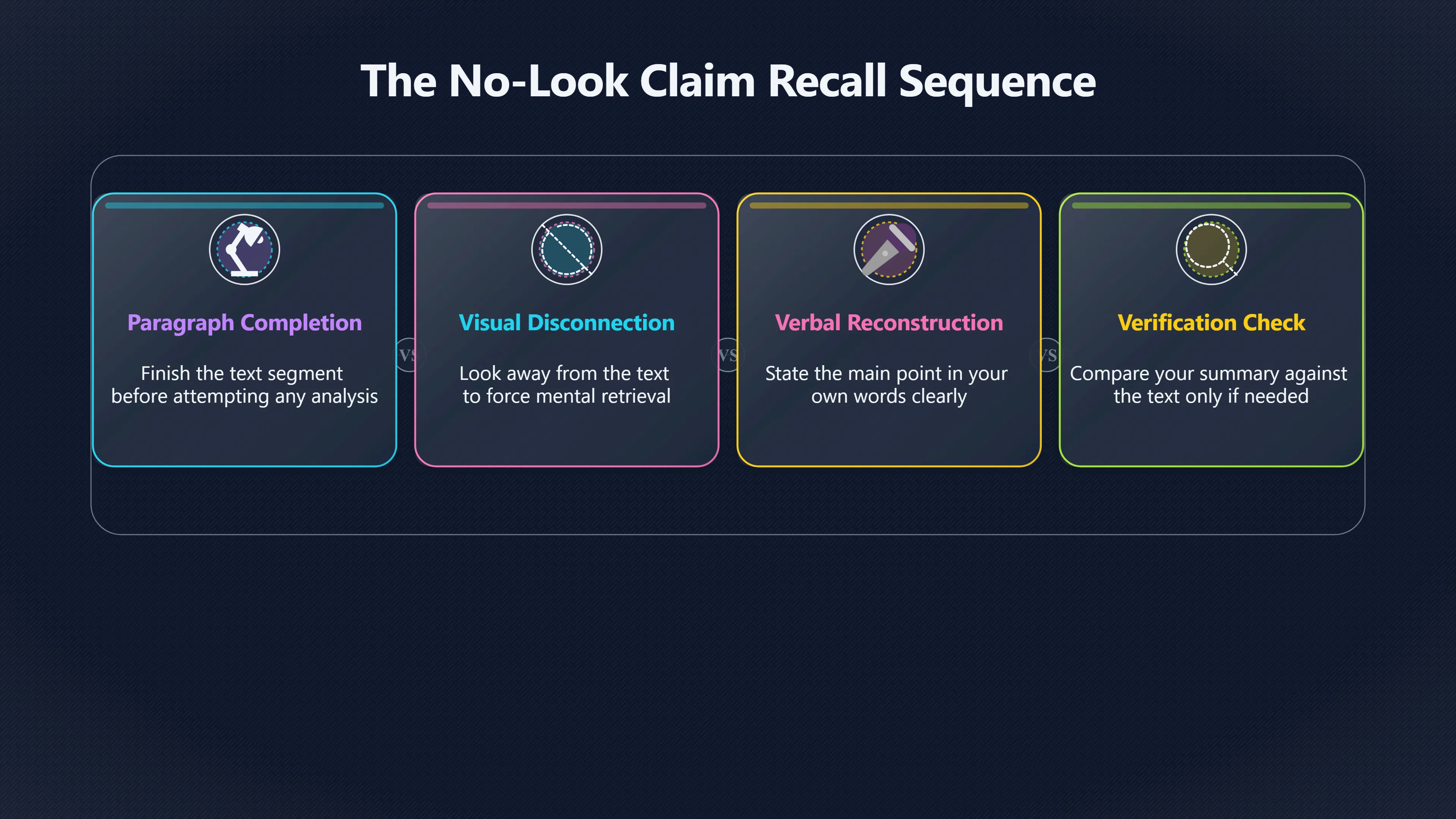
- Finish the paragraph.
- Look away from the text.
- State the main point in your own words.
- Compare your answer with the paragraph only if needed.
This works because recall is a stronger indicator of understanding than recognition. When the text remains visible, readers can mistake recognition for memory. Once the paragraph is hidden, they must retrieve the claim from their mental representation of the text.[Structural Learning]structural-learning.comfluency illusions students think they knowLearners recognise familiar material but cannot always produce it without cues…Read more…
The test becomes even more informative if the paragraph is argumentative or explanatory. In those cases, try completing the sentence:
“The author’s point was that…”
If you can finish that sentence clearly and quickly, comprehension probably survived the increase in reading speed. If you hesitate, produce several competing interpretations, or fall back on topic words, understanding may be weaker than it felt.
What Counts as Successful Claim Recall?
Many readers set the wrong standard. They believe success means remembering exact wording.
That is unnecessary.
A successful recall test captures the author’s idea accurately even when phrasing changes. For example:
Paragraph claim:
“Urban trees reduce summer temperatures by providing shade and cooling through evapotranspiration.”
Good recall:
“Trees help cool cities during hot weather through shade and other cooling effects.”
Weak recall:
“The paragraph talked about trees and temperature.”
The first response preserves the relationship between ideas. The second only identifies the topic.
Research on summarisation, self-monitoring, and main-idea instruction consistently finds that generating the central idea of a passage is closely tied to stronger comprehension and recall. Readers who can identify the main idea tend to understand the text more deeply than readers who focus primarily on surface details.[ERIC+3ResearchGate+3Rowan Digital Works]researchgate.netThe Role of a Summarization Strategy and Self-MonitoringThis study investigated the effectiveness of a main idea strategy and…
Why Producing an Answer Is Better Than Re-Reading
When claim recall fails, many readers immediately re-read the paragraph. While re-reading has value, it can also mask comprehension problems because familiar text becomes easier to process on the second pass.
A better sequence is:
- Attempt recall first.
- Identify what is missing.
- Then decide whether a re-read is necessary.
This approach takes advantage of well-established findings that generating explanations, summaries, or answers strengthens understanding more effectively than passive review alone. Producing an explanation forces readers to organise information and reveal gaps that would otherwise remain hidden. Andyʼs working notes+3education.asu.edu+3jstor.org[education.asu.edu]education.asu.eduinstruction based on self-explanationMarch 18, 2019 — Over twenty years of research has documented the fact that explaining a concept aloud to oneself enhances learning and a…
For readers reducing inner speech, this distinction is especially important. The objective is not merely to move the eyes faster. The objective is to process meaning efficiently. Retrieval-based checks reveal whether meaning was actually retained.
When Missing the Claim Means Slowing Down
An occasional failure is normal. A consistent pattern is not.
Slowing down becomes appropriate when several paragraphs in succession produce any of the following outcomes:
- You can name the topic but not the claim.
- You remember examples but not what they were meant to support.
- Multiple paragraphs blur together.
- You repeatedly need to look back to reconstruct the argument.
- You feel confident while reading but cannot explain the content afterwards.
These signs suggest that reading speed has moved beyond the rate at which ideas are being integrated into a coherent representation of the text. Comprehension-monitoring research emphasises that skilled readers adjust strategy when understanding weakens rather than maintaining a fixed pace regardless of results.[PMC+2IDEALS]pmc.ncbi.nlm.nih.govThe goal was to investigate the nature of online comprehension monitoring, its predictors, and its relation to reading comprehension.Read…
Importantly, slowing down does not mean returning to heavy word-by-word inner narration. Often a small reduction in pace is enough to restore reliable claim recall.

Turning Claim Recall into a Reading-Speed Benchmark
Readers often measure progress using pages per hour or words per minute. Those metrics are easy to track but reveal little about understanding.
A more meaningful benchmark combines speed with claim recall.
For example:
- Read several paragraphs at your target speed.
- After each paragraph, state the main claim.
- Count how many claims you can accurately recall.
- Adjust speed until recall remains consistently high.
This transforms claim recall from a simple comprehension check into a practical calibration tool. Instead of asking, “How fast can I read?”, the reader asks, “How fast can I read while still identifying the author’s point?”
That question aligns reading speed with the outcome that matters most: preserving meaning. When lighter inner speech is working well, claim recall remains strong even as pace increases. When claim recall begins to collapse, the reader has found the current limit of useful speed.
Amazon book picks
Further Reading
Books and field guides related to Can You Name the Paragraph's Main Point?. Use these as the next step if you want deeper reading beyond the article.
How to Read a Book
Rating: 4.0/5 from 41 Google Books ratings
Teaches identifying main arguments and extracting central claims from text.
Make It Stick
Explains retrieval practice and testing comprehension rather than relying on familiarity.
Reading Mind
First published 2017. Subjects: Reading, Reading comprehension, Cognitive psychology.
eBay marketplace picks
Marketplace Samples
Example marketplace items related to this page. Use the search link to explore similar finds on eBay.

Endnotes
1.
Source: pmc.ncbi.nlm.nih.gov
Link:https://pmc.ncbi.nlm.nih.gov/articles/PMC6071415/
Source snippet
The goal was to investigate the nature of online comprehension monitoring, its predictors, and its relation to reading comprehension.Read...
2.
Source: ideals.illinois.edu
Title: IDEALSComprehension monitoring
Link:https://www.ideals.illinois.edu/items/17988/bitstreams/64436/data.pdf
Source snippet
monitoring - IDEALSby L Baker · 1979 · Cited by 508 — Retrospective [reports]({{ 'reports/' | relative_url }}) and analysis of the recall protocols revealed that failures t...
3.
Source: educationendowmentfoundation.org.uk
Link:https://educationendowmentfoundation.org.uk/reading-house/comprehension-monitoring
Source snippet
Comprehension monitoringThe process in which readers determine whether they understand and can articulate what they are reading.Read more...
4.
Source: structural-learning.com
Title: fluency illusions students think they know
Link:https://www.structural-learning.com/post/fluency-illusions-students-think-they-know
Source snippet
Learners recognise familiar material but cannot always produce it without cues...Read more...
5.
Source: pmc.ncbi.nlm.nih.gov
Link:https://pmc.ncbi.nlm.nih.gov/articles/PMC7539662/
Source snippet
Effects of a Paraphrasing and Text Structure Intervention...by EA Stevens · 2019 · Cited by 55 — For students with reading disabilities...
6.
Source: researchgate.net
Link:https://www.researchgate.net/profile/Yan-Ping-Xin/publication/249833915_Enhancing_Main_Idea_Comprehension_for_Students_with_Learning_Problems_The_Role_of_a_Summarization_Strategy_and_Self-Monitoring_Instruction/links/5786f3a408ae3949cf556610/Enhancing-Main-Idea-Comprehension-for-Students-with-Learning-Problems-The-Role-of-a-Summarization-Strategy-and-Self-Monitoring-Instruction.pdf
Source snippet
The Role of a Summarization Strategy and Self-MonitoringThis study investigated the effectiveness of a main idea strategy and...
7.
Source: rdw.rowan.edu
Link:https://rdw.rowan.edu/cgi/viewcontent.cgi?article=1515&context=etd
Source snippet
Rowan Digital WorksUsing self-monitoring strategy instruction to improve reading...by M Brokenshire · 2014 · Cited by 2 — Their review f...
8.
Source: education.asu.edu
Title: instruction based on self-explanation
Link:https://education.asu.edu/sites/g/files/litvpz656/files/lcl/instruction_based_on_self_explanation.pdf
Source snippet
March 18, 2019 — Over twenty years of research has documented the fact that explaining a concept aloud to oneself enhances learning and a...
Published: March 18, 2019
9.
Source: jstor.org
Link:https://www.jstor.org/stable/20198324
Source snippet
The results indicate that student generation of questions while reading prose improves comprehension. In these studies all...
10.
Source: researchgate.net
Link:https://www.researchgate.net/profile/Linda-Baker-2/publication/49176467_Comprehension_Monitoring_Identifying_and_Coping_with_Text_Confusions/links/0fcfd50d1b7e48acc7000000/Comprehension-Monitoring-Identifying-and-Coping-with-Text-Confusions.pdf
Source snippet
Journal of Literacy ResearchThis study explored comprehension monitoring by having college students read and recall text containing inten...
11.
Source: files.eric.ed.gov
Title: ERIC“What’s the Main Idea?”: Using Text Structure to Build
Link:https://files.eric.ed.gov/fulltext/ED624282.pdf
Source snippet
ERICApril 26, 2022 — by AK Hudson · 2021 · Cited by 23 — The structure of a text can be used as a framework for accelerating students' co...
Published: April 26, 2022
12.
Source: notes.andymatuschak.org
Link:https://notes.andymatuschak.org/zF9BD4B7W9MaknXXn3Uhvox
Source snippet
Andyʼs working notesSelf-explanation effect27 Jul 2023 — Students who explain what they're learning to themselves (Self-explanation) perf...
Additional References
13.
Source: alliedhealth.ceconnection.com
Link:https://alliedhealth.ceconnection.com/files/FiveMinutesaDaytoImproveComprehensionMonitoringinOralLanguageContextsAnExploratoryInterventionStudywithPreKindergartnersfromLowIncomeFamilies-1481837511044.pdf
Source snippet
Minutes a Day to Improve Comprehension Monitoring in...2016 · Cited by 24 — A few previous studies have shown that comprehension monitor...
14.
Source: academia.edu
Title: (PDF) Self-report of reading comprehension strategies
Link:https://www.academia.edu/2691240/Self_report_of_reading_comprehension_strategies_What_are_we_measuring
Source snippet
recall main ideas. More recent intervention research has tested multiple strategies, such as reciprocal teaching (including monitoring, s...
15.
Source: centaur.reading.ac.uk
Link:https://centaur.reading.ac.uk/82407/12/1747021821999007.pdf
Source snippet
inference making and comprehension monitoring in...by H Joseph · 2021 · Cited by 32 — In this study, we used [eye movement]({{ 'eye-tradeoff/' | relative_url }}) methodology to...
16.
Source: youtube.com
Title: [Speed Reading]({{ ‘myths/’ | relative_url }}) Technique: How to Improve Your Comprehension
Link:https://www.youtube.com/watch?v=M19Ui6ssLhA
Source snippet
The Read And Recall Technique - Learn Everything You Study...
17.
Source: repository.ubn.ru.nl
Title: Pinzas Garcia
Link:https://repository.ubn.ru.nl/bitstream/handle/2066/145979/mmubn000001_160798027.pdf?sequence=1
Source snippet
monitoring in reading comprehensionby JR Pinzas Garcia · 1993 — Cognitive monitoring in reading comprehension: a study of differences amo...
18.
Source: atlantis-press.com
Link:https://www.atlantis-press.com/article/125991383.pdf
Source snippet
Self-Regulated Learning Strategies of Academic-Digital...by S Herwiana · 2023 · Cited by 1 — This study aims to find out how EFL student...
19.
Source: youtube.com
Title: Speed Reading Tutorial: Comprehension Tip
Link:https://www.youtube.com/watch?v=8R0a7XNbnuk
Source snippet
Speed Reading Technique: How to Improve Your Comprehension...
20.
Source: readinguniverse.org
Link:https://readinguniverse.org/skill-explainer/critical-thinking-strategies-2/comprehension-monitoring-skill-explainer/overview-of-comprehension-monitoring
Source snippet
Reading UniverseComprehension Monitoring Skill ExplainerComprehension monitoring is a process readers use before, during, and after readi...
21.
Source: shanahanonliteracy.com
Title: monitoring the reading comprehension of older students
Link:https://www.shanahanonliteracy.com/blog/monitoring-the-reading-comprehension-of-older-students
Source snippet
However, the text matters. Test...
22.
Source: youtube.com
Title: Become a Speed Reader in 10 Minutes
Link:https://www.youtube.com/watch?v=KUpLxO7wJU4
Source snippet
Speed Reading Tutorial: Comprehension Tip...
Topic Tree