Within Faster Reading
Why Hard Texts Need Slower Reading
Legal, scientific, and technical texts often require slower reading because the cost of missing meaning is higher.
On this page
- When detail matters more than pace
- Previewing dense structure
- Building speed through familiarity
Page outline Jump by section
Introduction
Reading dense material without rushing is not a failure of speed; it is one of the skills that makes speed useful. Legal clauses, scientific papers, clinical notes, standards, contracts and technical documentation often carry meaning in qualifications, definitions, exceptions, methods and cross-references. Missing one word can change the conclusion. The practical aim is therefore not to force the same pace across every text, but to read flexibly: preview first, slow down where the cost of error is high, and build familiarity so that future encounters with similar material become faster.
This matters because the evidence on speed reading is consistent on one point: large gains in raw pace usually come with losses in comprehension. A major review in Psychological Science in the Public Interest concluded that readers are unlikely to double or triple their reading speed while preserving the same understanding; when detailed understanding is not needed, skimming can help, but that is a different task from full reading.[PubMed]pubmed.ncbi.nlm.nih.govPub Med How Do We Read, and Can Speed Reading Help?by K Rayner · 2016 · Cited by 536 — The research shows that there is a trade-off between speed and accuracy. It is unlikely that re…
When detail matters more than pace
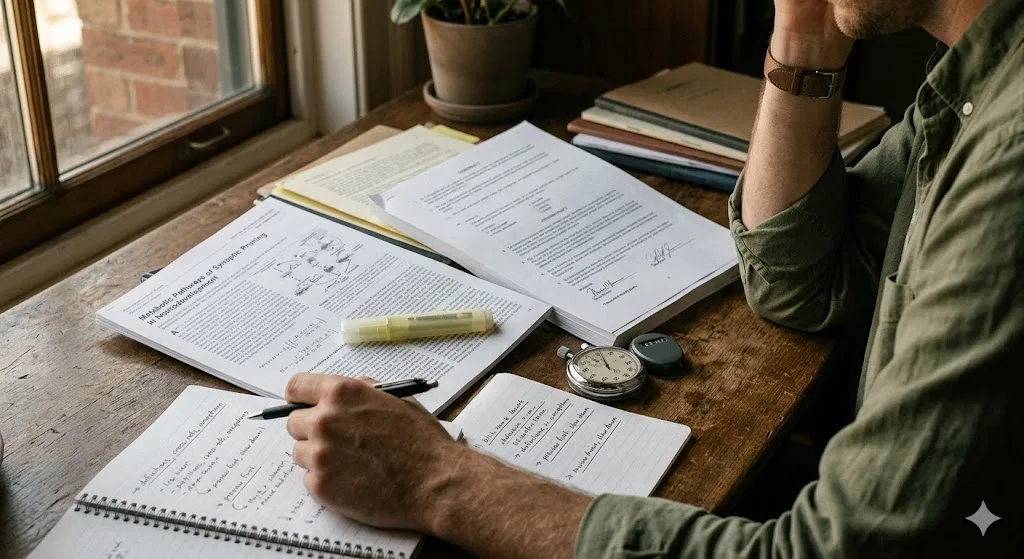
Dense texts slow readers because they ask the mind to do more than recognise words. A reader may need to hold a definition in memory, connect one sentence to a previous condition, check whether an example really follows from a result, or notice that a term is being used in a specialised sense. In ordinary prose, losing a minor phrase may not matter. In a contract, a lab protocol, a safety standard or a statistical result, a small qualifier can carry the risk, the exception or the entire claim.
Eye-movement research helps explain why slower reading is not merely a habit. In studies comparing regular reading, thorough reading and skimming, thorough reading involved longer total reading times and more rereading, and it produced higher comprehension scores. Skimming, by contrast, involved more word skipping and shorter reading times, but lower comprehension. The extra time was not wasted; it reflected the work of checking, integrating and repairing meaning.[PMC]pmc.ncbi.nlm.nih.govOne page of text: Eye movements during regular and thorough…by A Strukelj · 2018 · Cited by 87 — Thorough reading involved longer t…
The same pattern appears in specialised settings. A 2025 study of medical students reading clinical information found that skimming produced shorter reading times and poorer comprehension than reading for comprehension. More importantly, when statements were inaccurate, careful readers showed longer rereading times, suggesting that they were trying to integrate the text with clinical knowledge and detect conflict. During skimming, that sensitivity was weaker, which is precisely the danger in high-stakes material: the reader may get the gist while missing the flaw.[Springer Link]link.springer.comSpringer Linkinsights from experiments examining medical students' eye…by MA Soltan · 2025 · Cited by 1 — Reading times are shorter an…
Legal language gives a concrete example. MIT researchers reported that even lawyers preferred simplified legal documents, found them easier to understand, and did not see them as less enforceable. Other legal-language research points to centre-embedded clauses — interruptions inserted into the middle of a sentence — as especially damaging to comprehension because they break the main thread of meaning.[MIT News]news.mit.edunew study lawyers legalese 0529MIT NewsEven lawyers don't like legalese29 May 2023 — A new study shows lawyers find simplified legal documents easier to understand, mor…
For the reader trying to increase reading speed, the lesson is counterintuitive but useful: the fastest safe pace depends on the job. A dense paragraph that decides liability, diagnosis, reproducibility or system behaviour should be treated differently from a familiar news article. Speed improves when you stop spending close-reading effort on low-value passages, not when you rush through passages where precision is the point.
Previewing dense structure
Previewing is not the same as skimming for understanding. It is a short reconnaissance pass that tells you where to slow down later. Dense material often has a visible structure: headings, definitions, abstracts, methods, numbered clauses, tables, figures, footnotes, appendices, warnings, examples and exceptions. A preview lets the reader build a mental map before entering the difficult sentences.
Scientific papers make this especially clear. Guides from academic-skills centres commonly recommend treating research articles as structured documents rather than reading them as one continuous essay. The abstract gives a compressed preview, the introduction frames the question, the methods explain how the work was done, the results show what was found, and the discussion interprets the findings. Trent University’s guide warns that reading the abstract alone is not enough, but uses previewing as the first step in a process of understanding, analysing and reflecting.[Trent University]trentu.caTrent University Reading Scientific PapersTrent University Reading Scientific Papers
A useful preview of a scientific or technical text asks a few specific questions before close reading:
- What is the document trying to decide or prove? In a paper, this may be the research question or hypothesis; in a standard, it may be a requirement; in a contract, it may be an obligation or risk allocation.
- Where are the definitions? Dense texts often redefine familiar words. “Material”, “reasonable”, “significant”, “valid”, “shall”, “may” or “control” can carry technical meaning.
- Where are the exceptions and conditions? Speed often fails at “unless”, “except”, “provided that”, “subject to”, “notwithstanding” and similar pivots.
- Which sections are evidence, and which are interpretation? In a scientific paper, results and discussion do different jobs. In technical guidance, an example may not be a rule.
- What can be skimmed first and reread later? Tables, formulae, citations and appendices may be impossible to absorb in one pass, but they should be marked as places to return.
This previewing step can make reading faster overall because it reduces disorientation. Without a map, the reader may repeatedly stop to ask, “Why am I being told this?” With a map, slow reading becomes targeted. The reader is no longer trying to understand every sentence equally; they are identifying which sentences carry the load.
Why rereading is part of efficient reading
Many speed-reading systems treat regressions — looking back at earlier words or sentences — as a bad habit. In dense reading, that is often wrong. Looking back can mean that the reader has noticed ambiguity, contradiction or dependency. It is one of the ways comprehension repairs itself.
Research on eye movements has long shown that difficult passages and inconsistencies increase reading times, fixation counts and the likelihood of regressive eye movements. In other words, the eyes often go back because the mind has detected that the sentence has not yet fitted into a coherent interpretation.[ResearchGate]researchgate.netResearch Gate(PDF) Eye Movements as Reflections of ComprehensionResearch Gate(PDF) Eye Movements as Reflections of Comprehension
This is why “read it once, read it fast” advice works poorly for hard texts. Dense material may need layered passes:
- Orientation pass: identify the purpose, structure and difficult zones.
- Meaning pass: read the important sections slowly enough to paraphrase them.
- Verification pass: check definitions, figures, clauses, examples or source claims.
- Decision pass: decide what follows from the text and what remains uncertain.
The process may look slower line by line, but it can be faster at the task level. A reader who rushes through a scientific methods section and then misreads the result may lose more time later correcting the misunderstanding. A reader who pauses at a contract definition may avoid rereading the whole agreement under pressure.
Dense texts are hard partly because expertise is missing
A major reason dense texts feel slow is not just sentence length; it is unfamiliarity. Background knowledge helps readers predict what matters, recognise patterns and attach new information to an existing mental framework. Without it, every sentence does double duty: the reader must decode the words and build the subject matter at the same time.
Research summaries from the Association for Psychological Science report that background knowledge plays a key role in comprehension: readers with insufficient related knowledge are likely to struggle with text understanding. A study on prior knowledge and passage reading similarly notes that topic knowledge facilitates comprehension and can affect word identification during reading.[Association for Psychological Science]psychologicalscience.orgOpen source on psychologicalscience.org.
This explains a common historical pattern in professional reading. A junior lawyer may crawl through a clause that a senior solicitor reads quickly because the senior reader recognises the structure, the standard wording and the few words that depart from the norm. A first-year student may find a methods section almost unreadable, while a researcher in the field quickly separates routine procedure from the methodological choice that matters. The speed difference is not mainly eye speed; it is accumulated pattern recognition.
Scientific-paper research supports this experience. A study of readers’ perceptions of scientific literature found that inexperienced readers identified methods and results sections as particularly difficult and tended to undervalue their importance. That matters because methods and results often contain the evidence needed to judge whether the abstract’s headline claim is justified.[PMC]pmc.ncbi.nlm.nih.govOpen source on nih.gov.
The practical implication is encouraging. Dense reading gets faster through familiarity, but familiarity is built by careful encounters. Each slow paper, clause or technical note teaches recurring structures: how definitions are placed, how claims are qualified, how evidence is organised, and where authors hide uncertainty.
Building speed through familiarity
The best route to faster dense reading is not to remove carefulness; it is to make carefulness more fluent. This means developing the knowledge, vocabulary and structural expectations that reduce the amount of new processing required next time. Rayner and colleagues’ review of speed reading argues that maintaining high comprehension while getting through text faster comes from practice and becoming a more skilled language user, including having more vocabulary.[Sage Journals]journals.sagepub.comSage Journals So Much to Read, So Little TimeSage Journals So Much to Read, So Little Time
For dense texts, familiarity develops in three overlapping ways.
First, build a glossary as you read. A dense field often uses a limited set of recurring terms. The first encounter with “confidence interval”, “indemnity”, “material breach”, “null hypothesis”, “latency”, “throughput” or “contraindication” may require a pause. The tenth encounter should not. A short, personal glossary can turn future reading from translation into recognition.
Second, learn the document genre. Contracts have definitions, obligations, exclusions and remedies. Scientific papers have abstracts, methods, results and discussions, though the exact structure varies by field. Technical documentation has prerequisites, warnings, examples, parameters and failure modes. Genre knowledge lets the reader predict where information should be and which sections deserve slow attention.
Third, compare similar texts. Reading one technical standard slowly is hard; reading three related standards teaches what is boilerplate and what is distinctive. Reading one unfamiliar judgment is draining; reading several from the same legal area reveals recurring tests, authorities and patterns of reasoning. Familiarity narrows the unknown.
This kind of speed is less dramatic than speed-reading promises, but it is more durable. It does not depend on pretending that difficult sentences are easy. It changes the reader so that fewer sentences remain difficult.
How to choose the right slow pace
Not every dense-looking text deserves the same attention. A reader increasing reading speed needs a way to decide when to slow down and when to move on. The key question is not “Is this text hard?” but “What is the cost of missing something?”
Slow down when:
- the text creates obligations, risk, consent, safety or compliance duties;
- a definition controls the meaning of later sections;
- the author moves from evidence to interpretation;
- numbers, thresholds, dates, units or statistical claims affect the conclusion;
- a sentence contains exceptions, cross-references or qualifications;
- you would need to explain, apply or rely on the text later.
Move faster when:
- the passage is giving familiar background;
- you only need a first-pass map of the argument;
- examples repeat a point already understood;
- a citation list, appendix or table is not immediately relevant;
- you are deciding whether the document is worth deeper reading.
This is the historical-comparative difference between novice and expert reading. Experts are not slow everywhere. They are selective. They move quickly through recognised structure and slow sharply at consequential details. For a learner, the same selectivity can be practised deliberately: mark the load-bearing parts, read those closely, and avoid spending equal effort on every line.

What “faster” looks like with hard texts
With dense material, progress may not show up as a higher words-per-minute score. It may show up as fewer false starts, fewer complete rereads, better notes, quicker recognition of structure, and more accurate decisions about which parts deserve attention. That is still an increase in reading speed in the only sense that matters: more reliable understanding per unit of time.
A strong dense-reading session often looks like this:
- Preview the structure before close reading. Identify headings, definitions, claims, evidence and exceptions.
- State the reading purpose. Decide whether you need gist, application, critique, compliance, recall or decision support.
- Read load-bearing passages slowly. Do not rush definitions, methods, warnings, thresholds or exceptions.
- Paraphrase difficult claims. If you cannot restate a sentence in plain language, you probably have not understood it.
- Reread selectively. Return to the exact point of confusion rather than restarting the whole document.
- Leave a trace. Notes, margin comments, glossary entries and marked clauses make the next pass faster.
This approach preserves the central promise of increasing reading speed while rejecting its most damaging shortcut. The goal is not to read a legal clause, scientific result or technical warning as if it were light prose. The goal is to know when slowness is the efficient choice — and to become familiar enough with dense forms that careful reading gradually takes less effort.
Amazon book picks
Further Reading
Books and field guides related to Why Hard Texts Need Slower Reading. Use these as the next step if you want deeper reading beyond the article.
How to Read a Book
Rating: 4.0/5 from 41 Google Books ratings
Directly teaches adapting reading methods to difficult texts, including close and analytical reading.
Deep Work
Supports the focused attention and sustained concentration needed for dense technical and academic material.
Make It Stick
Explains comprehension, retention, and active processing strategies that complement slow, careful reading.
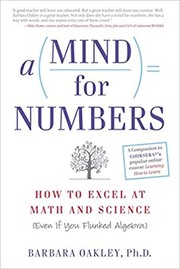
A Mind for Numbers
Shows practical approaches for working through difficult technical and scientific material without sacrificing understanding.
eBay marketplace picks
Marketplace Samples
Example marketplace items related to this page. Use the search link to explore similar finds on eBay.



Endnotes
1.
Source: pmc.ncbi.nlm.nih.gov
Link:https://pmc.ncbi.nlm.nih.gov/articles/PMC7198234/
Source snippet
One page of text: Eye movements during regular and thorough...by A Strukelj · 2018 · Cited by 87 — Thorough reading involved longer t...
2.
Source: link.springer.com
Link:https://link.springer.com/article/10.1186/s12909-025-08412-z
Source snippet
Springer Linkinsights from experiments examining medical students' eye...by MA Soltan · 2025 · Cited by 1 — Reading times are shorter an...
3.
Source: news.mit.edu
Title: new study lawyers legalese 0529
Link:https://news.mit.edu/2023/new-study-lawyers-legalese-0529
Source snippet
MIT NewsEven lawyers don't like legalese29 May 2023 — A new study shows lawyers find simplified legal documents easier to understand, mor...
Published: May 2023
4.
Source: researchgate.net
Title: Research Gate(PDF) Eye Movements as Reflections of Comprehension
Link:https://www.researchgate.net/publication/228625379_Eye_Movements_as_Reflections_of_Comprehension_Processes_in_Reading
5.
Source: pmc.ncbi.nlm.nih.gov
Link:https://pmc.ncbi.nlm.nih.gov/articles/PMC3142886/
6.
Source: pmc.ncbi.nlm.nih.gov
Link:https://pmc.ncbi.nlm.nih.gov/articles/PMC5746228/
7.
Source: researchgate.net
Link:https://www.researchgate.net/publication/399897944_Testing_the_Speed-Accuracy_Trade-Off_in_Reading_Effects_of_Reading_Speed_on_Comprehension_and_Eye_Movements
8.
Source: researchgate.net
Link:https://www.researchgate.net/publication/269816455_Construct_Validity_of_Careful_vs_Expeditious_Reading_Skills
9.
Source: researchgate.net
Link:https://www.researchgate.net/publication/378451771_PLAIN_LANGUAGE_INTERVENTION_TO_IMPROVE_PUBLIC_UNDERSTANDING_OF_LEGAL_LANGUAGE_DESCRIPTIVE_ANALYSIS_OF_CONTROVERSIAL_ARTICLES_IN_THE_JOB_CREATION_LAW
10.
Source: researchgate.net
Title: 390300289 Reading comprehension and semantic processing
Link:https://www.researchgate.net/publication/390300289_Reading_comprehension_and_semantic_processing
11.
Source: researchgate.net
Title: 286134733 What Makes It Difficult to Understand a Scientific Literature
Link:https://www.researchgate.net/publication/286134733_What_Makes_It_Difficult_to_Understand_a_Scientific_Literature
12.
Source: researchgate.net
Link:https://www.researchgate.net/publication/349683634_One_page_of_text_Eye_movements_during_regular_and_thorough_reading_skimming_and_spell_checking
13.
Source: researchgate.net
Title: 289918994 How to read scientific research articles A hands on classroom exercise
Link:https://www.researchgate.net/publication/289918994_How_to_read_scientific_research_articles_A_hands-on_classroom_exercise
14.
Source: researchgate.net
Link:https://www.researchgate.net/publication/290492746_So_Much_to_Read_So_Little_Time_How_Do_We_Read_and_Can_Speed_Reading_Help
15.
Source: discovery.researcher.life
Link:https://discovery.researcher.life/article/reading-comprehension-of-legal-texts-an-analysis-of-the-influence-of-lexico-grammatical-features-domain-knowledge-and-text-structure/4ea528fa963232a68898af2b1318bf49
16.
Source: pubmed.ncbi.nlm.nih.gov
Title: Pub Med How Do We Read, and Can Speed Reading Help?
Link:https://pubmed.ncbi.nlm.nih.gov/26769745/
Source snippet
by K Rayner · 2016 · Cited by 536 — The research shows that there is a trade-off between speed and accuracy. It is unlikely that re...
17.
Source: psychologicalscience.org
Title: speed reading
Link:https://www.psychologicalscience.org/publications/speed_reading.html
Source snippet
Association for Psychological ScienceSo Much to Read, So Little Time: How Do We...13 Jan 2016 — The report shows there is no quick and e...
18.
Source: trentu.ca
Title: Trent University Reading Scientific Papers
Link:https://www.trentu.ca/academicskills/how-guides/how-study/read-critically-and-efficiently/reading-scientific-papers
19.
Source: psychologicalscience.org
Link:https://www.psychologicalscience.org/news/releases/knowledge-reading-comprehension.html
20.
Source: journals.sagepub.com
Title: Sage Journals So Much to Read, So Little Time
Link:https://journals.sagepub.com/doi/abs/10.1177/1529100615623267
21.
Source: pmc.ncbi.nlm.nih.gov
Link:https://pmc.ncbi.nlm.nih.gov/articles/PMC12490762/
22.
Source: pmc.ncbi.nlm.nih.gov
Link:https://pmc.ncbi.nlm.nih.gov/articles/PMC7392212/
23.
Source: pmc.ncbi.nlm.nih.gov
Link:https://pmc.ncbi.nlm.nih.gov/articles/PMC9049824/
24.
Source: pmc.ncbi.nlm.nih.gov
Link:https://pmc.ncbi.nlm.nih.gov/articles/PMC7436780/
25.
Source: pmc.ncbi.nlm.nih.gov
Link:https://pmc.ncbi.nlm.nih.gov/articles/PMC6455959/
26.
Source: pmc.ncbi.nlm.nih.gov
Link:https://pmc.ncbi.nlm.nih.gov/articles/PMC4835101/
27.
Source: journals.sagepub.com
Link:https://journals.sagepub.com/doi/10.1177/1529100615623268
28.
Source: GOV.UK
Title: making sense of mode effects
Link:https://www.gov.uk/government/publications/making-sense-of-mode-effects/making-sense-of-mode-effects
29.
Source: education.qld.gov.au
Link:https://education.qld.gov.au/curriculums/Documents/literature-review.pdf
30.
Source: frontiersin.org
Link:https://www.frontiersin.org/journals/education/articles/10.3389/feduc.2023.1077882/full
31.
Source: hal.science
Link:https://hal.science/hal-05001737/document
32.
Source: education.nsw.gov.au
Link:https://education.nsw.gov.au/content/dam/main-education/about-us/educational-data/cese/2017-cognitive-load-theory-practice-guide.pdf
Additional References
33.
Source: law.georgetown.edu
Link:https://www.law.georgetown.edu/legal-ethics-journal/wp-content/uploads/sites/24/2024/03/GT-GJLE230044.pdf
Source snippet
Georgetown LawPlain Language in the Written Lawby L VAN BESIEN · Cited by 2 — 48 They discovered that, overall, legalese had a negative i...
34.
Source: bop.unibe.ch
Link:https://bop.unibe.ch/JEMR/article/download/Strukelj/Strukelj_final_pdf
Source snippet
BOP SerialsOne page of text: Eye movements during regular and...26 Feb 2018 — Thorough reading involved longer total reading times and m...
35.
Source: youtube.com
Title: How To Read Academic Literature Faster & Smarter Literature Review Tips
Link:https://www.youtube.com/watch?v=udCCGx1QywY
Source snippet
HOW TO READ FASTER WITH MORE FOCUS: 2 Essential Tips Revealed...
36.
Source: youtube.com
Title: HOW TO READ FASTER WITH MORE FOCUS: 2 Essential Tips Revealed
Link:https://www.youtube.com/watch?v=k7uM-x4tY0c
Source snippet
How To Read A Difficult Book - Superficial Reading...
37.
Source: youtube.com
Title: How to Read Anything Faster Than Everyone Else
Link:https://www.youtube.com/watch?v=qYkZJMRwFZo
Source snippet
How To Read Academic Literature Faster & Smarter Literature Review Tips...
38.
Source: academia.edu
Link:https://www.academia.edu/47446990/The_limits_of_plain_legal_language_understanding_the_comprehensible_style_in_law
39.
Source: facebook.com
Link:https://www.facebook.com/AngelaRaynerMP/?locale=en_GB
40.
Source: x.com
Link:https://x.com/AngelaRayner?lang=en
41.
Source: instagram.com
Link:https://www.instagram.com/angelaraynermp/?hl=en
42.
Source: academypublication.com
Link:https://www.academypublication.com/issues/past/tpls/vol03/06/02.pdf
Topic Tree
Follow this branch
Parent topic
Faster ReadingRelated pages 11
- Benchmarks How Fast Do Adults Really Read?
- Inner Voice Should You Silence Your Inner Voice?
- Knowledge Why Familiar Topics Feel Faster to Read
- Measure The Reading Speed Test That Actually Helps
- Myths Why Speed Reading Promises Fall Apart
- Phrases Read Phrases, Not Just Words
- Practice Can Rereading Make You Faster?
- Purpose When Should You Slow Down or Skim?
- +3 more in sidebar