Within Slow First
When Lookbacks Tell You to Slow Down
Backward lookbacks are often a repair signal, and noticing them early can help readers adjust pace before confusion expands.
On this page
- What regressions do during normal reading
- Warning signs before large backtracking starts
- Simple pace adjustments at confusing points
Page outline Jump by section
Introduction
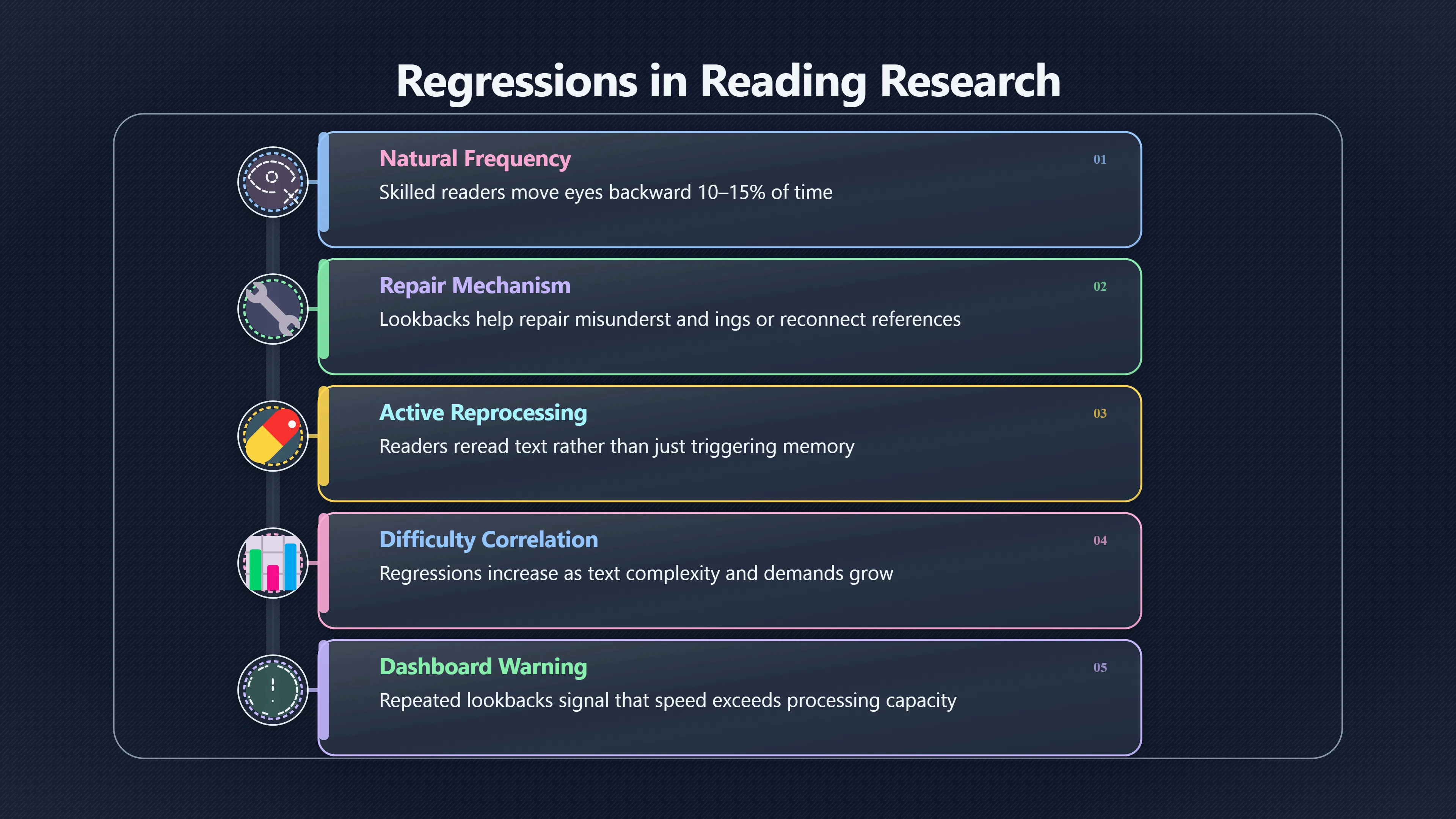
One of the most useful signals that a reader should slow down is not a feeling of confusion but the appearance of repeated lookbacks. In reading research, these backward eye movements are called regressions. They occur naturally in skilled reading and are not signs of failure. In fact, readers move their eyes backwards roughly 10–15% of the time, often to repair a misunderstanding, reconnect a reference, or verify a relationship between ideas.[Frontiers for Young Minds+2PMC]kids.frontiersin.orgFrontiers for Young MindsEye Movements During Reading2 Feb 2023 — To “regress” means to go back. Backwards eye movements happen about 10–…
 For people trying to increase reading speed, the important question is not whether regressions occur but what they are signalling. A small, targeted lookback can be a warning that comprehension is becoming unstable. Noticing that warning early and slightly reducing pace can prevent much larger backtracking later. The goal is to treat regressions as feedback from the reading process rather than as mistakes that must be eliminated.
What Regressions Do During Normal Reading
Reading is not a smooth left-to-right sweep across a page. The eyes pause, jump forward, occasionally skip words, and sometimes move backwards. These backward movements become more common when text is difficult, ambiguous, or unexpectedly complex.[Scholarpedia]scholarpedia.orgEye movementsEye movements17 Sept 2007 — Eye movements in reading. During… 10-15% of the time readers move their eyes (regress) back to…
Research suggests that regressions often support comprehension by allowing readers to reprocess information that was not adequately integrated during the first pass. Studies examining the function of regressions found evidence that readers use them to reread text itself rather than merely to trigger memory of previously seen words.[PubMed+2Springer]pubmed.ncbi.nlm.nih.govThe function of these "regressions" is still largely unknownThe function of regressions in reading: backward eye…by RW Booth · 2013 · Cited by 132 — Standard text reading involves frequent…
This distinction matters. If a reader briefly looks back to confirm a definition or reconnect a pronoun with its referent, the regression is performing useful work. The problem is not the lookback. The problem is continuing at the same pace when the lookback indicates that processing demands have increased.
A useful mental model is that regressions act like a dashboard warning light. They do not automatically mean something is wrong, but repeated warnings suggest that current reading speed may no longer match text difficulty.
Which Lookbacks Signal a Need to Slow Down?
Not every regression deserves attention. Skilled readers make many brief regressions that resolve immediately. The more important cues are patterns.
Several signs suggest that slowing down may be more efficient than maintaining speed:
- Repeated returns to the same sentence. If your eyes repeatedly revisit one location, the obstacle is probably conceptual rather than visual.
- Lookbacks after unfamiliar terms. Technical vocabulary, specialised definitions, and newly introduced concepts often require extra processing.
- Regressions at logical transitions. Words such as “however”, “unless”, “except”, and “therefore” frequently signal relationships that need careful integration.
- Frequent checks of earlier references. If you repeatedly return to identify who, what, or which idea a sentence refers to, the text may be exceeding your current processing pace.
- A growing chain of small regressions. Multiple short lookbacks within a few paragraphs can signal that understanding is becoming fragmented before confusion is consciously noticed.
Eye-tracking research consistently shows that regressions increase as text difficulty rises and as comprehension demands grow. More difficult material tends to produce longer fixations, shorter forward jumps, and more backward movements.[Scholarpedia+2Deep Blue]scholarpedia.orgEye movementsEye movements17 Sept 2007 — Eye movements in reading. During… 10-15% of the time readers move their eyes (regress) back to…
The practical lesson is that regressions often appear before a reader fully realises that comprehension is weakening.
Warning Signs Before Major Backtracking Begins
Large-scale rereading rarely appears without warning. More often, it is preceded by smaller signals that go unnoticed.
One common pattern occurs when a reader can still understand individual sentences but starts losing the connections between them. The eyes may briefly return to earlier phrases, then move forward again. Because overall comprehension still feels intact, the reader continues at the same speed. Several paragraphs later, the argument collapses and a major restart becomes necessary.
Research on comprehension monitoring suggests that regressions are closely linked to detecting inconsistencies and triggering re-analysis. Readers who actively monitor meaning often show targeted returns to relevant text when something does not fit their developing understanding.[Oxford University Research Archive]ora.ox.ac.ukThis seems to reflect sensitivity to comprehension monitoringford University Research ArchiveComprehension monitoring during reading: an eye-tracking…March 27, 2020 — by AK Hessel · 2020 · Cite…
In practical terms, useful warning signs include:
- Feeling the need to verify details more than once.
- Re-reading transition phrases to check how ideas connect.
- Remembering individual facts but not the overall argument.
- Frequently asking yourself, “How does this relate to the previous point?”
- Looking back even though you have not yet reached a point of obvious confusion.
These signals suggest that working memory is carrying a heavier load than usual. Slowing slightly at that moment is often cheaper than reconstructing the argument later.
Simple Pace Adjustments at Confusing Points
Useful slowing is usually modest. It does not require switching into extremely careful reading mode.
When regressions begin appearing more frequently, a reader can make several small adjustments:
Reduce Speed Around Structural Information
Definitions, qualifications, exceptions, and causal links often deserve a slower pass than surrounding text. These elements frequently determine how later material should be interpreted.
Instead of slowing for an entire chapter, slow for the sentence that introduces a key concept.
Pause Briefly After Dense Sentences
A short pause can sometimes replace a regression. Allowing a few seconds for integration may help working memory organise relationships before the next idea arrives.
This is particularly useful in academic papers, legal documents, technical manuals, and analytical writing.
Read for Relationships Rather Than Individual Facts
When regressions cluster around a passage, ask what relationship the author is establishing:
- Cause and effect?
- Definition and example?
- Claim and evidence?
- Rule and exception?
Identifying the relationship often resolves the need for repeated lookbacks.
Match Pace to Information Density
A page containing familiar examples can often be read quickly. A paragraph introducing several new concepts may require a slower rhythm.
Eye-movement research shows that readers naturally adjust fixation duration and regression behaviour in response to difficulty. Deliberately supporting that adjustment can improve overall efficiency.[Scholarpedia+2ResearchGate]scholarpedia.orgEye movementsEye movements17 Sept 2007 — Eye movements in reading. During… 10-15% of the time readers move their eyes (regress) back to…
Why Useful Slowing Can Increase Reading Speed
A common misconception is that any slowdown reduces efficiency. The evidence from reading research points to a more nuanced picture.
Regressions are part of normal reading, and many of them help readers build accurate understanding. Problems arise when readers ignore repeated regression cues and continue moving forward at a pace that exceeds their ability to integrate information. At that point, comprehension repair becomes larger, more expensive, and more disruptive.[PubMed+2MDPI]pubmed.ncbi.nlm.nih.govThe function of these "regressions" is still largely unknownThe function of regressions in reading: backward eye…by RW Booth · 2013 · Cited by 132 — Standard text reading involves frequent…
The fastest readers are not necessarily those who eliminate regressions. They are often the readers who recognise when a regression is signalling genuine processing difficulty and adjust before confusion spreads. A slight reduction in pace at the right moment can prevent an entire page of unnecessary rereading later.
In that sense, the most valuable lookbacks are not interruptions to reading speed. They are early-warning signals that help preserve it.
Amazon book picks
Further Reading
Books and field guides related to When Lookbacks Tell You to Slow Down. Use these as the next step if you want deeper reading beyond the article.
How to Read a Book
Rating: 4.0/5 from 41 Google Books ratings
Supports strategic rereading and purposeful review.
Deep Work
Encourages attention management that reduces costly comprehension breakdowns.

Reading Mind
First published 2017. Subjects: Reading, Reading comprehension, Cognitive psychology.
eBay marketplace picks
Marketplace Samples
Example marketplace items related to this page. Use the search link to explore similar finds on eBay.


Endnotes
1.
Source: pmc.ncbi.nlm.nih.gov
Link:https://pmc.ncbi.nlm.nih.gov/articles/PMC2906818/
Source snippet
Eye Movements in Reading: Models and Data - PMC - NIHFifth, readers make regressions (saccades backwards to look at words that occurre...
2.
Source: scholarpedia.org
Title: Eye movements
Link:https://www.scholarpedia.org/article/Eye_movements
Source snippet
Eye movements17 Sept 2007 — Eye movements in reading. During... 10-15% of the time readers move their eyes (regress) back to...
3.
Source: link.springer.com
Link:https://link.springer.com/article/10.3758/s13421-012-0244-y
Source snippet
function of regressions in reading: Backward eye...by RW Booth · 2013 · Cited by 134 — These results suggest that readers use regression...
4.
Source: researchgate.net
Link:https://www.researchgate.net/publication/228625379_Eye_Movements_as_Reflections_of_Comprehension_Processes_in_Reading
Source snippet
ResearchGate(PDF) Eye Movements as Reflections of Comprehension...Due to its high precision and non-intrusive nature, eye tracking has e...
5.
Source: pmc.ncbi.nlm.nih.gov
Link:https://pmc.ncbi.nlm.nih.gov/articles/PMC6235565/
Source snippet
by JR Folk · 2018 · Cited by 9 — This paper describes how to design materials to distinguish between regressions caused by comprehensi...
6.
Source: mdpi.com
Link:https://www.mdpi.com/2411-5150/3/3/35
Source snippet
Regressions during Readingby AW Inhoff · 2019 · Cited by 74 — In the most effective model, encoding and reprocessing were also strong...
7.
Source: researchgate.net
Link:https://www.researchgate.net/publication/355138336_The_Relation_between_Reading_Performance_and_Eye_Movement_Parameters_of_High-Skilled_and_Low-Skilled_Readers
Source snippet
skilled readers, and the average number of regressions. into AOI was 43.6... Eye-tracking methods have become a valuable tool for readin...
8.
Source: researchgate.net
Link:https://www.researchgate.net/publication/230658181_The_function_of_regressions_in_reading_Backward_eye_movements_allow_rereading
Source snippet
ue their memory for previously read words.Read more...
9.
Source: researchgate.net
Title: Eye movements during reading: Some current controversies
Link:https://www.researchgate.net/publication/12047093_Eye_movements_during_reading_Some_current_controversies
Source snippet
regressions' back to previously read text about 10-15% of the time. 16,21 Since information is acquired during pxations, a characteristic...
10.
Source: mdpi.com
Title: 2226 471X
Link:https://www.mdpi.com/2226-471X/9/12/360
Source snippet
Tracking Adults' Eye Movements to Study Text...by G Andreou · 2024 · Cited by 7 — Research has shown that better reading comprehension i...
11.
Source: kids.frontiersin.org
Link:https://kids.frontiersin.org/articles/10.3389/frym.2023.769381
Source snippet
Frontiers for Young MindsEye Movements During Reading2 Feb 2023 — To “regress” means to go back. Backwards eye movements happen about 10–...
12.
Source: pubmed.ncbi.nlm.nih.gov
Title: The function of these “regressions” is still largely unknown
Link:https://pubmed.ncbi.nlm.nih.gov/22886737/
Source snippet
The function of regressions in reading: backward eye...by RW Booth · 2013 · Cited by 132 — Standard text reading involves frequent...
13.
Source: deepblue.lib.umich.edu
Link:https://deepblue.lib.umich.edu/bitstreams/70109e05-1d8d-4bbc-933a-c168048774fb/download
Source snippet
Dodwell, 1979; Rayner & Pollatsek, 1998) and regressions often occur...Read more...
14.
Source: ora.ox.ac.uk
Title: This seems to reflect sensitivity to comprehension monitoring
Link:https://ora.ox.ac.uk/objects/uuid%3Aa16f42e2-529d-47ae-ba51-50b75dd43899/files/rkh04dp70d
Source snippet
ford University Research ArchiveComprehension monitoring during reading: an eye-tracking...March 27, 2020 — by AK Hessel · 2020 · Cite...
Published: March 27, 2020
15.
Source: Wikipedia
Link:https://en.wikipedia.org/wiki/Eye
Source snippet
EyeAn eye is a sensory organ that allows an organism to perceive visual information. It detects light and converts it into electro-che...
16.
Source: pmc.ncbi.nlm.nih.gov
Link:https://pmc.ncbi.nlm.nih.gov/articles/PMC12409514/
Source snippet
the rereading effect of digital reading through eye...by Y Xu · 2025 — The goal of this study is to investigate the differences in eye m...
17.
Source: pmc.ncbi.nlm.nih.gov
Link:https://pmc.ncbi.nlm.nih.gov/articles/PMC7888242/
Source snippet
Cognitive Model of Regressive Eye Movements during...by AF Weiss · 2020 · Cited by 9 — In the following, we will therefore propose a new...
18.
Source: kids.frontiersin.org
Link:https://kids.frontiersin.org/articles/10.3389/frym.2024.1237161
Source snippet
the Mental Effort of Reading Using Eye-...25 Jun 2024 — Scientists have explored the effects of cognitive workload on reading comprehens...
Additional References
19.
Source: facebook.com
Link:https://www.facebook.com/groups/FountasPinnell/posts/1815644225363041/
20.
Source: studenttheses.universiteitleiden.nl
Link:https://studenttheses.universiteitleiden.nl/access/item%3A2629036/view
Source snippet
eye movements to predict reading skills in childrenIn the present eye tracking study, we collected eye movements of school-aged children...
21.
Source: readlite.in
Title: These backward movements are called regressions. Eye-tracking research has
Link:https://readlite.in/concepts/regressions-reading/
Source snippet
Regressions in Reading: Why Your Eyes Jump Back (And Should)About 10-15% of the time, your eyes jump backward to text you've already passed...
22.
Source: users.cecs.anu.edu.au
Link:https://users.cecs.anu.edu.au/~Tom.Gedeon/pdfs/The%20effect%20of%20subject%20familiarity%20on%20comprehension%20and%20eye%20movements%20during%20reading.pdf
Source snippet
(Rayner, 1998). These backward saccades are termed regressions. Short regressions can occur within...Read...
23.
Source: readlite.in
Title: What Eye-Tracking Research Reveals About Reading
Link:https://readlite.in/concepts/eye-tracking-reading-research
Source snippet
regression tells us something about what's happening in the reader's mind. This makes eye tracking one of the most powerful tools in cogn...
24.
Source: d-nb.info
Link:https://d-nb.info/1227301006/34
Source snippet
Comprehension demands modulate re-reading, but not first...by AF Weiss · Cited by 58 — Abstract: Several studies have examined effects o...
25.
Source: cognitivetrain.com
Title: Some readers regress even more
Link:https://cognitivetrain.com/regression-in-reading/
Source snippet
Regression in Reading: Why Your Eyes Keep Going...Eye-tracking research shows that regressions account for 10-15% of all eye movements d...
27.
Source: youtube.com
Title: What Can Our Eyes Tell Us About Language? Eye Tracking
Link:https://www.youtube.com/watch?v=uXx73W0uyCg
Source snippet
The Brain's Challenge: Processing: What Eye Movements During Reading Reveal About Processing Speed...
28.
Source: summerreading.net
Link:https://summerreading.net/visual-processing-and-brain-based-learning
Source snippet
Visual Processing and Brain-Based Learning10 Jul 2018 — About 10-15% of the time, readers also shift back (known as regression) to look b...
Topic Tree