Within Measure
Why one reading speed number is misleading
Separate records for fiction, general articles, dense nonfiction, and technical text make progress easier to see and harder to fake.
On this page
- How text type changes normal reading speed
- What to track for each reading profile
- How separate records prevent unfair comparisons
Page outline Jump by section
Introduction
A single words-per-minute (WPM) score can make reading progress look better or worse than it really is. The same reader will typically move faster through a familiar novel than through a scientific paper, legal document, or technical manual. Research reviews of adult reading rates consistently find different average speeds for fiction and non-fiction, even before individual differences are considered. One large meta-analysis estimated average silent reading rates of about 260 WPM for fiction and 238 WPM for non-fiction, with substantial variation within each category.[ResearchGate]researchgate.netResearch Gate(PDF) How many words do we read per minute?A review…15 Aug 2019 — We estimate that the average silent reading rate for adults in English is 238 words per minute (wpm) for non-fi…
 For anyone trying to increase reading speed without sacrificing comprehension, the most useful approach is to keep separate records for different kinds of text. Instead of asking, “What is my reading speed?”, ask, “How fast do I read fiction, general articles, dense non-fiction, and technical material while still understanding them?” That distinction produces fairer comparisons and reveals where improvement is actually happening.
How text type changes normal reading speed
Reading speed is not a fixed personal trait. It changes according to vocabulary, sentence structure, subject familiarity, and the amount of reasoning required.
Fiction often contains more familiar language, narrative structure, and contextual clues. Readers can predict what is happening more easily, which helps maintain a faster pace. Non-fiction frequently contains longer words, denser information, and more concept-heavy passages. Brysbaert’s review concluded that part of the average speed difference between fiction and non-fiction can be explained by the longer words commonly found in non-fiction texts.[Semantic Scholar]semanticscholar.orgSemantic Scholar How many words do we read per minute?A review and…Based on the analysis of 190 studies (18573 participants), we estimate that the average silent reading rate for adults in…
The gap becomes even larger when moving from general non-fiction into specialised material. A magazine article about nutrition, for example, usually demands less effort than a research paper discussing study design, statistical methods, and biological mechanisms. Readers naturally slow down because they are processing ideas, not because they have suddenly become worse readers.
Research on text complexity repeatedly finds that more difficult texts reduce fluency and can impair recall and comprehension if readers try to maintain the same pace they use on easier material. Studies examining text complexity have shown negative effects on reading outcomes, particularly fluency and free recall, as complexity increases.[Springer Link]link.springer.comSpringer LinkUnderstanding the influence of text complexity and question…9 Jul 2018 — Text complexity negatively impacted reading outc…
This means that a drop in WPM is often a sign of appropriate adaptation rather than poor performance. A reader who slows from 280 WPM on fiction to 180 WPM on technical documentation may be reading efficiently in both situations.
What to track for each reading profile
Separate records work best when each category reflects a genuine reading purpose.
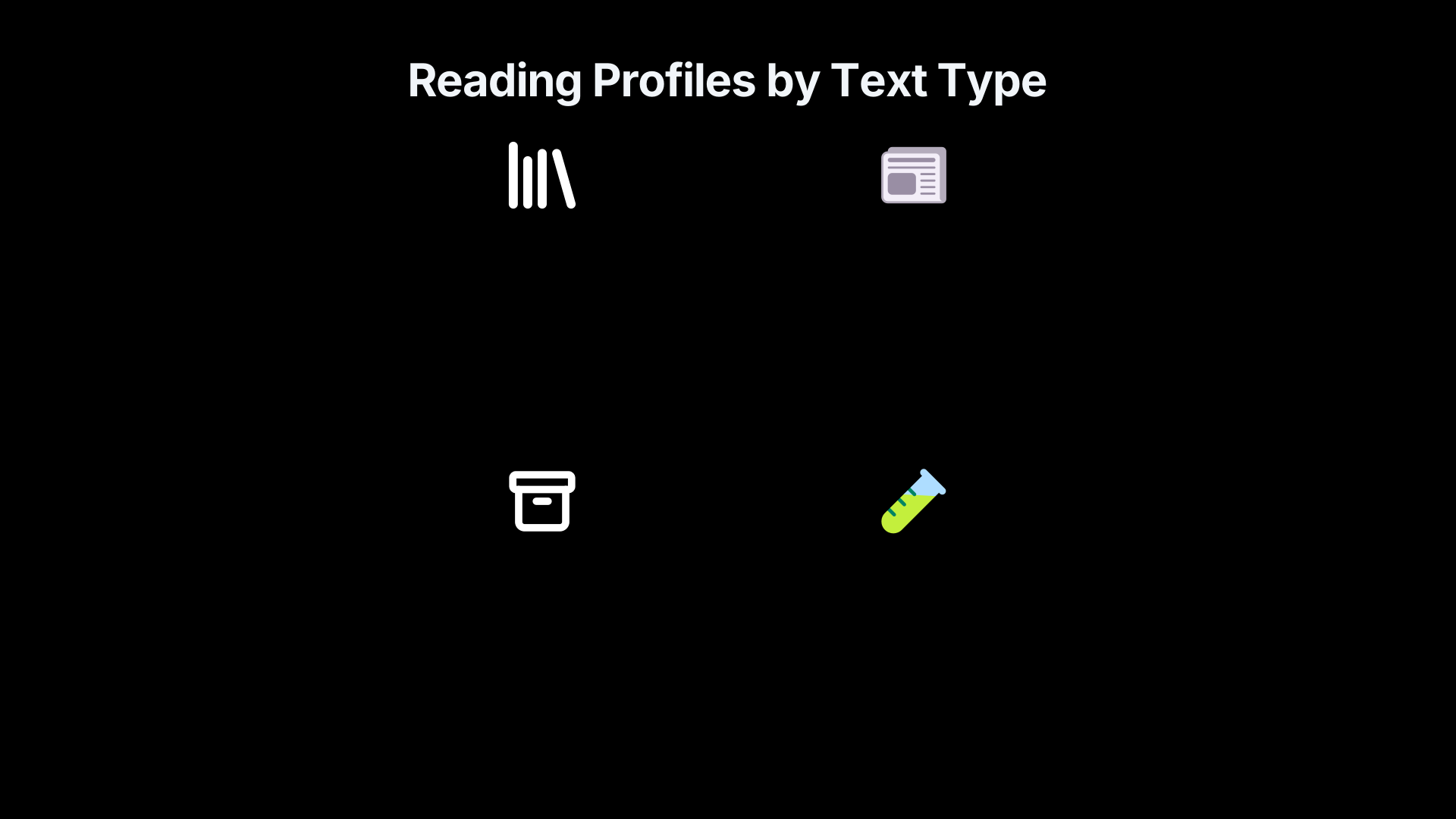
A practical system is to maintain four profiles:
ProfileTypical examplesMain goalFictionNovels, short stories, narrative non-fictionFollowing narrative and themesGeneral articlesNews, magazines, blogs, popular scienceUnderstanding ideas efficientlyDense non-fictionHistory, philosophy, academic booksRetaining arguments and evidenceTechnical textManuals, textbooks, scientific papers, professional documentsAccurate understanding and application
For each profile, record:
- WPM on previously unseen material.
- A brief comprehension score or recall check.
- The text source and approximate difficulty.
- Whether the subject was familiar or unfamiliar.
- The reading purpose (study, work, information gathering, leisure).
Keeping these details prevents misleading trends. A jump from 220 to 270 WPM may look impressive until you discover the newer text was a familiar blog article rather than a demanding chapter from a textbook.

Why technical and dense texts deserve their own category
Many readers make the mistake of treating all non-fiction as one group. In practice, dense explanatory writing and technical material often behave differently.
Technical texts frequently contain:
- Domain-specific vocabulary.
- Diagrams, tables, and equations.
- High information density.
- Concepts that depend on prior knowledge.
- Sentences that must be interpreted precisely.
When these features appear, reading speed becomes partly a knowledge problem rather than a fluency problem. A software engineer may read programming documentation quickly but slow dramatically when reading a legal contract. A medical student may move comfortably through anatomy notes but struggle with unfamiliar biostatistics material.
Research examining reading speed and comprehension has repeatedly shown that speed alone is not a reliable predictor of understanding. Readers often adjust pace according to task demands, and comprehension can remain stable across a range of speeds until demands exceed the reader’s processing capacity.[American Psychological Association+2PubMed]apa.orgxlm 0000030However, reading speed is not a consistent predictor of text comprehension…Read more…
Separate technical-text records therefore help identify whether slower performance reflects genuine reading limitations or simply the cognitive demands of the material.
How separate records prevent unfair comparisons
A single blended score creates several distortions.
First, it hides genuine improvement. Imagine a reader whose article-reading speed rises from 210 to 260 WPM while technical reading remains near 170 WPM. Averaging everything together may show only a small overall increase, masking meaningful progress in one area.
Second, it encourages accidental cherry-picking. If every test uses different material, readers can create the appearance of rapid improvement simply by choosing easier texts. Separate categories make such comparisons more transparent.
Third, it prevents false discouragement. Many people believe they are regressing when they encounter harder material and see their WPM fall. In reality, they may be reading at exactly the right speed for that type of text.
A useful analogy is athletic training. A runner would not compare sprint times directly with marathon pace. Both are running, but the demands differ. Reading profiles work the same way. Fiction, general articles, dense non-fiction, and technical documents place different demands on attention, vocabulary, memory, and reasoning.

What progress looks like across profiles
The most informative pattern is usually not identical improvement everywhere.
You might see:
- Fiction speed rising because eye movements and general fluency improve.
- General article speed rising through greater confidence and reduced regression.
- Dense non-fiction speed increasing only slightly, while comprehension improves significantly.
- Technical reading speed remaining stable while accuracy and retention improve.
From a comprehension-first perspective, all of these can represent success.
Research on reading rate consistently suggests that reading behaviour should be interpreted alongside understanding rather than in isolation. Faster reading is valuable only when meaning is preserved.[Biblio+2ResearchGate]biblio.ugent.beBiblio How many words do we read per minute?A review and meta…by M Brysbaert · 2019 · Cited by 879 — For silent reading of English non-fiction most adults fall in the range of 17…
That is why separate WPM records by text type are one of the clearest progress measures available. They acknowledge that reading speed is context-dependent, make comparisons fairer, and reveal where real gains are occurring instead of reducing every reading experience to a single, misleading number.
Amazon book picks
Further Reading
Books and field guides related to Why one reading speed number is misleading. Use these as the next step if you want deeper reading beyond the article.
How to Read a Book
Rating: 4.0/5 from 41 Google Books ratings
Explains why different text types require different reading approaches.

eBay marketplace picks
Marketplace Samples
Example marketplace items related to this page. Use the search link to explore similar finds on eBay.
Endnotes
1.
Source: researchgate.net
Title: Research Gate(PDF) How many words do we read per minute?
Link:https://www.researchgate.net/publication/335174808_How_many_words_do_we_read_per_minute_A_review_and_meta-analysis_of_reading_rate
Source snippet
A review...15 Aug 2019 — We estimate that the average silent reading rate for adults in English is 238 words per minute (wpm) for non-fi...
2.
Source: link.springer.com
Link:https://link.springer.com/article/10.1007/s11145
Source snippet
Springer LinkUnderstanding the influence of text complexity and question...9 Jul 2018 — Text complexity negatively impacted reading outc...
3.
Source: researchgate.net
Link:https://www.researchgate.net/publication/395516282_Text_difficulty_in_extensive_reading_Reading_comprehension_and_reading_motivation
Source snippet
(PDF) Text difficulty in extensive readingThis study investigates the effects of the text difficulty of extensive reading materials on th...
4.
Source: researchgate.net
Title: (PDF) Speed vs
Link:https://www.researchgate.net/publication/389697923_Speed_vs_Understanding_A_Study_of_Student_Readers
Source snippet
Understanding: A Study of Student Readers9 Mar 2026 — This study aims to examine the significant effect of [skimming]({{ 'skimming/' | relative_url }}) reading technique on...
5.
Source: researchgate.net
Title: (PDF) How many words do we read per minute?
Link:https://www.researchgate.net/publication/332380784_How_many_words_do_we_read_per_minute_A_review_and_meta-analysis_of_reading_rate
Source snippet
A review...by M Brysbaert · Cited by 857 — The average oral reading rate (based on 77 studies and 5,965 participants) is 183 wpm. Within...
6.
Source: researchgate.net
Link:https://www.researchgate.net/figure/Distribution-of-reading-rates-for-fiction-books_fig4_335174808
Source snippet
Distribution of reading rates for fiction booksWe estimate that the average silent reading rate for adults in English is 238 words per mi...
7.
Source: researchgate.net
Title: 380693343 Text readability its impact on reading comprehension and reading time
Link:https://www.researchgate.net/publication/380693343_Text_readability_its_impact_on_reading_comprehension_and_reading_time
Source snippet
Text readability: its impact on reading comprehension and...18 May 2024 — The current study aimed to evaluate the influence of text read...
Published: May 2024
8.
Source: reading.com
Link:https://www.reading.com/
Source snippet
Teach Your Child To Read Early, Step by StepReading.com helps your child learn to read with a proven, step-by-step program. Start today a...
9.
Source: biblio.ugent.be
Title: Biblio How many words do we read per minute?
Link:https://biblio.ugent.be/publication/8647789
Source snippet
A review and meta...by M Brysbaert · 2019 · Cited by 879 — For silent reading of English non-fiction most adults fall in the range of 17...
10.
Source: semanticscholar.org
Title: Semantic Scholar How many words do we read per minute?
Link:https://www.semanticscholar.org/paper/How-many-words-do-we-read-per-minute-A-review-and-Brysbaert/35bf5854514ee63095a6a3dc4a7bdaa2eb18929f
Source snippet
A review and...Based on the analysis of 190 studies (18573 participants), we estimate that the average silent reading rate for adults in...
11.
Source: apa.org
Title: xlm 0000030
Link:https://www.apa.org/pubs/journals/features/xlm-0000030.pdf
Source snippet
However, reading speed is not a consistent predictor of text comprehension...Read more...
12.
Source: pubmed.ncbi.nlm.nih.gov
Link:https://pubmed.ncbi.nlm.nih.gov/24999710/
Source snippet
Role of Reading Time Complexity and Reading Speed...by S Wallot · 2014 · Cited by 126 — However, reading speed is not a consistent predi...
13.
Source: pubmed.ncbi.nlm.nih.gov
Link:https://pubmed.ncbi.nlm.nih.gov/33910411/
Source snippet
reading rate prediction with word length...by M Brysbaert · 2021 · Cited by 10 — Previous research in English has suggested that reading...
14.
Source: Wikipedia
Link:https://en.wikipedia.org/wiki/Reading
Source snippet
ReadingReading is the process of taking in the sense or meaning of symbols, often specifically those of a written language, by means o...
Additional References
15.
Source: theamericanscholar.org
Link:https://theamericanscholar.org/reading-fast-and-slow/
Source snippet
Reading Fast and SlowA few empirical studies do suggest that reading speeds far beyond 500 words a minute can be attained, though these s...
16.
Source: rcps-cr.org
Link:https://rcps-cr.org/?lang=en&p=2371
Source snippet
Reading Fast is not always the same as UnderstandingAn exploratory research question was formulated to evaluate whether speed is still pr...
17.
Source: essentialskills.com
Title: the impact of fluency on reading comprehension how does reading speed matter
Link:https://essentialskills.com/blog/the-impact-of-fluency-on-reading-comprehension-how-does-reading-speed-matter/
Source snippet
The Impact of Fluency on Reading Comprehension17 Apr 2024 — Increased fluency is linked to better reading comprehension because it allows...
18.
Source: scribd.com
Link:https://www.scribd.com/presentation/898728179/Reading-Speed-and-Text-Complexity-1
Source snippet
• Fosters deeper analytical skills and understanding of data variability and distribution...Read more...
19.
Source: mdpi.com
Link:https://www.mdpi.com/2227-7102/14/8/854
Source snippet
The Influence of Format Readability on Children's Reading...by SL Day · 2024 · Cited by 23 — For reading comprehension, no speed–compreh...
20.
Source: textproject.org
Title: Does Text Complexity Matter in the Elementary Grades?
Link:https://textproject.org/wp-content/uploads/2022/07/Amendum-et-al.pdf
Source snippet
SJ Amendum · 2017 · Cited by 209 — The evidence for this shift—specifically, for how reading these complex texts affects students...
21.
Source: psychologicabelgica.com
Link:https://psychologicabelgica.com/articles/10.5334/pb.1189
Source snippet
No Correlation Between Articulation Speed and Silent...by M Brysbaert · 2023 · Cited by 12 — First, it was found that the average readin...
22.
Source: hmdpublishing.com
Link:https://hmdpublishing.com/education/tools/reading-time/non-fiction
Source snippet
Non-Fiction Reading Time Calculator | DurationAverage reading speed is 250 WPM, while comfortable listening speed is 150-160 WPM (1x audi...
23.
Source: reddit.com
Title: Ratio of reading fiction/non-fiction?
Link:https://www.reddit.com/r/books/comments/1768bsy/ratio_of_reading_fictionnonfiction/
Source snippet
r/booksWhat ratio do you try to read fiction and non-fiction? I am trying to read a little philosophy and other various non-fiction works...
24.
Source: irisreading.com
Title: How Fast Is Considered [Speed Reading]({{ ‘myths/’ | relative_url }})?
Link:https://irisreading.com/how-fast-is-considered-speed-reading/
Source snippet
(Quick Facts)Sep 24, 2022 — The general adult population read 150 – 250 words per minute, while adults with college education read 200 –...
Topic Tree