Within Phrases
The word groups that make sentences click
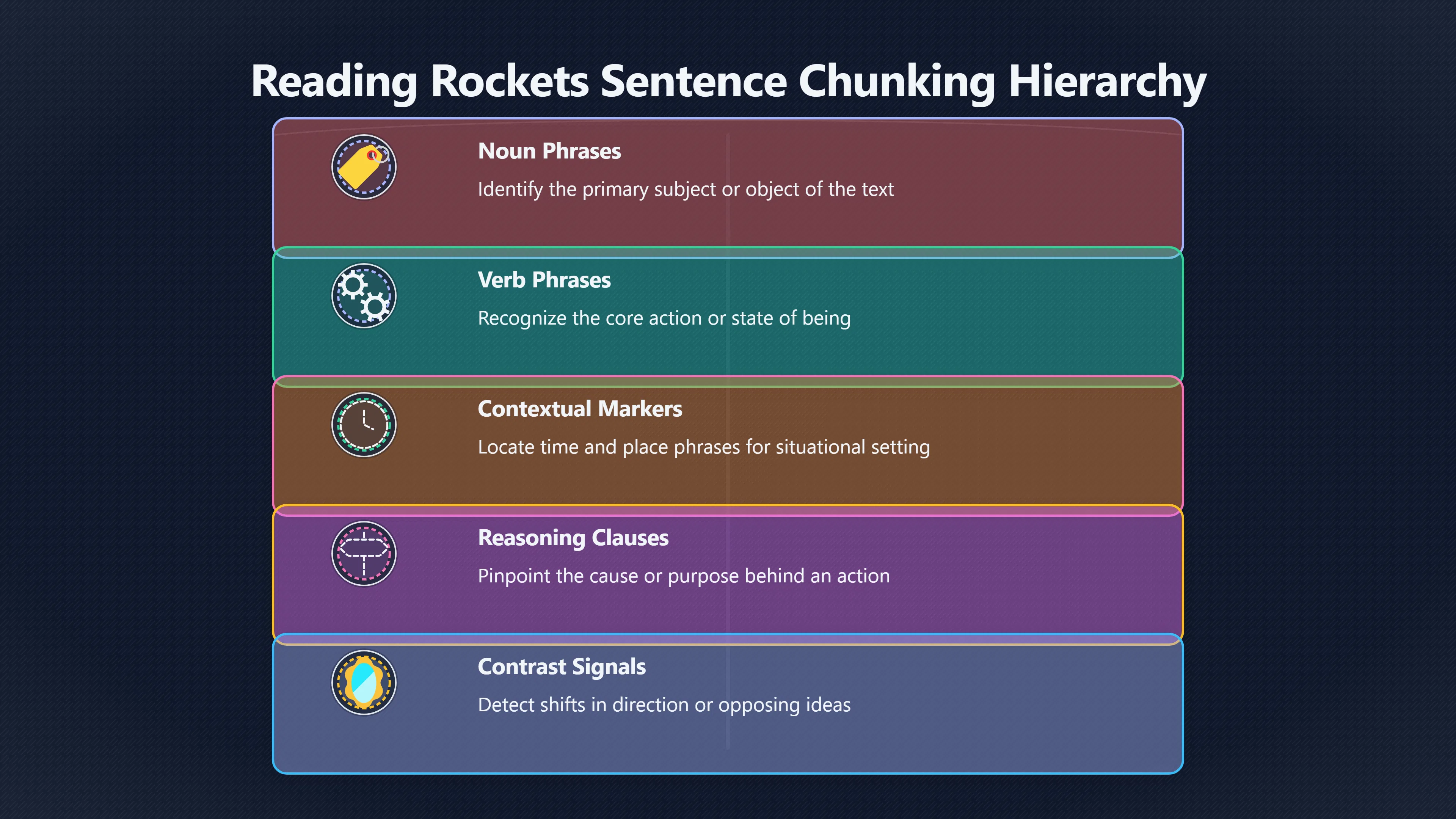
Noun phrases, verb phrases, time phrases, contrast signals, and embedded explanations are useful first targets for smoother reading.
On this page
- Who or what the sentence is about
- Actions, settings, and reasons
- Linking phrases and embedded explanations
Page outline Jump by section
Introduction
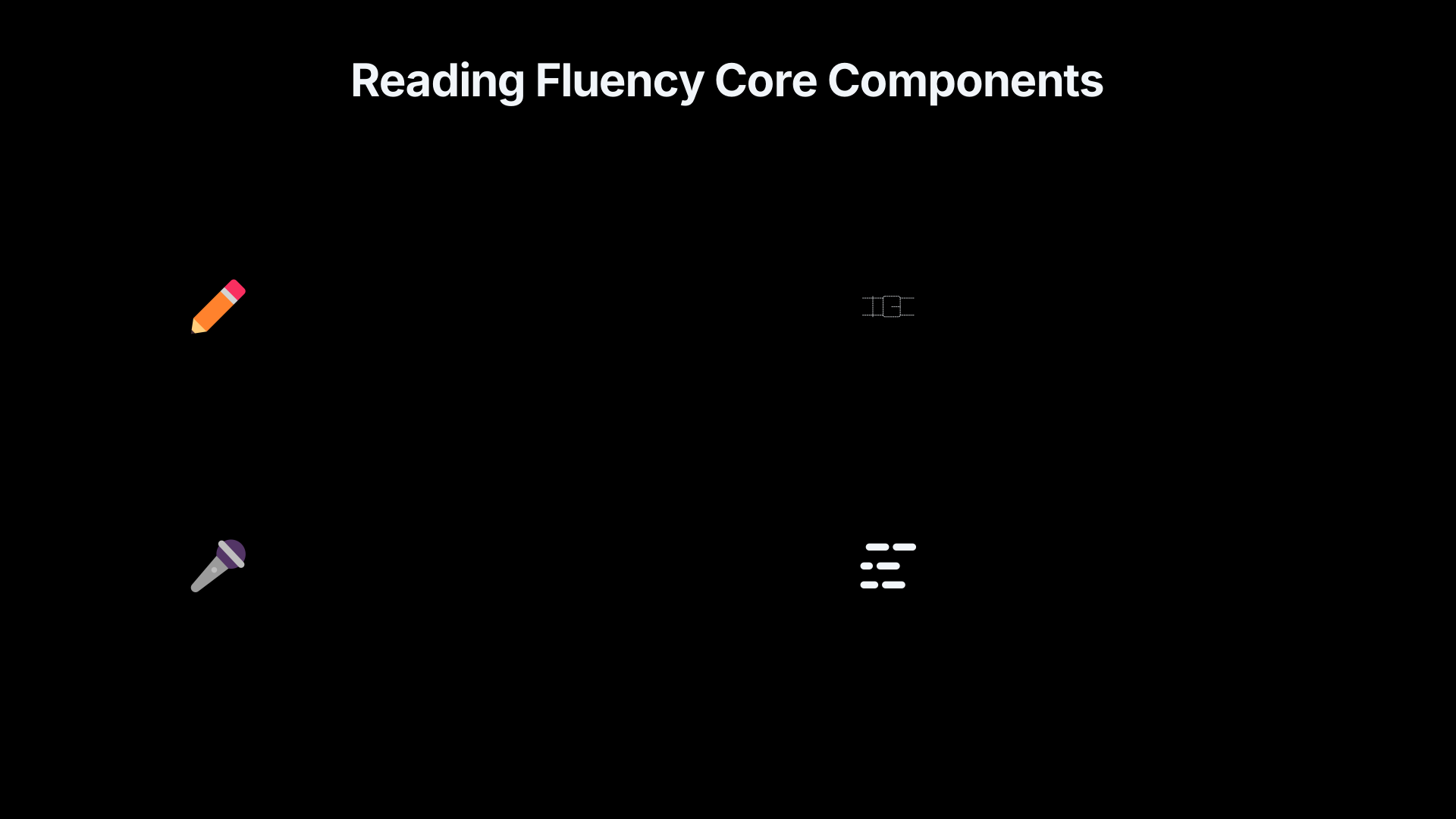
When readers first learn phrase reading, the biggest improvement often comes from noticing a few high-value word groups rather than trying to chunk every sentence perfectly. Most sentences become easier to understand and faster to process when you identify the groups that carry the main meaning: who or what the sentence is about, what is happening, when or why it is happening, and any signals that show a contrast or explanation.
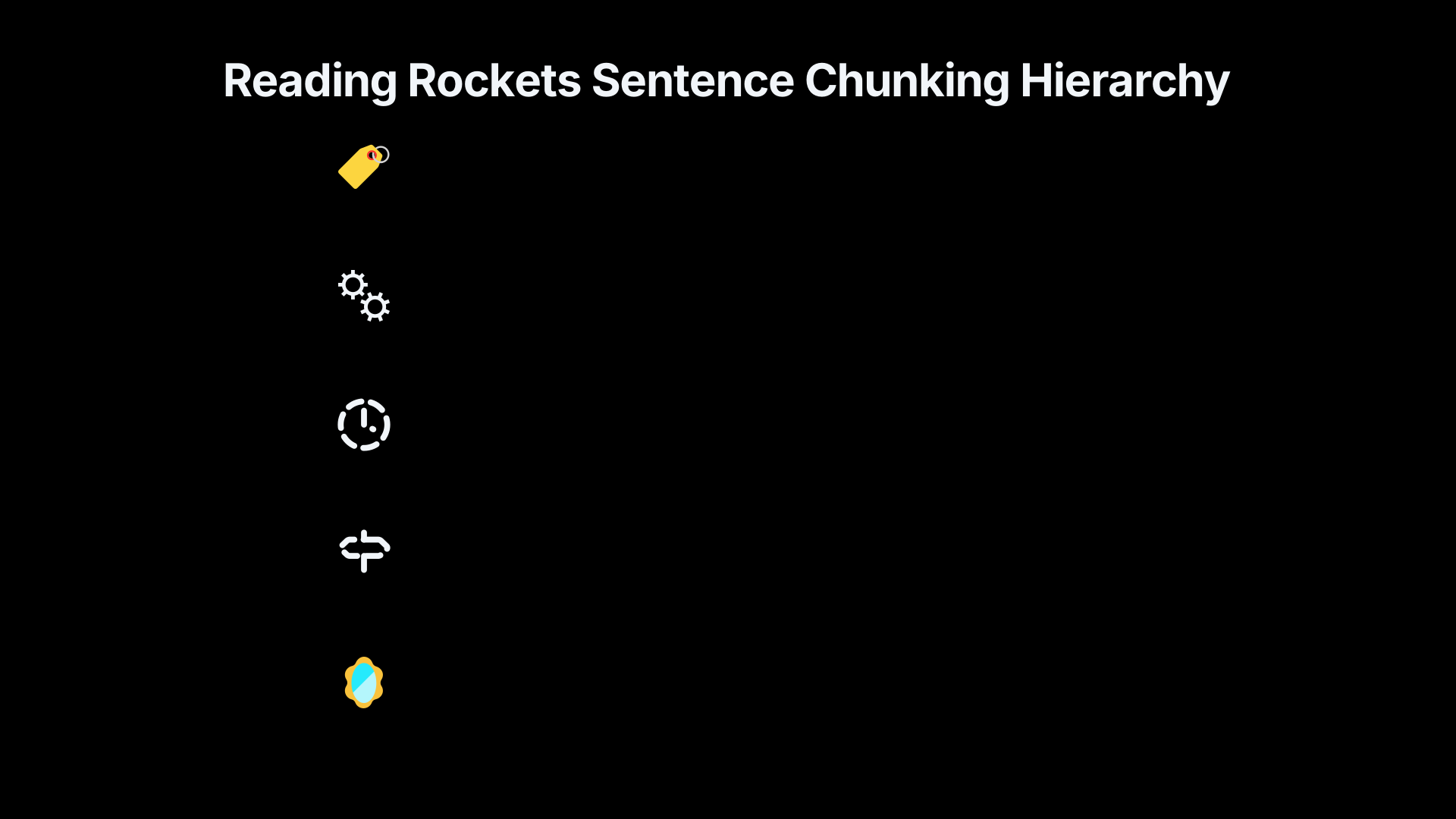 This matters because fluent reading depends on more than recognising individual words. Skilled readers naturally group words into meaningful units, allowing attention to stay on meaning rather than on decoding isolated words. Research on reading fluency consistently links accurate phrasing and prosody—the rhythm and grouping of language—to stronger comprehension and smoother reading.[Reading Rockets+2EEF]readingrockets.orgReading Rockets FluencyReading RocketsFluency: IntroductionFluency is the ability to read a text accurately, at a good pace, and with proper expression and comp…
Who or what the sentence is about
The first word groups worth spotting are noun phrases: groups of words that refer to a person, object, place, idea, or event.
Instead of treating each word separately, read the whole phrase as a single meaning unit.
Examples:[readingrockets.org]readingrockets.orgwhat teachers need know about sentence comprehensionReading RocketsWhat Teachers Need to Know about Sentence…16 Aug 2022 — They suggest that teaching students how to read sentences aloud…
- the exhausted rescue team
- a surprisingly simple solution
- the report from the finance department
- several of the older buildings
Consider this sentence:[centaur.reading.ac.uk]centaur.reading.ac.ukreading.ac.uk Working memory and L2 sentence processingmemory and L2 sentence processing - CentAURby I Cunnings · 2022 · Cited by 11 — In this chapter, I critically evaluate different models o…
The exhausted rescue team reached the village before dawn.
A word-by-word approach treats this as seven separate tasks. A phrase reader immediately sees:
The exhausted rescue team / reached the village / before dawn
The first chunk identifies the main subject of the sentence. Once that group is recognised, the rest of the sentence becomes easier to follow.
Long noun phrases are especially important because they often contain several descriptive words. Readers who fail to group them together may lose track of who or what the sentence concerns.
Compare:
- the proposal submitted by the regional planning committee
- the proposal / submitted / by / the / regional / planning / committee
The first reading preserves meaning. The second forces the reader to rebuild the idea repeatedly.
Actions, settings, and reasons
After identifying the subject, the next useful target is the verb phrase: the group that describes what is happening.
Examples include:
- has been improving steadily
- decided to postpone the launch
- was waiting near the entrance
- can be completed online
In fluent reading, these groups function as single actions rather than strings of separate words.
For example:
The research team has been improving the model for months.
The core action is not merely improving. The meaningful unit is:
has been improving
Seeing the whole action at once reduces the effort required to interpret tense, timing, and meaning.
Time phrases are another high-value group because they establish context quickly.
Examples:[readingrockets.org]readingrockets.orgwhat teachers need know about sentence comprehensionReading RocketsWhat Teachers Need to Know about Sentence…16 Aug 2022 — They suggest that teaching students how to read sentences aloud…
- before sunrise
- during the meeting
- over the next few weeks
- after the storm
In a sentence such as:
The company will release the update over the next few weeks.
The phrase over the next few weeks tells the reader when the action occurs. Treating it as one chunk is more efficient than processing each word separately.
Reason phrases work similarly:
- because of the weather
- due to technical difficulties
- to reduce costs
- in order to improve safety
For example:
The route was changed because of the weather.
The phrase because of the weather explains the cause. Readers who recognise it as a complete explanation avoid unnecessary pauses and backtracking.
Research on fluency suggests that effective readers allocate less attention to individual words and more attention to meaning-bearing units, freeing cognitive resources for comprehension.[d10a08pz293654.cloudfront.net+2CloudFront]d10a08pz293654.cloudfront.netReading with automaticity is reading words on sight automatically. ProsodySupporting pupils to develop fluent reading capabilitiesJuly 3, 2024 — Reading fluency can be defined as reading with accuracy, automatic…
Linking phrases and embedded explanations
Some of the most valuable groups are not subjects or actions but signals that show how ideas connect.
Contrast signals
Certain words announce that the sentence is about to change direction.
Common examples include:
- although
- however
- despite
- even though
- while
Consider:
Although the forecast was poor, the event attracted a large crowd.
A skilled reader often groups this as:
Although the forecast was poor / the event attracted a large crowd
The opening phrase creates an expectation, while the second phrase reverses it. Recognising the contrast structure early reduces confusion and improves comprehension.[Reading Rockets]readingrockets.orgwhat teachers need know about sentence comprehensionReading RocketsWhat Teachers Need to Know about Sentence…16 Aug 2022 — They suggest that teaching students how to read sentences aloud…
Explanation and detail phrases
Many sentences contain extra information inserted to clarify a point. These embedded explanations are useful to recognise as separate units.
For example:
The committee, which had met three times already, approved the proposal.
The phrase:[sarahsnippets.com]sarahsnippets.comPhrasing plays a big role in reading fluency because it helps students learn to group…Read more…
which had met three times already
adds information but is not the main message.
A phrase reader identifies:
The committee / which had met three times already / approved the proposal
This prevents the reader from losing sight of the sentence’s central action.
Another example:
The bridge, built in the nineteenth century, remains in use today.
The inserted phrase provides background information. Treating it as a separate chunk keeps the main sentence structure clear.
Linking phrases that organise ideas
Many texts use predictable groups that guide readers through arguments and explanations:
- for example
- as a result
- on the other hand
- in contrast
- in addition
These phrases function almost like road signs. Readers who notice them quickly can anticipate how the next idea relates to the previous one.
For instance:
The costs increased significantly. As a result, the project was delayed.
The phrase as a result immediately signals a cause-and-effect relationship.
What to look for first when reading faster
When practising phrase reading, there is no need to mark every possible chunk. Start with the groups that carry the most meaning:
- Noun phrases — who or what the sentence is about.
- Verb phrases — what is happening.
- Time and place phrases — when or where events occur.
- Reason phrases — why something happens.
- Contrast signals — words that indicate a change in direction.
- Embedded explanations — extra details that can be treated as separate units.
These categories appear repeatedly across almost all forms of writing. Learning to recognise them quickly helps sentences feel less like long strings of words and more like connected packets of meaning. Because fluent readers naturally group language in this way, they can devote more attention to understanding ideas rather than managing individual words.[themindcompany.com+3keystoliteracy.com+3sarahsnippets.com]keystoliteracy.comThe Importance of Teaching Prosody as Part of Reading…11 Jul 2023 — Fluent readers chunk words together in appropriate, meaningful phr…
Amazon book picks
Further Reading
Books and field guides related to The word groups that make sentences click. Use these as the next step if you want deeper reading beyond the article.

The Sense of Style
Explains how readers process sentences and why certain word groupings improve comprehension.

The Elements of Style
Helps readers notice sentence structure, relationships between ideas, and clear phrasing.

English Grammar in Use Book with Answers: A Self-study Refere...
Builds practical understanding of phrases, clauses, subjects, and sentence construction.
eBay marketplace picks
Marketplace Samples
Example marketplace items related to this page. Use the search link to explore similar finds on eBay.

Endnotes
1.
Source: educationendowmentfoundation.org.uk
Title: why focus on reading fluency
Link:https://educationendowmentfoundation.org.uk/news/why-focus-on-reading-fluency
Source snippet
EEFWhy focus on reading fluency? | EEF23 Mar 2022 — Lower levels of automaticity and prosody are associated with lower levels of comprehe...
2.
Source: d10a08pz293654.cloudfront.net
Title: Reading with automaticity is reading words on sight automatically. Prosody
Link:https://d10a08pz293654.cloudfront.net/production/documents/reading_fluency_glossary.pdf
Source snippet
Supporting pupils to develop fluent reading capabilitiesJuly 3, 2024 — Reading fluency can be defined as reading with accuracy, automatic...
Published: July 3, 2024
3.
Source: d2tic4wvo1iusb.cloudfront.net
Title: Cloud Front READING FLUENCY
Link:https://d2tic4wvo1iusb.cloudfront.net/production/eef-guidance-[reports
Source snippet
READING FLUENCY - Cloudfront.netReading fluency can be defined as reading with accuracy, automaticity and prosody. When pupils...
4.
Source: keystoliteracy.com
Link:https://keystoliteracy.com/blog/the-importance-of-teaching-prosody-as-part-of-reading-fluency/
Source snippet
The Importance of Teaching Prosody as Part of Reading...11 Jul 2023 — Fluent readers chunk words together in appropriate, meaningful phr...
5.
Source: sarahsnippets.com
Link:https://sarahsnippets.com/fluency-phrased-reading-scooping/
Source snippet
Phrasing plays a big role in reading fluency because it helps students learn to group...Read more...
6.
Source: themindcompany.com
Title: 8 reading efficiency techniques
Link:https://themindcompany.com/blog/8-reading-efficiency-techniques
Source snippet
Your brain naturally processes language in groups to reduce eye fixations and give your working...Read more...
7.
Source: readingrockets.org
Title: Reading Rockets Fluency
Link:https://www.readingrockets.org/reading-101/reading-101-learning-modules/course-modules/fluency
Source snippet
Reading RocketsFluency: IntroductionFluency is the ability to read a text accurately, at a good pace, and with proper expression and comp...
8.
Source: readingrockets.org
Title: what teachers need know about sentence comprehension
Link:https://www.readingrockets.org/blogs/shanahan-on-literacy/what-teachers-need-know-about-sentence-comprehension
Source snippet
Reading RocketsWhat Teachers Need to Know about Sentence...16 Aug 2022 — They suggest that teaching students how to read sentences aloud...
9.
Source: readingrockets.org
Link:https://www.readingrockets.org/reading-101/reading-and-writing-basics/fluency
10.
Source: readingrockets.org
Link:https://www.readingrockets.org/topics/fluency/articles/developing-fluent-readers
Source snippet
Developing Fluent ReadersfluencyFluency is the ability to read a text accurately, at a good pace, and with proper expression and comprehe...
11.
Source: readingrockets.org
Link:https://www.readingrockets.org/reading-101/reading-101-learning-modules/course-modules/fluency/[practice
12.
Source: readingrockets.org
Title: But that’s not the case.Read more
Link:https://www.readingrockets.org/blogs/shanahan-on-literacy/can-we-really-teach-prosody-and-why-would-we-want
Source snippet
Can We Really Teach Prosody and Why Would We Want To?5 Jul 2023 — If word reading fluency and text reading fluency were the same, they'd...
13.
Source: readingrockets.org
Link:https://www.readingrockets.org/reading-101/reading-101-learning-modules/course-modules/fluency/depth
Source snippet
Fluency: In DepthRepeated oral reading of familiar texts can substantially improve reading fluency in typical elementary students as well...
14.
Source: educationendowmentfoundation.org.uk
Link:https://educationendowmentfoundation.org.uk/reading-house/fluency
15.
Source: hfleducation.org
Title: Reading fluency?
Link:https://www.hfleducation.org/blog/reading-fluency-how-do-i-teach
Source snippet
How do I teach that?1 Dec 2022 — Reading fluency is defined as being a combination of automaticity, accuracy and prosody. When a child ca...
Additional References
16.
Source: hfleducation.org
Link:https://www.hfleducation.org/reading-fluency
Source snippet
HFL Reading Fluency ProjectOur Reading Fluency Project works to significantly improve outcomes for pupils and is designed to help equip t...
17.
Source: fluencyfocus.org.uk
Link:https://www.fluencyfocus.org.uk/our-approach
Source snippet
Our ApproachFluent readers read accurately, at an appropriate speed without great effort(automaticity), and with appropriate stress and i...
18.
Source: teachwire.net
Link:https://www.teachwire.net/news/prosody-in-reading/
Source snippet
Prosody in reading – How to teach it in primaryProsody is a vital component of reading fluency. Find out how you can bring it into your l...
19.
Source: roadeenglishhub.co.uk
Link:https://www.roadeenglishhub.co.uk/blog/reading-just-right-the-goldilocks-guide-to-fluency/
Source snippet
Reading Just Right: The Goldilocks Guide to FluencyAs the Education Endowment Foundation (EEF) notes, “Fluent readers demonstrate automat...
20.
Source: ces.org
Link:https://www.ces.org/prosody-in-reading/
Source snippet
Reading Room- Prosody in ReadingDo repeated readings: Doing repeated reading helps reinforce prosody and improves fluency. Partner up: Pu...
21.
Source: hfleducation.org
Link:https://www.hfleducation.org/blog/new-reading-fluency-guidance-materials-produced-collaboration-education-endowment-foundation
Source snippet
New reading fluency guidance materials produced in...7 Jun 2022 — Two new tools designed to support practitioners in developing pupils'...
22.
Source: youtube.com
Link:https://www.youtube.com/watch?v=5XkbCn5npq0
Source snippet
Developing FluencyThis video shows an after-school program called RAVE-O that helps teach reading fluency in Malden, Massachusetts. For m...
23.
Source: educationendowmentfoundation.org.uk
Title: eef blog reading fluency practice in the primary classroom
Link:https://educationendowmentfoundation.org.uk/news/eef-blog-reading-fluency-practice-in-the-primary-classroom
Source snippet
EEF blog: Reading Fluency Practice in the Primary...29 Mar 2022 — Rob Laight explains how to develop reading fluency practice using the...
24.
Source: centaur.reading.ac.uk
Title: reading.ac.uk Working memory and L2 sentence processing
Link:https://centaur.reading.ac.uk/106198/1/Working%20Memory%20and%20L2%20Sentence%20Processing%20-%20Final.pdf
Source snippet
memory and L2 sentence processing - CentAURby I Cunnings · 2022 · Cited by 11 — In this chapter, I critically evaluate different [models]({{ 'models/' | relative_url }}) o...
25.
Source: scispace.com
Link:https://scispace.com/pdf/eye-movements-in-reading-span-tasks-to-working-memory-487m6pjj49.pdf
Source snippet
nline measure of the time-course of processing and storage components.Read more...
Topic Tree