Within Purpose
Why the dullest clauses may matter most
Contracts punish casual skimming because definitions, exclusions, renewals, payment triggers, and liability limits can change the real deal.
On this page
- Definitions, exclusions, and subject to wording
- Renewals, cancellations, payment triggers, and deadlines
- Liability limits, warranties, indemnities, and dispute clauses
Page outline Jump by section
Introduction
Reading contracts quickly is not the same as reading them casually. Among common business and personal documents, contracts impose some of the highest costs for missed details because obligations are often hidden in definitions, exceptions, cross-references, and clauses that appear routine. The fastest effective contract reader is usually not the person who races through every page, but the person who knows exactly where risk tends to hide and slows down there.
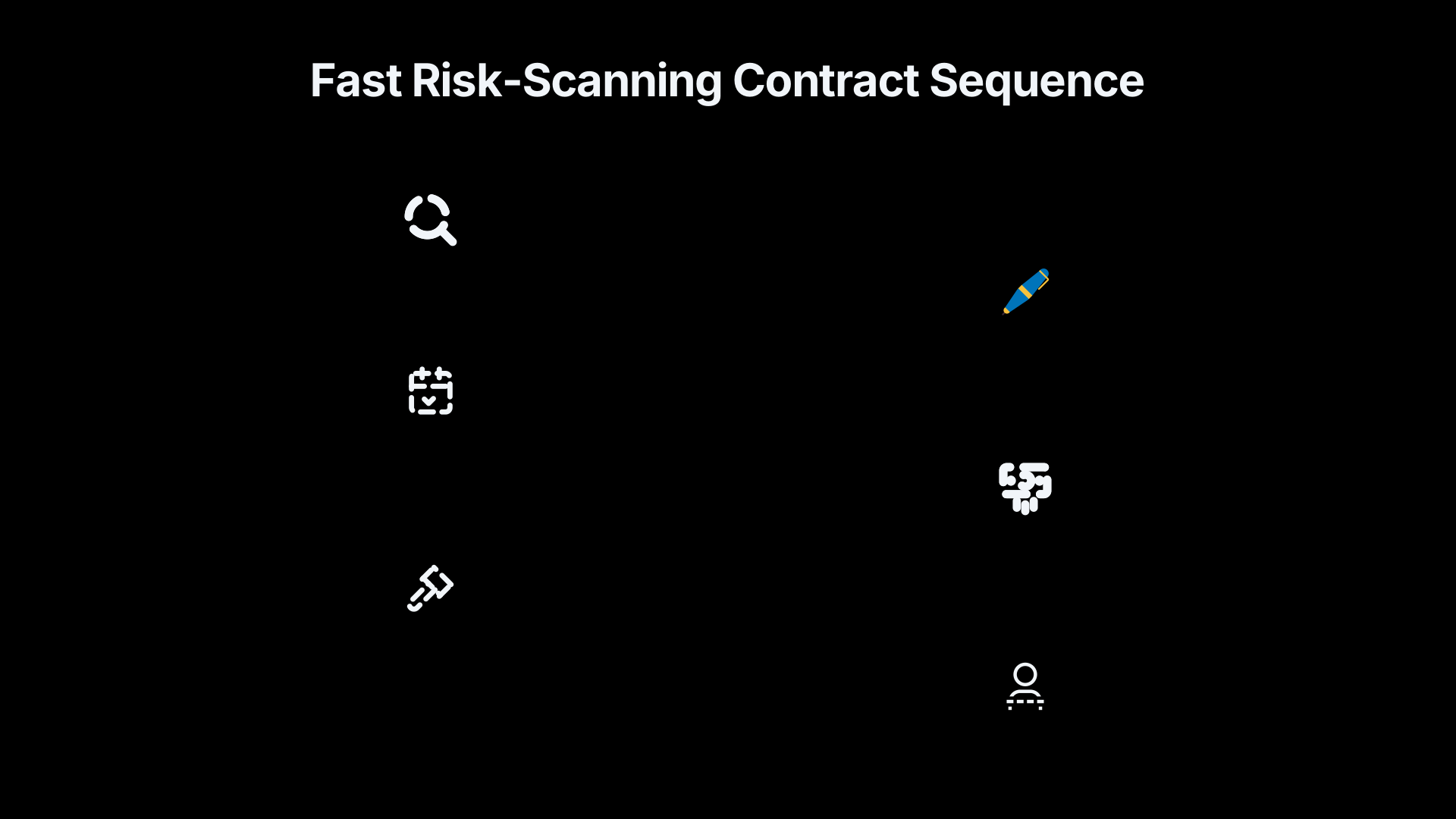 Many disputes arise not from the headline deal terms but from provisions that reshape them: a broad definition, an exclusion buried in a later section, an automatic renewal trigger, or a liability cap that limits recovery when something goes wrong. Courts generally treat contracts as risk-allocation tools, meaning seemingly technical wording can determine who pays, who bears losses, and who has legal remedies.[Ashurst]ashurst.comquickguide limiting and excluding liabilityQuickguide Limiting and excluding liability10 Jan 2025 — This guide sets out the principles to be considered when drafting these c…
Definitions, Exclusions, and “Subject To” Wording
When reading for speed, definitions deserve disproportionate attention. They often appear at the front of a contract and look administrative, but they can silently change the meaning of dozens of later clauses.
A reader may see a term such as “Services”, “Confidential Information”, “Losses”, or “Affiliate” and assume it has its ordinary meaning. In many contracts, however, those terms are defined much more broadly or narrowly than expected. Once defined, the special meaning controls throughout the document.
A useful contract-reading shortcut is to highlight every capitalised term and ask three questions:
- What does it include?
- What does it exclude?
- Where else is it used?
A broad definition can expand obligations far beyond the headline bargain. For example, a confidentiality clause may appear limited until the definition of confidential information reveals that nearly everything exchanged between the parties is covered.
Exclusions require similar scrutiny. Readers naturally focus on what a contract grants, but risk often sits in what it takes away. A warranty may appear generous until a later paragraph excludes key situations. A service commitment may seem firm until performance is made conditional on exceptions and carve-outs.
Pay particular attention to phrases such as:
- “subject to”
- “except as otherwise provided”
- “notwithstanding”
- “sole and exclusive remedy”
- “unless agreed in writing”
These phrases create hierarchies within the contract. A favourable clause can be weakened significantly by a later provision that overrides it.
Why Dense Cross-References Matter
Contracts frequently send readers elsewhere through references such as “subject to Section 12.4” or “except as provided in Schedule B”.
Skimming readers often ignore these references because they interrupt flow. Yet the referenced section may contain the actual risk allocation. A useful speed-reading technique is to mark every cross-reference and immediately inspect it before continuing. This takes seconds and can prevent major misunderstandings.
Renewals, Cancellations, Payment Triggers, and Deadlines
Many costly contract surprises involve timing rather than price.
Automatic renewal provisions are a classic example. A contract may appear to end after one year, but an auto-renewal clause can extend it unless notice is given during a narrow cancellation window. Consumer-protection regulators have devoted increasing attention to automatic renewal and negative-option arrangements because customers often overlook these provisions. The US Federal Trade Commission has repeatedly highlighted risks associated with subscriptions and renewals that continue unless consumers actively cancel.[Consumer Advice+2Federal Register]consumer.ftc.govConsumer AdviceGetting In and Out of Free Trials, Auto-Renewals…Some will auto-renew if you don't cancel first, A negative option is w…
When reviewing a contract, identify:
- Initial term length.
- Renewal length.
- Notice period required to avoid renewal.
- Permitted cancellation methods.
- Consequences of late notice.
A reader who finds these answers in five minutes may save months of unwanted commitment.
Payment clauses deserve the same treatment. The stated fee is rarely the whole story. Hidden risk frequently appears in payment triggers, escalation provisions, late-payment penalties, and reimbursement requirements.
Look specifically for:
- Conditions that trigger invoices.
- Automatic price increases.
- Minimum purchase commitments.
- Interest on late payments.
- Requirements to pay disputed invoices before contesting them.
The practical reading strategy is to trace a complete timeline: signing, delivery, invoicing, payment, renewal, and termination. This often exposes obligations that are scattered across multiple sections.
Deadlines That Quietly Change Rights
Contract rights frequently depend on notice periods.
A party may have the right to terminate, dispute charges, reject goods, make a warranty claim, or seek reimbursement only if notice is provided within a specified period.
These deadlines are often easy to miss because they appear in procedural language rather than headline commercial terms. Yet a missed notice deadline can eliminate rights that otherwise seemed guaranteed.
For risk-focused reading, dates and notice requirements should be marked immediately during the first pass through the contract.
Liability Limits, Warranties, Indemnities, and Dispute Clauses
The most financially important clauses are often among the least exciting to read.
Liability Limits: What Happens When Things Go Wrong?
A limitation-of-liability clause determines how much one party can recover if the other breaches the agreement. Rather than focusing on performance, it focuses on failure. These clauses commonly cap damages, exclude particular categories of loss, or both.[Sirion+2Icertis]sirion.aiThese provisions define the extent to which parties can be heldLimitation of Liability Clauses: A Definitive Guide30 Apr 2026 — Limitation of liability clauses are essential in managing risk in…
For example, a supplier might agree to provide a critical service while simultaneously limiting liability to the fees paid during the previous twelve months. The service commitment may appear strong, but the remedy for failure may be modest.
When reviewing liability provisions, look for:
- Financial caps.
- Excluded categories of damages.
- Unlimited-liability exceptions.[nortonrosefulbright.com]nortonrosefulbright.comNorton Rose FulbrightLiability clauses in technology and outsourcing contractsUnlimited liability: A clause providing for those instances…
- Special treatment of negligence, fraud, or misconduct.
Commercial contracts often distinguish between losses that can be claimed and losses that cannot. Financial exposure can therefore differ dramatically from a reader’s first impression of the deal.[Norton Rose Fulbright]nortonrosefulbright.comNorton Rose FulbrightLiability clauses in technology and outsourcing contractsUnlimited liability: A clause providing for those instances…
Indemnities: Risk-Shifting in Disguise
Indemnity clauses deserve special attention because they can transfer responsibility for losses from one party to another.
An indemnity generally requires one party to compensate another for specified losses, liabilities, costs, or third-party claims.[LexisNexis]lexisnexis.comIndemnity clause Meaning | Legal GlossaryAn indemnity clause is a contractual risk-allocation provision under which one party a…
The reading trap is that indemnities often appear deep in the contract and use technical language. Yet they may create obligations that exceed what a casual reader expects.
Questions to ask include:
- What losses are covered?
- Does the indemnity cover third-party claims?[uk.practicallaw.thomsonreuters.com]uk.practicallaw.thomsonreuters.comyou take an indemnity against third party claims for injury…15 Dec 2017 — The contract between A and B caps A's liability to B for los…
- Are legal costs included?
- Is the indemnity capped?
- Does it survive termination?
A particularly important issue is the relationship between indemnities and liability caps. Depending on the contract’s wording, indemnity obligations may receive different treatment from ordinary liability provisions. Lawyers frequently negotiate this point because it can significantly alter risk exposure.[Practical Law+2Osborne Clarke]uk.practicallaw.thomsonreuters.comPractical LawDo indemnities ordinarily sit outside a liability cap?4 Jan 2022 — Indemnities would ordinarily sit outside of the limitatio…
Warranties and Remedy Restrictions
Readers often focus on promises and overlook remedies.
A warranty may sound reassuring until the contract states that repair, replacement, or refund is the exclusive remedy. Clauses labelled “exclusive remedy” or “sole remedy” deserve immediate attention because they can limit the options available after a breach.
The key reading question is not merely, “What is promised?” but also, “What happens if the promise is broken?”
Dispute Clauses Can Matter Before Any Dispute Exists
Dispute-resolution clauses frequently receive little attention during negotiations because neither side expects litigation.
Yet these provisions determine:[sirion.ai]sirion.aiThese provisions define the extent to which parties can be heldLimitation of Liability Clauses: A Definitive Guide30 Apr 2026 — Limitation of liability clauses are essential in managing risk in…
- Where disputes will be heard.
- Which law applies.
- Whether arbitration is required.
- How quickly claims must be brought.
A favourable commercial deal can become much more expensive if enforcement must occur in an inconvenient jurisdiction or under unfamiliar procedures.
A Fast Risk-Scanning Method for Contracts
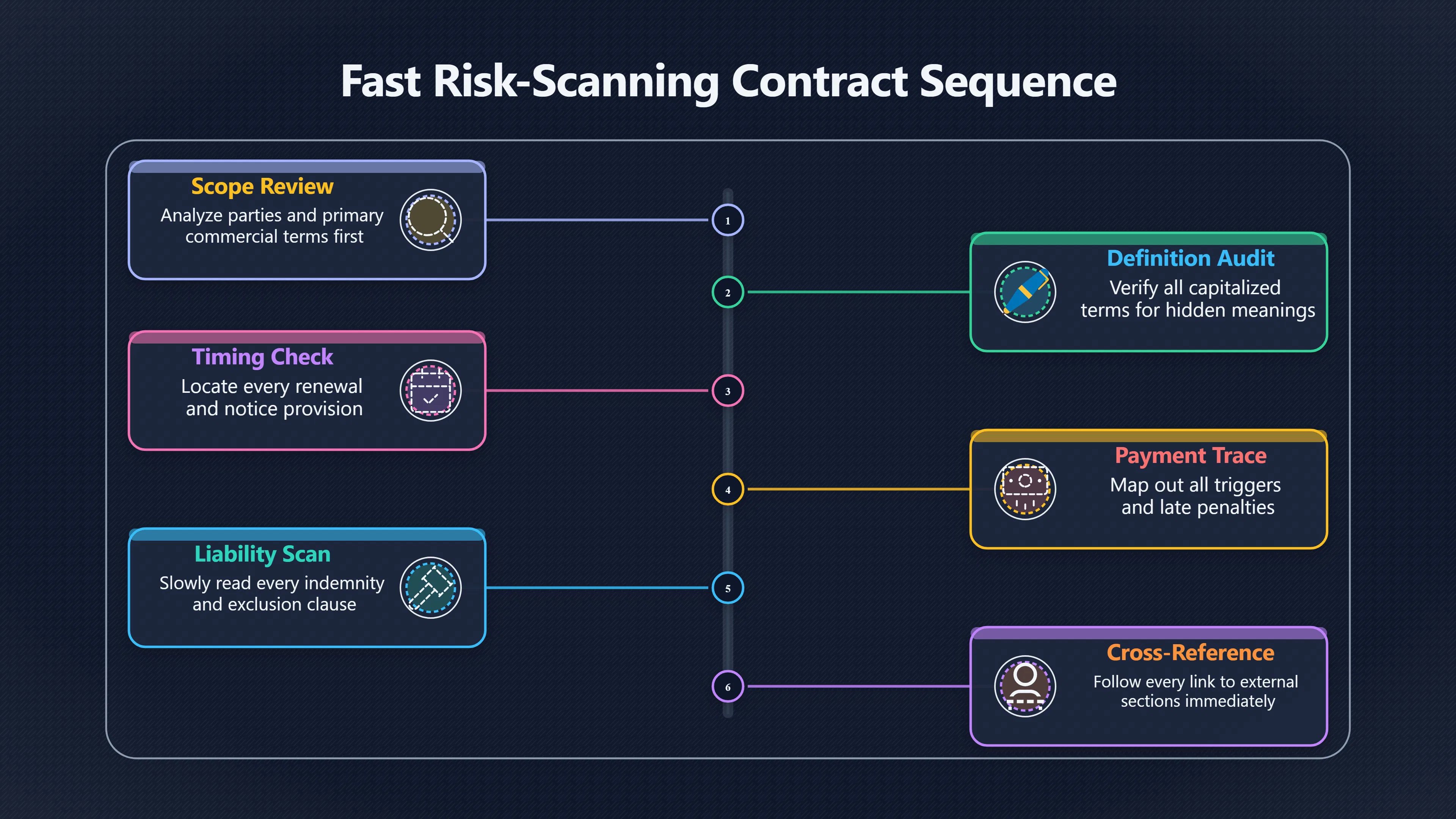
For readers whose goal is both speed and protection, a practical sequence is:
- Read the parties, scope, and commercial terms.
- Review all defined terms that appear repeatedly.
- Locate every renewal, termination, and notice provision.
- Trace payment triggers and deadlines.
- Read every liability, warranty, exclusion, and indemnity clause slowly.[icertis.com]icertis.comlimitation of liability clauseA Comprehensive Guide19 Mar 2025 — A limitation of liability clause is a provision within a contract that caps the amount of damages one…
- Check dispute-resolution and governing-law sections.
- Follow every cross-reference attached to those clauses.
This approach deliberately ignores the temptation to give equal attention to every page. Instead, it concentrates effort where contracts most commonly hide meaningful risk.
Why the Dullest Clauses Often Matter Most
Contracts are unusual documents because the sections that look least important are often the sections that control outcomes when problems arise. Definitions reshape obligations, exclusions narrow rights, renewal clauses extend commitments, and liability provisions determine who ultimately bears losses.
For increasing reading speed, the lesson is not to read contracts faster across the board. It is to read selectively. Skim routine narrative, but slow down wherever the contract allocates risk. The greatest gains come not from moving your eyes faster, but from recognising which paragraphs deserve far more attention than their dull appearance suggests.
Amazon book picks
Further Reading
Books and field guides related to Why the dullest clauses may matter most. Use these as the next step if you want deeper reading beyond the article.
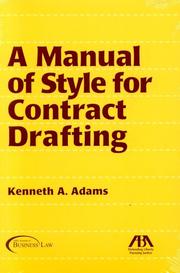
A Manual of Style for Contract Drafting
Explains definitions, obligations, exclusions, and hidden risk.

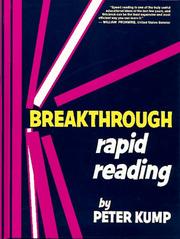
Breakthrough rapid reading
First published 1979. Subjects: Speed reading, Rapid reading, Du shu fang fa.
How to Read a Book
Rating: 4.0/5 from 41 Google Books ratings
With half a million copies in print, How to Read a Book is the best and most successful guide to reading comprehension for the general re...
eBay marketplace picks
Marketplace Samples
Example marketplace items related to this page. Use the search link to explore similar finds on eBay.



Endnotes
1.
Source: ashurst.com
Title: quickguide limiting and excluding liability
Link:https://www.ashurst.com/en/insights/quickguide-limiting-and-excluding-liability/
Source snippet
Quickguide Limiting and excluding liability10 Jan 2025 — This guide sets out the principles to be considered when drafting these c...
2.
Source: sirion.ai
Title: These provisions define the extent to which parties can be held
Link:https://www.sirion.ai/library/contract-clauses/limitation-of-liability-clauses/
Source snippet
Limitation of Liability Clauses: A Definitive Guide30 Apr 2026 — Limitation of liability clauses are essential in managing risk in...
3.
Source: icertis.com
Title: limitation of liability clause
Link:https://www.icertis.com/contracting-basics/limitation-of-liability-clause/
Source snippet
A Comprehensive Guide19 Mar 2025 — A limitation of liability clause is a provision within a contract that caps the amount of damages one...
4.
Source: sirion.ai
Link:https://www.sirion.ai/library/contract-clauses/limitation-of-liability-vs-indemnification/
Source snippet
Limitation of Liability vs Indemnification: Key DifferencesA limitation of liability clause sets boundaries on the amount or types...
5.
Source: lexisnexis.com
Link:https://www.lexisnexis.com/en-gb/legal/glossary/indemnity-clause
Source snippet
Indemnity clause Meaning | Legal GlossaryAn indemnity clause is a contractual risk-allocation provision under which one party a...
6.
Source: uk.practicallaw.thomsonreuters.com
Title: Practical Law Limiting liability: drafting and negotiating
Link:https://uk.practicallaw.thomsonreuters.com/2-520-5359?contextData=%28sc.Default%29&transitionType=Default
Source snippet
liability: drafting and negotiating - Practical LawA [practice]({{ 'practice/' | relative_url }}) note that explains the legal and commercial issues involved in negotiating...
7.
Source: consumer.ftc.gov
Link:https://consumer.ftc.gov/articles/getting-and-out-free-trials-auto-renewals-and-negative-option-subscriptions
Source snippet
Consumer AdviceGetting In and Out of Free Trials, Auto-Renewals...Some will auto-renew if you don't cancel first, A negative option is w...
8.
Source: federalregister.gov
Title: negative option rule
Link:https://www.federalregister.gov/documents/2024/11/15/2024-25534/negative-option-rule
Source snippet
15 Nov 2024 — In automatic renewals, sellers automatically renew consumers' subscriptions when they expire, unless consumers affirmativel...
9.
Source: ftc.gov
Link:https://www.ftc.gov/news-events/news/press-releases/2024/10/federal-trade-commission-announces-final-click-cancel-rule-making-it-easier-consumers-end-recurring
Source snippet
Federal Trade CommissionFederal Trade Commission Announces Final “Click-to-...16 Oct 2024 — Federal Trade Commission Announces Final “Cl...
10.
Source: nortonrosefulbright.com
Link:https://www.nortonrosefulbright.com/en-de/knowledge/publications/1cb2397c/liability-101-liability-clauses-in-technology-and-outsourcing-contracts
Source snippet
Norton Rose FulbrightLiability clauses in technology and outsourcing contractsUnlimited liability: A clause providing for those instances...
11.
Source: uk.practicallaw.thomsonreuters.com
Link:https://uk.practicallaw.thomsonreuters.com/a-132-9522?contextData=%28sc.Default%29&transitionType=Default
Source snippet
Practical LawDo indemnities ordinarily sit outside a liability cap?4 Jan 2022 — Indemnities would ordinarily sit outside of the limitatio...
12.
Source: osborneclarke.com
Title: spotlight on contractual indemnities
Link:https://www.osborneclarke.com/insights/spotlight-on-contractual-indemnities
Source snippet
Osborne ClarkeSpotlight on contractual indemnities1 Mar 2019 — There is no general rule as to whether a clause limiting liability applies...
13.
Source: legal.thomsonreuters.com
Title: indemnification clauses in commercial contracts
Link:https://legal.thomsonreuters.com/en/insights/articles/indemnification-clauses-in-commercial-contracts
Source snippet
Thomson Reuters LegalIndemnification Clauses in Commercial Contracts20 Oct 2024 — A limitation of liability clause in a contract caps the...
14.
Source: uk.practicallaw.thomsonreuters.com
Link:https://uk.practicallaw.thomsonreuters.com/w-026-1588?contextData=%28sc.Default%29&transitionType=Default
Source snippet
Basics: Indemnification and Limitation of Liability...This presentation gives a high-level overview of indemnification and limitation of...
15.
Source: uk.practicallaw.thomsonreuters.com
Link:https://uk.practicallaw.thomsonreuters.com/a-040-6482?contextData=%28sc.Default%29&transitionType=Default
Source snippet
you take an indemnity against third party claims for injury...15 Dec 2017 — The contract between A and B caps A's liability to B for los...
16.
Source: ftc.gov
Link:https://www.ftc.gov/legal-library/browse/rules/negative-option-rule
Source snippet
Negative Option RuleFederal Trade Commission Proposes Rule Provision Making it Easier for Consumers to “Click to Cancel” Recurring Subscr...
Additional References
17.
Source: loeb.com
Link:https://www.loeb.com/en/insights/publications/2024/10/click-to-cancel-ftc-releases-final-rule-for-subscriptions
Source snippet
'Click to Cancel' – FTC Releases Final Rule for SubscriptionsThe new rule requires sellers to provide a simple mechanism for a consumer t...
18.
Source: crowell.com
Link:https://www.crowell.com/en/insights/client-alerts/clicking-all-the-right-boxes-ftc-moves-to-revive-click-to-cancel-rule-following-eighth-circuit-vacatur
Source snippet
FTC Moves to Revive “Click-to-Cancel” Rule Following...The draft ANPRM signals the FTC's intent to revisit and potentially revive regula...
19.
Source: taulersmith.com
Link:https://taulersmith.com/ftc-rule-proposal-automatic-renewals
Source snippet
FTC Rule Proposal on Automatic RenewalsThe FTC rule proposal on automatic renewals would impose strict requirements on companies that off...
20.
Source: taylorwessing.com
Link:https://www.taylorwessing.com/de/insights-and-events/insights/2018/06/liability-exclusions-under-german-law
Source snippet
Liability Exclusions under German LawUnder German law limitation/exclusion of liability clauses respectively indemnity clauses require an...
21.
Source: stevens-bolton.com
Link:https://www.stevens-bolton.com/insights/102ktw4/limiting-liability-in-commercial-contracts/
Source snippet
Limiting liability in commercial contractsAn exclusion, limitation or exemption clause in a commercial contract seeks to exclude or limit...
22.
Source: dglaw.com
Link:https://www.dglaw.com/wp-content/uploads/2022/01/Negative-Option-Marketing.pdf
Source snippet
Negative Option MarketingFor automatic renewal offers that include a free gift, trial, or promotional pricing, sellers must notify consum...
23.
Source: sra.org.uk
Link:https://www.sra.org.uk/solicitors/standards-regulations/indemnity-insurance-rules/
Source snippet
Indemnity Insurance RulesThese rules require firms that are authorised by the SRA to take out and maintain professional indemnity i...
24.
Source: gunder.com
Link:https://www.gunder.com/en/news-insights/insights/client-insight-click-to-cancel-amendements-to-the-ftc-negative-option-rule-and-california-automatic-renewal-law
Source snippet
Client Insight: “Click to Cancel” Amendments to the FTC...Jun 23, 2025 — The FTC's new “Click to Cancel” rule and California's updated l...
25.
Source: cms.law
Link:https://cms.law/content/download/443673/file/Consequential%20Loss%20Clauses%20in%20the%20Energy%20Sector_An%20international%20guide_FINAL.pdf
26.
Source: cooley.com
Link:https://www.cooley.com/news/insight/2024/2024-10-23-ftc-finalizes-negative-option-rule-governing-subscriptions-and-trial-offers
Source snippet
FTC Finalizes Negative Option Rule Governing...23 Oct 2024 — The FTC has finalized a new rule that governs negative option features, suc...
Topic Tree