Within Benchmarks
When Slow Reading Is a Problem
Slow reading can be appropriate for dense material, but persistent slowness on easy text may point to vocabulary, attention, vision, or decoding barriers.
On this page
- Dense text versus avoidable slowdown
- Comprehension clues that matter more than pace
- Friction points worth checking first
Page outline Jump by section
Introduction
Slow reading is not always a problem. In many situations, it is a sign that the text itself is demanding careful thought. A dense scientific paper, a legal contract, a philosophical argument, or a technical manual often requires a slower pace because the reader is building understanding rather than merely recognising words. Within realistic adult reading benchmarks, speed only becomes meaningful when considered alongside comprehension and text difficulty. Research suggests that average adult silent reading is around 238 words per minute (wpm) for non-fiction and 260 wpm for fiction, but individual rates naturally fall well above and below those averages depending on the task.[Ghent University Bibliography]biblio.ugent.beGhent University Bibliography How many words do we read per minute?A review and meta…by M Brysbaert · 2019 · Cited by 817 —… reading rate for adults in English is 238 words per minute (wpm) for non…
 The important question is not whether reading is slow. It is whether the slowness reflects productive thinking or an avoidable barrier. Useful friction helps comprehension. Unnecessary friction repeatedly interrupts it.
Dense Text Versus Avoidable Slowdown
Readers often assume that good reading means maintaining a steady pace. In reality, efficient readers constantly adjust speed.
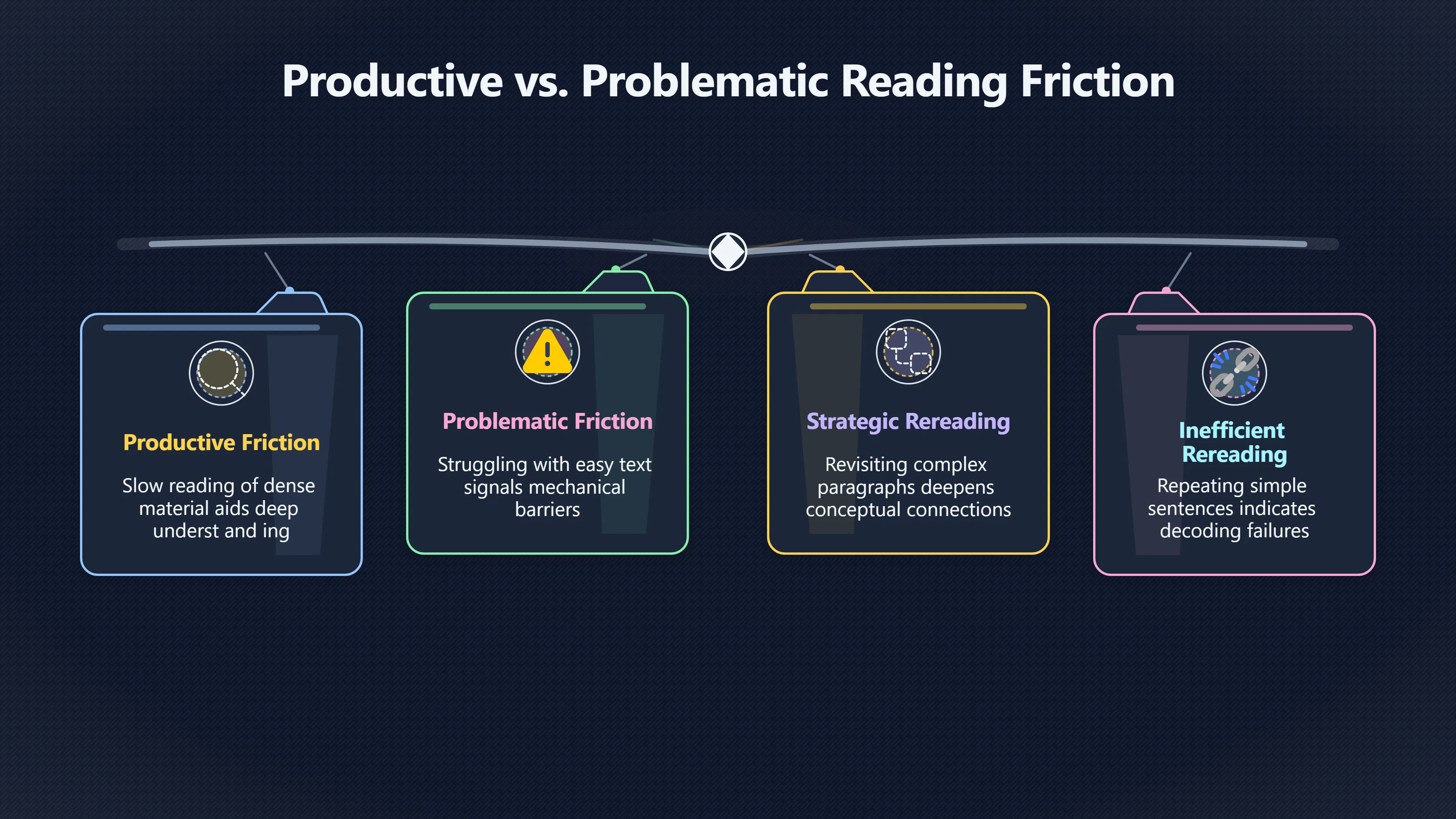
A chemistry textbook, a difficult research article, or a chapter introducing unfamiliar concepts creates what might be called productive friction. The reader pauses, rereads a sentence, checks a definition, or mentally connects new information to existing knowledge. These interruptions are not failures. They are part of understanding.
Historical comparisons illustrate the point. Before modern mass education, scholarly reading was frequently slow, deliberate, and often performed with annotation. Readers were expected to wrestle with difficult texts rather than consume large volumes quickly. Even today, professional researchers and lawyers routinely slow down when precision matters more than throughput.
The opposite pattern occurs when a text is relatively easy but reading remains effortful. A short news article written in familiar language should not require constant decoding. When readers repeatedly lose their place, struggle to recognise common words, or need multiple passes through straightforward material, the slowdown may be coming from the reading process rather than the text itself.
One useful rule is:
- Slow reading of difficult material is often normal.
- Slow reading of easy material deserves investigation.
This distinction matters because many speed-reading discussions treat all slow reading as a defect. Research on reading consistently shows that task demands strongly influence realistic reading rates, making a single personal speed number a poor measure of reading skill.[Ghent University Bibliography]biblio.ugent.beGhent University Bibliography How many words do we read per minute?A review and meta…by M Brysbaert · 2019 · Cited by 817 —… reading rate for adults in English is 238 words per minute (wpm) for non…
Comprehension Clues Matter More Than Pace
The most revealing indicator of reading effectiveness is not words per minute but what happens after reading.
A reader moving through a complex article at 120 wpm who can accurately explain the argument may be reading more effectively than someone racing through at 300 wpm and remembering only fragments.
Research reviews of speed-reading claims repeatedly find that large gains in speed usually come with comprehension costs. While readers can skim for general ideas, there is little evidence that people can dramatically exceed normal reading rates while maintaining full understanding of detailed material.[PubMed+2Association for Psychological Science]pubmed.ncbi.nlm.nih.govPub Med How Do We Read, and Can Speed Reading Help?by K Rayner · 2016 · Cited by 537 — So Much to Read, So Little Time: How Do We Read, and Can Speed Reading Help? Psychol Sci Public…
Useful friction often produces signs such as:
- Better recall of key ideas.
- Accurate summaries after reading.
- Ability to explain concepts in your own words.
- Successful application of information later.
Problematic friction tends to look different:
- Frequent rereading without improved understanding.
- Losing track of sentence structure.
- Reaching the end of a paragraph and remembering almost nothing.
- Mental fatigue that appears far earlier than expected.
The distinction is subtle but important. Reading slowly because you are thinking is different from reading slowly because the mechanics of reading are consuming excessive effort.
When Rereading Is Helpful
Many readers view rereading as evidence of inefficiency. In practice, strategic rereading is common among skilled readers confronting difficult material.
For example, a reader working through a statistical explanation may revisit a paragraph because later information changes its meaning. That kind of rereading deepens comprehension.
Less useful rereading occurs when the same sentence must be read repeatedly simply to identify the words or hold them in working memory. In that case, the friction is no longer serving understanding.
Friction Points Worth Checking First
When reading remains unusually slow across a wide range of easy texts, several factors are worth examining before assuming a lack of intelligence or effort.
Vocabulary Gaps
Readers process familiar words much faster than unfamiliar ones. Decades of psycholinguistic research show that word frequency strongly affects recognition speed. Rare or unfamiliar vocabulary creates additional processing demands because the brain must devote more effort to identifying and interpreting the word.[PubMed]pubmed.ncbi.nlm.nih.govThe word frequency effect: a review of recent…by M Brysbaert · 2011 · Cited by 686 — We review recent evidence indicating that r…
Someone entering a new field may temporarily read slowly simply because the terminology is unfamiliar. This usually improves with exposure.
Attention and Concentration
Reading speed often falls when attention repeatedly breaks.
A reader who must restart sentences, recover from distractions, or fight mental wandering may appear slow even though basic reading skills are intact. In these cases, the bottleneck is not decoding words but maintaining focus long enough to build meaning across paragraphs.
A practical clue is inconsistency. If reading speed varies dramatically depending on environment, interest, or fatigue, attention may be a larger factor than reading ability.
Vision and Visual Comfort
Vision issues do not always present as obvious blur.
Poor visual comfort, uncorrected vision problems, eye strain, or difficulties maintaining visual tracking can make reading feel unusually effortful. Readers sometimes compensate by slowing down, increasing rereading, or shortening reading sessions.
Persistent discomfort, headaches, or difficulty sustaining reading are often better reasons to seek an eye examination than a specific words-per-minute score.
Decoding and Fluency Difficulties
Some adults continue to experience reading fluency difficulties that originated in childhood, even if they developed effective coping strategies.
Organisations specialising in dyslexia note that adults with reading difficulties may read slowly, need to reread frequently, struggle to skim efficiently, or find reading unusually effortful despite adequate intelligence and education.[British Dyslexia Association+2International Dyslexia Association]bdadyslexia.org.ukBritish Dyslexia AssociationSigns of dyslexia (adult)Signs of dyslexia (adult) · Confuse visually similar words such as cat and cot · Spe…
Importantly, slow reading alone does not indicate dyslexia. However, persistent slowness combined with a history of reading struggles, spelling difficulties, word-recognition problems, or heavy reliance on rereading may justify further assessment.[Mayo Clinic+2International Dyslexia Association]mayoclinic.orgMayo Clinic DyslexiaMayo ClinicDyslexia - Symptoms and causes6 Aug 2022 — Difficulty reading, including reading aloud · Slow and labor-intensive reading and…
A Historical Shift in Expectations
Modern readers are exposed to constant messages about productivity, information overload, and consuming more content faster. This can create the impression that every slowdown is undesirable.
Historically, however, reading was often evaluated by understanding rather than speed. The pressure to maximise words per minute is relatively recent and has been amplified by commercial speed-reading programmes.
Research reviews have repeatedly concluded that reading speed cannot be increased indefinitely without affecting comprehension. Human reading remains constrained by visual processing, language comprehension, memory, and attention.[PubMed+2USF Faculty]pubmed.ncbi.nlm.nih.govPub Med How Do We Read, and Can Speed Reading Help?by K Rayner · 2016 · Cited by 537 — So Much to Read, So Little Time: How Do We Read, and Can Speed Reading Help? Psychol Sci Public…
Seen from that perspective, some forms of slow reading are not obstacles to learning but evidence that learning is happening.
When Slow Reading Becomes a Problem
A useful test is to compare your pace across different kinds of material.
If you read advanced, unfamiliar, or conceptually dense material slowly, that is usually appropriate. If you read everyday articles, emails, novels, and simple instructions at a similarly slow pace and still struggle to understand them, the friction may be signalling a genuine barrier.
The goal of increasing reading speed is therefore not to eliminate all friction. It is to remove avoidable friction while preserving the thoughtful pauses that produce understanding. The fastest useful reading rate is not the highest number you can reach. It is the fastest pace at which comprehension remains strong for the task in front of you.
Amazon book picks
Further Reading
Books and field guides related to When Slow Reading Is a Problem. Use these as the next step if you want deeper reading beyond the article.
How to Read a Book
Rating: 4.0/5 from 41 Google Books ratings
Explains why different texts require different reading speeds.

The Speed Reading Book
Helps distinguish inefficient habits from necessary slow reading.

eBay marketplace picks
Marketplace Samples
Example marketplace items related to this page. Use the search link to explore similar finds on eBay.



Endnotes
1.
Source: faculty.cas.usf.edu
Title: Rayner Schotter Masson Potter Treiman 2016 PSPI
Link:https://faculty.cas.usf.edu/eschotter/papers/Rayner_Schotter_Masson_Potter_Treiman_2016_PSPI.pdf
Source snippet
USF FacultyHow Do We Read, and Can Speed Reading Help?by K Rayner · 2016 · Cited by 522 — The current article reviews what the scientific...
2.
Source: dyslexia.com
Link:https://www.dyslexia.com/about-dyslexia/signs-of-dyslexia/common-characteristics-of-adult-dyslexia/
Source snippet
These characteristics are often inconsistent, and may vary depending upon...Read more...
3.
Source: blog.dyslexia.com
Title: and comprehension when the words dont stick
Link:https://blog.dyslexia.com/dyslexia-and-comprehension-when-the-words-dont-stick/
Source snippet
Slow reading lets your brain catch up and connect the visuals and that's where...Read more...
4.
Source: biblio.ugent.be
Title: Ghent University Bibliography How many words do we read per minute?
Link:https://biblio.ugent.be/publication/8647789
Source snippet
A review and meta...by M Brysbaert · 2019 · Cited by 817 —... reading rate for adults in English is 238 words per minute (wpm) for non...
5.
Source: pubmed.ncbi.nlm.nih.gov
Title: Pub Med How Do We Read, and Can Speed Reading Help?
Link:https://pubmed.ncbi.nlm.nih.gov/26769745/
Source snippet
by K Rayner · 2016 · Cited by 537 — So Much to Read, So Little Time: How Do We Read, and Can Speed Reading Help? Psychol Sci Public...
6.
Source: psychologicalscience.org
Title: speed reading
Link:https://www.psychologicalscience.org/publications/speed_reading.html
Source snippet
Association for Psychological ScienceSo Much to Read, So Little Time: How Do We Read, and...13 Jan 2016 — The report shows there is no q...
7.
Source: psychologicalscience.org
Title: speed reading promises are too good to be true scientists find
Link:https://www.psychologicalscience.org/news/releases/speed-reading-promises-are-too-good-to-be-true-scientists-find.html
Source snippet
Association for Psychological ScienceSpeed Reading Promises Are Too Good to Be True...Jan 14, 2016 — A team of psychological scientists...
8.
Source: pubmed.ncbi.nlm.nih.gov
Link:https://pubmed.ncbi.nlm.nih.gov/21768069/
Source snippet
The word frequency effect: a review of recent...by M Brysbaert · 2011 · Cited by 686 — We review recent evidence indicating that r...
9.
Source: bdadyslexia.org.uk
Link:https://www.bdadyslexia.org.uk/advice/adults/am-i-dyslexic/signs-of-dyslexia
Source snippet
British Dyslexia AssociationSigns of dyslexia (adult)Signs of dyslexia (adult) · Confuse visually similar words such as cat and cot · Spe...
10.
Source: dyslexiaida.org
Link:https://dyslexiaida.org/dyslexia-basics/
Source snippet
Dyslexia BasicsDyslexia refers to a cluster of symptoms, which result in people having difficulties with specific language skills, partic...
11.
Source: dyslexiaida.org
Link:https://dyslexiaida.org/dyslexia-test/
Source snippet
Do I Have Dyslexia?Dyslexia Self-Assessment for Adults; 1, Do you read slowly?; 2, Did you have trouble learning how to read when you w...
12.
Source: mayoclinic.org
Title: Mayo Clinic Dyslexia
Link:https://www.mayoclinic.org/diseases-conditions/dyslexia/symptoms-causes/syc-20353552
Source snippet
Mayo ClinicDyslexia - Symptoms and causes6 Aug 2022 — Difficulty reading, including [reading aloud]({{ 'reading-aloud/' | relative_url }}) · Slow and labor-intensive reading and...
13.
Source: dyslexiaida.org
Link:https://dyslexiaida.org/screening-for-dyslexia/dyslexia-screener-for-adults/
Source snippet
International Dyslexia AssociationDyslexia Screener for AdultsThe Adult Reading History Questionnaire (ARHQ) is a self-report screening t...
14.
Source: dyslexiaida.org
Link:https://dyslexiaida.org/testing-and-evaluation/
Source snippet
International Dyslexia AssociationTesting and EvaluationTypically, students with dyslexia score lower on tests of reading comprehension t...
Additional References
15.
Source: psychologicalscience.org
Link:https://www.psychologicalscience.org/news/the-harsh-truth-about-speed-reading.html
16.
Source: readingrockets.org
Link:https://www.readingrockets.org/topics/developmental-milestones/articles/common-signs-dyslexia
Source snippet
Common Signs of DyslexiaDyslexia is a language-based disability that affects both oral and written language. With help, children with dys...
17.
Source: researchgate.net
Link:https://www.researchgate.net/figure/Distribution-of-reading-rates-for-fiction-books_fig4_335174808
Source snippet
Figure 5: Distribution of reading rates for fiction booksWe estimate that the average silent reading rate for adults in English is 238 wo...
18.
Source: psychonomic.org
Link:https://www.psychonomic.org/page/brysbaert
Source snippet
Marc BrysbaertMarc Brysbaert is author of over 250 articles and book chapters, of which 25 appeared in Behavior Research Methods. His int...
19.
Source: perfors.net
Link:https://perfors.net/authors/marc-brysbaert/
Source snippet
Marc BrysbaertMarc Brysbaert. Latest. The "Small World of Words" English word association norms for over 12,000 cue words · privacy. ©And...
20.
Source: codereadnetwork.org
Link:https://codereadnetwork.org/wp-content/uploads/2023/10/Signs-of-Dyslexia-in-Adults-1.pdf
Source snippet
Signs of Dyslexia in AdultsI found learning to read difficult at school. 2. I continue to read slowly. 3. I often need to re-read paragra...
21.
Source: thereadingcenter.org
Link:https://www.thereadingcenter.org/signs-of-ld
Source snippet
Signs of Learning Disability/DyslexiaIn Adults · May hide their reading problems, many subterfuges · May spell poorly, relies on others t...
22.
Source: das.org.sg
Link:https://das.org.sg/learning_differently/understanding-dyslexia/
Source snippet
Understanding DyslexiaPoor spelling is highly related to poor reading, and poor spelling shows up first.... Even so, they may continue t...
23.
Source: apm.net.au
Link:https://apm.net.au/iea/support/blog/how-to-know-if-you-ve-got-dyslexia
24.
Source: moveforwardwithdyslexia.com
Link:https://www.moveforwardwithdyslexia.com/dyslexia/speed-reading-for-dyslexics.html
Topic Tree