Within Timing
When faster rereading is really guessing
Skipping endings, guessing from first letters, and memorising a passage can create fast scores without stronger reading.
On this page
- The shortcuts that inflate timed rereading scores
- Why familiar passages can hide weak word recognition
- How fresh passages expose memorisation
Page outline Jump by section
Introduction
Timed rereading can genuinely improve reading speed, but it can also create an illusion of improvement. A reader who already knows a passage may begin to rely on shortcuts rather than accurate word recognition. Skipping word endings, identifying words from their first few letters, or remembering what comes next in the text can make rereading look faster even when underlying reading skill has not changed. The result is a score that appears impressive on a familiar passage but fails to transfer to new material.
 This distinction matters because reading fluency is not simply speed. Research and assessment guidance consistently define fluency as a combination of accuracy, rate, and understanding. Faster performance that depends on guessing rather than recognising words accurately does not represent the same kind of improvement as genuine automatic reading.[NICHD+2Reading Rockets]nichd.nih.govNICHDNational Reading PanelFluency depends upon well developed word recognition skills, but such skills do…Read more…
The shortcuts that inflate timed rereading scores
Repeated reading works because familiarity can reduce the effort required to recognise words. However, familiarity can also encourage behaviours that mimic fluency without strengthening it.
Common shortcuts include:
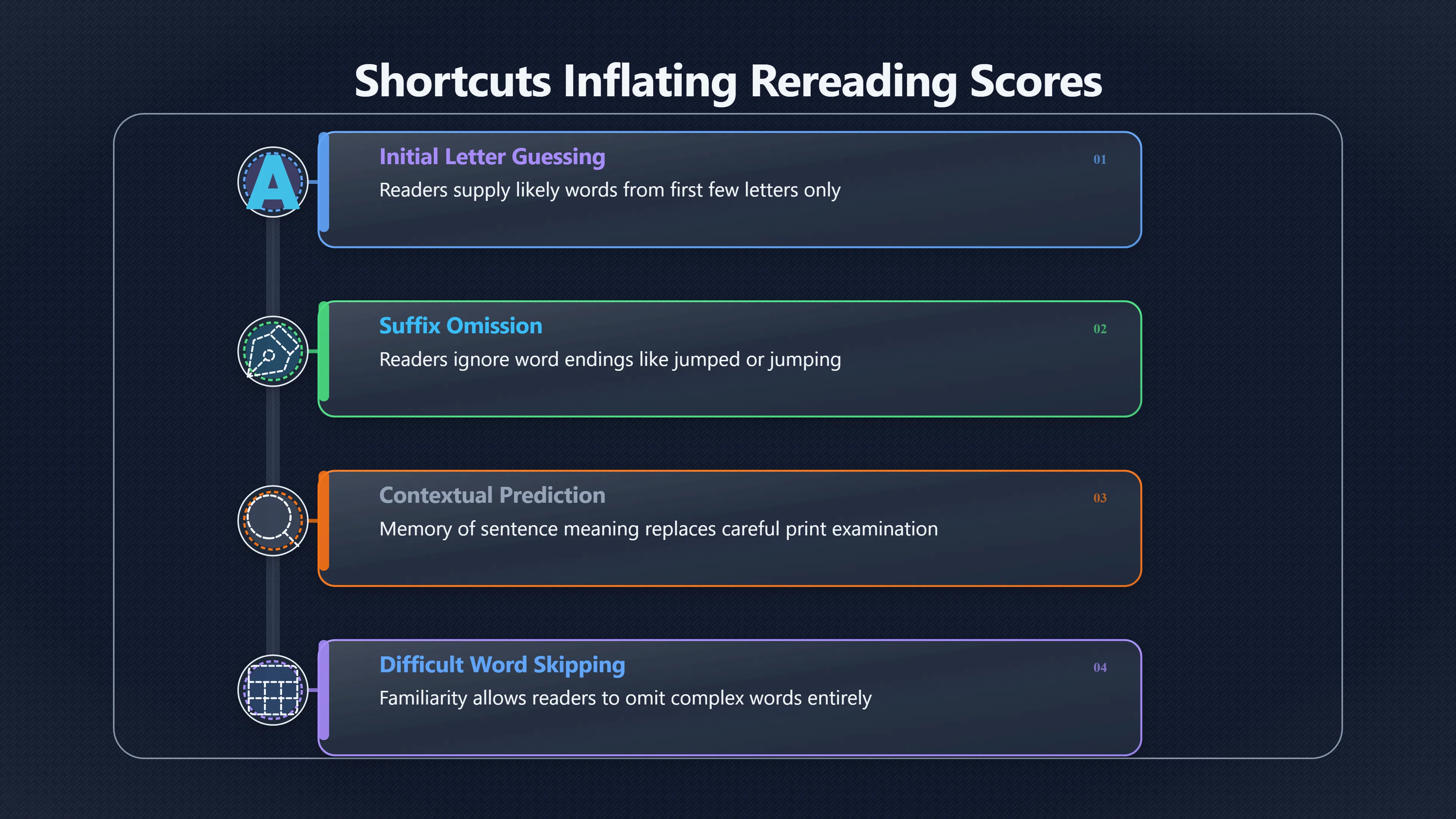
- Guessing from the first letter or first few letters. A reader sees the beginning of a word and supplies what seems likely from memory or context rather than fully processing the word.
- Ignoring endings and small details. Words such as jumped, jumping, and jumps may be treated as interchangeable because the reader focuses on the stem and overlooks the ending.
- Predicting from sentence context. After several rereadings, the reader may remember the meaning of the sentence and supply expected words without carefully examining the print.
- Skipping difficult words entirely. Familiarity with the overall passage can make omissions less noticeable because the reader still knows what the text is about.
These behaviours can reduce reading time dramatically. Yet the speed gain comes from reducing attention to the text rather than becoming more efficient at decoding and recognising words. Literacy researchers emphasise that fluent reading depends on accurate and rapid word recognition, not on guessing strategies.[NIFDI+2NICHD]nifdi.org402 the three cueing system in reading will it ever go awayThey immediately recognize them. Word reading is fluent and allows them to focus on…Read more…
A useful warning sign is when speed increases much faster than accuracy. If a reader suddenly becomes much quicker but begins substituting, dropping, or altering words, the apparent fluency gain may be driven by shortcuts rather than improved reading skill. Assessment systems that use words correct per minute were developed partly to prevent these errors from being counted as success.[Reading Rockets+2Reading Rockets]readingrockets.orgReading RocketsTimed Repeated ReadingsThe teacher or partner counts the number of words read correctly in one minute (WCPM). This score i…
Why familiar passages can hide weak word recognition
The more often a passage is reread, the easier it becomes to remember. That memory can mask weaknesses that would still appear in unfamiliar text.
Consider a reader who struggles to recognise the word frightened automatically. On the first reading, the word causes hesitation. After several rereadings, the reader may no longer need to identify the letters carefully because they remember that frightened appears at that point in the sentence. The hesitation disappears, but the underlying recognition problem may remain.
This is one reason repeated reading studies often distinguish between improvement on a practised passage and transfer to new passages. Improvement limited to the familiar text can reflect growing familiarity with that specific material. Stronger evidence of reading development appears when gains carry over to previously unseen passages.[SPARK]spark.bethel.eduRepeated Readings and Their Impact on Reading Fluencyby SN Olson · 2023 — The transfer studies also indicated that repeated reading…
Research on repeated reading generally finds positive effects on fluency and comprehension, but those benefits are thought to arise from better word reading and greater automaticity, not from memorising a particular text.[Shanahan on Literacy+2Reading Rockets]shanahanonliteracy.comShanahan on LiteracyEverything You Wanted to Know about Repeated ReadingRepeated reading usually leads to better oral reading performance…
This creates an important practical distinction:
Familiar passage improvementNew passage improvementMay reflect memory, prediction, or guessingMore likely to reflect improved reading skillCan occur without stronger word recognitionRequires stronger word recognitionOften produces large short-term gainsUsually produces smaller but more meaningful gains
A reader who doubles their speed on one memorised passage has not necessarily become twice as fluent.

How fresh passages expose memorisation
New passages act as a reality check because memory can no longer do the work.
When readers encounter unfamiliar text, they cannot rely on remembering sentence patterns or anticipating specific words. They must recognise words from the print itself. Any improvement that survives this transition is much more likely to represent genuine growth in fluency.
This is why many fluency assessments use previously unseen passages and count errors carefully. The goal is to measure how efficiently readers process new text, not how well they recall an old one. Words-correct-per-minute measures subtract mistakes from total words read so that guessing cannot easily masquerade as progress.[Reading Rockets+2Reading Rockets]readingrockets.orgWhile it may…Read more…
Fresh passages often reveal three outcomes:
- True improvement. Reading remains faster and accurate because word recognition has become more automatic.
- Partial improvement. Some gains transfer, but difficult words still cause delays.
- Memorisation effects. Speed collapses when the familiar passage is removed, showing that earlier gains depended heavily on remembering the text.
The third outcome can be discouraging, but it is valuable feedback. It identifies where practice has become a memory exercise rather than a reading exercise.
What genuine fluency looks like
The most reliable sign of improvement is not the fastest rereading time. It is the ability to read accurately, smoothly, and with understanding across different texts.
Reading experts consistently describe fluency as accurate reading at an appropriate pace with comprehension and expression. Speed is part of the picture, but it is not the whole picture. A reader who recognises words correctly, maintains meaning, and carries those skills into unfamiliar passages has developed a stronger reading system than a reader who merely learns to predict a familiar text.[Reading Rockets+2Reading Rockets]readingrockets.orgoral reading fluency more speedReading RocketsOral Reading Fluency Is More than SpeedOct 28, 2016 — Fluency is the ability to read a text accurately, at a good pace, an…
For timed rereading practice, the safest interpretation of a faster score is therefore conditional: it counts as progress only when accuracy remains high and the improvement eventually appears in fresh reading material. Otherwise, the timer may be measuring increasingly efficient guessing rather than increasingly efficient reading.[Reading Rockets+2Reading Rockets]readingrockets.orgReading Rockets Should We Be Using Words Correct Per Minute?One way is to accomplish high degrees of proficiency in decoding, and second is to hurry.Read more…

Amazon book picks
Further Reading
Books and field guides related to When faster rereading is really guessing. Use these as the next step if you want deeper reading beyond the article.


Essentials of Assessing, Preventing, and Overcoming Reading D...
Focuses on accurate word recognition and decoding.
eBay marketplace picks
Marketplace Samples
Example marketplace items related to this page. Use the search link to explore similar finds on eBay.

Endnotes
1.
Source: nichd.nih.gov
Title: NICHDNational Reading Panel
Link:https://www.nichd.nih.gov/sites/default/files/publications/pubs/nrp/Documents/ch3.pdf
Source snippet
Fluency depends upon well developed word recognition skills, but such skills do...Read more...
2.
Source: nifdi.org
Title: 402 the three cueing system in reading will it ever go away
Link:https://www.nifdi.org/resources/hempenstall-blog/402-the-three-cueing-system-in-reading-will-it-ever-go-away.html
Source snippet
They immediately recognize them. Word reading is fluent and allows them to focus on...Read more...
3.
Source: spark.bethel.edu
Link:https://spark.bethel.edu/cgi/viewcontent.cgi?article=2039&context=etd
Source snippet
Repeated Readings and Their Impact on Reading Fluencyby SN Olson · 2023 — The transfer studies also indicated that repeated reading...
4.
Source: nifdi.org
Link:https://www.nifdi.org/news-latest-2/blog-hempenstall/398-fluency-its-significance-and-promotion
Source snippet
Reading fluency: Its significance and promotionThis article examines the effects of a reading fluency intervention on the fluency and com...
5.
Source: readingrockets.org
Title: [oral reading]({{ ‘reading-aloud/’ | relative_url }}) fluency more speed
Link:https://www.readingrockets.org/blogs/shanahan-on-literacy/oral-reading-fluency-more-speed
Source snippet
Reading RocketsOral Reading Fluency Is More than SpeedOct 28, 2016 — Fluency is the ability to read a text accurately, at a good pace, an...
6.
Source: readingrockets.org
Link:https://www.readingrockets.org/reading-101/reading-and-writing-basics/fluency
Source snippet
Basics: FluencyFluency is the ability to read a text accurately, quickly, and with expression. Fluent reading builds stamina for reading...
7.
Source: readingrockets.org
Link:https://www.readingrockets.org/classroom/classroom-strategies/timed-repeated-readings
Source snippet
Reading RocketsTimed Repeated ReadingsThe teacher or partner counts the number of words read correctly in one minute ([WCPM]({{ 'wcpm/' | relative_url }})). This score i...
8.
Source: readingrockets.org
Link:https://www.readingrockets.org/topics/assessment-and-evaluation/articles/understanding-and-assessing-fluency
Source snippet
While it may...Read more...
9.
Source: readingrockets.org
Link:https://www.readingrockets.org/reading-101/reading-101-learning-modules/course-modules/fluency/practice
Source snippet
Fluency: In PracticeSubtract the number of errors read per minute from the total number of words read per minute. The result is the avera...
10.
Source: shanahanonliteracy.com
Link:https://www.shanahanonliteracy.com/blog/everything-you-wanted-to-know-about-repeated-reading
Source snippet
Shanahan on LiteracyEverything You Wanted to Know about Repeated ReadingRepeated reading usually leads to better oral reading performance...
11.
Source: readingrockets.org
Link:https://www.readingrockets.org/blogs/shanahan-on-literacy/everything-you-wanted-know-about-repeated-reading
Source snippet
Reading RocketsEverything You Wanted to Know about Repeated ReadingAug 4, 2017 — Repeated reading usually leads to better reading perform...
12.
Source: readingrockets.org
Link:https://www.readingrockets.org/reading-101/reading-101-learning-modules/course-modules/fluency/depth
Source snippet
Fluency: In DepthFluency is the ability to read a text accurately, at a good pace, and with proper expression and comprehension. develops...
13.
Source: readingrockets.org
Title: Reading Rockets Should We Be Using Words Correct Per Minute?
Link:https://www.readingrockets.org/blogs/shanahan-on-literacy/should-we-be-using-words-correct-minute
Source snippet
One way is to accomplish high degrees of proficiency in decoding, and second is to hurry.Read more...
14.
Source: readingrockets.org
Title: how important reading rate
Link:https://www.readingrockets.org/blogs/shanahan-on-literacy/how-important-reading-rate
Source snippet
How Important Is Reading Rate?Jan 7, 2019 — “The corresponding rate for poor readers at this level is 50 to 70 words per minute. Accordin...
15.
Source: readingrockets.org
Link:https://www.readingrockets.org/topics/fluency/articles/fluency-instructional-guidelines-and-student-activities
Source snippet
Fluency: Instructional Guidelines and Student ActivitiesThe best strategy for developing reading fluency is to provide your students with...
16.
Source: readingrockets.org
Link:https://www.readingrockets.org/literacy-home/reading-101-guide-parents/your-first-grader/fluency-activities
Source snippet
Fluency: Activities for Your First GraderBy December, most first graders can read 50 words correct per minute. And by the end of the scho...
17.
Source: readingrockets.org
Link:https://www.readingrockets.org/topics/fluency/articles/screening-diagnosing-and-progress-monitoring-fluency-details
Source snippet
Screening, Diagnosing, and Progress Monitoring for FluencyScreening, diagnosing, and progress monitoring are essential to making sure tha...
18.
Source: readingrockets.org
Title: fluency norms chart 2017 update
Link:https://www.readingrockets.org/topics/fluency/articles/fluency-norms-chart-2017-update
Source snippet
Fluency Norms Chart (2017 Update)View the results of the updated 2017 study on oral reading fluency (ORF) by Jan Hasbrouck and Gerald Tin...
19.
Source: readingrockets.org
Link:https://www.readingrockets.org/topics/assessment-and-evaluation/articles/reading-accuracy
20.
Source: pmc.ncbi.nlm.nih.gov
Link:https://pmc.ncbi.nlm.nih.gov/articles/PMC3320221/
Source snippet
synthesis of fluency interventions for secondary struggling...by J Wexler · 2008 · Cited by 242 — In studies that show the positive effe...
21.
Source: quizlet.com
Link:https://quizlet.com/958395093/fluency-reading-rockets-flash-cards/
Source snippet
Reading Rockets FlashcardsAutomaticity: - refers to accurate and speedy word recognition - refers to reading with expression and clarity...
22.
Source: shanahanonliteracy.com
Title: three cueing and the law
Link:https://www.shanahanonliteracy.com/blog/three-cueing-and-the-law
Source snippet
Three-Cueing and the Law16 Nov 2024 — Three-cueing refers to how people recognize and read words. A cue is a signal that provides a hint...
23.
Source: shanahanonliteracy.com
Title: Should We Be Using Words Correct Per Minute?
Link:https://www.shanahanonliteracy.com/blog/should-we-be-using-words-correct-per-minute
Source snippet
May 2, 2020 — Teacher question: When providing fluency instruction, should time, such as the number of words per minute, be an element?Re...
Published: May 2, 2020
Additional References
24.
Source: researchgate.net
Link:https://www.researchgate.net/publication/398253041_Effect_of_Repeated_Reading_for_Developing_Reading_Fluency_and_Reading_Comprehension_in_EFL_Students_Pre_Experimental_Study
Source snippet
(PDF) Effect of Repeated Reading for Developing...29 May 2026 — Based on the results of the study, it was found that repeated reading wa...
Published: May 2026
25.
Source: readnaturally.com
Link:https://www.readnaturally.com/article/hasbrouck-tindal-oral-reading-fluency-chart
26.
Source: quizlet.com
Link:https://quizlet.com/738508685/letrs-unit-1-assessment-flash-cards/
27.
Source: pendium.ai
Link:https://pendium.ai/playreadle/the-reading-ceiling-why-guessing-words-fails-and-o-afd62d
28.
Source: scholarsarchive.byu.edu
Link:https://scholarsarchive.byu.edu/context/facpub/article/8947/viewcontent/5._Immediate_repeated_reading_has_positive_effects_on_reading_rate_for_English_language.pdf
Source snippet
Repeated Reading Has Positive Effects on...by JH Hansen · 2024 · Cited by 4 — The objective of this [eye- tracking]({{ 'eye-tracking/' | relative_url }}) study was to accuratel...
29.
Source: youtube.com
Link:https://www.youtube.com/watch?v=TnTmGOFOXb4
Source snippet
Fluency & Words Read Correct Per MinuteTo read fluently is to read in a manner that one can access the meaning of a text. Fluency is impo...
30.
Source: readingfluency.app
Title: busy teachers guide to oral reading fluency assessment
Link:https://readingfluency.app/content/busy-teachers-guide-to-oral-reading-fluency-assessment
Source snippet
A Busy Teacher's Guide to Oral Reading Fluency AssessmentMar 3, 2026 — At its best, ORF gives you a quick view of three things working to...
31.
Source: landmarkoutreach.org
Title: fluency interventions text and passage level
Link:https://www.landmarkoutreach.org/strategies/fluency-interventions-text-and-passage-level/
Source snippet
Repeated reading–having students read a passage of text out loud multiple times with “immediate corrective feedback” from a...Read more...
32.
Source: pridereadingprogram.com
Title: reading fluency passages repeated reading
Link:https://pridereadingprogram.com/reading-fluency-passages-repeated-reading/?srsltid=AfmBOopuUoQjlAKrLPP3loDvZdMnbMHUyw_UknPNZP96qRiC04WS9o0l
Source snippet
Reading Fluency Passages: Repeated Reading Guide6 May 2026 — Learn how to use reading fluency passages and repeated reading to build accu...
Published: May 2026
33.
Source: instagram.com
Link:https://www.instagram.com/reel/DY46QsCOGju/
Source snippet
e: 📖 Sentence Pyramids 🎭 Repeated Reading with Reader's Theatre...
Topic Tree