Within Faster Reading
Why Speed Reading Promises Fall Apart
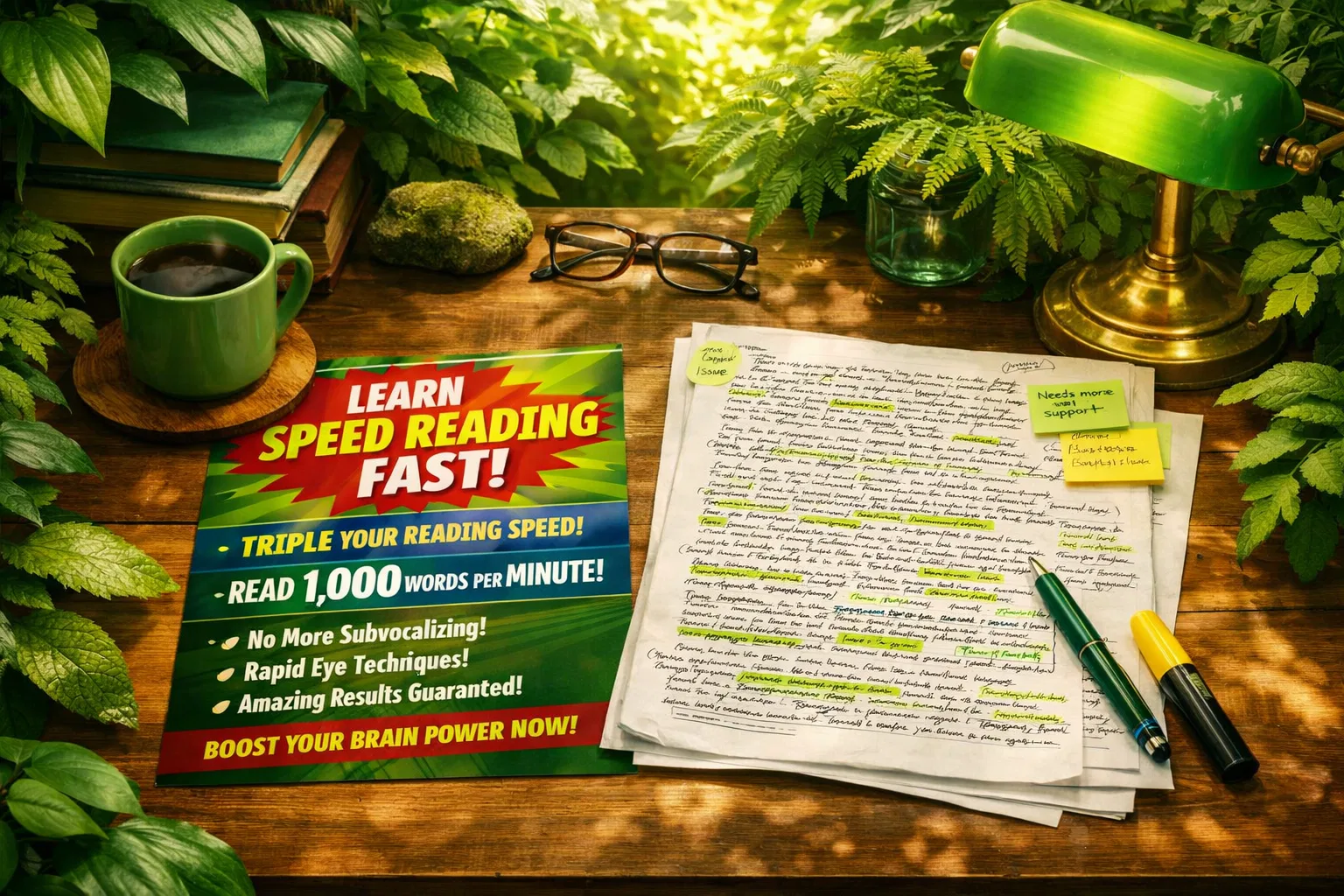
Extreme speed-reading claims usually confuse skimming with full reading and tend to sacrifice understanding.
On this page
- The speed accuracy tradeoff
- What skimming can and cannot do
- Red flags in speed reading courses
Page outline Jump by section
Introduction
Speed-reading promises usually fall apart because they treat reading as an eye-movement problem when it is mainly a meaning-making problem. You can move your eyes faster, skim headings, or flash words rapidly on a screen, but full comprehension still depends on recognising words, linking ideas, making inferences, noticing uncertainty, and remembering what the text says. The evidence is consistent on the central tradeoff: large jumps in reading speed tend to reduce understanding, especially when the material is unfamiliar, dense, technical, literary, or high-stakes. A major review in Psychological Science in the Public Interest concluded that readers are unlikely to double or triple normal reading speed while preserving the same comprehension; faster skimming can be useful, but it is not the same as careful reading.[PubMed]pubmed.ncbi.nlm.nih.govPub Med How Do We Read, and Can Speed Reading Help?by K Rayner · 2016 · Cited by 534 — The research shows that there is a trade-off between speed and accuracy. It is unlikely that re…
That does not mean every attempt to read faster is a scam. It means the honest goal is flexible reading: skim when you only need the gist, scan when you need a fact, read normally when you need understanding, and slow down when the text is doing difficult work. The myth is not that people can become more efficient readers. The myth is that comprehension can be detached from the time and attention needed to build it.
The Speed-Accuracy Tradeoff
The central problem with extreme speed-reading claims is simple: as speed rises, comprehension usually falls. Reading is not just visual intake. It is a chain of mental operations: identifying words, parsing grammar, connecting sentences, building a situation model, checking ambiguities, and integrating new information with what you already know. Some of these operations can become more fluent with practice, but they cannot all be compressed indefinitely.
This is why “words per minute” is a weak measure unless it is paired with a comprehension test. A person can report 700 or 1,000 words per minute after glancing through pages, but that number says little unless they can answer questions that test main ideas, details, inference, structure, and retention. Marc Brysbaert’s review and meta-analysis of reading rate estimated average adult silent reading at about 238 words per minute for English non-fiction and 260 for fiction, based on a large body of studies. Those figures do not prove that everyone must read at that pace, but they make many commercial claims look implausible when those claims promise several times normal speed with unchanged comprehension.[Gwern]gwern.netHow many words do we read per minute? A review and…Based on the analysis of 190 studies (18,573 participants), we estimate that t…
The tradeoff becomes sharper as the reading task becomes more demanding. A familiar news article, a simple email, or a chapter you only need to preview can be processed quickly because the reader can rely on expectation and background knowledge. A legal clause, a scientific paper, a poem, a medical instruction sheet, or a philosophical argument cannot be handled the same way without losing what makes it important. In difficult texts, “slow” behaviours such as pausing, rereading, and checking context are not signs of poor reading. They are part of comprehension.
A more useful distinction is between reading rate and comprehension rate. Reading rate asks how fast the eyes or display move through words. Comprehension rate asks how much accurate understanding the reader gains per minute. Speed-reading courses often optimise the first number while quietly degrading the second. Real improvement means increasing the amount you understand in the time available, not merely increasing the number of words you have passed over.
Why the Classic Speed-Reading Fixes Misfire
Many speed-reading systems repeat a familiar set of claims: stop subvocalising, reduce regressions, widen your visual span, use a pointer, or take in whole lines at once. Each idea has a grain of plausibility, but the leap from “this affects reading” to “this can safely be removed” is where the trouble begins.
Subvocalisation is not just a bad habit. Many readers experience an inner voice while reading, and speed-reading advice often presents that voice as a bottleneck. The misleading part is the assumption that phonological processing is the same as speaking every word aloud in the head. Research on phonological coding shows that sound-related information is deeply involved in skilled reading: it helps readers distinguish words, hold phrases in working memory, and connect spelling to meaning. Trying to suppress it completely may make fast visual exposure possible, but it risks weakening comprehension, especially for complex sentences or unfamiliar vocabulary.[PMC]pmc.ncbi.nlm.nih.govPhonological coding during reading - PMC - NIHby M Leinenger · 2014 · Cited by 170 — Finally, there is some evidence that less skilled…
Regressions are not simply wasted motion. Regressions are backward eye movements, and speed-reading courses often treat them as inefficient habits. In real reading, they frequently serve a repair function. Readers look back when a sentence turns out to be ambiguous, when a pronoun needs resolving, when a detail matters, or when the first pass did not build a coherent meaning. Eliminating regressions may make the eye trace look cleaner, but it can remove a mechanism the reader uses to fix misunderstanding. Rayner and colleagues’ review emphasises that normal eye movements are closely tied to comprehension rather than being removable mechanical inefficiencies.[USF Faculty]faculty.cas.usf.eduRayner Schotter Masson Potter Treiman 2016 PSPIRayner Schotter Masson Potter Treiman 2016 PSPI
The visual span cannot be expanded without limit. Skilled readers do use information around the point of fixation, but the useful perceptual span is constrained. Research on eye movements and perceptual span found that faster readers had a larger span than slower readers, yet this does not support the popular claim that readers can take in whole paragraphs or pages at a glance. The sharpest visual information comes from the fovea, the small central region of vision; peripheral text contributes, but it does not give full word recognition across a whole line.[PMC]pmc.ncbi.nlm.nih.govPMCEye movements, the perceptual span, and reading speedPMCEye movements, the perceptual span, and reading speed
The deeper mistake is treating the eye as the limiting machine and comprehension as an automatic by-product. In ordinary reading, the eyes do not merely photograph text. They sample information in a way guided by language processing. Fixations, skips, and regressions change with word length, predictability, difficulty, and the reader’s purpose. That flexibility is a feature, not a flaw.
What Skimming Can and Cannot Do
Skimming is real, useful, and often confused with speed reading. It is a selective strategy for extracting the gist of a text without processing every word. Used well, it helps a reader decide whether a document is relevant, identify the main argument, preview structure, or prepare for closer reading. The University of North Carolina’s Learning Center describes skimming as deliberately focusing on main ideas while skipping details, examples, data, and elaboration.[The Learning Center]learningcenter.unc.eduThe Learning Center SkimmingThe Learning Center Skimming
That is valuable when the task matches the method. Skimming can help when you need to:
- judge whether an article is worth reading closely;
- find the broad position of a writer before a seminar;
- review a familiar chapter before an exam;
- locate the section of a report that deserves deeper attention;
- handle low-stakes material where approximate understanding is enough.
But skimming has clear limits. It is weak when the value of the text lies in details, reasoning, evidence, tone, sequence, or exceptions. A skimmed scientific paper may reveal the topic and conclusion while missing the method that makes the conclusion fragile. A skimmed contract may catch the headline obligation while missing the caveat. A skimmed historical argument may pick up the thesis while losing the chronology and counter-evidence. The technique works by ignoring some information; it cannot also guarantee that the ignored information was unimportant.
This is where many speed-reading claims blur categories. If a course teaches people to preview headings, read first sentences, notice keywords, and skip examples, it may improve skimming. But if it markets that as “reading” with full comprehension, the claim becomes misleading. Skimming is not failed reading. It is a different tool. Its usefulness depends on being honest about what it leaves behind.
Why Speed-Reading Apps Feel Convincing
Speed-reading apps can feel persuasive because they make speed visible. Rapid serial visual presentation, often shortened to RSVP, shows words one at a time in the same place on a screen. This removes line sweeps and many eye movements, so the text appears to flow faster. Apps using this approach can make a passage look impressively quick, especially with short, simple material.
The weakness is that RSVP removes some of the reader’s normal control. In ordinary reading, you can pause on a difficult word, glance back to repair a sentence, use upcoming words as preview, and vary your pace without thinking much about it. RSVP sets the pace externally. That can work for brief or simple text, but it becomes fragile when comprehension requires rereading, integration, or reflection. Research on modern speed-reading apps using RSVP found that they did not foster reading comprehension in the way their promises suggested.[PubMed]pubmed.ncbi.nlm.nih.govOpen source on nih.gov.
This helps explain the gap between demonstration and real use. A short familiar passage flashed at high speed may feel manageable. A long article with names, qualifications, nested arguments, and unfamiliar concepts is different. The problem is not that RSVP is useless in every context. It may help with constrained display situations or quick exposure to simple text. The problem is treating it as a general replacement for reading when normal eye movements and self-paced rereading are part of how readers preserve meaning.
The same effect appears in other “technique” demonstrations. A person may appear to move down a page quickly with a finger guide or central fixation method. The visible performance looks fast, but the invisible question is what was understood, what was retained, and what could be explained accurately afterwards. Without that check, speed is theatre.
Red Flags in Speed-Reading Courses
Speed-reading courses vary, and not all advice under the label is worthless. Some courses include useful study skills: previewing, setting a purpose, avoiding distractions, building vocabulary, and practising with easier texts. The risk appears when marketing promises outpace the evidence.
A course deserves scepticism when it shows several of these warning signs:
It promises extreme speeds with full comprehension. Claims of doubling or tripling reading speed while preserving normal understanding conflict with the major research review on speed reading. The more impressive the words-per-minute claim, the more important it is to ask how comprehension was measured.[PubMed]pubmed.ncbi.nlm.nih.govPub Med How Do We Read, and Can Speed Reading Help?by K Rayner · 2016 · Cited by 534 — The research shows that there is a trade-off between speed and accuracy. It is unlikely that re…
It measures success with weak tests. A few easy recall questions immediately after a passage do not prove deep comprehension. Stronger testing asks about inference, argument structure, contradictions, delayed recall, and application. If the test only checks whether the reader caught the gist, the course may be teaching skimming rather than reading.
It treats normal reading behaviours as defects. Advice to eliminate subvocalisation, regressions, or fixations often oversimplifies the reading process. These behaviours can be inefficient in excess, but they also support comprehension. A blanket instruction to suppress them is a warning sign.[PMC]pmc.ncbi.nlm.nih.govPhonological coding during reading - PMC - NIHby M Leinenger · 2014 · Cited by 170 — Finally, there is some evidence that less skilled…
It uses familiar or easy texts as proof. People read faster when the topic, vocabulary, and structure are familiar. That does not mean the technique will transfer to dense or unfamiliar material. Reading Rockets notes that even skilled readers slow down when texts contain unfamiliar words or topics, and that fluency depends on accuracy and ease, not speed alone.[Reading Rockets]readingrockets.orgOpen source on readingrockets.org.
It confuses confidence with comprehension. Many readers feel productive after moving quickly through a text. But speed can create a false sense of mastery because the reader recognises keywords and broad themes without being able to reconstruct the reasoning. A good course should make that risk visible rather than hide it.
The practical test is straightforward: after using the method, can the reader explain the argument, recall the important details, identify what is uncertain, and use the information correctly later? If not, the speed gain is mostly cosmetic.
The Better Goal: Flexible Reading
The strongest alternative to speed-reading mythology is not slow reading for everything. It is flexible reading. Good readers adjust pace to purpose. They skim a table of contents, scan for a date, read a news story briskly, slow down for a difficult paragraph, and reread a sentence when the meaning breaks. That flexibility is more useful than trying to force all texts through one high-speed technique.
Reading fluency research also supports a broader view of speed. The National Reading Panel described fluent reading as involving speed, accuracy, and proper expression, with fluency serving comprehension rather than replacing it. Reading Rockets makes the same practical point: rate is less important than accurate, easy reading, and pushing speed can be counterproductive when the text is difficult or comprehension is shaky.[NICHD]nichd.nih.govNICHDNational Reading PanelNICHDNational Reading Panel
For someone trying to increase reading speed responsibly, the safer question is not “How do I stop reading normally?” but “Which part of this task deserves close attention?” A useful approach looks like this:
- Preview before committing. Look at headings, abstracts, introductions, summaries, and conclusion sections to decide where careful reading is needed.
- Skim for structure, not for mastery. Use skimming to map the text, not to pretend you have absorbed it.
- Read normally for meaning. When the details matter, let your pace respond to difficulty.
- Slow down at compression points. Definitions, equations, legal conditions, methodological caveats, and turning-point paragraphs often carry more weight than surrounding prose.
- Check comprehension actively. After a section, summarise the claim in your own words. If you cannot, the speed was too high for that purpose.
The irony is that real reading efficiency often comes from knowledge, not tricks. A person who knows a field well can read faster in that field because vocabulary, patterns, and assumptions are already familiar. That is not magic; it is expertise reducing cognitive load. The path to faster understanding is therefore partly cumulative: read more, learn more words, build background knowledge, and become better at choosing the right depth for each text.
What the Myths Get Half Right
Speed-reading myths persist because they are not entirely detached from reality. There are inefficient reading habits. Some readers do reread because they are distracted rather than because the text requires it. Some subvocalisation can become slow, exaggerated narration. Some people read every document with the same level of attention, even when a quick preview would be enough. Some readers lack a clear purpose and therefore spend time on low-value details.
The correction is to improve judgement, not to abolish normal reading. A finger or cursor can help some readers maintain attention. Previewing can reduce wasted effort. Skimming can help triage. Practice can improve fluency. Background knowledge can make familiar material faster. But these are modest, conditional gains, not evidence for extraordinary claims.
The honest version of speed improvement is therefore less glamorous and more useful: read easy or familiar material faster, read difficult material more strategically, and do not confuse passing your eyes over words with understanding them. The reader who knows when to skim, when to scan, when to slow down, and when to reread is not failing at speed. They are using speed intelligently.
Amazon book picks
Further Reading
Books and field guides related to Why Speed-Reading Promises Fall Apart. Use these as the next step if you want deeper reading beyond the article.
How to Read a Book
Rating: 4.0/5 from 41 Google Books ratings
Focuses on reading for understanding rather than raw speed.
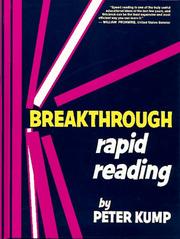
Breakthrough rapid reading
Useful as a representative speed-reading text for comparison with evidence-based approaches.

The Only Skill that Matters
Discusses practical approaches to faster learning and reading.
Endnotes
1.
Source: gwern.net
Link:https://gwern.net/doc/psychology/linguistics/2019-brysbaert.pdf
Source snippet
How many words do we read per minute? A review and...Based on the analysis of 190 studies (18,573 participants), we estimate that t...
2.
Source: pmc.ncbi.nlm.nih.gov
Link:https://pmc.ncbi.nlm.nih.gov/articles/PMC4211933/
Source snippet
Phonological coding during reading - PMC - NIHby M Leinenger · 2014 · Cited by 170 — Finally, there is some evidence that less skilled...
3.
Source: faculty.cas.usf.edu
Title: Rayner Schotter Masson Potter Treiman 2016 PSPI
Link:https://faculty.cas.usf.edu/eschotter/papers/Rayner_Schotter_Masson_Potter_Treiman_2016_PSPI.pdf
4.
Source: pmc.ncbi.nlm.nih.gov
Title: PMCEye movements, the perceptual span, and reading speed
Link:https://pmc.ncbi.nlm.nih.gov/articles/PMC3075059/
5.
Source: nichd.nih.gov
Title: NICHDNational Reading Panel
Link:https://www.nichd.nih.gov/sites/default/files/publications/pubs/nrp/Documents/ch3.pdf
6.
Source: fast.com
Link:https://fast.com/
7.
Source: pubmed.ncbi.nlm.nih.gov
Title: Pub Med How Do We Read, and Can Speed Reading Help?
Link:https://pubmed.ncbi.nlm.nih.gov/26769745/
Source snippet
by K Rayner · 2016 · Cited by 534 — The research shows that there is a trade-off between speed and accuracy. It is unlikely that re...
8.
Source: learningcenter.unc.edu
Title: The Learning Center Skimming
Link:https://learningcenter.unc.edu/tips-and-tools/skimming/
9.
Source: pubmed.ncbi.nlm.nih.gov
Link:https://pubmed.ncbi.nlm.nih.gov/29461715/
10.
Source: readingrockets.org
Link:https://www.readingrockets.org/reading-101/reading-101-learning-modules/course-modules/fluency/depth
11.
Source: readingrockets.org
Link:https://www.readingrockets.org/topics/fluency/articles/fluency-introduction
12.
Source: quizlet.com
Link:https://quizlet.com/958395093/fluency-reading-rockets-flash-cards/
13.
Source: mjstjournal.com
Link:https://mjstjournal.com/index.php/mjst/article/view/6617
14.
Source: pmc.ncbi.nlm.nih.gov
Link:https://pmc.ncbi.nlm.nih.gov/articles/PMC8590178/
15.
Source: pmc.ncbi.nlm.nih.gov
Link:https://pmc.ncbi.nlm.nih.gov/articles/PMC7141082/
16.
Source: pmc.ncbi.nlm.nih.gov
Link:https://pmc.ncbi.nlm.nih.gov/articles/PMC12801452/
17.
Source: pmc.ncbi.nlm.nih.gov
Link:https://pmc.ncbi.nlm.nih.gov/articles/PMC8559868/
18.
Source: Wikipedia
Link:https://en.wikipedia.org/wiki/RSVP
19.
Source: Wikipedia
Link:https://en.wikipedia.org/wiki/Speed
20.
Source: Wikipedia
Title: Rapid serial visual presentation
Link:https://en.wikipedia.org/wiki/Rapid_serial_visual_presentation
21.
Source: users.castle.unc.edu
Title: 0912 visual info
Link:https://users.castle.unc.edu/~jlsmith/ling060/outlines/0912_visual-info.pdf
22.
Source: frontiersin.org
Link:https://www.frontiersin.org/journals/education/articles/10.3389/feduc.2023.1077882/full
23.
Source: contemporaryjournal.com
Link:https://contemporaryjournal.com/index.php/14/article/view/1228
24.
Source: journal.iainlangsa.ac.id
Link:https://journal.iainlangsa.ac.id/index.php/jl3t/article/view/11053
25.
Source: play.google.com
Link:https://play.google.com/store/apps/details?hl=en&id=org.zwanoo.android.speedtest
26.
Source: cejsh.icm.edu.pl
Title: icm.edu.pl TH E CASE OF EYE MOVEMENT TRAINING BY
Link:https://cejsh.icm.edu.pl/cejsh/element/bwmeta1.element.desklight-afb177c9-f5b1-4a9e-8bf4-647c2fc22c82
Additional References
27.
Source: wired.com
Link:https://www.wired.com/2017/01/make-resolution-read-speed-reading-wont-help
Source snippet
Basic calculations based on the properties of eyes and texts indicate that an average reading speed is around 280 words per minute, a val...
28.
Source: researchgate.net
Title: Research Gate(PDF) How many words do we read per minute?
Link:https://www.researchgate.net/publication/332380784_How_many_words_do_we_read_per_minute_A_review_and_meta-analysis_of_reading_rate
Source snippet
A review...Apr 12, 2019 — We estimate that the average silent reading rate for adults in English is 238 word per minute (wpm) for non-fi...
29.
Source: journals.sagepub.com
Title: Sage Journals So Much to Read, So Little Time
Link:https://journals.sagepub.com/doi/abs/10.1177/1529100615623267
Source snippet
It is unlikely that readers will be able to double or triple their reading speeds (e.g....Read more...
30.
Source: psychologicalscience.org
Title: speed reading promises are too good to be true scientists find 2
Link:https://www.psychologicalscience.org/observer/speed-reading-promises-are-too-good-to-be-true-scientists-find-2
31.
Source: researchgate.net
Link:https://www.researchgate.net/publication/232954947_Reading_Fluency_More_Than_Automaticity_More_Than_a_Concern_for_the_Primary_Grades
32.
Source: researchgate.net
Link:https://www.researchgate.net/publication/337256453THE_ANALYSIS_OF_SKIMMING_AND[SCANNING
33.
Source: researchgate.net
Link:https://www.researchgate.net/publication/399897944_Testing_the_Speed-Accuracy_Trade-Off_in_Reading_Effects_of_Reading_Speed_on_Comprehension_and_Eye_Movements
34.
Source: researchgate.net
Link:https://www.researchgate.net/publication/249134643_A_Review_of_the_National_Reading_Panel%27s_Studies_on_Fluency_The_Role_of_Text
35.
Source: flowfluency.com
Link:https://flowfluency.com/blog/automaticity-and-repeated-reading-unlocking-the-key-to-fluency/
36.
Source: phonicshero.com
Link:https://phonicshero.com/automaticity-in-reading/
Topic Tree
Follow this branch
Parent topic
Faster ReadingRelated pages 11
- Benchmarks How Fast Do Adults Really Read?
- Dense Texts Why Hard Texts Need Slower Reading
- Inner Voice Should You Silence Your Inner Voice?
- Knowledge Why Familiar Topics Feel Faster to Read
- Measure The Reading Speed Test That Actually Helps
- Phrases Read Phrases, Not Just Words
- Practice Can Rereading Make You Faster?
- Purpose When Should You Slow Down or Skim?
- +3 more in sidebar